Hawks definitely do not like children

By 18:30, the smoke and the temperatures were cooperating and it seemed like a good time to go and check on the Cooper’s Hawk family in Assiniboine Park. When I arrived at the Park, there were several cricket games going on, families were meeting and sharing a pot luck outside – many for the first time since spring 2020, there were birthday parties and children running around.

When I found the spot and knew where the hawks had their nest and were hunting for bugs and chipmunks the other day, there were children running around. I could see the hawks in the sky circling. They never went to the nest tree or came to the ground. It is the life of a birder. It would be wonderful to see them a few more times before migration. The Canada Geese do not usually begin leaving until the middle of September through to the end of October. I have seen some miss the group and wind up walking about on an early snow. Weather is such a significant factor in the challenges our birds face.

For those who are not sure what migration actually is. Our feathered friends Move from one area for breeding during the spring and summer to another area for winter. They have adapted to the pattern of coming and going in order to survive. It is based on food supplies.

Different species travel different routes to their winter homes. These are long journeys. For example, the Ospreys in the United Kingdom will travel some 8,000 kilometres or 5,000 miles to places in Africa. The birds will fly over land, sea, and desert to reach their destinations. People wonder why the birds just don’t live in Africa all the time. The answer is rather simplistic: there would not be enough nesting sites or food for all of them plus their chicks. There are also a lot of very hungry predators ready to take those lovely fluffy little ones. So they disperse from Africa to sites in the United Kingdom and Europe.

The birds decide when it is time for them to migrate. The hormones in their body begin to change. Unlike spring when this hormone change leads to breeding, the autumn sees the birds restless until they know that it is time to depart. These hormones trigger a lot of eating. Fat begins to gather under their skin. They gain weight. It is that fat that will see them through their migration. Still, they stop and feed along the way. Normally they hunt for food in the early mornings and late afternoons. High pressure systems are good for flying but low pressure systems bring winds and rain. When the birds get into a low pressure system, they will normally stop flying, if they can, and wait til another high pressure system comes through. Migration times vary because of the winds and the weather. Birds that soar and ride the thermals can travel as much as 465 km or 300 miles in a stretch. Some gather in flocks like the storks in Latvia and Estonia. Sometimes birds pair up to migrate. For the Ospreys, the female leaves and the male stays behind until there are no fledglings crying for food.

Not all birds migrate. Even I have a sedentary Sharp-shinned Hawk that defies all logic to stay on the Canadian prairies for the winter. The Osprey in Australia do not migrate. The birds in the Amazon Rainforest do not migrate. There is plenty of food and nesting sites for them year round. This past spring and early summer there was much discussion over the migration of birds from Florida. In Jacksonville, Samson, the father of Legacy, stays in the area of the nest year round. Gabrielle, on the other hand, migrates north – yes north – to cooler summer climates. This year she might have discovered it is hotter up north! Even some of the Ospreys in Florida do not migrate; they stay year round. There are plenty of fish for them as well as nests.

Birds take different routes. The White Storks from Latvia either taken a western route or an eastern route. Dr Erick Greene and his team in Montana study the migratory movements of the Ospreys from the Clark Fork River area with satellite transmitters. In the United States, some fly over Hawk Mountain where there is an annual count. In fact, you can go to this site to see the number of birds traveling over this marvellous area with its thermals. Here is the link for you for their autumn migration count that will being in about a week!

https://www.hawkmountain.org/conservation-science/hawk-count

Migration is extremely challenging and we hope that all of the adults will return to their nests the following spring and that we will see the juveniles who take their first flight to Africa in a couple of years.

And now for some birding and nest news

Poole Harbour: Blue 022 and CJ7 who were so visible until a few weeks ago sky dancing, mating, and working on the nest with the streaming cam are now working on another nest in the area. There is no camera. They are still doing everything together and everyone is looking forward to the first hatches in Poole Harbour for 200 years.

Dahlgren: A large part of the nest in King George, Virginia, collapsed today. It will be fixed in the fall well after Jack and Harriet’s migration.

Kielder Forest: All 16 of the 2021 juveniles have fledged successfully. Everyone is elated. This is 6 more fledglings than their previous best year. Congratulations everyone!

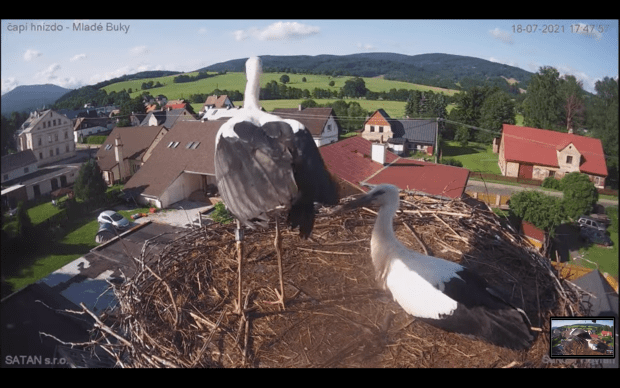
Mlade Buky: Bucachek and his new love spent the night on the nest in Mlade Buky, Czechoslovakia. Oh, how sweet! Just as the dawn is beginning to appear, they are both preening.

Balloons, something that impacts all birds: Virginia, Maine, Maryland, and Delaware have or are going to pass shortly the release of balloons. Hawaii has already passed a law on helium balloons.

Port Lincoln Ospreys, Australia: Dad and Mom have been taking turns incubating the eggs. Here is dad on the nest. A little earlier he had been pestering Mom. He kept pulling on that turquoise rope wanting his turn. It was too funny. The Port Lincoln Ospreys are an example of sedentary birds. They do not migrate. There is no need.

Loch Arkaig: The two juveniles of Louis and Dorcha have now fledged. I have not heard anything about the chosen names yet.

Collins Marsh: Malin was a little wet off and on during Saturday. S/he is sleeping on the nest alone tonight. There is no perch – let us hope that the parent or both parents are in a nearby tree in case there are any owls about. It seems like a pattern. Does mom always spend Saturday night off the nest?

WBSE, Sydney Olympic Forest: 27 and 28 continue to eat until their crops almost burst and sleep. Meanwhile there has been an intruder today and Lady and Dad were honking in alert.
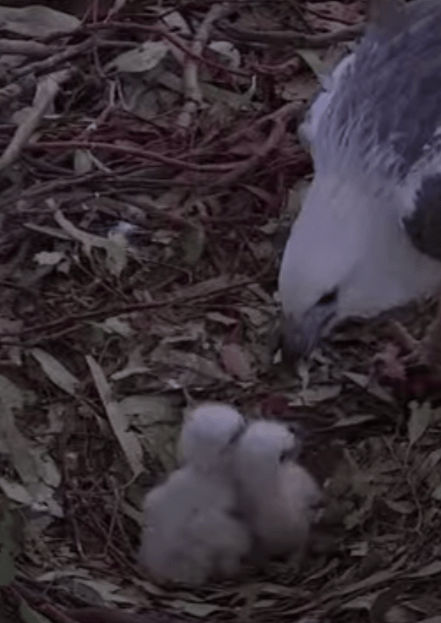
And last but very special, A Place Called Hope. Along with other wildlife centres, they are receiving quite a number of starving Great Blue Herons and other herons. Why would they be starving? It has been raining in the Connecticut area and all the herbicides and pesticides that people put on their lawns and gardens makes its way into the environment, into the water table, into the ponds. It is poison. If your gardening centre or lawn care person tells you that the chemicals they use are ‘Green’ – well, think again. Whatever they are using kills. So sad. It is OK if your lawn doesn’t look emerald green.

Thank you so much for joining me today. Have a lovely Sunday. Take care of yourselves. I look forward to seeing you soon.

Thank you to the following for their streaming cams and their FB pages where I grab my screen shots: A Place Called Hope, Mlade Buky White Stork Cam, Collins Marsh Osprey Nest, Port Lincoln Osprey Project, and Sea Eagles, Birdlife Australia and the Discovery Centre.

The featured image is Dad at the Port Lincoln Osprey Barge taking his turn incubating his two eggs.

Fledge at Mlade Buky and other news in Bird World

We have a fledge at the White Stork nest in Mlade Buky!

Oh, this is just so wonderful. The people of this community can be so proud as these three beautiful birds leave their nest. It was their help that made it possible for these three to be alive today. Bravo.

Here is the video so you can watch it.

The heat wave has taken more tolls on birds in the Pacific Northwest not just the Osprey chicks that literally roasted in the nests. Cooper’s Hawks have been jumping off the edge of the nests so they do not get cooked by the hot sun. This is a real tragedy in the making. Even the number of birds at my feeders is down. They spend the day in the myriad of vines in the shade of the house and the lilac bushes only coming out to drink and return to shade. The outside temperature near the water bowls reads 34 C. That is hotter than it is in the West Indies! So please put out water for the birds! Find old dishes and provide them with something. Thank you!

I hope that you are able to open this. If not you could Google ‘hawks jumping out of nests to avoid heat’. This is just so sad.

The streaming cams for many of the nests are being turned off as the season ends. Glaslyn will turn off the feed to Aran and Mrs G’s nest shortly as will Rutland Water on the Manton Bay Nest of Blue 33 and Maya. We will look forward to another season with them in the future. Blue 33 and Maya are a super Osprey couple – celebrities if you will allow me to call them that. They have been together since 2015 and have fledged 17 chicks. They raised a nest of four in 2019. That is almost unheard of and really takes a strong male to feed that many. I am impressed. I told someone if I came back as an Osprey in another life I wanted Blue 33 for my mate. He is incredible. They will return to the Rutland Manton nest in late March – usually within an hour of one another.

I expect many others will follow as it is costly to run the cameras. If you go to the camera and it is not functioning check the nest’s FB page. They have probably turned off the camera til the next season. But please remember that the breeding season is only beginning in Australia with the Peregrine Falcons, Port Lincoln Ospreys, and the WBSE.

NC0 up at the Loch of the Lowes nest is out fishing for her chicks. She is incredible. She spots the fish from the nest and dives down and gets it. Here is a very rough cut of a video of the two Loch of the Lowes chicks enjoying themselves.

I never thought I would say that a Golden Eagle nestling was cute but Zenit certainly is.

Zenit is really working on his wing flaps and from his crop it appears that he has had a feeding. That is good. I am just thinking how lucky Zenit is to be in a tree nest with shade.

Kindness is one of the cutest Bald Eagle nestlings I have ever seen! Here she is again trying to nibble around mom.

Oh, how beautiful. Kindness sitting next to Mom. Everyone thinks Kindness is a female because her Dad loves to feed her!

You are getting to be a big girl, Kindness. You are 52 days old today! More than halfway to fledge which will be around 89 days – the average for the Glacier Gardens nest. (The average in Alaska is 80 days).

Tiny Little has been in the nest every time I checked on her. A fish came in and 462 ate and ate. Then 464 came and couldn’t get the fish tail down. Tiny Little was playing with it when White YW brought in another fish. Tiny Little ignored it and dad left with the fish! Silly Tiny! Some dads will feed their chicks but White YW doesn’t seem to do this very often preferring that Blue 35 take on those duties almost exclusively. Tiny Little has yet to get confident in opening up a fish with a head.

White YW returned to the nest at 17:39 and Blue 35 flew in to feed Tiny Little. Tiny did not ignore that fish this time!!!!!!!

Oh, she just loves being fed by mum. Tiny Little eats for about forty minutes.

This kiddo should be stuffed.

At 21:00, Tiny Little and big sib 462 were cuddled up duckling style read to sleep.

It is not clear to me if Tiny Little ever did a second flight today. She was flapping those wings really hard and walking around the nest looking down for a long, long time. Often I had to leave only to return to find Tiny on the nest. Maybe someone saw her fly again?

Tiny tried everything but getting over on the middle left side of the nest and just going for it like she did when she fledged was something she did not do. There were a few good hovers. Fingers crossed for tomorrow. Need to get those wings strong and self-feeding down for migration.

The couple who saved the little osprey chick that fell into the river at the Putuxent Osprey Nest 2 were surprised that so many people from around the world watch their birds! I mentioned to them the need for an emergency number on the streaming cam. Fingers crossed! Thank you to everyone that sent them a thank you note. The chick is doing well.

Thank you for joining me for a quick look at a few nests on a Sunday evening. Take care. It is very hot in so many places or there are torrential rains and flooding. So where ever you are be careful.

Thank you to the following for their streaming cams where I took my screen shots: Glacier Gardens Park, Cumbrian Wildlife Trust and the Foulshaw Moss Osprey Nest, Mlade Buky White Stork Cam, Patuxent Park Osprey Cam 2, and Asociatia Wild Bucovino.

Continuing to Track Elsa -and other news in Bird World, Sunday 4 July

Everyone that watches the Achieva Osprey Nest in St Petersburg, Florida is following the tracking of Tropical Storm Elsa. The latest weather news is that Elsa will remain a Tropical Storm bringing heavy rain, thunderstorms and tornadoes, and some wind to Florida. The current tracking has Elsa interacting with Jamaica and that is slowing her down. She will speed up a bit as she hits the warm waters in the Gulf of Mexico. Elsa is not expected to intensify to hurricane status.

The good news for Tiny Tot and the Achieva Nest is that the current model shows the intensity off the west coast of Florida (but it could shift). Elsa will be trying to make landfall North of Tampa early Wednesday morning. I pulled the following model shots off of the weather broadcast in the area. The white thicker arc line on the left is the current believed path that Elsa will take. That could shift, however, and be anywhere in the area between it and the darker blue arch line.

This is Elsa at 11 am EDT. You can see the strongest area is right over Kingston, Jamaica.

I will continue to follow Elsa and report as we get closer to the beginning of the week with more certainty as to how the storm will impact St. Petersburg.

The last time I checked on Tiny Tot was 1:54 nest time and she was there fish begging hoping Jack would hear her and bring some lunch in. I do not believe Tiny Tot has had any fish yet today. She had a nice fish at 6:47 last night.

I checked on the Fortis Exshaw Osprey Nest in Canmore, Alberta. There was a fish delivery at 9:30 this morning and both of the surviving chicks were eating. Last night one of them had an enormous crop. So this nest is bucking the trend and has 2 survivors and 1 dead from the heat. Indeed, last night I thought we might have lost 2 but this morning there were two little heads eating.

The top image is last evening. You can see that huge crop on the little one.

This was right after the fish delivery on Sunday morning around 9:30.

There were two heads clearly seen in the image below. Well done Exshaw!

Kindness just gets cuter every day. This is Sunday morning in the Glacier Gardens Bald Eagle Nest in Juneau, Alaska. Talk about one very much loved eaglet. Her parents Freedom and Liberty really take good care of her.

It looks like it is the end of the season at the Newfoundland Power Osprey Nest, sadly. We know that the oldest chick got on top of the little one hatching. Mom tried to pull the bigger one off by its legs and both died. There was one remaining egg. That egg now seems to be broken and abandoned. If I am reading this wrong, please let me know.

Tiny Little Bob continues to rebuild the Foulshaw Moss Nest. It is interesting that he is also finding pieces of dry fish there that must be yummy. Tiny Little isn’t sharing with Big Sister when he does find a piece!

It is still wet up at the Loch of the Lowes. Laddie delivered an evening fish and got out of that nest fast! There was quite the scramble. NC0 will try and feed the Bobs so everyone gets something. Sadly, it was a bit of a twiddler that was delivered so it won’t go far.

News out of Australia. Mom and Dad at the Port Lincoln Osprey Barge have been mating and Mom is feverishly working on nest restorations. Mom is watching dad eating a fish not far away and wondering why he isn’t sharing and hasn’t been helping her! With all the twigs in and now the soft lining…it won’t be long!

Last year’s first hatch, Solly, returned to Streaky Bay and then went right back to Eba Anchorage. It appears that this might be where Solly is making her permanent home. Thanks to the satellite tracker her every move is monitored! Solly is doing well. That is excellent news.

News coming out of New Brunswick, Canada. A rare Stellar’s Sea Eagle – not seen in Canada – but in Russia – is in Canada on the Restigouche River! Have a read:

https://www.cbc.ca/news/canada/new-brunswick/stellers-eagle-new-brunswick-bird-1.6086439?fbclid=IwAR0AlwJvLZcMP4kaHkwTWzVPN6CWSIcngRufRVWPF3DZoi1Jwb63y3z6KFQ

And while I would like to leave us on a happy note, another Osprey was found entangled in monofilament fishing line in an Osprey Nest in Alberta and had to be detangled. Please, please, if you fish be responsible. Don’t fish where you know your line is going to get caught up and broken in underwater tree trunks leaving line and hook to harm the wildlife. Thank you.

Thank you for joining me today. Take care all. For those of you celebrating 4 July – have a happy one.

Thank you to the following for their streaming cams where I grabbed my screen shots: Achieva Credit Union, Scottish Wildlife Trust and Friends of Loch of the Lowes, Cumbrian Wildlife Trust and the Foulshaw Moss Osprey Cam, Newfoundland Power Corporation, Fortis Alberta, Port Lincoln Osprey Project, Port Lincoln FB Page, Glacier Gardens Bald Eagle Cam, and Channel Two Weather News.

The weather continues to claim the lives of our beloved Ospreys

The heat wave that hit the Pacific Northwest on the 28th of June continues to claim the lives of Ospreys. It is impossible to know the full extent of the impact because the vast majority of nests are not monitored. We now know for sure that two chicks at Clark PUD in Washington, 1 chick at Cowlitz PUD, 3 chicks at Osyoos, Exshaw lost 1 of 3 chicks, and all three at the Red Deer Nest in Alberta are unwell as I write and are not expected to survive. They are not eating. The little ones survived the heat to be hit with a torrential storm. Sadly I am not holding out much hope. The only raptor rescue in the interior of British Columbia has saved 26 raptors from perishing in a 24 hour period.

In a recent article, “The record-setting day when global heating surpassed COVID-19 as the existential crisis” in The Narwhal, Arno Kopecky came to the conclusion that the record breaking heat was not ready to take a downward curve because there are serious repercussions. The biggest one of those is wildfires. The town of Lytton hit a Canadian record for 47.5 degrees C. Then we watched that town burn to the ground.

There will be more wildfires – fires that rage and kill humans and animals and burn the trees that help cool the planet. Creeks and wells will continue to dry up. No water, no fish.

Kopecky mourns the lack of seriousness and understanding and says that it took this “extreme heat wave to galvanize public concern over climate change”. He believes that it is NOW – not in three months – but NOW when the heat is still killing that we, the people, must talk to our leaders and friends “about what a heat wave like this means, and what we’re willing to do about it.”

It is understood that the heating of the oceans will cause more hurricanes and storms. Right now sitting off the coast of Cuba is Elsa. That storm has its heart set on battering the west coast of Florida where there are many sea birds including our beloved, Tiny Tot.

This is the latest map showing the path that they believe Elsa will take. What happens around Cuba could change this trajectory.

For those of us worrying about Tiny Tot, the good news comes out of Wales at the beginning of June. How many of you watch the UK Osprey Nests? If you don’t, you should!

Wales was hit by a Force 11 wind storm that brought heavy rain. The wind was blowing at 75-78 mph. Mrs G, the oldest Osprey in the United States, was on the nest with her and Aran’s 2021 brood. Chicks were hatching as this storm raged. The chicks died but not because of the storm. Mrs G was soaked but she stayed on that nest! In an earlier storm that hit Wales, Monty, one of the most beloved Osprey males in Welsh history, went fishing during Storm Hector for his family.

So what I am saying is that many birds and nests will weather such a storm just fine. We are fortunate that there are no chicks on the Achieva Nest. Chicks have perished in such storms as evidenced by several weather systems that hit Martha’s Vineyard and region years ago. Imagine if this were the 10th of March?! The nest tower that the Achieva Credit Union built should have been designed to withstand a hurricane. Tiny Tot and Jack will hunker down. They may eat a lot more before the storm arrives to sustain themselves.

And now for some brief news from other nests. Electra has been on and off the nest at Cowlitz PUD. This morning around 6:30 ish, her and Wattsworth were both on the nest.

Mom and Dad both slept on the ropes last night at the Port Lincoln Osprey Nest in Australia. This is giving hope that the 2021 season is about to begin for these rare birds in Australia.

I was also very happy to see the official report on the ringing of the three ospreys on the Foulshaw Moss nest in Cumbria. There is some information to be corrected. The first hatch is a female and she is now Blue 462. Middle Bob is the one that they could not determine the sex. That bird is Blue 463. Tiny Little Bob – oh, bless you – is a male and is Blue 464. He weighed 1.6. I always believed that Tiny Little was a tiny little boy and that Big Bad Bob was a female. Thankfully it turned out that way! Someone had written, incorrectly and I picked up on it, that because Tiny Little was growing so fast it had been decided he was a female. Oh, dear.

Tiny Little is definitely growing! He still prefers not to lean on Big Bad Sister – and she is a big girl. There they are looking at something coming – White YW with a fish perhaps.

The two Rutland chicks, 095 and 096, of Maya and Blue 33 continue to practice their flying skills. They are doing great.

Flying certainly makes the little ones tired. It takes a lot of energy especially when they are learning. Both have had some good power naps.

Blue 33 makes sure that they are all fed. 095 and 096 take turns eating. Neither is out witting the other with the fish and the self-feeding. That is truly refreshing. Maya and Blue 33 rank up there as one of the power couples of UK Ospreys in terms of rearing chicks. There is never a shortage of food and Maya keeps good organization on the nest.

It is raining around the UK Osprey Nests right now. Earlier the two Bobs on the Loch of the Lowes Nest were enjoying a lovely dinner right in the middle of the drops. It is a bit too soggy to think about fledging right now but that day is coming. We will all need our worry beads!

Did you follow Louis and Aila on the Loch Arkaig Osprey Nest? If you did, I know that you are amongst tens of thousands sad because Aila did not return from her migration this year. Louis finally took another mate. They now have chicks on another nest, off camera. One devoted Osprey fan visited the area of the nest and was able to take photographs. I am sorry I cannot share them with you but what I can say is that Louis and Mrs Louis (that is what someone is calling her) have at least two healthy chicks on that nest! They are soooooo cute. There could be three. Mrs Louis would not move from her perch on the railing of the nest for the visitor to see further into the nest. I am so happy for this very devoted Osprey Dad.

Thank you for joining me and thank you to all that send me a note or make a comment. Let us all wish that Elsa gets slowed down before she gets to Florida. Take care everyone.

Thank you to the following for their streaming cams where I grab my screen shots: Achieva Credit Union, Scottish Wildlife Trust and Friends of Loch of the Lowes, Cumbria Wildlife Trust and Foulshaw Moss Osprey Nest, LRWT and Rutland Water Manton Bay Ospreys, and Port Lincoln Osprey.