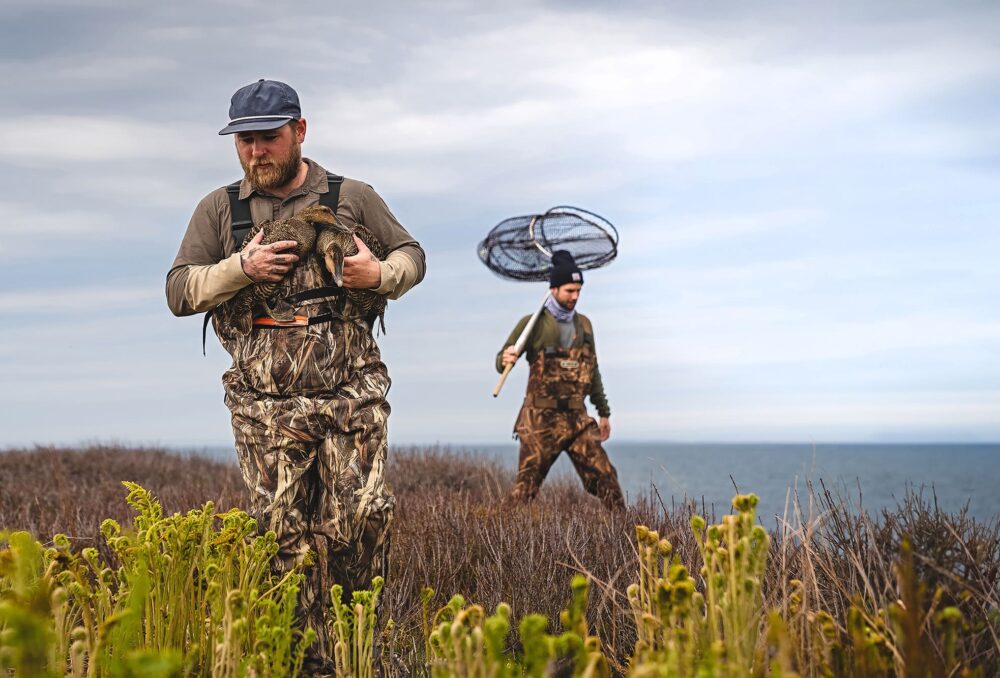
Three men dressed in camo chest waders scramble through knee-high brush on a coastal island off Nova Scotia’s South Shore. They’re trying to flush common eider ducks out of the “tuck,” small fir trees growing in bunches in defiance of the constant wind. A female eider leaps out and one of the men runs after her. She flaps her mottled brown wings furiously as she tries to escape while he swings his net over, trapping her. Soon, she quiets.
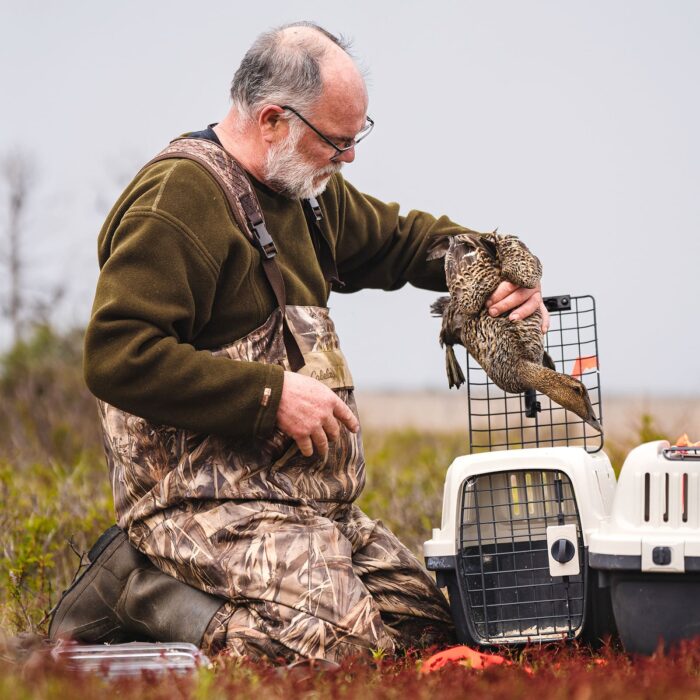
The researcher walks the bird over to Scott Gilliland, a now-retired waterfowl biologist with the Canadian Wildlife Service and now Adjunct at Acadia University. Gilliland then sedates the hen so she can safely be transported to a veterinarian’s office and tagged with a special satellite tag that transmits data for up to three years.
Gilliland and his crew are here trying to solve a mystery. Decades ago, these islands were covered by thousands of common eiders laying eggs and raising their young. But researchers now estimate that up to 85 per cent of breeding eiders have been lost in the southern part of their habitat range. In an age of rapid climate change and other anthropogenic changes to the environment (think plastic pollution, aquaculture, offshore wind and more), there could be countless reasons why. Gilliland and his team are a part of a large-scale cross-border collaborative research project under the Sea Duck Joint Venture (SDJV), that aims to figure out why, and where, the birds are going.
As a SDJV member, Ducks Unlimited Canada (DUC) is a major partner involved in this research, with many other organizations and communities with a vested interest in common eider conservation.
“One of the greatest assets of this project is the partnership that leverages expertise on both sides of the border,” says Matt Dyson, a research scientist with DUC’s Institute for Wetlands and Waterfowl Research. “What we learn will provide critical links between habitat and population dynamics and help us develop impactful conservation programs.”
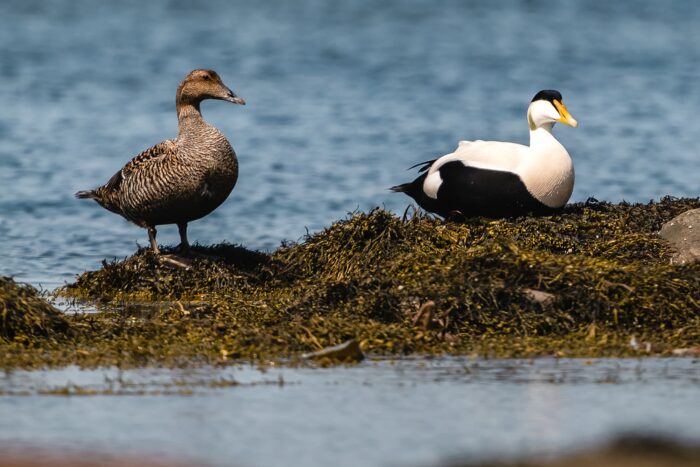
Common eiders are sea ducks that spend their lives on the ocean near the coast, looking for food. The habitat range of the American subspecies stretches from Massachusetts to the sub-Arctic in central Labrador. They’re regal birds, the males coloured in a distinctive pattern of black and white feathers, reminiscent of an orca. Both sexes have an elongated bill stretching back almost to their eyes.
By the early 20th century, the species’ population had plummeted from overhunting so much that a moratorium was put on the harvest via the United States Migratory Bird Treaty Act of 1918. Their numbers recovered enough for the moratorium to be lifted and the birds flourished for decades. That is, until the early 2000s when, according to the SDJV, waterfowl managers in Massachusetts, Maine, Nova Scotia and New Brunswick noticed dwindling numbers near the Gulf of Maine.
Conservation organizations and governments have been studying the population and their movements in various projects north and south of the border. It wasn’t until 2019 at a workshop hosted by DUC, the Canadian Wildlife Service (CWS) and Acadia University in St. Andrews, N.B., that biologists and wildlife managers decided they needed to combine their efforts in a more strategic way and formed a new collaborative research group comprised of more than a dozen partners, encompassing universities, government agencies and non-profit organizations, including DUC, CWS and the Nunatukavut Government.

Because the eider population was changing so rapidly, the group couldn’t rely on traditional tracking methods like banding data (from hunters returning bands that researchers had attached to birds’ legs) to understand changes in the species’ numbers and distribution through its traditional habitat. Researchers instead decided they needed to use state-of-the-art satellite tags that would give them real-time information for about three years on where in their range eiders were breeding, nesting, and over-wintering. And in coastal Labrador, where common eiders are a culturally significant species, the SDJV is supporting Inuit communities to integrate this research with traditional knowledge to better understand the species’ migratory patterns and habitat use.
“As soon as we release the birds they’re transmitting, and that information gets fed back to us every day,” says Gilliland, a key leader of this project. “It will give us a good idea of where they winter, where they breed, and all the habitats they use in between.”
“At Ducks Unlimited Canada, we felt it was important to partner on such a large collaborative research project to improve our understanding of common eider habitat and how it’s shifting,” says Nic McLellan, a research biologist with DUC in the Atlantic region and one of the eider research investigators. “What we’re learning from these transmitters is not only exciting, but also critical for future marine habitat conservation in Atlantic Canada.”
Once Gilliland’s team has caught all the birds that they can transport, they scramble back over the shrub and the rocks covered in seaweed to their aluminum boat perched on the shore, this time ferrying cat crates filled with sleeping eiders. From here, they bring the birds to the clinic of a local veterinarian Gilliland’s been working with since the 1990s.
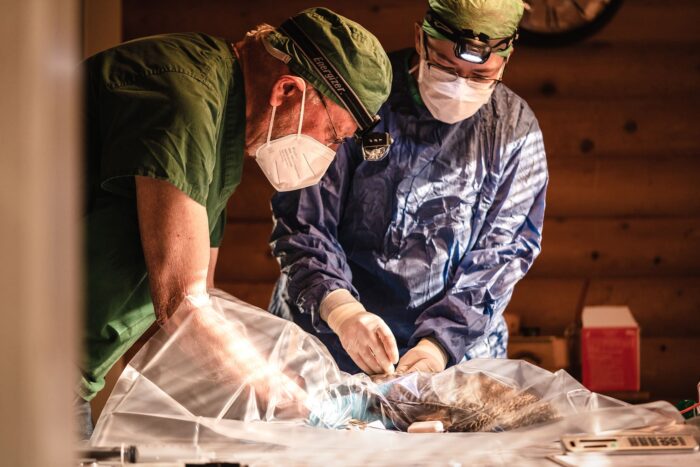
In the clinic’s operating room, one of the ducks is prepped for surgery before the vet embeds a satellite tag about the size of a C battery into her abdominal cavity. After she’s been sewn up and released, the only sign of her adventure will be a short antenna poking out of her back. “They look a little bit like a roboduck when they’re done,” says Gilliland.
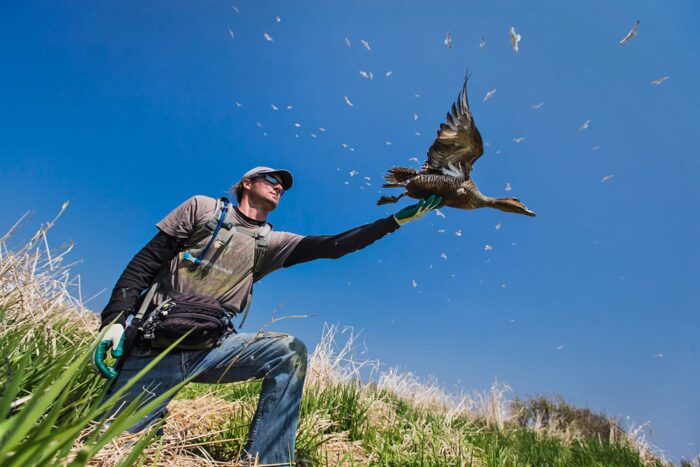
That evening the team brings the ducks in their crates back to the shore, from where they can fly back to the island and to their waiting nests full of olive-coloured eggs covered with fluffy grey eider down.
Researchers do have a hypothesis about what is happening to these birds. Though the overall population is declining, common eiders seem to be disappearing from one place in particular: in or near the Gulf of Maine, at about the middle of their habitat range. The population in the north, in Quebec and Newfoundland and Labrador, and in the south of their range, in Massachusetts, New York and Rhode Island, seem to be growing.
The Gulf of Maine is one of the fastest-warming places on the planet. The water here is warming three times faster than the global average. It’s wreaking havoc on marine species as large as right whales and as small as blue mussels — a primary food source for eiders. While climate change is making places like the Gulf of Maine inhospitable, it’s also melting the ice in the northern part of the common eider wintering range, opening up new places for eiders to feed on mussels for longer periods.
The research the SDJV is doing has implications not just for the eiders themselves, but for traditional harvesters, wildlife lovers and for other wildlife species. What the working group discovers here will help all wildlife scientists understand what happens when a micro-climate changes too quickly for the ecosystem to keep up. It will offer a glimpse of what we can expect as the planet continues to warm, and potentially offer solutions for protecting new habitat areas that could help species like the common eider not just continue to exist but to thrive.
Watch the research unfold
The video documents the 2023 field season research in detail, including how researchers capture nesting eider hens, record their body condition, band them and implant the radio telemetry technology used to transmit their location from radio to satellite and track their movements. View more videos on our YouTube playlist.