The streaming cam is now back on line at the Port Lincoln Osprey Barge. Instead of being late Wednesday it is Thursday. It is a wet miserable day there, too. The osplets are waiting for their breakfast fish to arrive. It is currently 10:30.
The stark contrast between that gorgeous blue of the Port Lincoln waters and the white of the talons makes it almost appear as if Mum and the chicks had gone shopping for those vinyl ‘mod’ boots of the Twiggy era.
Mum is amazing. She tries absolutely everything to try and crowd the chicks under here so they will not get wet. Of course, their feathering will not keep them dry but there is nothing so nice to keep a chill off as being toasty warm under Mum.
The chicks are standing a bit more. Isn’t that one cute? You can really see the development of the tail. Their pantaloons are showing, too. The term has been adopted for decades when talking about the upper leg feathers of the raptors. Originally, the casual name for them was ‘britches’. They are actually the crural feathers and they cover the tibial area of the leg. They continue up to the chest.
Look at those wing and tail feathers! Wow. Growing before our eyes they are.
The skies open again around 9:37 and Mum works hard to crowd in next to the chicks.
Once the rain stops she is off to try and catch a fish for everyone’s breakfast. She has been fishing more and it is certainly keeping the wee babes happy – and full.
It is really beginning to be difficult to tell which chick is which. Each had some type of a mark on their head. Little Bob had a big circle and he had the white webbing pattern on his cere with a huge white swipe with a wide paint brush under his eye. If that him in the middle?
Big ‘sometimes-not-so-nice’ sibling is in the very front. Her eye is much darker with a wider eye stripe. She has always appeared much darker than the other chicks. Did you know that professional ball players adopted adding a black line under their eyes to keep off the glare?
You can really see the very dark wooly down on the chick standing up. You can also see how the crural feathers continue on to the chest area easier, too.
Now look. Is that our Little Bob at the back? I think so. The circle and the white are there as is the white on the cere. Oh, but they could be fooling us. Even their sizes are coming together so that it is difficult to recognize one from the other.
Let us hope that a nice fish for their breakfast arrives soon!
Ah. There is Little Bob turned around facing Mum in case a fish lands right there.
Awwww. Xavier. What a sweetie. He has arrived with the third item of prey for the baby at 10:14 but Diamond is ignoring him. The chick is full having had two feedings already. Maybe Xavier will get a chance to enjoy that Starling himself.
Remember to go and vote on the names for Xavier and Diamond’s baby. Cilla Kinross selected Maori names for weather. You can find the form here:
As the sun sets in central Louisiana, Anna and Louis are still on the nest making adjustments for the upcoming eggs. They have now flown off and are roosting elsewhere.
Wish for a fish! The trio at Port Lincoln will be very hungry when it arrives.
Take care. Thank you so much for joining me this evening.
Thanks to the following for their streaming cams where I took my screen shots: the KNF Bald Eagle Cam, Charles Sturt University Falcon Cam at Orange and Cilla Kinross, and the Port Lincoln Osprey Project.
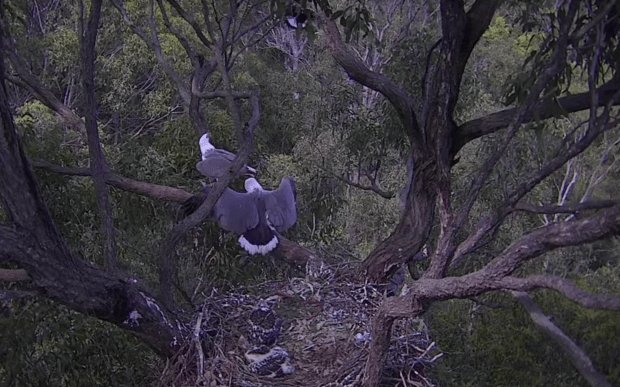
WBSE 27 and 28, the two little sea eaglets in the old Ironbark Nest in Sydney’s Olympic Park, had an early morning breakfast of bird.
Ah, just guess who was the first one up at the breakfast table? If you said, 28 you are absolutely right.
The little bird filled up their empty tummies but it wasn’t big enough -like a grand fish -to fill their crops, too. After breakfast the pair did some wing flapping, standing, and attempts at walking. They still need their wing tips to help with their balance.
Look at the tail that is growing on WBSE27! 27 is the one flapping its wings below.
Well, the Australian Magpie was not giving the White-bellied Sea Eagles a break today. For a couple of hours after feeding the eaglets, Lady defended the nest ducking and honking as the Magpie swooped down trying to hit her.
In the image below, Lady is honking at the Magpie.
Here is a good image of the bird as it goes to land on a branch of the nest tree. This bird is cheeky – they must taste terrible or Lady could have that Magpie for lunch! I would not blame her.
In this image you can see the Magpie caught in flight right above Lady’s head.
Here the Magpie is flying around Lady. It is right over her head.
Dad came to help Lady. All of the big raptors – at the top of the food chain – attract all the small birds and owls. It is surprising how much physical damage these small feathered creatures can do. Last year, BooBook Owl injured Lady’s eye. They can, of course, knock the eaglets out of the nest.
Tiaki looks out to the world that awaits her. Her name means protector of the land and the seas. I hope that they also protect her.
As Albies fly around her in the strong winds, Tiaki raises her wings. She will be off on her big adventure soon.
The chicks are all hovering in the strong winds. In a blink they will be gone. I think I put down 12 September on the guessing game but it could just be any time. Quarry Chick fledged 3 days ago.
Tiaki received her GPS tracker today. Ranger Sharyn Bronte said, “A wider study of the entire Northern Royal Albatross is being conducted this year. And in a first for a Royalcam chick Tiaki as received a tracker. Trackers have deployed on northern royals on the Chathams where 99% of the world population of this species breeds.We are extremely lucky to have 20g devices are available to track LGK, LGL and Tiaki. Although LGL’s device failed it has provided valuable data. Devices are extremely light compared to the weight of the bird and attached to back feathers. These feathers molt within a year and the device will fall off. The device is solar powered and will remotely send data until molting.”
If you read my column regularly, you will know that I am a big supporter of GPS trackers. I also support Darvic bands. Much new information on the migrations, winter and summer breeding grounds – and yes, deaths, are revealed amongst other things. Studying birds or watching them in their nests is never for the faint of heart. Their lives are full of challenges, most placed on them by humans.
Last year, a lovely Polish woman wrote to me to tell me she didn’t know how I could be so calm when ‘bad things’ happened to the birds. Those were not her exact words but that is what she meant. I was not the least bit offended. The truth is I feel for each and every one of them. That caring is inside a bigger box that is now labelled ‘ avian activist’. I want to help stop those things that cause the birds injury or death when it can be avoided. Rodenticides, sticky paper traps, lead shot, lead bullets, lead in fishing equipment, fishing line, fishing nets, windows, garbage dumped on the roads, habitat loss, wild fires caused by arson, electrocution, bread fed to the birds —— and simple neglect or oversight. Like having emergency contact numbers for the streaming cams where there is no 24/7 chat with knowledgable moderators.
I am working on a way to remember Malin, the Osprey nestling at the Collins Marsh Nature Centre, whose life was needlessly cut short. The Malin Code. Osprey streaming cams that follow The Malin Code would have either 24/7 moderators who can access emergency help immediately or emergency numbers at the top of the historical information on the nests. Individuals who are in charge of parks or areas with nests would be trained to recognize the physical signs (11 of them) from food begging to alerting and the 8 vocalizations. It is the least requirement. The other is that they pay attention to what is happening on the nest. They need to know the difference between a juvenile and an adult. Etc. Whew. Yes, I get worked up. If you can think of anything else that these organizations should be doing, let me know. Don’t be shy! At the end of the year, the streaming cam that best implemented The Malin Code would get a donation, big enough to motivate them to do what is right for the birds.
OK. On to what is happening in some of the scrape boxes:
Diamond and Xavier spent some time in the scrape box together today. There was a bit of a conversation between Diamond and Xavier. I need to learn to speak falcon.
There is a real soft spot in my heart for the little male Peregrine Falcon in Melbourne. Maybe it is the ledge where he comes scurrying in to take his turn incubating the eggs or when he brings prey to the eyases.
He is the cutest thing and makes the biggest messes plucking pigeons right in the nest with the eyases. But, last year, I noticed that those three girls really knew what to do with a feathered bird. They were not shy. By the time they fledged, they were professional pigeon pluckers. Can you say that fast 10x?
What a cutie! Our stealth raptor.
Have you ever wondered about the black faces of the Peregrine Falcons? Did you know that the size and intensity of the black varies by region? Have a read.
Cody and the lads down in Kisatchie National Forest have done a great job with the camera for the Bald Eagle Nest of Anna and Louis. Cody says that the sound is going to be fantastic.
Isn’t that a gorgeous sunset over Lake Kincaid? Such a lovely spot for a Bald Eagle nest —- and, of course, there is the lake that is stocked with some really nice fish. Couldn’t get much better. Everyone is just waiting for the Eagles to return.
Speaking of Bald Eagles returning, both Samson and Gabby are at home in Jacksonville and Harriet and M15 are in Fort Myers. All that reminds me I have to check and see what is happening at Captiva.
I want to leave you with an image of Tiny Little. She is one of the fledgling Ospreys in my long time study of third hatch survivors. She has a Darvic ring-Blue 463. Here she is as a wee one.
Blue 35 is feeding Tiny Little by herself. Look at ‘big nasty sister’ in the middle. It really is thanks to excellent parenting that Tiny survived – and became the dominant bird. Gosh, I wish she had a tracker. Is she at Poole Harbour? has she made it to Brittany? will she go to The Gambia? or Senegal? or Southern Spain? My ‘wish list’ includes getting someone to look for her if I can’t be there myself during the winter of 2022.
That’s it for me tonight. Tomorrow I am off in search of a Green Heron. Take care everyone. Stay safe. Be kind. Remember: Life is for living.
Thank you to the following for their streaming cams where I take my screen shots: 367 Collins Street Falcons, Sea Eagles @ Birdlife Australia Discovery Centre, The Kisatchie National Forest Bald Eagle Cam, The Falcon Cam Project Charles Sturt University at Orange and Cilla Kinross, Cornell Bird Lab and NZ Doc Royal Albatross Cam and FB Page and The Cumbrian Wildlife Trust and the Foulshaw Moss Osprey Nest.