We are going to start off with a check on what is happening in San Francisco – before moving on to Daisy.
An absolutely adorable 4 min 16 sec radio discussion on The Love Story in the Sky at The Campanile.
Did you know that Peregrine Falcons were virtually wiped out in California? In the late 1970 there were only two nesting pairs? This was the result of DDT. There is lots of literature but reading Rachel Carsons, Silent Spring, is a very good start.
DDT might have been banned after the revelations of Rachel Carson and others but it remains in the soil in various places. One of those is Big Bear California where DDT was sprayed on Big Bear Lake to kill the mosquitoes. It is still a contributing factor in thin egg shells which may be part of the problem with Jackie and Shadow, the Bald Eagles that have their nest at Big Bear.
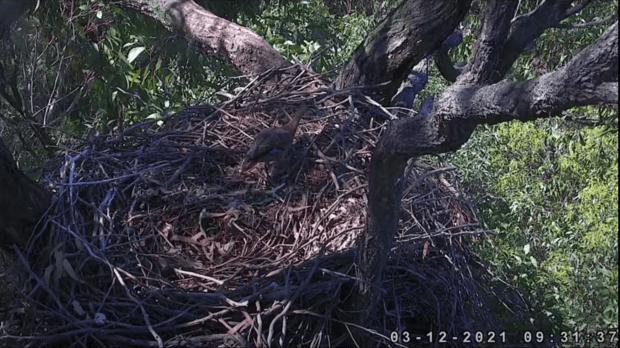
Daisy the Duck did not spend the night on the White-Bellied Sea Eagle nest.

She arrived before sunrise to check on the nest. No one else was there. Daisy will be very cautious. She does not want to draw attention to the egg cup where her first egg was laid.

She goes over to where her egg is and checks. It is still there. Safe.

We can see where Daisy’s egg is because we know it is there but it is nicely covered with leaves and nest material so the predators cannot find it.
Daisy leaves right as the sun is rising and the forest is waking up.

Daisy carefully waits on a branch when she returns an hour and a half later. Can you see her?


She is checking and rolling her egg.

Daisy is very still. When she is in labour, her tail will move up and down.


There are now two eggs! Look you can see them both. Daisy is holding herself up so as not to break the second egg. When the eggs are laid they are soft. The air will dry off the surface and make them hard.

Daisy has settled on the eggs nicely. She is having a rest. Daisy will not do hard incubation until all of the eggs are laid. That is so they will hatch at the same time.

This last image of Daisy was taken a few minutes ago. It is nearly 08:30 in Sydney, Australia.

So far Daisy has been lucky. Lady and Dad did visit the nest tree a week ago and then on the day that WBSE 27 was released from care, they were not at the River Roost. They will often go to Goat Island if there are no eaglets to look after. Still, we know that they do come to check the nest.
Someone asked me why Daisy does not stay on the eggs now all the time. If she did they would not all hatch on the same day. Secondly, she is a very smart little duck. Her presence on the nest makes all of the other forest animals and birds curious. Last January they had never seen a duck on the big sea eagle nest — and neither had anyone else! I think Daisy will try and protect her eggs really well this year from the Ravens. She is almost a year older and she is ‘wiser’ now. Her breeding and the laying of eggs normally coincides with plenty of food and water. Her mate, who came to inspect the nest last year, only takes part in the mating ritual. The rest is up to Daisy. That is why she is so vulnerable. Only 20% of Pacific Black Ducks live to be 2 years old. Indeed, the average life span is only about two years. Oh, I so hope that she is successful this year! There are so many people hoping for Daisy!
You can join in and become a real Daisy fan. She needs all the love and positive energy we can all send her. Soon the name of the streaming cam will be changed from Sea-Eagle to Duck Cam! Here is the link to the streaming cam. Daisy arrives about 13:15 CDT or around 05:15 Australian Time. I am not expecting her to stay all day but she might surprise me.
Once Daisy lays all of her eggs (there could be 11), she will begin her hard incubation. Incubation will last for 29 days after the laying of the last egg. This is the difficult time. Daisy still has to eat and have some relaxing time. Last year she even went out during the night. It is then that the eggs are vulnerable. As long as she is incubating them, the Ravens seem not to bother. Our fears of the sea eagles proved to be nothing. They could behave differently this year but they were not a threat last save for the fact that scattering the down nesting material allowed the eggs to be seen. Fingers crossed.
Thanks for joining me. Take care everyone. See you soon!
Thank you to the Sydney Sea Eagle @ Birdlife Australia Discovery Centre for their streaming cam where I took my screen captures.