A week ago all of us held our breath as E19 and E20 sorted out their sibling rivalry. There was never a worry. Harriet and M15 are so experienced at parenting and both of them step up to the plate and take on dual feedings. The rivalry has, it seems, diminished so much that any events are rare.
This afternoon the pair enjoyed some nice cat fish. No narration required! Harriet might want a quiet afternoon so she fills up both of them. They fall asleep with large crops!
Adorable!
Thank you for joining me. Take care all.
Thank you to SWFlorida Eagle Cam and the D Pritchett Family for their streaming cam where I took my screen shots.
At 8:56:34, Dad brought in a massive fish (despite having eaten his fair share) to the Port Lincoln Osprey Nest.
The image below shows the size of the fish a little better despite much of it hidden under mom. Imagine that the top part is up at her beak where she is feeding one of the chicks to get an idea. Little Bob is in the middle. You can see the white lace on his cere and the black circle on top of his head.
Dad returned at 9:11:33 to see if Mum was finished feeding the chicks. She wasn’t and she did not let him take the fish.
The trio lined up again. Big Bob, who had eaten first, is full and is moving away from the feeding line. She is letting the two younger siblings have their share.
Middle and Little are right in there. Their feathers are growing so quickly. Look along the edge of Little Bob’s wing. They are beginning to look like fringe.
Oh, goodness. Dad is rather anxious this morning. He returns a second time at 9: 28:20.
Mum is still feeding Middle and Little Bob. Oh, and look. Big Bob is waking up again. Is he ready for another round of fish?
You can see that there is still lots of fish left. The chicks have now been eating for 34 minutes and it looks like half the fish is left. Dad is really having a close look. Mum does not give the fish to him, again. She seems to have decided that he is not going to rush her today.
Ah, Big Bob is back up at the end of the line wanting some more. This is such a polite nest. Big Bob does not push his way to the front of the line, she waits.
By 9:29, Mum decides to move the fish around to the other side. Maybe she thought Dad was going to take it. She continues to feed the chicks and herself.
Despite the fact that the chicks have moved so that they can pass out in their respective food comas, Mum continues to feed Little Bob.
Little Bob is ‘stuffed’ and has turned away from any more bites of fish. Mom is doing a good job eating that nice fish near the tail. She needs to eat, too! Dad seems to have nodded off waiting! In the end, I do not think Dad even got a nibble of the tail. We have to remember that he did have a big chunk before he brought the fish to the nest.
The trio and Mum finished off that extra large fish in 47 minutes. Amazing.
Dad brings another fish to the nest at 13:29:38. Everyone is fed and it is not even the middle of the afternoon. This is a good example of how the feedings change. When the three were wee, they needed more feedings with less fish at each one. Now they will eat much more fish but, there will be less feedings. They are really, really growing. Little Bob is 24 days old today while Middle and Big are 26 days old.
Xavier watches from the ledge of the scrape box as Diamond feeds their wee babe. So far there appears to be no pip or crack on a second egg. It is unclear if there is even a pip.
It is the middle of the afternoon and Xavier is again resting on the ledge. He was seen limping and he is probably resting that leg. Instead of Starlings and Parrots, Xavier has been bringing in pigeon which is a much larger prey item. He might have strained his leg when he was hunting.
I also wonder if he can hear the second chick? or if he just wants to be there with Diamond in the scrape? or wants to brood the chick and incubate the eggs?
The waiting must be frustrating for these two. Big Bob (or Only Bob) is poking its head out from under Diamond to the right of the egg. Cute.
At the nest of the White-Bellied Sea Eagles in Sydney’s Olympic Park forest, a Pied Currawong will not leave WBSE 27 and 28 alone. It has been harassing them on and off all day. It is the Pied Currawongs who are intent on chasing the little sea eagle fledglings out of the forest. Normally, eagles fledge and return to the nest for the parents to feed them while they strengthen their flying skills. Many will return to the nest for feedings for up to a month. If they are rushed away, the ‘map’ or return to the nest might not be imprinted in their memory.
27 and 28 are smart. They can hunker down duckling style and watch but the Currawong cannot harm them. These birds can knock them off if they were standing on a branch or injure them if they were standing up.
These two will be branching so soon and then fledging. They can walk and stand and both are self-feeding. We are entering the 11th week. From hatch to fledge for the Australian White-Bellied Sea Eagles is 80-88 days. The median is 83.1.
Here is a video of WBSE 28 stealing the prey from 27. Fantastic!
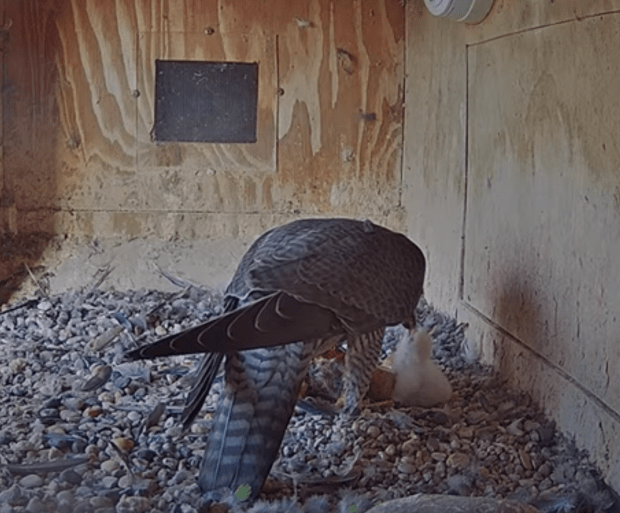
At the 367 Collins Street Peregrine Falcon scrape, Mum has left the scrape box and is off for a break and to retrieve prey for the eyases. Look at how much room they take up today!
They look like a large white Persian cat if you squint.
Time for your mid-afternoon pigeon everyone!
Dad had it prepared and ready for Mum to bring and feed the youngsters.
Yummy.
The oldest two are getting more hawk like in their appearance.
Except for the Pied Currawong’s harassment, all of the nestlings are doing very well. It is, indeed, a pleasure to be able to watch them grow from hatch to fledge. How fortunate we are!
Thank you for joining me. Take care everyone. See you soon.
Thank you to the following for their streaming cams where I took my screen shots: the Port Lincoln Osprey Project, 365 Collins Street Falcons by Mirvac, Charles Sturt University Falcon Cam at Orange and Cilla Kinross, and Sea Eagle Cam @ Birdlife Australia Discovery Centre.
There is still time for you to put in your count for the October Big Bird e-Bird Count. You have until midnight as far as I know. In one hour we had 37 Dark-eyed Juncos, 3 Blue Jays, 3 Harris’s Sparrows, 1 American Robin, and a host of House Sparrows. There were also 3 grey squirrels and 1 red and then Little Woodpecker came when the new suet cylinder went up. I wonder if they sit and watch? or how good their noses are.
Everyone of them seems to know the minute the feeders are full and once the suet cylinder is finished when a new one is put in place. It is much cooler than it was a few days ago and the sky has been a light grey all day. I wonder how long the Dark-eyed Juncos will be with us?
There is, as far as I know, only one hatch at the Peregrine Falcon scrape box in Orange. The little one has been fed several times already. It gets full with 3 or 4 nice bites of prey.
And then it will pass out quickly in a food coma! It is quite frightening the first time you see this happen, especially with a newly hatched chick.
Yesterday I made a video clip of one of the feedings at the 367 Collins Street Peregrine Falcon Scrape.
The Collins Street Kids are really growing. The two larger ones now jump a bit to get up to Mum’s beak for the prey.
There was a beautiful golden glow on Mum at the Port Lincoln Osprey Barge this morning. Viewers got a treat. The cam operator showed the Calypso Star I taking clients out for shark cage diving. You might know it but it was that business that allowed the Port Lincoln Osprey Barge and streaming cam to come into existence. Thank you Calypso Star!
It is 8:23 just now and the kiddos are still waiting for breakfast. They will certainly not starve! Never. Last night when they went to sleep their crops were bursting.
Once of those funny crop shots when they lean back to preen. Look how big that is. Each of them was the same.
Here’s Little Bob! Look at that crop and then look at his feet!!!!!! I love Clown Feet Time.
I am learning just to keep quiet on bird chats. A couple of days ago, a dear woman, who has been quite ill and is recovering, was more than put down because she suggested that birds have emotions. There is a lot of research on this subject. For the next week or so, I will post some academic/scientific papers on this topic. Some will be shorter and some longer. The one today concerns two particular emotions: fear and frustration. It is titled, “Avian Emotions: Comparative Perspectives on Fear and Frustration.” It was published in Frontiers of Psychology in December 2018.
I grew up in Oklahoma (home of the Five Civilized Tribes before it became a state) where there are strong beliefs about animals and birds. They serve as messengers of the Spirits of the Indigenous people. Some offer warnings – others are there to help. Here is an interesting article birds as symbols.
We are looking for a hatch for Xavier and Diamond today. It might not happen. If it doesn’t, it is just fine. Those who watched their scrape last year certainly came to love their only hatch, Izzi. He was quite remarkable.
Thank you for stopping in today. Remember to turn in your bird count if you haven’t already. Take care. See you soon!
Thank you to the following for their streaming cams where I took my screen shots and video clips: the Port Lincoln Osprey Project, 367 Collins Street Falcons by Mirvac, and Charles Sturt University at Orange Falcon Cam and Cilla Kinross.
It seriously does not get better than this: I take a break to check on our federal election results and turn around to check on the chicks at the Port Lincoln Osprey nest and they are being fed —— again!
The whale of a fish that Dad brought in this morning still has some left even after the last feeding. I have genuinely lost count of the feedings but we are up to at least five and I think maybe six. The last one began with Dad bringing the remaining fish to mom at 12:14. The kids ate and it is now 12:36 nest time. They will be fed at least three or four more times before they tuck it in for the night. Fantastic. Like the little songbirds in their nests whose parents fly in and out continually, this trio of osplets are thriving with more frequent feedings at this stage in their development.
It was time for a nap. One of the chatters was worried about Little Bob being out from under Mom. You can also see the heads of Big and Middle Bob sticking out. Little Bob was too warm or he would have been under. And if he got chilled, he would push to get under mom. If she was worried she would have scooped him up. She did look and check on him several times.
There is still some fish remaining that you can see at the bottom right. The chicks were full when mom finished feeding and got them settled again.
Less than an hour later, Dad is back on the nest. Just look at mom’s eyes. You can also see one of the wee babes with its head out.
Mom feeds the babies again! I don’t even know if they were hungry.
Everyone is fed and tucked. Dad is over on the ropes and I bet mum is wanting to catch a little sleep. It looks like the whale of a fish was finished.
During my walk today, I noticed a lovely pine tree. It had three Black capped chickadees on the branches. Then I stopped at another yard and saw no less than 15 bird feeders and various bird baths and watering containers. At the corner was the house with the pollinator garden. Long before it became a stylish phrase ‘I have a pollinator garden’, my neighbour was doing just that. People reported him to the city authorities because, well, his boulevard and yard looked a mess. Today, the flowers are growing in the pots hanging between the trees and the rest are native plants helping the environment. I don’t think anyone looks at that garden with disdain any longer. I mention this because I got a note this evening from a reader asking me what are all the things they can do to help the birds. Gosh, I didn’t know where to start there is so much to be done. So let’s start with the basic principle that everything is connected. Here are a few ideas and we will add to them on a regular basis.
Shrinking your lawn is one of the first one that comes to mind. In their book, Planting in a Post-Wild World, the authors suggest that we think of turf or lawn as an area rug, not the whole floor. Use the grass areas to draw attention to something. Most eco-gardeners suggest having no more than 50% turf. It is suggested that you set your mowers to 3 inches or 7.5 cm. You will not kill your grass by cutting it too short and you will also not kill the turtles or little bunnies that hunker down. Do not mow at sunset as many species come out at that time of day.
Do not treat your turf with anything. No matter how green the companies claim their products to be, if they kill something they will also kill other things. You can also save a lot of money.
If you are doing some fall planting, use native plants and pollinators. These will be good for the insects and small birds.
Plant a native tree.
Do not rake your lawn. Leave it. Just leave it alone. If you must, rake the leaves into areas and spread them being as gentle as possible.
Locally we are recommending leaving out hummingbird feeders. The little ones are still staying in some of our more northern areas. They are migrating through and really can use the energy.
The small songbirds migrating have really been eating my suet cylinders. That fat and those specialized seeds and insects give them fuel also.
I will stop there. There is so much we can do from supporting bird friendly coffee and building bubblers (small fountain areas) and little ponds, window decorations to stop bird strike, etc. A friend of mine wrote to me today and they had been in an area where there were no birds. They said that it was ‘eerie.’ Can you imagine a world without birds?
Thank you so much for checking in with me. It is going so well for the family at Port Lincoln. What a joy! Take care all. See you soon.
Thank you to the Port Lincoln Osprey Project for their streaming cam where I took my screen shots.