The plumage on a Peregrine Falcon is incredibly cute. Those beautiful slate grey heads, the horizontal striped pantaloons, the white chest, the gorgeous yellow legs and talons and cere.
One of the cutest is the little 8 year old lad below, Grinnell. Grinnell was, until the 29th of October, the resident male along with his mate, Annie, at The Campanile on the grounds of UC-Berkeley in San Francisco. On that day, Grinnell had an altercation with two falcon interlopers. He was found grounded on a garbage can about a mile and a half from The Campanile. Was he driving the interlopers out? was he fleeing? We will never know. Fortunately, he was found and taken into care at the Lindsay Wildlife Centre. There he had surgery on his wing and received antibiotics, anti-parasites, and anti-inflammatory drugs. He was doing well enough when he arrived at the clinic that he could feed himself. Apparently he quite loved the quail!
As you can see from the FB posting below, Grinnell is doing well.
Decisions will be made as to where he will be released by a couple of agencies. It is not known if Grinnell will return and fight for his territory and Annie, his mate of 6 years. Only time will tell. The good news is that Grinnell is recovering from his injuries.
Meanwhile, Annie has been getting friendly with the intruder. Oh, I wish it would go away! Annie does not know where Grinnell is and she has been scraping in the box, etc indicating that she is receptive to the new male. Falcon experts have stated that Annie will not enter into the battle if the two males rival for the territory – prime real estate! She will want to protect herself so that she will be healthy during breeding season.
Keep sending positive thoughts Grinnell’s way.
I know that some have been worried about the falcon left on the ledge at 367 Collins Street. At 11:12, Dad brought a huge prey item onto the ledge. You can see the eyas beginning to mantle, very excited. The bird was not prepped and Dad worked on it but the chick was not eating. I am not a vet but it appears that something is causing the chick to not be able to open its beak wide enough to eat. The chick appears not to be preening despite the floof (this normally causes them to itch and preen constantly) and I am concerned that there is ‘something’ not right.
I am not that familiar with the birds in Australia but it looks like it could be a Sulphur-Crested Cockatoo or a Gull.
I feel really sorry. The Dad is working hard to feed and get the little one to eat and well, it appears that it can’t. It is only a guess as to what is wrong with the chick. Will anyone do anything to get it into care, I do not know. Every country and even every state is different in their laws and attitudes. All we can do is hope that the wee bird will improve on its own.
The weather in Port Lincoln is dire. One of the boats near the barge has gone under the water in the rough waves. No one was on board. It is a cold front moving through the area. It is 13 degees C with 32 kph winds. It is not a good day for fishing with the choppy water but the osplets have been doing some hovering. I hope they don’t get blown off the nest prematurely! So far they are all safe and secure!
I wish I had better news about the little falcon on Collins Street. Send lots of love and positive wishes for there to be a turn around or — for a miracle and someone approve it going into care.
Take care everyone. See you soon.
Thank you to the following for their streaming cams where I took my screen shots: 367 Collins Street Falcons by Mirvac and the Port Lincoln Osprey Project. I would also like to thank the individuals who have shared the FB posting about Grinnell.
It was a great discussion by Lynn and Sean from Cal Falcons and Cheryl from Lindsay Wildlife Rehabilitation Centre on Grinnell. I taped it to post here but the file size is too large. Lynn and Sean archived the discussion. Here is the link:
Grinnell is the male Peregrine Falcon whose mate is Annie. Their territory for the past five years has been the campus of the University of California at Berkeley in San Francisco. Their scrape box is in the most iconic building on campus, The Campanile.
On 29 October, Grinnell was observed to be in a territorial fight with two intruder falcons. He was found 1.5 miles away from the Campanile grounded. The eight year old falcon was taken into care. Grinnell had minor surgery related to an injury on his wing. He also had a significant injury to one of his legs, his top beak end was also broken and there were other injuries related to the fight. Grinnell is on medication twice a day that includes anti-inflammatories, anti-parasites, as well as antibiotics. It is not clear if Grinnell could have survived without human interference since he was grounded. He was given fluids and was very hungry and ate on his own instead of being fed by clinic staff. This means that they put food in his hospital cage and he eats when he wants. They checked the sutures in his wing and the wound has not completely healed. They will continue to check that and Grinnell’s parasite load. All birds have parasites at various levels and of various kinds. They do not know for certain but Grinnell will be in care for another week to a month. He has to be fully healed and capable of hunting and flying before he will be released. His beak tip is keratin like our fingernails and will grow back. It is not like a broken bone. At this time they do not know where they will release Grinnell. The experts note that if Grinnell wants to return to his territory even if they released him 100 miles away with the falcon’s keen navigation systems he would find home. So there will be continuing discussions about an appropriate location.
One of the most asked questions was: what about Annie? First, Annie and Grinnell have been together for 5 years raising chicks. Grinnell is an excellent falcon dad partaking in many activities raising the chicks – more than most falcon males who simply do the hunting. This is a big plus for Grinnell. Annie does not know where Grinnell is. He is just gone. Not there. Annie is currently maintaining her territory on top of the Campanile. Annie has been scraping in the scrape box, displaying breeding behaviours towards the ‘new guy’. The falcon experts say that Annie will not likely enter into a fight with the interloper. She does not want to get injured and not be able to breed next year. If Grinnell returns to fight the interloper, she will likely stay out of it to avoid injury. Someone asked if Annie would know Grinnell if he returned. The answer was ‘certainly yes’. Annie would know Grinnell by a sound of his voice miles away. But right now, Annie just knows that Grinnell is not there. She does not know where he is.
Annie in the scrape box. 5 November 2021.
I hope you will listen to the discussion. The questions and the responses were quite informative.
There has been an update on the Joburg Spotted Owls – the foster owlet put in the box with a mother and her two. It has been returned to the box once and has jumped out again. It is now in the garden of the owners. There is a carport and the parents will continue to feed it. They are opting not to return it to the nest box because it will only jump out again.
The weather was grand. 10 degrees C. I visited two of our parks in search of Wood Ducks and was not disappointed. At one there were 25 Mallards, 2 Wood Ducks, and about 400 Canada Geese. At the other there were 6 Wood Ducks, a few Mallards, and about 50 Canada Geese. I will post images tomorrow.
Take care everyone. I hope your weekend is starting off well. See you soon.
Lindsay Wildlife Clinic in Walnut Creek, California just posted an update on Grinnell. Grinnell is one of the UC Berkeley Peregrine Falcons. His mate is Annie and their natal nest is on top of the Campanile. Grinnell was involved in an altercation, protecting his territory, with an intruder male. He was found on the 29th sitting on a trash can unable to fly with multiple injuries. He was taken to the Lindsay Wildlife Clinic where he underwent surgery.
This is their update today:
GRINNELL UPDATE, AND THANK YOU: Grinnell the Peregrine Falcon continues recovering from his injuries in our wildlife hospital. The surgical site on his wing is healing and he underwent additional radiographs on Nov. 2 to check the bruising on his right leg. He is eating well (he’s pictured here with a full crop after dining on a quail) and our veterinary team expects it will take 10-14 days to heal from his injuries. On Grinnell’s behalf, we would like to thank everyone for their well wishes and for their donations and support as we work to return him to the wild, where he belongs. Photos by Dr. Krystal Woo, Lead Wildlife Veterinarian.
So glad he is doing well. Hang in there, Annie. Grinnell will be home shortly. If you wish to make a donation, go to the Lindsay Wildlife Clinic FB Page. There is a donate button.
Thank you to the Lindsay Wildlife Clinic FB Page where I took this screen capture.
I know that some of you have watched birds fall out of nests including Silo Chick at Patuxent River Park last summer. Remember that feeling when you saw that little osplet fall into the water, heard the splash, and saw the others looking down? Felt helpless? Of course. Thankfully that story ended well. I have no idea how many called but the osprey was located and literally tossed back into the nest. It was an enormous relief. Others are not so lucky.
I posted a new owl box streaming cam in Joburg, South Africa just the other day. An orphaned Spotted Eagle owl was put in the box with two other owlets. The mother accepted it! Fantastic. The adopted owl is 5 days older than the other two and it got curious about the outside world today and fell out of the nest box!
What no one knew, at the time, was that the owl landed on a huge platform under the box. If it doesn’t get back into the box on its own, it will be placed back inside the box. Relief.
Yarruga was starving this morning. There were two prey deliveries at the scrape box and there was not a scrap left of either meal.
Yarruga was so excited when the second meal appeared that she could not stand still to eat. She literally ran around the scrape box as in the images below.
Xavier was certainly glad when that feeding was over! There is not a drop left for either of the adults. Yarruga was soooooo hungry after having only 2 feedings yesterday. She does love her food! And she is certainly growing. Look how big she is next to Xavier!
In fact, Yarruga should have had a nice tasty little duckling yesterday but Diamond saw it and quickly took it from Zavier and flew out of the scrape! One has to imagine that this is quite the delicacy (as opposed to the dreaded Starling!). After her injury, I am actually glad that she got it.
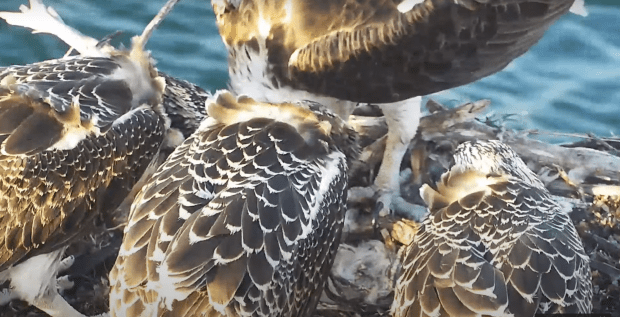
Port Lincoln did a nice close up of the juvenile feathering of the three osplets this morning. Just look at the variations in the depth of the white juvenile feather banding. Little bob is in the middle.
As the dominant bird, Little Bob often gets the first bite. She is full and letting the other two have their turns as she looks out to the water in the image below. Of course, I am saying ‘she’ because of her thick legs. Wait til Monday when the banders declare she is a he. How funny! Whatever gender, that bird is gorgeous and I will continue to celebrate the times that she put Big Bob in his place.
There she is below.
Victor Hurley, the main researcher for the Peregrine Falcons in Victoria has been posting information on the 367 Collins Street FB Page. The last posting was on ‘Dispersal’ because, as we know, the falcons will be fledging shortly. I imagine that there are many things in this column that would be of interest to many of you. This is what he wrote:
First Flight Normally, this is not such a serious undertaking as that from an inner city high rise ledge. Normally pre-fledgling Peregrine Falcons will scramble around across their natal cliff for quite some time before taking their first flight. Mostly this is successful and they land high on another ledge or small perch. In a city location they will land on the roof top of another building nearby. If the winds are tricky then things can go south pretty quickly. Once they have mastered their first flight then they will spend increasing time “on the wing” and following and learning from the parents how to hunt. As soon as each youngster achieves their first kill the adults (parents) will stop providing any more food and that youngster is on their own to find food. Once all young are successfully hunting then depending upon the experience and ruthlessness of the adults they will all be chased with serious determination out of the territory altogether. In some cases this may occur in December or even early the nest year. Either way the young tend not to return again to the nest ledge that we have been observing. Maybe occasionally, but then only briefly.
Plumage differencesLeading up to this first flight the adults restrict the level of food resources they bring to the nest. This explains the weight loss of the nestlings. The wings of the nestlings are still growing but they are also losing weight. This makes them lighter with larger wings which provides for a “lower wing loading” which makes their first flight easier. Neat, huh! The other point I thought I would raise here is that of the plumage differences. Peregrine Falcons as with most raptors and many other bird species have a juvenile plumage phase and an adult plumage phase. The juveniles are in essence a brownish colour with vertical splotchy stripes over a “dark milk tea” fawn base colour on the front and dark brown wing, back and head. Whereas the adults have a near black hood for the head, slatey grey wings and back with a soft cream bib and base colour overlayed with fine dark grey-black horizontal stripes. The tail and main wing flight feathers are also longer in the juveniles and they moult shorter feathers with each year as they get older.
Natal dispersal This is the ultimate question. Where and how far do Peregrines disperse to find a place of their own in which to breed. Natal dispersal is the distance (and direction for those interested) in how far fledgling Peregrine Falcons ultimately move to find and establish (read take over for the most part) their own breeding site. Amongst Peregrine Falcons in Victoria, as with most bird species the world over, the females disperse further from their fledging site to breeding site then do males. Based on observing 127 breeding adults with leg bands (placed on them as nestlings) the females dispersed on average 64km (range 6-280km) and males average 25km (rang 1.6-90km). This differing dispersal distance minimises the likelihood of siblings interbreeding. The average age at first breeding is as follows: females 2.6 years (average) and for males 3.3 years (average). Another way of presenting this same data includes presenting the direction as well as the distance males and females disperse. No bias in dispersal direction was recorded.Victoria is a relatively flat area of the planet, its highest point above sea level is Mt Bogong (1,979m) and~80% of Victoria is <200m ASL. So for a predatory species like the Peregrine Falcon that doesn’t migrate annually due to milder winters and having the highest wing loading of any Peregrine sub-species globally, in a state (Victoria) with limited high altitude cliff faces with an abundance of low lying wetlands and associated birdlife and a very diverse range of parrot species what is a cliff nesting raptor to do? A look at all (256) of the Peregrine Falcon nests ever described in Victoria provides the answer to this question. The Peregrine Falcon in Victoria has overcome these obstacles by adopting a range of novel nesting situations (by nesting in stick nests of other birds, tree hollows and of course buildings (a growing trend globally). So this leads to another interesting question. Do those birds raised in one type of nest only adopt others of the same “nest type”? or will they readily disperse to a different type? That is to say, do they become behaviourally “imprinted” on the nest type they are raised on? Again thanks to the long term banding of nestlings and resighting of adults (with telescopes) by volunteers with the Victorian Peregrine Project the natal dispersal patterns of 127 Peregrine Falcons have been identified so far showing that 30.2% have adopted a different (novel) nest type from the one they were hatched and raised in. Between the sexes dispersal patterns are similar with 26% of females and 23% of males adopting different or “novel” nests in which to breed. Combined 30.2% of Peregrines undertake novel natal dispersals to find a place to breed. So the myth of nest type imprinting has been pretty thoroughly exploded with these bird banding results.Further to this, slightly counter-intuitively, novel dispersal events (dispersing from one nest ‘type’ to another) were less dispersive with no sex bias. That is those individuals who adopted a ‘novel’ nest type did so by dispersing a shorter distance on average than those undertaking a typical natal dispersal. Presumably they are doing this in order to exploit a familiar (geographically closer) food/prey resource by adopting a novel nest type in order to remain close by to that prey resource.So back in 1991 when Peregrine Falcons were first identified breeding at 367 Collins Street, Melbourne it was one of only two or three nest sites on built structures that were known. Since then over 20 new sites have been discovered and the number continues to grow. Nest site selection is driven by its proximity to food resources as well as the security (from predators and human disturbance) and how protected the nest is from rainfall and water runoff.Surviving the first two years…The third question (although not chronologically) is what is the survivorship of young Peregrine Falcons in their first two years prior to breeding. Generally, it is accepted that there is a ~a 66% die-off of Peregrine Falcons within their first year. Given the youngest breeding is at two years post hatching I have trawled the VPP database again to investigate causes of mortality of ~240 banded Peregrine Falcons in their first two years post banding. Most banding occurred at or around 24 days post hatching. When considering the various incidents there was no sex bias. That is neither sex is more prone to any cause of death compared to the other. Rock falls, cliff collapses or storms bringing down trees or stick nests have been a surprisingly regular threat to young of this species. The constant and ever present shooting of Peregrine Falcons continues to this day. The first ever band recovery of a Peregrine Falcon in Australia was in 1958 in Victoria. Disease of course is Trichomoniasis and predators varies from Red Foxes, Brown Falcons and even Peregrine Falcons in limited circumstances. Secondary poisoning has generally been a result of pigeon control campaigns.”
This information would, in general, apply to all falcon populations. And if you read all that – it is a ‘Double Whew’ for today. I have been reminded that Victoria Hurley is doing a Q & A tomorrow. I cannot find the link to it. If I do I will send it out later.
Thank you for joining me. Everyone has been fed at least once if not twice already. Diamond is looking much better. No news on WBSE 27 yet and nothing on Grinnell. Take care!
Thank you to the following for their streaming cams where I took my screen captures: Port Lincoln Osprey Project and Charles Sturt University Falcon Cam and Cilla Kinross.
I am so grateful to one of my readers (Thank you, B) for reminding me about Grinnell. Sadly, I had been monitoring Diamond and my note about Grinnell had gotten lost in the pages. I feel really bad because we all care so much for Annie and Grinnell.
Everyone loves Grinnell! Grinnell is the partner of Peregrine Falcon, Annie. They have their scrape at the UC-Berkeley Campanile in San Francisco. I know many of you watch the streaming cam of the couple raising their eyases. This season Annie and Grinnell raised three male hatches to fledge: Wek-Wek, Fauci, and Kaknu.
This is part of the original announcement appearing in the UC Berkeley News:
“Grinnell, the UC Berkeley campus’s beloved male peregrine falcon, was found injured southeast of campus on Friday following a fight with a pair of peregrine falcons and is being treated at the Lindsay Wildlife Rehabilitation Hospital in Walnut Creek. The incident is raising questions about whether he and Annie, his longtime mate, who likely also was there during the attack, can hold onto their home atop the Campanile, where they’ve raised their young for five years.
It is possible that the new pair is trying to take over the territory,” said Mary Malec, a member of Cal Falcons who monitors local raptor nests for the East Bay Regional Park District. “In other territories, sometimes the fight ends with one skirmish, and sometimes the fights last over many days.”
It is very fortunate that Grinnell did not break any bones. However, the tip of his top beak is broken. There is also a wound on his head, an injury on his left wing, feathers missing under his chin, and various abrasions on his body, according to the wildlife clinic.
Sadly, territorial fights are not unusual especially when the real estate is as prime as it is at the Campanile.
The Campanile at Berkeley. Grinnell and Annie raise their chicks above the bell.
The UC Falcon FB page has reported that the male intruder has gone into the scrape box and is trying to court Annie. Here he is on the streaming cam. So it appears that it is a lone male as opposed to a couple.
Grinnell will be kept until he is fit to return to the wild. It is not easy for the birds to live in the wild….human causes and territorial fights often mean death or major injuries. We will have to wait and see what happens.
Please send your most positive thoughts out to Grinnell, Annie his long time mate, and also to Diamond who is healing in Orange, Australia today.
Thank you for joining me today. Please take care everyone.
Thank you to ‘B’ for reminding me of Grinnell’s injury and sending me the link to the reports and to UC Cal Falcons streaming cam and FB Page where I took my screen captures.