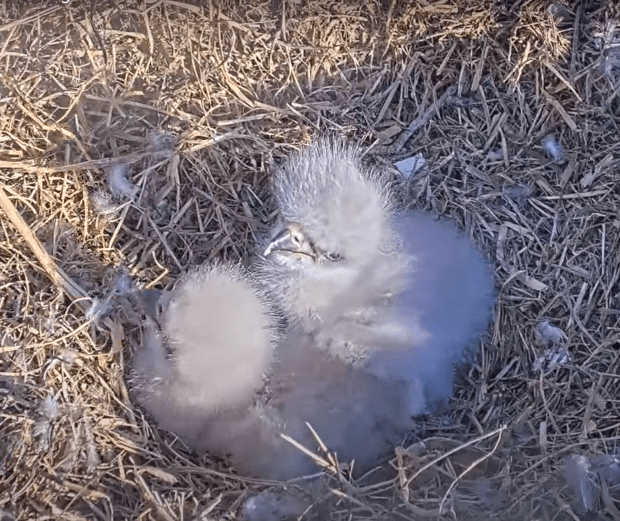
Social media is filled with pictures of Harriet and M15’s two little eaglets. Those eaglets are adorable.
The meaning of the word ‘pistol’ describing someone is a compliment. It means that they are full of surprises. And, so it was today, that E20 showed him or herself to be a ‘pistol’ when it provoked the first round of beaking on the nest at the 07:04 feeding, its first! It happened again at 09:04 and Lady Hawk caught it in a video for us.
Those eaglets are sure cute even when they have fish juice running all over them.
No problem opening wide. The eaglets are eating some nice fresh fish flakes today and loving it.
Look at the size of that bite. I think that is E19 up at Harriet’s beak.
Harriet always makes sure that each of the babies are fed. She is a very experienced and excellent Bald Eagle Mum. She also knows when to put her foot down on the nonsense – she just casually goes over and gets on top of both of them. Sometimes they will miss a meal if she decides they need too. Often M15 will step in and they will tandem feed the youngsters. That is the best!
Wonderful dad, M15 on guard.
Another example of fishing line! This hawk was really lucky. Around a river or lake and you see fishing line – help clean it up! We owe it to them. — In order to help we need to be ready. It helps to have a very sharp pair of scissors, a box, some garbage bags, and gloves in the trunk. Of course, you can add to that. A fishing net is great along with old towels to help the birds not get so stressed.
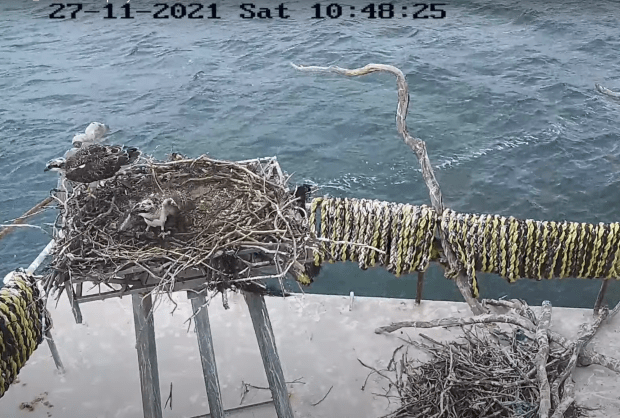
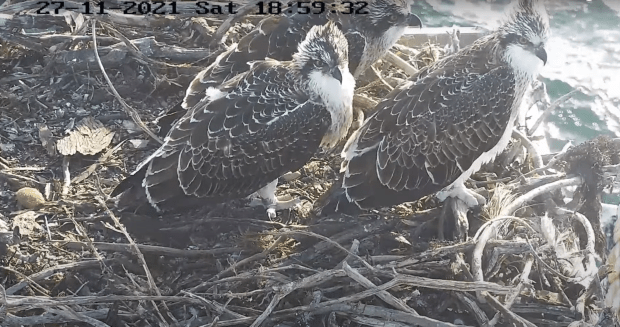
I am so proud of the three juveniles at the Port Lincoln Osprey Barge. I just went to check on them and Falky tries fishing. I recorded it for you. He will dive from the right ropes into the water and he will do several flybys before landing pack on the ropes. Oh, they are sure trying.
I want to close with a beautiful video of Xavier and Diamond bonding in the scrape box. Nothing more precious than seeing a pair of raptors confirming their togetherness. It was a hard season for them with the loss of Yurruga and the other two eggs not being viable. We wish them the best for next year.
It seems like today is a day of videos instead of images. I hope that you enjoyed them.
Take care everyone. Thank you so much for joining me today. Enjoy little E19 and 20. We will be at the clown feet stage before we know it.
Thank you to the following for their streaming cams where I took my screen and video captures: SWFlorida Eagle Cam and D Pritchett and the Port Lincoln Osprey Project.
It is almost the end of November and in about 25 days there will be at least one bobble head, if not two, on the Fort Myers, Florida Bald Eagle nest of Harriet and M15. Bald Eagles are strikingly beautiful – the gorgeous pure white head of the adult with that large bright yellow beak, espresso brown body plumage and watery light blue eyes. The hatchlings are just as adorable with their light grey down. They are called ‘bobble heads’ because they do not have the strength
While we are waiting for those eggs to hatch in Florida, there is a new streaming cam focused on a small New Zealand falcon, the Karearea.
Wikimedia Commons
They are adorable. Thanks Sharon Dunne for mentioning this new cam. The chicks are delightful! Here is the link:
Here is a short video of the chicks trying to get settled in the nest cup.
The Kareara are indigenous to New Zealand. At present, they are very vulnerable. They believe that there are between 5-8,000 birds in the whole of New Zealand. Their threats are loss of habitat, cats, mustelids (they are like wolverines), and hedgehogs. Hedgehogs like their eggs.
The falcons have also been found on several islands but, the area with the highest population is the Kaingaroa Forest between Rotorua and Taupo on New Zealand’s central North Island. You can see Taupo on the map above. The Kaingaroa Forest is the largest forest plantation in New Zealand and is the second largest forest in the Southern Hemisphere. It is 190,000 hectares. The first trees were planted in the early 1900s. They are harvested for the construction industry.
The adults are 40 cm and 50 cm in length. Like almost all raptors, the females are larger than the males.
Wikimedia Commons
In fact, the female can weigh almost twice as much as the males who weigh between 240 g and 350 grams. The females are between 410 g and 720 grams. They cannot fly nearly as fast as the Peregrine Falcons but the Karearea do reach speeds of up to 100 kmh. They are also capable of catching prey that is larger than they are. Wow! They do not eat carrion (dead animals). Their diet consists of mammals, lizards, birds, and insects. These small falcons hunt by watching from a high point flying fast, grasping the prey with their talons and then killing it with a bite to the neck.
Wikimedia Commons
Oh, I hope that you enjoy these adorable little falcons. It is a perfect time to watch them. The Port Lincoln lads will be taking the fish deliveries off the nest to eat them soon. Ervie has already tried fishing and last night he slept on the post not in the nest. He is growing up! No word yet on who will be the Royal Cam family and Cilla Kinross is planning to hunt in unexpected places for Yurruga. And one of my favourite Bald Eagle couples, Gabby and Samson, have been working on their nest. Oh, they are a stunning pair.
Gabby on the left and Samson on the right. Northeast Florida Bald Eagle Nest, Jacksonville.
Thank you so much for joining me. Take care. See you soon.
Thank you to the following for their streaming cams or their FB pages where I took my screen captures: Northeast Florida Bald Eagle Nest and the AEF and Southwest Florida Bald Eagle Nest and the D Pritchett family.
Are you having Peregrine Falcon withdrawal since the Collins Street kids and Yurruga fledged? Did you know that there are a pair of falcons living in Baltimore, Maryland that do not migrate? Their names are Barb and Boh. Barb will lay her eggs in March (normally) but for now the camera is live every day! The history of the scrape is located on the web cam page.
Urban hawks are very fascinating as are the amount of wildlife that exist in the very large urban parks such as Central Park in NYC. I always recommend this site. There are some good videos on Cedar Waxwings and the Peregrine Falcons as well as the RTH’s. The blog is run by Bruce Yolton who is extremely knowledgable. Check it out if you are interested in how wildlife survives in some major cities like New York.
There is also an Osprey streaming cam in Maryland that you should have on your radar. It is the home of Tom and Audrey 2 on the property of The Harrison Family.
This Osprey family, Tom and the original Audrey, were the subject of a book full of wonderful images, Inside An Osprey’s Nest. A Photographic Journey through Nesting Season. The images and text are for year 2015 when Tom and Audrey became adoptive parents – twice! The story is as good as the images showing the arrival of the two chicks to the nest and then, a little later, another chick lands on the nest and wants to be part of the family.
The eggs of Tom and Audrey are determined to be non-viable. The eldest two nestlings are removed from a nest with four chicks. Imagine Audrey’s surprise when she returns to her nest from a break to find not three eggs but two chicks and an egg. It is a very heart-warming story!
One of our readers asked if I would share some information from that big book on Australian birds of prey – and the answer is definitely yes! It is too difficult to find that volume and too expensive to purchase but, oh so wonderful to share! We will work our way through Australian birds of prey!
The latest news on two peregrine falcons that we are watching – Grinnell, the mate of Annie at UC-Berkeley’s Campanile – and Yurruga, the recent fledge at Orange is no news. The last posting from UC Falcons is that the interloper male appeared briefly on the ledge and was greeted by Annie. It was raining in Orange. Diamond and Xavier were about but Yurruga was not seen. He could be in the trees staying quiet out of the weather. Perhaps he will be spotted today.
The boys at the Port Lincoln Osprey Barge are doing fine. Bazza decided to be a little aggressive when he received one of the morning fish deliveries from dad. Afraid that Ervie might steal his late breakfast, Bazza decided to mantle and then thrust himself at Ervie just to make sure Ervie understood.
Bazza was very quick to protect its fish and mantle Ervie. The mantling is not the problem it is that beak. They can do a lot of damage to one another if they decide that is what is necessary.
Bazza finally settles and goes back to eating his fish.
Later. All is forgotten. Simply beautiful fledglings. Falky is on the right, Bazza with his great crest is on the left and Ervie is behind with his sat-pak.
Someone said that Falky had a wing or feather injury but I can see nothing to indicate that in these images. Falky is definitely one beautiful elegant bird. He has really come into himself in terms of flying. I also hear rumours that Ervie is trying his hand at fishing. Wonderful!
Just beautiful. Sometimes I just stare at these three boys. What joy they gave to us this year. I wish each had a sat-pak because we get so attached to them and then – poof. Nothing. What happened? Rather than think things are well, I like to know. If something happens, then we need to deal with it. Like Solly’s electrocution. Put the protectors on the poles. It is simple.
As we prepare for Bald Eagle season, I want to stop and say that there are so many many nests. You have your favourites and I have mentioned mine in the last few days. Some of the first eggs that will hatch belong to M15 and Harriet at the SWFlorida Eagle nest in Fort Myers on the property of the D Pritchett family. Those eggs are set to hatch from the 25-28 of December. They are an experienced family with little trauma – the GHOW being the exception. If you are after an eagle family to watch, SW Florida should be your first go to this season. There are three cameras. You can find the others on YouTube.
Ithaca, New York is the same temperature as the Canadian prairies today, 0. Yes, it warmed up and the sun is out! Ferris Akel’s tour is live at the moment. He is on Wildlife Drive and it is snowing but he did find some beautiful swans.
If you are reading this at the right time you can still join the tour. On Thursday Ferris found Big Red and Arthur on the Cornell Campus. Maybe he will do the same today!
I am also happy to report that so far, knock on wood, Dyson has not found the new feeder for Little Woodpecker! Yippee.
Take care everyone. Thank you for joining me today. I hope you have a marvellous Saturday. See you soon.
Thank you to the following for their streaming cams where I took my screenshots: Port Lincoln Osprey Project and Ferris Akel.