The Daisy Chronicles, Day 6

It is 13:32 at Daisy’s nest in the Sydney Olympic Forest on Day 5. The Ravens came and Daisy thwarted them for an entire 13 minutes. At least one Raven returned a couple of hours later and Daisy sent him packing. I also found out that WBSE Dad had come to the nest and stomped around on the egg cup the evening of Day 4 for Daisy. The eggs were not damaged.

Daisy has been rolling the eggs many times. I wonder if this is it – if these are the last 5 eggs and she was frightened from her first nest and rushed here to try and at least save some. It is curious. Sometimes waiting to find out is not easy.

As I am writing this, I do not know if Daisy’s eggs will survive to reach Day 6. Sunset on Day 5 is at 19:56.

Will she stay til it is dark and then go and take a break and forage? Neither the WBSE or the Ravens should come at night and from last year, we know that Daisy can come and go in the dark.

The weather forecast for the Sydney area is not good. There is a thunderstorm for today. You can see below.

The winds were already starting. Daisy became ever so alert. She was plucking at her breast, adding leaves – any she could find – and rolling the eggs for the entire afternoon of Day 5.

Daisy covered her eggs flying off the nest at 15:59. You can hear the rain falling on the leaves.
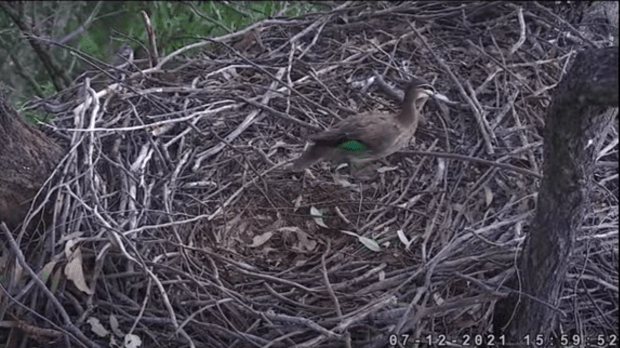
I hope that our little duck gets lots of food while she is foraging and that the ongoing thunderstorm keeps the predators away.

Besides the predators Daisy has that other problem of a lack of material to cover the eggs. Maybe the winds will blow some leaves off the tree and cover those eggs. We can wish!

DAY 6: It is 03:49:00 and Daisy will be arriving back at the egg cup for Day 6. No one disturbed the eggs during the night, so far.

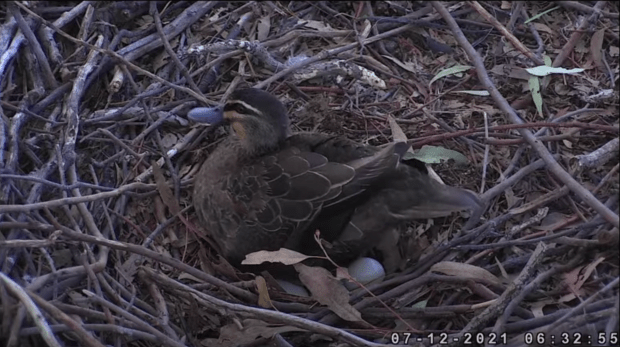
Daisy laid egg number 6 at 06:42:50.

She stood very still after the sixth egg.

The duck eggs are so big. Daisy seems to be having a bit of a time trying to stand up so the sixth one will harden.

Daisy has settled down comfortably.

I wonder what she will do. Will she stay for the normal two hours, cover the eggs and leave? or will she remain at the nest til around 16:00 and depart? We wait.

There have been two very brave birds on this nest. Today we are looking at one of them – Daisy. She should give us all hope that we might not be big but we can be brave and protect that which is dear to us. She is an inspiration. Of course, the other one was WBSE 26 whose leg was broken early in the nest and who endured pain and suffering to meet all of the milestones so that she could fly. What an amazing bird. They both bring tears to my eyes. They were inspirational to so many who have/had challenges. I will personally never forget Daisy or WBSE 26 – ever. I am certain that many of you feel the same.

WBSE 25 holds and comforts its little sister, 26, after its leg is fractured. WBSE 25 will go on to encourage 26 to meet all the milestones and will help her to reach them.

If I had three wishes –

  • The first would be for the WBSE nest to be near to the shore of the river so that the sea eaglets had a better chance of survival. They would be near to their parents after fledge to be taught how to hunt, to be fed while in training and building their flying skills. Not run out of town by the Pied Currawong and left to their own devices.
  • WBSE 26 to have had a very special veterinary surgeon give it a chance.
  • For someone to have built duck boxes for Daisy and the few other female ducks in the river so that their eggs might survive to have ducklings jumping out. They could do a large Pacific Black Duck display and put in permanent binoculars for interested parties to watch – and capture the video of the ducklings jumping and swimming in the river. It would really add to the study of the nature in the area. (Perhaps they already have this????).

I clearly believe in intervention. Humans have destroyed habitat and have built buildings where duck nests used to be and maybe WBSE nests as well. They have also poisoned the Parramatta River and the waters around Sydney. We owe the wildlife a chance. Just this morning I had this vision in my head of the forest caretaker taking a long pole and dumping a basket of leaves on that nest. Now wouldn’t that be grand? Obviously when she was not on the eggs…yes, I do daydream about the birds like you!

I will continue to monitor Daisy throughout the day. So far she is fine. I have not heard any ‘cawing’ from the Ravens so far. There will be an update later this evening.

Thank you so much for your interest and love for this brave little duck! Keep sending positive energy and warm wishes. We can hope. Take care everyone.

Thank you to the SeaEagles@Birdlife Australia Discovery Centre for their streaming cam where I took my screen captures.

The Daisy Chronicles, day 5

Daisy, that little Pacific Black Duck, arrived at the old Ironwood Tree deep in the Sydney Olympic Forest at 05:10:31 on 7 December. She is due to lay her fifth egg today.

Little is Daisy aware that a Raven came to the nest on Day 4, yesterday, and became curious. It did not, however, disturb the eggs. I am led to believe that this is because they cannot smell them. So if Daisy is able to gather more leaves – these are large eggs – she will be able to thwart the Ravens until such time she runs out of leaves and twigs and must use her down.

Also unknown to Daisy is the fact that Lady and Dad have returned to their River Roost from Goat Island. The streaming cam picked them up today roosting. Will Day fly into the nest to check today? He often does a quick security run.

See the two white dots on the tree in the middle. That is Lady and Dad.

The camera could not focus in on them but it is definitely the White-Bellied Sea Eagle couple that own this nest!

Last year Dad broke one of the eggs and ate it. He did not like the taste. Neither sea eagle likes the down – it sticks to their beak. They simply do not understand it – it is foreign to them. They were curious as to who was using the nest and Dad understood that eggs are not bothered. Indeed, one time I thought Dad was going to incubate those eggs of Daisy’s!

Daisy arrived at 05:10:31. Once again she was very cautious approaching her eggs.

Look who has come to see Daisy! Last year 8 or 9 Rainbow Lorikeets would come and visit Daisy every morning. They were all over the tree surrounding her. It was simply beautiful.

The bird coming down on the top right is called a Noisy Miner. Noisy Miners are members of the Honeyeater family. They are grey with a black head, a yellow-orange beak and feet with a light yellow patch behind the eye. There are also white tips on the tail feathers. They will not hurt Daisy or her eggs. They are curious but it is possible that they could draw the attention of other birds, like the Ravens, that could predate Daisy’s eggs.

The Lorikeets seemed to come every morning like they were saying hello to Daisy. And here they are today. The one must have told the others that their friend, the little Duck, was back in the nest of the sea eagles.

I don’t know about you but I had to run and get a tissue.

No words necessary as the Lorikeets continue to gather around Daisy.

We are nearing the time that Daisy laid her egg yesterday. I can still hear the Lorikeets and the Noisy Miner.

Oh, how grand it was to see the Lorikeets come to welcome Daisy!

Yesterday Daisy laid her 4th egg at 06:19:36. Egg 3 was laid at 06:55:07. I am hoping that it is earlier for Daisy today so that she can wait for the egg to harden, cover the eggs well, and get away from the nest before the Raven or the Sea Eagles arrive. Fingers crossed they stay away!

Daisy began gathering leaves around 06:23.

With the Sea Eagles back at the River Roost, I am so nervous for Daisy. Last year Dad visited often – curious to find out who was using his nest. I do not believe they would harm Daisy but Daisy and Dad certainly played tag with one another. I hope it is more peaceful for our little duck this year but who knows! Wonder when Dad will come and check on this nest?

It is 06:28 nest time. Daisy hasn’t laid her 5th egg. You can still hear the Lorikeets in the tree. Last year they seemed to be around when the larger predators weren’t. Come on Daisy, hurry! Lay your egg and get out of the forest.

At 06:32:55, Daisy lays her 5th egg!

Daisy moves around in the nest bowl clockwise.

She is moving the eggs about but she appears also to be using her paddle feet to enlarge the egg cup. How smart is that?! She needs those eggs to sink down low especially if she is going to lay several more. Notice how big those eggs are. It takes a lot of nutrients out of Daisy’s system to lay all those eggs.

Daisy has settled down lower than on previous days. She has also brought in some more leaves closer to the egg cup.

Daisy is trying to rest. If today, follows what has happened on the previous four days, Daisy will stay on the eggs for about 2 hours, cover them and depart. Let us hope that she is not disturbed and has time to get those leaves over so that nothing seems out of place if Dad or the Raven come calling.

At 06:42, there was only one Sea Eagle at River Roost. Is Dad fishing? or is he coming to the forest? We wait.

Daisy is way down on the eggs, her head tucked in. So far no Sea Eagle coming. Sometimes last year Daisy just got away in the nick of time. She needs to cover those eggs well though and not be in a rush.

Thank you for joining me today. I will continue to monitor Daisy until she departs and check on the nest throughout the day. If anything happens, I will let you know. Take care. Keep sending your positive wishes to our little duck, Daisy!

Thank you to the Sea Eagle@BirdLife Australia Discovery Centre for their streaming cam where I took these screen captures.

The Daisy Chronicles, Day 4

Going back to Day 3, Daisy duly stayed on the three eggs for a bit. The third egg was laid at 06:55:06. Daisy began preparing to depart, moving leaves and twigs over the eggs at 08:17. Within two minutes, she was gone — after checking that no one was around watching.

Oh, she is such a beautiful brave little duck!

This programme seems to have put the images backwards! The top row and one on the second shows Daisy covering up her precious eggs.

Day 4: 6 December 2021

Everyone’s favourite duck, the Pacific Black Duck, Daisy, flew into the nest at 05:21:51. You might be able to see her fluttering and flying up in the image below. She is the blurry mark above ‘2021’.

Daisy landed on the nest a second later.

Daisy seemed a tad more nervous this morning. She is extremely cautious taking almost two minutes before she waddles over to the egg cup.

I wonder what sounds from the forest Daisy is hearing that are making are nervous? Are Lady and Dad back from Goat Island? Has Daisy seen them?

Daisy was still nervous after she settled. She did not remove the leaves. She laid down on them and used her paddle feet to stir them around and the eggs.

At precisely 06:19:36, Daisy laid her first egg – about half an hour earlier than the day prior.

There it is. You can see that it is wet and shiny. It will need to harden and Daisy will hope that predators stay away so that she can cover up her clutch of four eggs completely today.

Daisy is allowing the air to harden the egg as she stands over her clutch. If she follows the same routine of previous days, she will remain on the nest for not quite two hours.

So far Daisy’s luck has held. We hope that the Sea Eagles remain on Goat Island. And Daisy may resist putting down with the eggs until there is hard incubation so as not to attract the Ring-tailed Possums who have made a nest also in the sea eagles’s tree.

Good Luck today, Daisy! Cover the eggs really well. You have hundreds of people watching you and sending you much love and luck!!!!!!

Thank you for joining me today. I will bring updates for other nests later today that will include a final check in on Daisy. Take care all.

Thank you to the Sea Eagle@Birdlife Australia Discovery Centre for their streaming cam where I took my screen captures.

The Daisy Chronicles, day 3

Daisy appears to have established a routine coming to and from the nest. I will check this today once it approaches dawn in Sydney.

Yesterday she arrived before dawn and checked on the one egg. She cautiously returned later and laid her 2nd egg. Once it was hard and she had warmed it for a short while, she began bringing leaves from all around the nest – stretching her little neck to its fullest. If she heard a predator, she would stop everything. Slink down into the nest cup as best she could and wait. Then she would begin gathering leaves again. Then she departed.

The images below are from the time Daisy arrived til she left on day 2.

Today is Day 3! Oh, our brave little duck. She arrived before dawn. Egg 3 was laid at 6:55:07. You can see that moment in the images below. Oh, this little duck from last year learned so much in a year. Many of you have written to me remembering that last year we felt that if Daisy had arrived a month earlier the eggs might have all hatched. Well, this smart duck did that this year. This would be her first clutch of the season. She can lay eggs twice. Last year Lady and Dad spent the month of December at Goat Island for the most part rarely checking on the nest. We will never know if Lady hadn’t tossed the down all over the place if those eggs could have remained hidden from the Ravens. But, if Dad and Lady are away from the nest ———— well, Daisy, we are all sending you the best energy that we can.

You could hear the Sulphur-Crested Cockatoos and the other birds in the forest. Daisy is extremely cautious – as she should be.

It looks like there are a few sprinkles on Daisy’s feathers. Our beautiful little duck is standing above thee eggs so the third will dry and the shell harden.

Daisy will do what she has done the other two days. Allow the shell to harden. She may stay on the three eggs a bit before covering all three and leaving the nest. She appears to not have removed any down from her breast yet for the eggs.

The egg is now dry enough to Daisy to lay down on all of the eggs.

I wish Daisy knew how many well wishes she has from around the world including her good friend ‘I’ from Poland.

Thank you so much for being here for Daisy today. Stop in tomorrow for Day 4 of The Daisy Chronicles. Stay safe!

I will continue to monitor the situation — and, of course, you can, too. Here is the link to the streaming cam!

Thank you to the Sea Eagles @Birdlife Australia Discovery Centre for their streaming cam where I took my screen captures.

The Daisy Chronicles, day 2

We are going to start off with a check on what is happening in San Francisco – before moving on to Daisy.

An absolutely adorable 4 min 16 sec radio discussion on The Love Story in the Sky at The Campanile.

Did you know that Peregrine Falcons were virtually wiped out in California? In the late 1970 there were only two nesting pairs? This was the result of DDT. There is lots of literature but reading Rachel Carsons, Silent Spring, is a very good start.

DDT might have been banned after the revelations of Rachel Carson and others but it remains in the soil in various places. One of those is Big Bear California where DDT was sprayed on Big Bear Lake to kill the mosquitoes. It is still a contributing factor in thin egg shells which may be part of the problem with Jackie and Shadow, the Bald Eagles that have their nest at Big Bear.

Daisy the Duck did not spend the night on the White-Bellied Sea Eagle nest.

She arrived before sunrise to check on the nest. No one else was there. Daisy will be very cautious. She does not want to draw attention to the egg cup where her first egg was laid.

She goes over to where her egg is and checks. It is still there. Safe.

We can see where Daisy’s egg is because we know it is there but it is nicely covered with leaves and nest material so the predators cannot find it.

Daisy leaves right as the sun is rising and the forest is waking up.

Daisy carefully waits on a branch when she returns an hour and a half later. Can you see her?

She is checking and rolling her egg.

Daisy is very still. When she is in labour, her tail will move up and down.

There are now two eggs! Look you can see them both. Daisy is holding herself up so as not to break the second egg. When the eggs are laid they are soft. The air will dry off the surface and make them hard.

Daisy has settled on the eggs nicely. She is having a rest. Daisy will not do hard incubation until all of the eggs are laid. That is so they will hatch at the same time.

This last image of Daisy was taken a few minutes ago. It is nearly 08:30 in Sydney, Australia.

So far Daisy has been lucky. Lady and Dad did visit the nest tree a week ago and then on the day that WBSE 27 was released from care, they were not at the River Roost. They will often go to Goat Island if there are no eaglets to look after. Still, we know that they do come to check the nest.

Someone asked me why Daisy does not stay on the eggs now all the time. If she did they would not all hatch on the same day. Secondly, she is a very smart little duck. Her presence on the nest makes all of the other forest animals and birds curious. Last January they had never seen a duck on the big sea eagle nest — and neither had anyone else! I think Daisy will try and protect her eggs really well this year from the Ravens. She is almost a year older and she is ‘wiser’ now. Her breeding and the laying of eggs normally coincides with plenty of food and water. Her mate, who came to inspect the nest last year, only takes part in the mating ritual. The rest is up to Daisy. That is why she is so vulnerable. Only 20% of Pacific Black Ducks live to be 2 years old. Indeed, the average life span is only about two years. Oh, I so hope that she is successful this year! There are so many people hoping for Daisy!

You can join in and become a real Daisy fan. She needs all the love and positive energy we can all send her. Soon the name of the streaming cam will be changed from Sea-Eagle to Duck Cam! Here is the link to the streaming cam. Daisy arrives about 13:15 CDT or around 05:15 Australian Time. I am not expecting her to stay all day but she might surprise me.

Once Daisy lays all of her eggs (there could be 11), she will begin her hard incubation. Incubation will last for 29 days after the laying of the last egg. This is the difficult time. Daisy still has to eat and have some relaxing time. Last year she even went out during the night. It is then that the eggs are vulnerable. As long as she is incubating them, the Ravens seem not to bother. Our fears of the sea eagles proved to be nothing. They could behave differently this year but they were not a threat last save for the fact that scattering the down nesting material allowed the eggs to be seen. Fingers crossed.

Thanks for joining me. Take care everyone. See you soon!

Thank you to the Sydney Sea Eagle @ Birdlife Australia Discovery Centre for their streaming cam where I took my screen captures.