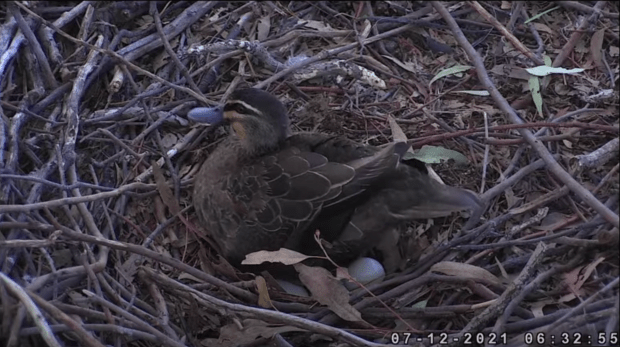
The Daisy Chronicles, Day 13

Ever since Daisy landed back on the nest this morning, I have been more than curious. Her neck was ‘huge’. This image is later but squint and see that floppy large ‘crop’! It is so big that it is catching the light and looks like a shiny ball almost in the centre of the picture. She looks like she is sleeping on a puff pillow.

Over the time Daisy has been on the nest, I have had conflicting reports about whether or not ducks have crops. I was told that they have an expanded esophagus as well as a gizzard.

I continued to research this because I was completely dumbfounded about Daisy. She has obviously foraged very well during the three hours she was away before dawn. That bulge looks like a crop – a term used with raptors – for a place to store food before it goes to the main stomach. So I found this image by Murray State University. The vet students were dissecting a wild duck. Do you see what I see? The arrows for the Empty Crop and the Esophagus point to the same place. If we look at our live duck, Daisy, I think it is safe to say that an extended esophagus is also a crop. Mystery solved. Daisy is literally ‘full to the brim’. Hopefully she will be quite content to wait til sunset not have to leave. It seems that the Ravens check at least twice a day to see if she is on the nest.

So far, it has been another wonderfully uneventful morning on Daisy’s nest. I just want to pinch myself. Could our little duck actually fledge those 8 ducklings to be?

A Noisy Miner came to visit. It is right on the branch that is illuminated – look right above Daisy. This bird will not harm Daisy – it doesn’t have the nicest voice but it will not hurt our Duck or her eggs!

Last clutch, everyone wished that Daisy had come to the nest earlier – in December – because that is when Lady and Dad seem to spend the most time on Goat Island. Lady loves Goat Island. Dad’s former mate liked a different location after fledging the eaglets. No sign of Dad or Lady at the River Roost so far today.

Daisy is just sleeping away with the warm sun shining down on her and her 8 eggs. Oh, what a little sweetheart.

It is after noon for Daisy. I cannot tell you how quiet the forest has been. It is positively wonderful. There is a gentle wind that rocks Daisy and her eggs. You can hear a plane fly over once in awhile. Blissful.

Here are some images that I enlarged so we can see Daisy better. She is so camouflaged in those images above that you can hardly make her out from the sticks.

Other Bird World News: Wow. Ervie, that incredible third hatch at Port Lincoln Osprey barge, is really flying. Fran Solly, Take2Photography, reports that Ervie’s tracker shows he is following Dad to go out when he goes fishing. ​Solly says that “He (Ervie) went around the corner to the main Bay and along the wharf. I’ve seen Mum and Dad both fish there.” Oh, Ervie, you are a survivor! At the Kisatachie National Forest Bald Eagle Nest, Anna broke one of the two eggs while landing today. While that is very sad, hopefully the other one will stay safe and hatch. One healthy eaglet is good! Last I checked there was not an egg on Samson and Gabby’s Bald Eagle nest in Jacksonville, Florida. We wait. Anxiously.

Oh, I wish the NE Florida nest used a 24 hour clock!

Ferris Akel has cut down his streaming tour of last Saturday to show the Snowy Owls. For the people around the Finger Lakes of NY, Snowy Owls were a rarity. In Manitoba, you can often see 25 or 30 within a short distance during the winter. If you want to see these fluffy owls, here is the link:

Everything is alright in the world of Daisy. This is so wonderful. I will continue to monitor her until she leaves for her evening foraging. I hope this time is as quiet as the morning has been!

Thank you so much for joining me today. Take care everyone. Stay safe!

Thank you to the following for their streaming cams where I took my screen captures: Sea Eagles@ Birdlife Australia Discovery Centre, NE Florida Bald Eagles and the AEF, and Murray State University.

The Daisy Chronicles, day 5

Daisy, that little Pacific Black Duck, arrived at the old Ironwood Tree deep in the Sydney Olympic Forest at 05:10:31 on 7 December. She is due to lay her fifth egg today.

Little is Daisy aware that a Raven came to the nest on Day 4, yesterday, and became curious. It did not, however, disturb the eggs. I am led to believe that this is because they cannot smell them. So if Daisy is able to gather more leaves – these are large eggs – she will be able to thwart the Ravens until such time she runs out of leaves and twigs and must use her down.

Also unknown to Daisy is the fact that Lady and Dad have returned to their River Roost from Goat Island. The streaming cam picked them up today roosting. Will Day fly into the nest to check today? He often does a quick security run.

See the two white dots on the tree in the middle. That is Lady and Dad.

The camera could not focus in on them but it is definitely the White-Bellied Sea Eagle couple that own this nest!

Last year Dad broke one of the eggs and ate it. He did not like the taste. Neither sea eagle likes the down – it sticks to their beak. They simply do not understand it – it is foreign to them. They were curious as to who was using the nest and Dad understood that eggs are not bothered. Indeed, one time I thought Dad was going to incubate those eggs of Daisy’s!

Daisy arrived at 05:10:31. Once again she was very cautious approaching her eggs.

Look who has come to see Daisy! Last year 8 or 9 Rainbow Lorikeets would come and visit Daisy every morning. They were all over the tree surrounding her. It was simply beautiful.

The bird coming down on the top right is called a Noisy Miner. Noisy Miners are members of the Honeyeater family. They are grey with a black head, a yellow-orange beak and feet with a light yellow patch behind the eye. There are also white tips on the tail feathers. They will not hurt Daisy or her eggs. They are curious but it is possible that they could draw the attention of other birds, like the Ravens, that could predate Daisy’s eggs.

The Lorikeets seemed to come every morning like they were saying hello to Daisy. And here they are today. The one must have told the others that their friend, the little Duck, was back in the nest of the sea eagles.

I don’t know about you but I had to run and get a tissue.

No words necessary as the Lorikeets continue to gather around Daisy.

We are nearing the time that Daisy laid her egg yesterday. I can still hear the Lorikeets and the Noisy Miner.

Oh, how grand it was to see the Lorikeets come to welcome Daisy!

Yesterday Daisy laid her 4th egg at 06:19:36. Egg 3 was laid at 06:55:07. I am hoping that it is earlier for Daisy today so that she can wait for the egg to harden, cover the eggs well, and get away from the nest before the Raven or the Sea Eagles arrive. Fingers crossed they stay away!

Daisy began gathering leaves around 06:23.

With the Sea Eagles back at the River Roost, I am so nervous for Daisy. Last year Dad visited often – curious to find out who was using his nest. I do not believe they would harm Daisy but Daisy and Dad certainly played tag with one another. I hope it is more peaceful for our little duck this year but who knows! Wonder when Dad will come and check on this nest?

It is 06:28 nest time. Daisy hasn’t laid her 5th egg. You can still hear the Lorikeets in the tree. Last year they seemed to be around when the larger predators weren’t. Come on Daisy, hurry! Lay your egg and get out of the forest.

At 06:32:55, Daisy lays her 5th egg!

Daisy moves around in the nest bowl clockwise.

She is moving the eggs about but she appears also to be using her paddle feet to enlarge the egg cup. How smart is that?! She needs those eggs to sink down low especially if she is going to lay several more. Notice how big those eggs are. It takes a lot of nutrients out of Daisy’s system to lay all those eggs.

Daisy has settled down lower than on previous days. She has also brought in some more leaves closer to the egg cup.

Daisy is trying to rest. If today, follows what has happened on the previous four days, Daisy will stay on the eggs for about 2 hours, cover them and depart. Let us hope that she is not disturbed and has time to get those leaves over so that nothing seems out of place if Dad or the Raven come calling.

At 06:42, there was only one Sea Eagle at River Roost. Is Dad fishing? or is he coming to the forest? We wait.

Daisy is way down on the eggs, her head tucked in. So far no Sea Eagle coming. Sometimes last year Daisy just got away in the nick of time. She needs to cover those eggs well though and not be in a rush.

Thank you for joining me today. I will continue to monitor Daisy until she departs and check on the nest throughout the day. If anything happens, I will let you know. Take care. Keep sending your positive wishes to our little duck, Daisy!

Thank you to the Sea Eagle@BirdLife Australia Discovery Centre for their streaming cam where I took these screen captures.

White-Bellied Sea Eagles and the birds that visit their nest

In a 2014 article in The Smithsonian Magazine, Rachel Neuwer asks why there is a Sulphur Crested Cockatoo in a Renaissance image of the Virgin and child, Madonna della Vittoria. Rebecca Mead examines the image by Andrea Mantegna, painted in 1496. You can see the painting of the Madonna and child with saints in the article below (sorry, it has a copyright so I can’t show it). The Sulphur Crested Cockatoo is above the Virgin’s part in her hair a little to the left.

https://www.smithsonianmag.com/smart-news/why-there-australian-cockatoo-italian-renaissance-painting-180950227/

As I drank my morning coffee several days ago, I flipped through the latest New Yorker. In that 5 July edition, there is an article, Invasive Species.

https://www.newyorker.com/magazine/2021/07/05/where-did-that-cockatoo-come-from

Each writer considers how the Sulphur-Crested Cockatoo made its way from AustralAsia all the way to Italy focusing on the initial discovery of the bird in the painting by Heather Dalton, a British historian living in Australia.

The Mantegna is not, however, the first time that a parrot is included in a picture. Parrots show up in the murals of Pompeii, the Italian city buried by ash when Mt Vesuvius erupted in 79 CE. They are also the subject of floor mosaics in the region. Indeed, exotic birds (not just parrots) appear as subjects in many mosaics and frescoes in the Roman domus.

Alexander the Great’s army went as far as parts of India before stopping on their eastern expansion of his empire. Their presence on what is today the Indian subcontinent heavily influenced the art of the Gandharan region. In turn, Alexander acquired a parrot from the Punjab in 327 BCE. If parrots were in Italy 1700 years before the Mantegna, one might begin to ask what is all the fuss? The Barber Institute of Fine Art in Birmingham, England hosted an exhibition solely on parrots in art in 2007. They were exotic, they were status symbols, and it appears that they were present in the art of the Italian Peninsula for some 2400 years to today. Of course, they were not all Sulphur-headed Cockatoos and that could well be the reason for the continuing discussion about the Mantegna. Other species of parrots came from the southeastern coast of Africa and from the region of the Indian subcontinent and Southeast Asia. Sulphur-Crested Cockatoos originate in Australia and the islands of Indonesia and it was surely the trade through the islands of Indonesia that spirited the bird all the way to the port of Venice along with black peppercorns and other spices.

“20121210 Sulphur-crested Cockatoo (Cacatua galerita) – a first-time visitor” by Degilbo on flickr is licensed under CC BY-NC-ND 2.0

Sulphur-Crested Cockatoos are extraordinarily beautiful and are the largest of the white parrots. I have never seen them in the wild. Indeed, it was not until I watched the White-Bellied Sea Eagle streaming cam in the Sydney Olympic Park that I heard them before I saw them. It sounded like someone being murdered in the forest! Seriously. One of the moderators answered the question, “What is that?” Later, these lovelies were seen climbing all over the old Ironbark Tree.

Sulphur-crested cockatoos are nut, root, and fruit eaters and live for up to eighty years. They make their nests in tree hollows where the female lays one to three eggs. Those eggs are incubated for thirty days. The little ones remain in the nest being fed by the parents for a period of approximately sixty-five days after hatch. The breeding season for these parrots is August to January in the Southern Hemisphere.

Why am I talking about these parrots today? It is because of the White-Bellied Sea Eagles (WBSE), Lady and Dad. The two eggs that Lady has been incubating will be hatching in approximately two weeks. There is a live streaming cam that is on day and night, 24/7 year round except for maintenance. If you like birds of Australia, you can often see them coming and going around the Sea Eagles nest. The birds are either curious as to what is going on in the nest or they would like the Sea Eagles to leave! The streaming cam in the Sydney Olympic Park is the only one in the world that observes the second largest eagles in Australia.

It is in the middle of the night. This is the WBSE nest in the Ironbark Tree in the forest of the Sydney Olympic Park.

The Rainbow Lorikeets are curious. They come as a group climbing all over the branches of the tree. They are easy to spot!

“rainbow lorikeets” by cskk is licensed under CC BY-NC-ND 2.0

Every once in awhile the Galahs come to the Ironbark Tree. I think they are adorable. One of the WBSE chatters from Australia said that if anyone visits Australia and someone calls them a ‘Galah’, it is an insult meaning the person is not very smart. I have no idea how the Galah got that reputation except that I have seen several in the talons of Peregrine falcons in Australia.

“Galahs in Love” by David Cook Wildlife Photography is licensed under CC BY-NC 2.0

The Noisy Miners are definitely heard before they are seen. They are a constant in the forest around the WBSE Nest.

“Noisy miner (Manorina melanocephala) (24 – 27 centimetres)” by Geoff Whalan is licensed under CC BY-NC-ND 2.0

The Pied Currawong flits around the WBSE nest all the time. I do not like them! Once the nestlings have fledged the Currawongs gather and try to chase them out of the forest. They did this on the first try with WBSE 25 last year and during the re-fledging of WBSE 26.

“Pied Currawong” by Tatters ✾ is licensed under CC BY-SA 2.0

Then there is the smallest owl in Australia, the BooBook. Isn’t it cute? This owl, like all others, flies silently and it can see very well in the dark. It comes in the night hitting the WBSE has they roost for the night. They fly low over the nestlings trying to hit them and make them leave. One attack injured Lady’s eye last year. Despite their size they are to be taken very seriously. The BooBook often has a nest in the forest the same time as the WBSE so it is very protective and wants the eagles gone for fear they will eat its young.

“Boobook owl” by jeans_Photos is licensed under CC BY 2.0

Here is a compilation video of Lady and Dad after the first egg was laid through the 23rd of June. It shows the actual labour of the second egg and a changing of the incubation shift from Lady to Dad.

Here is the link to watch the WBSE in the Sydney Olympic Park:

https://www.twitch.tv/seaeaglecam

Be sure to check out the time difference. One of the most beautiful moments of the day is when the adults do a duet at sunrise. It is an amazing way to start the day. It wakes up the forest but it is also a continuous bonding method between the birds. The nestlings will join in with their parents when they are older. It will warm your heart. Here3 is a video clip I made after Lady laid the first egg. She leaves the nest and joins Dad on the branch for the singing.

Thank you for joining me today. It is now three days since Tiny Tot was at the nest. We are all having Tiny withdrawal. Take care everyone.

Thank you to the WBSE Streaming Cam, BirdLife Australia, and the Discovery Centre and Twitch TV where I took my screen shots and video clips.