Egrets, Herons, Mangroves and more in Bird World

4 December 2022

Good Morning Everyone,

I hope that this finds you well wherever you are.

The plan was for today, Saturday in Grenada, to be a full day of birding. Up at 0400 and off for the drive north getting there right before sunrise at 0600. If it rained, we would not go. So packed and ready to go — and the rain starts! We look at one another and decide to take a chance that the rain would stop and, it did! It was a glorious day. Cloudy initially which helped to see some birds and then hot and clear blue skies later. The best real estate on the island are those properties that have not only a beautiful view but also, lots of windows to open and wind to go with them!

The stairs down to the boardwalk at Levere National Park were slippery with the sticky clay. Some of the places between the wooden stairs had washed away. By the time we got to the bottom, the boardwalk was flooded. Those gum boots really came in handy. However, the water was higher than they were tall!!!!!! Still we made it to the little dock and the look out tower for birds.

Imagine silence. Not a human sound at all save for us. Just birds.

Mangroves. To me, these are very special places that I only see in the tropical areas where I have visited or lived. The trees – there are 80 varieties -that grow there only need low-oxygen soil and slow moving water. The soil will accumulate around their tangled roots. In fact, these enormous tangled roots make the trees look like they are being pushed out of the water. These wild looking trees stabilise the land and are home to fish, birds, and other aquatic life.  

This is an aerial photo of Laverne National Forest where I spent the morning. The pond and surrounding mangrove area is ‘landlocked’. This is the very north of Grenada looking out to the Atlantic Ocean as opposed to the Caribbean Sea which is in the South.

St George’s is at the very tip of the island close to True Blue and The Lime. Because Grenada is an island created by a volcano, there is hardly a flat spot anywhere. The roads are narrow, windy, often with a straight drop into the sea and lots of pot holes. It takes about an hour, depending on traffic, to go from the southern tip to the most northern.

I am not an expert on bird vocalisations but, I am getting better with the help of Merlin ID. The ‘Sound ID’ function works much better than the ‘Photo ID’ and it helped me to pin point the first sounds at Leverne National Park. It was a Green Heron. The Green Herons actually flew back and forth in front of me, too close and too quick and unannounced to capture their image. But, what a marvellous quiet place – the only sound was birds!!!!!! Just think about it. Noise cancelling headphones with only sounds from a mangrove would take you to this place.

It has rained a lot. The images below are looking back to a small wooden boardwalk. The top photo is when it was dry last spring. The bottom one, covered with leaves, is from yesterday. In the distance the boardwalk was under water — the reason that I brought my gum boots. It was deeper than the boots were high. That was rather interesting. Have you ever been in a mangrove? They smell – lots of decomposition and sulphur.

The lake and mangrove are absolutely still. Not a ripple in the water except for when the Tarpons come up for air. I sat and watched the Green Herons fly into this area. The foliage is so thick you cannot see them once they are perched.

I missed the opportunity to record the vocalisations of the birds from the mangrove when we first arrived. A huge mistake because they became mostly silent as the hours progressed. You would catch glimpses of them flitting about. There is one flying across the grove.

This is a Great Blue Heron. There were several of them flying across the water. In the spring they made their nests about 1 metre or 36 inches above the water in the mangrove thickets. They lay from 4-6 very light blue-green eggs from March to July. Despite it being a well known area, my son tells me that the herons hatched their eggs near to the boardwalk without any problem – no human interference with their nests and their habitat is protected. It is a lovely safe spot for them.

Great Blue Herons are the largest of the ‘dark’ heron family in Grenada. They are approximately 106-132 cm or 42-52 inches in length

They have such beautiful form and are absolutely silent when they are flying.

There were Great Egrets, Green Herons, Great Blue Herons, Little Blue Herons, a Black crowned Night Heron, an American Woodcock, and a Smooth Billed Ani.

About 10 minutes away, there was a small pond at Mt Hartman. It has not been levelled and the area is so beautiful. The Chinese own the land and are saying they are turning it into a luxury resort, I hope it takes a zillion years. There is something so wonderful about places just being left!

Cows was tethered along the road. There is where you see the Cattle Egret. They get their name because they hang around the cows waiting for the insects and grasshoppers to be kicked up.

Notice how small these egrets are.

Did you know that until the 1930s Cattle Egrets were only seen on the continent of Africa?

They have a very stout yellow beak with beautiful white plumage, and yellow-green eggs.

There were a pair of Common Moorhens or Gallinules swimming in the pond near to the Cattle Egrets.

A Great Egret flew in and landed on the other side of the pond.

This is a Great Egret. We know this because of its size but, more clearly, its distinctive yellow bill and black legs. And the pure white plumage.

Talk about graceful.

The Great Egrets are large, measuring 85-107 cm or 34 to 42 inches. The Cattle Egret is only 48-64 cm or 19-25 inches. You can see the size difference in the image below.

On the off chance there were some shore birds around, we headed to the most northern tip of the island. No birds but fascinating flowers growing up out of the sandy soil.

The sea is very rough and it is not safe to swim here like it is in the South in the Caribbean Sea.

At the end of the day, a Broad Shouldered Hawk circled my son’s property. A perfect ending to a perfect day!

Tomorrow is a break – a wee one – from the birds. To kick off the Christmas Season, there is a huge event featuring carolling, a walk through light show, food and drinks. One of the things that I like best is that in December there is sorrel and you can make your own sorrel juice. In addition, following the idea of ‘no waste’, the simmer flowers of the plant are then used in Christmas cakes. They are delicious. I hope there are some tomorrow to take home!

A Quick Check at a ‘few’ of the nests we are watching.

Elain made a lovely compilation video of events of 3 December 2022 at the Orange scrape of Diamond and Xavier. Some bonding, some family time. Quite enjoyable. Thanks Elain!

These are the Day 3 highlights from the nest of Royal Albatross GLY. The rangers are keeping a close eye on all the albatross, especially GLY as he is waiting for L to re-appear and let him go and feed. Did I say that the albatross are easy to watch? Not when their mate does not return like it did to the Royal Cam family last year, YRK and OGK. OGK went missing in May after hatch. The Rangers will help – and that is what you need to know. They supplemental feed every chick and parent if necessary. How kind, how forward thinking. I really support their efforts!

This is the most recent announcement on Rita that I could find. Continue to send your positive wishes. Rita did so well with the surgery. Now let’s see if a miracle will happen and she will get some circulation in that wing.

Samson and Alden have not returned. I am starting to accept that Samson may not be with us. It is sad but, it is a reality that we might have to accept.

‘J’ sent me the most recent posting from the AEF on Gabby at he nest she shares with Samson who has now been missing 9 cays. Thank you ‘J’.

“Today at 12:19 AM
AEF~NEFL Nest Cam~Gabby was perched on Sunset and V2 came to the nest, Gabby went to the nest to join.  I didn’t edit much as I wanted to show the entire interaction between Gabby and V2. At first she seemed very tolerant.  But after about 3 mins Gabby seemed less tolerant and there was a short tussle.  V2 didn’t push it with Gabby.  Gabby seemed to have enough and went off to roost. V2 stayed in the nest  awhile and went to LOP where V2 is perched (not in video). I suspect they will both spend the night.”

V2 has extremely light eyes and a tint to his white head.

Meanwhile, Harriet and M15 are tending to their two previous eggs while continuing to work on their nest on the Pritchett Property in Fort Myers, Florida.

Jackie and Shadow were back in their nest at Big Bear Lake in California today. They are really getting those side rails nice and strong and high!

Jackie is gorgeous. And formidable. I would not want to be a person trying to get too close to her nest with an eaglet in it. No, not ever.

Anna and Louis have their second egg at the E-1 Bald Eagle nest in the Kisatchie National Park. Congratulations to everyone at KNF! This is fantastic news. For the past two years, Anna and Louis have fledged one eaglet each year. In 2020, it was the first time that a Bald Eagle family had used this nest and raised a fantastic eaglet – Kisatchie!

Our beautiful feathered friends, no matter what species, understand, care deeply, and grieve. The latest on a Moli Mum who has been ever so faithful to her chick that died in 2020. Hob Osterlund writes that she has chosen for a second time to lay her egg on top of that of her dead little one. Oh, how I hope that this year she is successful in raising a family.

Zoe had fish yesterday – Dad brought in 3 and Mum 1. thanks, ‘A’. You can check on Zoe’s day under the streaming cam. Click on the observation board. She has been flying about exploring her territory.

Both of the Australian fledglings, Indigo and Zoe, are doing well. We can relax!

Thank you so much for joining me today. It is always a pleasure to have you hear and to receive your comments and letters via e-mail. Always. I am a little late in responding but, please, do not hesitate to write. Take care of yourselves. See you soon!

Thank you to the following for their streaming cam, videos, and postings which make up my screen captures: Hob Osterlund, Tonya Irwin and KNF Bald Eagle Nest, FOBBV, NEFL-AEF, Ron and Rita’s Nest Watchers, NZ-DOC and Cornell Bird Lab, and Charles Sturt Falcon Cam and Cilla Kinross, Elain. Thank you to ‘J’ who reached out to me with the latest announcement on Rita! And to ‘A’ who sent me all the time stamps and a review of what was happening. Much appreciated.

Did Rubus fly to the tower? an osprey eating a fish in Central Park? and other news in Bird World

27 November 2022

Good Morning Everyone,

Well, we have all worried about Rubus and it seems that there might be some good news coming. I sure hope so! There is, currently, a lot of confusion about whether or not Rubus was flying around the tower with Xavier and Diamond yesterday. We wait for positive confirmation with high hopes.

It has been warm on the Canadian Prairies but it appears that we will now be sliding from +5 C to -10 C. It can be a bit of a roller coaster here sometimes but, a blue sky and sunshine are always welcome and that is what it is like this morning.

Little Red has mastered balancing himself on the feeder and eating so he is well and appears to be in good health as the winter begins to set in.

I love the Sparrows. While they generally eat the Black Oil Seed and Millet, they also seem to be liking the Butter Bark. It will certainly give them a lot of energy. You can make your own. There are recipes on the Internet using primarily peanut butter and cornmeal. If you have a good one, send it to me! Please.

I think Sparrows are beautiful. Just look at the range of colours out of a very simple paint box for them.

In the Mailbox:

Do you a follow the Tweed Valley fledgling, Glen, Blue 708? Well you might have gotten a real lump in your throat when everyone was worried that he was grounded on top of a building in Portugal. But great news has been posted and sent to me by ‘G’. This is fantastic news. Here are those two tweets:

We have seen those sat pads going haywire in areas where there are a lot of hydro or cell towers or both. But it is possible, looking at the map above, that Glen took off over the Atlantic where there would be no transmissions and then – wow – he lands in Morocco and the signal returns. ‘G’ reports that after flying over the Atlantic for 36 hours, Glen then rested for 12 hours in Khnifiss Bio-reserve and is now fishing in the same area. Thank you ‘G’ and what a relief this is to have everything fully confirmed. Glen is a strong bird, my goodness. Wishing a long and productive life for this fledgling!

Oh I get the most marvellous mail and today, ‘M’ sent me a link to something very special. Imagine an Osprey catching a fish in the pond in Central Park in the middle of New York City. Yes, you read that correctly! It is a rare sight indeed!!!!!!


There is more news from Bernard in Brittany!

I am certain that everyone was so excited to hear the news about Willow being spotted in Brittany in mid-September. That news comes on the heels of another Scottish bird being spotted in the same region which Bernard reported. Here is the information on it that Brian Etheridge sent to Bernard. Some of you might be quite interested in this osprey sighting. Osprey, blue/white 527 at Anse of Combrit, Brittany 29 on 3 September 2022. “This bird was ringed on 25 June 2022 as a chick in a nest of three young near Errogie, Scottish Highlands, 57. 46’12″N, 004.23’19″W by myself, Adam Ritchie and Ian Perks. The British Trust for Ornithology metal ring number is 1489674. This is the first sighting of this bird since fledging in July.”

Well, 527 has been spotted again! Mary Cheadle’s tells me that Blue/White 527 was one of many Ospreys photographed and counted by Jean-marie Depart in Senegal on 16 November. Now that should put a smile on our faces! I am very hopeful that Willow LW5 will be sighted if she is in Jean-marie’s territory!!!!!!

527 as photographed by JMD on 16 September 2022, above.


Atlantic puffins” by U. S. Fish and Wildlife Service – Northeast Region is marked with Public Domain Mark 1.0.

‘N’ sent me a lovely announcement from Audubon. The focus is on Puffins. I had no idea that warming seas could cause the fish to grow larger causing starvation in the Puffins, did you? Here is a brief extract from that mailing by Audubon:

We monitor nesting on remote islands in the Gulf of Maine and this year they have great news! Despite a steep decline in 2021, seabirds like Atlantic Puffins finished this past summer on a remarkably higher note with twice as many chicks surviving and fledging compared to last year. Thanks to generous support from you and your fellow bird lovers, Audubon is able to closely monitor delicate habitats like this one and carefully tend to the birds that very much depend on us to survive.
 
The puffins’ precarious journey for survival is just one of countless examples in which the climate crisis harms and threatens our beloved birds. Last year, warming waters gave rise to increased butterfish counts, a food source too large for small Atlantic Puffin chicks to swallow, tragically leading to starvation. The climate crisis is also making storms more frequent, much stronger, and increasingly unpredictable. 

Australian Nests:

This was posted under the streaming cam by Cilla Kinross. Please keep reading as the news gets better throughout the afternoon.

“Our small search party scoured the campus today for Rubus without luck. The only place that adults gave warning calls was in Girinyalanha (when Indigo was in the box), so there is still a chance that he is there, but just hard to find. I’ll send another call out to staff to keep an eye out for him. However, at this stage, I’m not that hopeful. I have received a lot of criticism about why Rubus was not put back in the box (including hate mail, which I could do without, thank you). On reflection, Rubus probably should have come into care when he was found on the ground, not put in a tree (and certainly not put back in the box). But I was reassured by Victor Hurley’s assessment that it was unlikely that he had trichomoniasis (canker) and we often have birds still with a bit of fluff, that fly poorly for a couple of days before they come good. He was flying and his parents were feeding him, so I was not too worried. I take responsibility for that decision, even though I was not able to be present at the time (for personal reasons). If found, he will taken into care for veterinary assessment and rehabilation if necessary. I will let you know if and when that happens.”

Later there was some more positive news: “NEWS 27th November 2022 1300 h While our small search party was looking in the woods below the tower, a falcon flew out towards the tower. As I couldn’t see Indigo in the box any more, I assumed the bird we saw flying was Indigo BUT Indigo was in the box (at the back), so it was a different falcon. On tower cam, at that time, this same bird was seen to harrass Xavier into leaving the microwave, so I believe it was Rubus. This is typical juvenile behaviour, not something Diamond would do. She would land on the roof. Hopefully, we will soon see all four falcons on the roof together, so we can be sure.

This would be grand. I am so hoping that the mystery falcon is Rubus and all is well.
Breakfast came in the form of a Quail for Indigo who carried it to the scrape box and ate it, leaving leftovers in the corner just like she has been taught by Diamond and Xavier. Approximately 0613.

Diamond came and raided the pantry! There will be a lesson in this for Indigo!

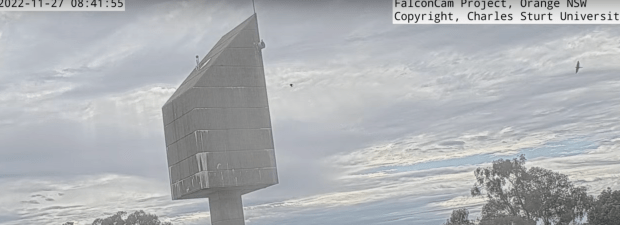
Now let us go back to where this mystery of Rubus begins. At 084155, the tower cam shows two falcons flying. Indigo was in the scrape box at the time. Is there a third flacon sitting on that appendage sticking out on the right near the top? I hope so!

Diamond had been in the scrape and flew out – top image. Then Indigo came into the scrape – bottom image.

It is a tad confusing and perhaps misleading. If there had been three clear falcon profiles around the tower while Indigo was in the scrape box, then yes, we would know. On one occasion a flying bird thought to be a falcon was, indeed, a Swallow. Cilla has said that she will go out and investigate before she heads home. What she needs is to see 4 falcons on top of the tower. Proof. Fingers crossed — and toes.

Cilla has posted a video of the event at the tower. She says she is not wanting to get our hopes up but here is the footage.

There is some indication that the juvenile that was in the scrape box for so long on the 26th in Australia was Rubus but nothing is confirmed.


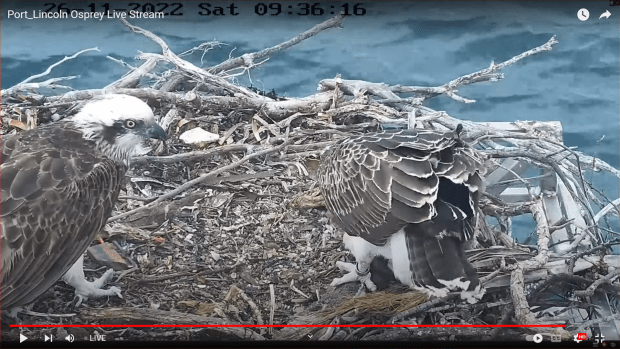
Breakfast came to Port Lincoln about 090609. Mum was on the nest with the fish and Zoe was elsewhere. Zoe flew in and took that fish and had her fill.

Here comes Zoe wanting that fish!

In Port Lincoln, it looks like Mum has landed another big flat fish at 1309. There she is eating it on the ropes while Dad sits stoically and Zoe is in the nest screaming for fish. I hope that Mum eats her fill. She will always share with her daughter, always, unless she is absolutely starving and sometimes, as we have seen this season, even then.

Well, it is hard to tell what happened with that fish. The camera was fixed in a particular location and if there was a fish transfer to Zoe, we could not see it. In the background you could hear Zoe fish calling so maybe Mum didn’t land on the nest?? Zoe is definitely not going to starve. This fledgling eats more fish than I could imagine. And still wants more!

Dad delivered his second fish of the day at 2043. Zoe in the nest and took it but Mum flew over. I wonder if she still wants to feed her daughter and have a bedtime snack?


No 16. Red List Bird. Pochard

The Pochards are a stunning duck that arrives in the United Kingdom from Scandinavia to over winter in the slower moving rivers and estuaries. There is now, also, a small group of Pochards that stay in the United Kingdom year round. They populate the newly created reservoirs and gravel pits. the Pochard feeds on seeds, roots and other plant material as well as small invertebrates by diving and also tabling.

There are declines in Northern Europe and this will decidedly impact the number coming to the United Kingdom in the fall. One of the major threats to the Pochard are the predatory mink that have invaded their breeding areas. The draining of lowland marshes and fish ponds for agriculture is causing a massive decline in the numbers. The major cause is climate change and there is also a growing number of mink – predators – in their breeding grounds in the north. That could account for a great loss of these gorgeous waterfowl. Other threats include egg collecting, fishing, disease such as Avian Flu, human disturbance, and illegal hunting!

Red-crested Pochard” by Andrej Chudy is licensed under CC BY-NC-SA 2.0.

Let us have a look at this duck more closely in his breeding plumage. He has intense red eyes with a fiery rusty-copper head, a distinctive black breast, a dark taupe on the wings and back, a black rump and grey at the tip of the tail. The under area is white. In this image the bill appears to be red. You would recognise them immediately. The legs and feet are a blue grey for both genders.

Now just look at the female. How beautiful she is with her two little goslings. The eye is the deepest brown-black – not red -with a softer auburn head. The body is white mingled with the same soft auburn from the head.

mare i fill 06, xibecs – madre e hijo, patos colorados – mom and son, red-crested pochard” by ferran pestaña is licensed under CC BY-SA 2.0.

In his text for Red Sixty Seven, Mike Dilger states, ” I will concede that of all our threatened bird species, the more glamorous and charismatic species, such as the Puffin and Cuckoo, will undoubtedly grab the headlines. But, I’d argue, a winter without spotting a Pochard would be even worse than Christmas without a turkey.” (12)


Thank you so much for joining me today. Take care all. See you soon!

Thank you to the following for their videos, posts and streaming cams which make up my streaming cams: ‘G’ and Conservation without Borders, ‘M’, Quoteny, MC, Bernard, and Jean-marie Dupard, OpenVerse, Charles Sturt Falcon Cam and Cilla Kinross, and Port Lincoln Osprey.

Zoe eats a whopper, Ervie, and where are you, Rubus, darling?

26 November 2022

Good Morning Everyone,

The kittens thought it was about time that they got their pictures in the blog – again! It is almost impossible to actually call them kittens now. They are 4x the size they were when they arrived. That will be a month on Tuesday. If you look closely at Lewis, you will notice that his nose has some scratches. Those scratches are from his ‘sweet’ ‘never do anything wrong’ sister, Missy. Poor little, Lewis. She took a couple of nicks out of his left eye, too. Ah, it is always the quiet ones, eh, Lewis?

I am going to start off with some really good news. I know that any time we are feeling a little ‘low’, Ervie can always make us smile. Port Lincoln Osprey posted a video of Ervie enjoying a freshly caught fish at Delamere this morning. I wonder if he was out fishing with Dad?

Now for the worrisome. Rubus has not been seen since the 23rd when he was on the ridge of the building. There has been a break in the news and I just thought it was because Cilla had not been out and about but, turns out, Indigo has been seen and photographed but not our sweet little lad.

I have received a note from ‘J’ that included this announcement from Cilla Kinross. It says: “I am organising a bit of search tomorrow morning at 0830 with some locals. Not sure how many will turn up, but hopefully 3 or 4 so we can split up and have a good look for Rubus. The bird wil go to a raptor carer and if and when he’s returned, I’ll decide at that stage. Probably I would put him close to Indigo so easy for parents to find.”

This is not the news that we had hoped. Let us all get really positive and send that energy out to the grounds of Orange to help our wee lad.

I found this message from Cilla below the streaming cam: “NEWS 26th November 2022 1900h I had a good look around this morning. No sign of Rubus. I asked Security to keep an eye for him, especially if he was on the ground. Indigo was sitting quietly in the trees in Girinyalanha and I took some photos.”

At 1450, Indigo flew into the scrape box looking for leftovers and hoping for prey. He is big and strong and gorgeous.

Here is a video of Indigo arriving in the scrape box with prey!

Oh, what a darling Xavier is. He went into the scrape just to see how Indigo was making out with his prey. They are taking such good care and teaching Indigo such valuable lessons. Oh, I hope dear Rubus is found so that the family can be back together again soon.

Xavier you are the cutest!

It was certainly good news to see that Willow, Louis and Dorcha’s first fledgling of 2022 had been spotted in the same area as Paith from the Dyfi nest. There must be a message board somewhere for young osprey fledglings from the UK on good places to stop enroute to their winter vacation (or should I say their home for the next couple of years?).

Yesterday it was a bit of a feast at the Port Lincoln Osprey nest and this morning an extremely large flat fish (a flounder? they do have them in PL) appeared on the nest. Mum flew in when Dad arrived but Zoe took charge. Now, that fish was big enough to feed three but, it didn’t. Zoe ate every last bit of it. She worked on that fish for more than two hours!!!!!!!!! Mum gave up and went off to get her own. I can only imagine the number of fish Zoe’s mate is going to have to produce when she has a nest of osplets. Just think about it. I am not certain I have ever seen an osplet eat as much fish as our Zoe.

Mum waited for over an hour hoping to get some breakfast but, the fact is, Zoe does not share.

At one time there were gulls overhead and both Mum and Zoe were alarming.

No 16. The Red List. The White-fronted Goose

Greater White-fronted Goose” by Rick Leche is licensed under CC BY-NC-ND 2.0.

Oh, goodness. Isn’t that a beautiful goose? White-fronted geese are medium sized. The white face is set off by that taupe of the head and back, the splotched chest, and that orange bill of the Greenland geese with legs to match. On occasion, the bill can be pinkish – that of the Siberian birds. There is a fluffy white bottom under those grey-brown back and wing feathers. What is amazing is the ombre – going from the solid taupe head, to the lighter neck, then lighter still on the breast. Just imagine if someone took this into their hair salon and asked for the stylist to copy it! It would be quite stunning, actually. Females and males are similar while the juveniles lack the white face, the black barring, and their taupe colour is not as deep as that of the adults.

Greater White-fronted Goose (Anser albifrons) DSC_0139” by NDomer73 is licensed under CC BY-NC-ND 2.0.

They breed in the cold of the Arctic tundra areas in the spring and summer. Greenland is one of the sites. In his entry, Gill Lewis writes, “This Greenland summer has seen her new brood hatch and grow. Her proud gaggle follow her, tail-waggling and beak-nibbling on the arctic tundra. A family, feeding and fattening.” In his entry, David Stroud said, “…she hatched six goslings and, with her mate, led them three kilometres up the steep valley sides and onto the lake-studded plateau used for brood-rearing and moulting.” Can you imagine, those wee ones following behind their Mum and walking upwards for 3 kilometres? It would be an incredible sight. They eat grasses, clover, grain, winter wheat and potatoes, according to the RSPB.

These lovely geese then fly and spend their winters in Ireland, the Orkneys, and Britain.

Why are these lovely waterfowl on such rapid decline? It is interesting and can be remedied. But, first. In 1982 shooting of White-fronted Geese in the UK was outlawed. Even so, their numbers have been falling rapidly. There are simply not enough youngsters to replace the adults and the cause is well known. The warming of the North Atlantic is the primary cause with its climatic changes and heavy snow falls. Those snows are arriving earlier and earlier at a time when the geese need feed before laying their eggs. So little food. One other cause, the one that can be remedied and is being done so for some species is wetlands. Instead of draining land so that humans can take over more and more vast tracks of it, we need to stop and rebuild the wetlands that are required for all our waterfowl. Whether or not anyone will find a way to halt or even slow the warming of our planet with its land and oceans is another story – a particularly grim one. So sad, these geese have been flying back and forth from the Arctic to the UK for 2 million years – just think about it. And, oh, how quickly we have ruined the entire landscape for them – in a blink of that time.

So when rewilding and news of the creation of wetlands comes to your ears, stand up in support of it – and remember the White-fronted Goose when you do.

Greater White-fronted Goose (Anser albifrons) DSC_0132” by NDomer73 is licensed under CC BY-NC-ND 2.0.

In the News:

Long-Billed Curlews” by FotoGrazio is licensed under CC BY-NC-ND 2.0.

The Curlew. These amazing shorebirds with their extremely long curved beaks are also in rapid decline. Oh, how I love reading these short Country Diary Posts. I hope you do, too.

https://www.theguardian.com/environment/2022/nov/25/country-diary-a-cloud-of-curlews-carries-me-away


Thank you so much for being with me this morning. Let us all collectively send our warmest and most positive wishes to Orange so that Rubus might be found safely and be cared for as he needs. Take care all. See you soon.

Thank you to the following for the posts and streaming cams that make up my screen captures: Port Lincoln Osprey, Port Lincoln Osprey FB, Orange Australia Falcon FB, Charles Sturt Falcon Cam and Cilla Kinross, Openverse, and The Guardian.