Tomorrow is the day that the vote on Menhaden will happen. It is a big day for our ospreys and I thank everyone who sent their comments to the committee.
Great news about Snow – Flying Higher and Lifting Off. Mum and Dad would be proud.
Victor Hurley was concerned about the female at 367 Collins Street. The adult female has been feeding her and she is eating better and both looked good a few minutes ago.
Adult on nest with prey – eaglet on the branches earlier at the Olympic Park WBSE nest in Sydney.
M15 and F26 were seen mating on the old nest at the Pritchett Farm in Fort Myers, Florida.
Egg watch continues at NE Florida nest of Beau and Gabby.
Thank you so much for being with us on this quick update. There is one other thing – Mary Cheadle is holding a final fundraiser for The Woodland Trust and the Loch Arkaig nest of Louis and Dorcha.
Thank you to everyone advocating for the Ospreys tomorrow – what a great image. Thank you to SK Hideaways and to everyone who else who posted information, images, or both. I am grateful to the owners of the streaming cams that let us watch these incredible birds.
It is 1700 on the Canadian Prairies (Saturday), and it is 14 degrees C. Toby and I have just returned from a marvellous, slow-sniffing walk. No rushing. People running or walking their dogs, children jumping on trampolines, or neighbours barbecuing. It feels a wee bit like summer and not the beginning of the second week in November!
Thank you to everyone for your supportive notes. They really do mean a lot and lift me when the days seem nothing but icy cold and grey. Caregiving is hard, but navigating whether or not to bring your loved one home from the hospital when they cannot walk or place them in a long-term care facility is even more difficult. There are too many variables like staffing – here, the turnover can be huge. Then there is not enough staff at night to help with a two-person lift. I could go on, but I suspect many of you have had experiences with LTC facilities, and I don’t need to say anything more. We were fortunate to find my mother a wonderful facility in Edmond, Oklahoma, when she needed it, and I wasn’t allowed to bring her to Canada. Here, the best facilities have 1-2 year wait lists.
If you find yourself or a friend beginning to care for someone with any type of dementia, I urge you to pick up a copy of The Days Memory Leaves Behind. A Compassionate Guide to Understanding Dementia, Navigating Its Challenges, and Finding Meaning in Everyday Life by Sylvan Everleigh. This is not a medical book – it is one of the most practical guides by a caregiver I have seen! I wish I had read it earlier.
The ‘bird book’ I have been waiting for since I saw a note that it was being written and illustrated is now for sale. Kathryn Keir (author) and Penny Albright (illustrator) have finished their book about Aran, the Glaslyn osprey that was mate to Mrs G and Elen. All proceeds go toward the camera and maintenance at Aran’s new nest (he lost his mate, Elen, and Glaslyn’s nest to Teifi in 2025), and he had a new mate and chick in 2026. Kathryn Keir kindly kept us informed through photographs, but now, in 2027, we can watch this much-loved male again with his new mate.
Here is the information so you can order your copy- and please do support this great effort. The price is right and all funds go directly to streaming next years events!
But further…there are many streaming cams that solicit donations that are owned by millionaires or the Dept of Natural Resources in the US who get funds from selling hunting licenses to operate their cameras. Support those small ones that actually need the money to operate!
Kathryn will be away for a few days so if you don’t hear from her, don’t fret.
The really good news is that SE37 and SE38 fledged from the Olympic Park WBSE nest in Sydney and RETURNED! They have been fed on the nest and all is well. Relief.
Long time viewers of this nest and readers of my blog will recall the concern over the Currawongs driving the newly fledged eaglets out of the forest. However, for the past two years, this has not happened and the eaglets have gotten stronger and wiser by being fed at the nest and then, following the parents, down to the river. Yes, we might find them in care (or worse), but they survived the fledge and returned to the nest!
Parents at 367 are slowing food deliveries as the two surviving chicks of four reveal their juvenile feathers and begin flap, flapping.
Fans of Pepe and Mulhady will be celebrating a second egg. Gracie Shepherd caught the first on video: https://youtu.be/MBt4K2ZzSR4?
We are on egg watch for Gabby and Beau at the NE Florida nest near Palm Court.
New patients and some releases from our local wildlife rehabiliation centre, Wildlife Haven:
nside the Hospital: This Week’s Patient Stories
Migration is underway, and that means we’re seeing a lot of birds come through our doors in need of care along their journey south. Here’s a look at the patients, progress and happy endings your support helped make possible this week.
A New Arrival: Rough-Legged Hawk This Rough-legged Hawk arrived at Wildlife Haven a few days ago after being spotted along the roadside near Petersfield, Manitoba. The finder had driven past him twice before deciding to stop and bring him back to his farm. He noticed the bird could only manage short jumps and was unable to get enough lift to fly properly. The Rough-legged Hawk was found on the roadside struggling to fly.
On examination, we found a fracture in his wing, as well as a blood blister, which was removed, cleaned and sutured. Dr. Celena applied a wing wrap to help stabilize the injured bone, and we’ll be rechecking him in a few days to see how he’s progressing.
Dr. Celena applies a wing wrap to help stabilize the fracture and support healing.
A Little Saw-whet Owl Returns to the Wild This little Northern Saw-whet Owl was found in a Steinbach backyard unable to fly and suffering from significant head trauma. We’re not sure what happened, but it may have been the result of a collision.
Northern Saw-whet Owls are one of the smallest owl species in North America, standing just 18 cm tall and weighing about as much as a robin.
When he first arrived, he was barely responsive, so we got him started on pain medication and anti-inflammatories, gave him a quiet space to recover, and hand-fed him throughout the week while he regained his strength. It took several days, but slowly he started becoming more responsive (and even hissing at us again!). Before long, we spotted him flying around his enclosure!The little Saw-whet needed to be hand-fed for several days to regain his strength. Our Assistant Rehabilitation Manager wipes his mouth after being fed.
He was successfully released back into the Steinbach area this week and can now continue his migration south.
A Virginia Rail with a Dislocated Toe A Virginia Rail arrived from Winnipeg this week with shoulder bruising and a badly dislocated left toe. Our veterinary team repositioned the toe and splinted it, but after another assessment, discovered healing would take several weeks, if not longer.
Virginia Rails are very secretive and spend most of their time hidden in thick marsh vegetation. They are a migratory species and travel to southern parts of the United States and Mexico for the winter.
She couldn’t afford that delay, as she should already be migrating south for the winter. To give her the best chance back in the wild, the team decided to amputate the toe for a faster recovery. Dr. Celena performed the surgery on Thursday. The Virginia Rail is now on the mend, and we hope to get her back out to the wild, healed and feeling better, to make the trip south before it gets too cold.
Dr. Celena performing surgery the Virginia Rail to remove its dislocated toe.
Some of you might be worried about Shadow and Kaydee but both eagles have returned to the Big Bear nest after being away for quite a few days (nearing a week, I believe). They are both fine.
New osprey chicks have been spotted at nests throughout South Australia and the sole remaining chick on Thistle Island appears to be thriving.
It was 14 C yesterday but cooler today and damp again. Toby is not a fan! He would rather curl up in a warm chair.
Calico reminds us that reading is good!
Thank you so much for being with us today. Take care. We will be back with you soon!
Thank you to SK Hideaways, Kathryn Keir and Penny Albright, Raptor Persecution UK, Sydney Eagle Cam and all those who posted on FB or created videos as well as the owners of the streaming cams. We are always grateful.
Toby and I have had a lovely walk today and are preparing to meet our friend, Connie, and her dog, Izzy, for a longer “sniffing meet” tonight at 1800. The weather is not so bad. Yes, I need a light wool coat and a toque, but the sun is shining, and the sky is blue, and we are feeling joyful!
Dylan and Seren (Blue 5F) lost their three chicks this year at the main Llyn Clywedog nest in Wales. Seren appeared to have been frightened and bolted, leaving the chicks uncovered during a cool night. All died from hypothermia. Dylan and Seren recovered, and today, Seren was photographed on her favourite post in The Gambia. She has arrived safely.
There are now only two surviving eyases on the 367 Collins Street ledge. The eldest died of either Trichomoniasis or HPAI, falling off the ledge during the early hours of the morning. I hope that the carcass was found and taken for testing so that the results can be known. The other two chicks appear to be fine. Let us hope it stays that way! These are excellent parents.
Congratulations for SE38 who fledged and returned to the nest several times before being seen on camera on the ground.
Jack and Jill were together at the Achieva nest today.
The Woodland Trust published their video summary of the 2026 Loch Arkaig ospreys. Here is the link: https://youtu.be/jKM7mRL0iaQ?
Thank you so much for being with us today for this quick report. Please take care. We will be back with you at the weekend.
Thank you to everyone who posted images and information on FB, to RT at Raptor Persecution UK for constantly seeking the truth, to Jeff Kear and the group at UK Osprey Info FB, and to everyone else – we are grateful for all the news you share. To the owners of the streaming cams, we owe you a great debt as without your service we would not be able to watch these incredible lives.
It is heavily overcast and 14 degrees C in Winnipeg. Incredible. We have had drizzle all day, but it didn’t keep Toby from wanting to go out for a walk and then – to run all over Melissa’s clean floor!
The garden has been full of birds. I think the Starlings beat the Crows today. They are so beautiful. The squirrels have thick fur for the winter and everyone is caching.
We have videos!
SK Hideaways Videos Week of 25 October 2026
Channel Islands: The Extreme Sport of Eagle Nest/Cam Maintenance ~ Dr. Sharpe, IWS, and explore are ROCKSTARS~ 2026 Oct This was extreme sport at its most extreme. The incomparable team of Dr. Peter Sharpe and his team ventured across hill and dale, scaled craggy hillsides, and helicoptered in to spruce up the Two Harbors, West End, Sauces Canyon, and Fraser Point territories of our beloved Channel Island Eagles. Enjoy the adventures of these superheroes, thank your lucky stars it wasn’t you, and consider donations to the amazing organizations that make it all happen. Video: https://youtu.be/CYKma9rOOKk
Sadly, we are likely to lose at least one of the female chicks this week, as previously reported. Glad to have been able to capture some happy times last week.
M24 Declares GUTTER STOMPING Kickoff with Food Lure ~ 2026 Oct 30 The chicks have been content lounging in the northern wing since they discovered it 12 days ago. But dad M24 decided it was time they got some exercise, so he lured them back across the gutter with food. (OK, I made that up, but it did get them moving.)While it wasn’t a full-blown gutter stomp, it was a great start, whetting our appetite for more to come. Video: https://youtu.be/fPE_FIXZFqQ
Wingers, Mini Gutters Stomps & Ledge Heart-Stoppers ~ 2026 Oct 29 At nearly 4 weeks old, the chicks are nonstop entertainment. While gutter stomping hasn’t begun in earnest, there are plenty of wingers and beak nibbles, as well as laying on the ledge, which causes older viewers a bit of heartburn. Grateful to Dr. Hurley for zooming the north camera such that we have a closer view of all the antics. Video: https://youtu.be/xdgJN1A6VC0
Little Man Scrambles Up to Nest ~ Cuddle Puddle Threesome Unites ~ 2026 Oct 25 Three cheers for this determined, feisty Little Man. He scrambled up to the north nest with his sisters like a champ. All is right with his world. Video: https://youtu.be/e1BXSwcR5ao
Eagles, Eagles Everywhere ~ A Busy Day in the Habitat ~ 2026 Oct 31 There was a stream of eagle traffic in Shadow’s habitat this afternoon. Not sure if there were two or four eagles perched on two of Shadow and Kaydee’s favorite trees, but they were all a joy to see whoever they were. Video: https://youtu.be/SrEcbiUurA4
Chase Catches a WHOPPER ~ Not Too Interested in Sharing with Cholyn ~ 2026 Oct 29 Chase arrived at the Two Harbors nest with a massive fish ~ tailless, which was a surprise ~ and began chowing down. But all the while, he kept an eye out for Cholyn, who has been known to swoop in and steal his meal. Well, she did swoop in, but Chase was ready and flew to the Overlook nest to finish eating. He continued to guard the fish till he’d had enough, then moved aside at which point Cholyn arrived and enjoyed the leftovers. Those two ~ what a joy to behold. Video: https://youtu.be/eNwjTR-gktk
‘J’ sent me a good news story from Switzerland. Ironically, it is from the area where my family live/d. My great-great-grandfather, Johannes Simeon Bruesch (and many before him) helped to govern the area around Chur. This is about the Bearded Vulture.
“During this year’s breeding season, 30 young bearded vultures fledged in Switzerland. Of these, 29 came from wild broods, and one young bird was released into the wild. This brings the total number of young bearded vultures that have fledged in Switzerland since the reintroduction project began in 1991 to just under 300. About 80 per cent of them came from wild broods.
A New Record The international project to reintroduce the bearded vulture has set a new record for 2026 with 72 wild broods. The bearded vultures were most successful in Switzerland, with 29 wild broods, followed by France, Italy, and Austria, which recorded 18, 17, and eight wild broods, respectively.
Reintroductions Remain Important Since the project began in 1991, a total of 299 young vultures have fledged in the Swiss Alps. Of these, 242 came from wild broods and 57 from reintroductions. This illustrates that, in terms of numbers, reintroductions now contribute less to the growing population. Nevertheless, they remain important because the risks of inbreeding are increasing. For this reason, young bearded vultures continue to be released into the wild, contributing to the genetic diversity of the still-small population.
Hotspots in Graubünden and Valais In Switzerland, the bearded vulture population density has so far been highest in Graubünden and Valais. In these two cantons, eighteen and seven young birds, respectively, have fledged this year. Two breeding pairs were also successful in the canton of Bern, while one pair each in the cantons of St. Gallen and Ticino raised a young bird.
Bearded Vulture Count, October 10–18 Once again, we are organizing the annual count of bearded vultures living in Switzerland. Volunteers are invited to help with this effort.”
According to the Vulture Conservation Foundation, “The Bearded Vulture is Europe’s rarest vulture. Still, the population of the species on the continent is on the rise thanks to extensive reintroduction and conservation efforts. It is an unmistakable bird, both for its breathtaking features and its unique behaviour.”
“Bearded Vultures were once found in all the mountain ranges of southern Europe from western Spain to the Balkans. Over the 19th and 20th Centuries the Bearded Vulture was intensively persecuted and combined with a decline in wild mountain herbivore population and changes in farming practices, the population becoming extinct across nearly all of its European range.
Efforts to reintroduce the Bearded Vulture began in the late 1970s with the Alpine Reintroduction Project and in the space of just 40 years the population of Bearded Vultures in the Alps is firmly been reestablished, making it one of the world’s most successful wildlife comeback stories. Following the success of this project efforts began in Spain to bring the Bearded Vulture back with the Andalucia Reintroduction Projects in 1996 followed by the Valencia Reintroduction Project in 2018.
Whilst today the species occupies a small percentage of its former range, in the Pyrenees, Sierra Nevada and Alpine mountain ranges and small populations on the islands of Corsica and Crete, the population in western Europe is increasing.”
Genus
Gypaetus barbatus
Common name in other languages
German Bartgeier; French Gypaète Barbu; Spanish Quebrantahuesos; Portuguese Brita-ossos; Swedish Skäggam
IUCN Red List Status (Europe)
Near threatened
Left in the wild
1,675-6,700 mature individuals worldwide (BirdLife International 2021)
Pyrenees, Sierra Nevada and Alpine mountain range, Corsica and Crete (Europe)
Habitat
Remote, mountainous areas, with precipitous terrain, usually above 1,000 m
Size
100-115cm
Wingspan
2.5-2.85m
Weight
4.5-7.1kg
Diet
Feeding on carrion, with a large proportion (around 85%) made up of bones, usually of mountain herbivores such Ibex, Chamois, Red Deer and domestic animals like sheep
Life expectancy
up to 40 years in captivity
An adult Bearded Vulture from the e-Bird archives:
The Olympic Park eagles are getting ready to fledge!
At 367 Collins Street, the sick chick is keeping itself to the north end of the ledge while the two, hopefully healthy, babies are at the south end flapping.
Diamond and Gimbir aren’t giving up on those eggs. So sad.
Liberty and Guardian are working on their nest in Redding, California today.
Eagle having a meal at Little Miami Conservancy:
Beau and Gabby are working hard at the NE Florida nest.
Some sad news coming out of Latvia from Maria Marika:
Thank you so much for being with us today. Take care of yourselves and thank you, as always, for your love and support. Toby, The Girls, and I are coping with a horrible situation but we are alright. The key is to not try and go back but move forward – and find joy in ways you might have forgotten or overlooked.
Thank you to SK Hideaways, to eBird for the image of the Bearded Vulture, to the Bearded Vulture Conservation Society for their information and to ‘J’ from Berlin for sending me the good news story. Thank you to everyone else who posted information and images on FB, and to the owners of the streaming cams, I am always grateful, always.
I just caught this post by Victor Hurley, the Peregrine Falcon researcher in Melbourne.
Good morning Falcon Watchers,
I have been concerned for a little while now that one of the larger nestlings has been looking a bit off colour and not feeding adequately. Diagnoses from this distance is always challenging. From what I have seen both at this site and other urban sites it appears as if this one has a Trichomoniasis infection. This is a contagious disease that attacks the mouth, crop and oesophagus. It occurs in a range of bird species with adult pigeons and doves often acting as resistant, sub-clinical carriers. Its transmission to young Peregrines in the nest is through direct contact via being fed infected prey.
The rules at this site are that we do not interfere. These are wild birds in an urban environment. No correspondence will be entered into on this matter.
P.S. it is unlikely that this one will transmit it to the other siblings. The adults could bring in further infected prey and those too could become infected. Only time will tell.
P.S.S. I could be wrong and it is bird flu. How this one is presenting seems much more typical of Trich and not Bird Flu. However, bird flu presents differently and faster acting leading to death.
P.S.S.S. Yes this will be fatal.”
Let us hope that this does not spread to the others. Sadly, we have seen Trichiminosis at this nest in earlier years.
Thank you to Dr Hurley and to the owners of the streaming cam at 367 Collins Street.
Gosh, the week flew by. In some parts of the world, the time changed, but here in Manitoba, we stayed the same. This year, we did not ‘fall back’. A vote was taken, and there will be no more Daylight Saving Time. I wonder how this will impact people’s lives – or not. We wait to see.
Gorgeous birds at the feeders all week. Those Starlings sure love the cat and dog kibble.
Mr Crow isn’t all black – check out those gorgeous iridescent feathers!
We could not forget about Junior. We continue to have seven Blue Jays at the feeder the instant the peanuts are put out. It is fantastic to wake up to their presence and their song throughout the day.
You probably wonder about the Calicos – Calico and her baby, Hope. They tend to keep to themselves while these three hang out together all day long.
Again, thank you for your wonderful letters of support. I won’t lie. Am I doing OK? Not really, but we are doing the best we can in a horrible situation, just like millions of other families are right now. I am so grateful for the support I have and the small team that makes sure Don has someone visit him each day. It makes a difference to me. Does it mean something to Donald? I sure hope so, as it is an effort for everyone, and I am so grateful. It gives me a chance to recharge my batteries a bit, so to speak, and to clear my head.
I am hoping to get everyone who visits to get someone to take a photo with them and Donald and then I am going to have those images printed for a book and a tiny blanket. Perhaps it will help him to remember.
Did you have little ones for Halloween? Toby dressed up like a lizard and helped me deliver goodie bags to the five children on our block and one special adult. A nearby street has their annual block party for Halloween, and there are about thirty other children who come trick-or-treating- the weather was grand.
This is the latest from Judy Harrington re the WBSE:
November 1: Rain in the night, with the eaglets flapping -then it eased and all settled again. Early start to the day then both were seen down on the river, one appeared to be eating. Lady arrived at the nest at 7:21, closely followed by Dad with an eel. Eaglets were quick to react – as was Lady, claiming the prey. She fed 37 then both ate. Before that just before 6am SE37 branched -at last official. And again at 6:37. More prey at 9:40 when Dad came with a fish, quickly grabbed by 38 -eating until 37 took over. 38 moved to PB beside Dad. 37 self-fed very well, finishing the rest. Then they rested and waited. Late afternoon both parents were down on River Roost, with a duet. Late afternoon, Lady brought a gull nestling in and again fed them both. Satisfied eaglets at end of day.
With no little chicks this year for Gimbir and Diamond, Holly Parsons has been posting memories along with other ‘Diamond Fans’. Here is a YouTube compilation of Gizmo and Pluto from 2019 by Holly: https://youtu.be/VJvrY7Jbhsw?
The trio at 367 Collins Street are growing right before our eyes. The oldest is a real corker – loving to hang out on the ledge and give us all indigestion with worry.
e-Bird states a Northern Nutcracker is a : “Large, distinctive corvid, roughly the size of a Eurasian Jay. Note the long and heavy bill, white-flecked face, and black cap. Note white-spotted dark brown back and sides. Short tail, white vent, and white tail markings evident during undulating, woodpecker-like flight. Inhabits coniferous and mixed forests, from lowlands up into high montane forests. Often stores nuts for the winter. Mostly resident but large numbers may irrupt periodically out of the normal range in response to food shortages. Gives a variety of calls, especially during the breeding season, including harsh grating rasps, as well as quieter “mumbling” calls and mimicry. Formerly grouped with Southern Nutcracker under the more generic “Eurasian Nutcracker.”
When asked about the challenges that the Northern Nutcracker faces, we get the following:
The primary environmental challenges for the northern nutcracker are centered around climate change, indirect habitat degradation, and volatile food supply failures:
Indirect Climate Change Impacts on Seed Sources
The northern nutcracker is a dietary specialist that relies heavily on a co-dependent, mutualistic relationship with specific trees. In Europe, its primary winter food comes from the seeds of the Swiss stone pine (Pinus cembra) and the common hazel (Corylus avellana), while its Siberian counterpart (N. c. macrorhynchos) relies on the Siberian pine.
Alpine Habitat Contraction: Climate warming alters subalpine and mountain ecotones. While nutcrackers assist trees in colonizing higher altitudes by caching seeds at upper treelines, long-term modeling indicates that alpine and montane habitats are at severe risk of extensive species contraction due to rising temperatures.
Severe Food Failures and “Irruptions”
When localized ecosystems experience consecutive years of optimal weather, nutcracker populations experience a breeding boom. However, if these boom cycles are immediately followed by widespread pine seed crop failures, the birds suffer catastrophic food shortages.
Mass Displacement: Extreme resource scarcity forces the birds into massive, desperate migratory events called irruptions. During these periods, tens of thousands of nutcrackers are forced out of their native habitats—Siberian nutcrackers, for example, have been pushed thousands of miles across Scandinavia, the Netherlands, and into the UK in search of basic sustenance.
High Boreal Forest Dependency
According to data tracked by the BirdLife International DataZone, the northern nutcracker possesses a high forest dependency rating. This makes them acutely vulnerable to any disruptions in contiguous old-growth coniferous and mixed forests. Widespread logging, clear-cutting for infrastructure, and extreme, climate-driven boreal wildfires heavily compromise the specific stands of trees they need to harvest and cache up to 100,000 seeds annually per bird.
The end of the season update from Rutland Water on the Ospreys with a YouTube video link:
“As all three got more confident in their flying abilities, 8R7(26) caused a bit of concern on 22nd July. Seen leaving the nest just after 6am, he was absent for a large portion of the day, but returned to the nest just after 4pm, having not been seen at any of his usual spots during that time at all.
It was then 8R5(26)’s turn to disappear, spending extended periods off the nest and then, on 31st July, we saw him for the final time this year, flying off the poplar branch after a large breakfast, off round the back of the poplar trees and away. At the time, he was 80 days old, so rather young for migration, but he had proven to be a strong chick during his 29 days since fledging. Hopefully, we’ll see him again in two years.
Seemingly inspired by her male siblings, 8R6(26) then had a period of disappearing from the nest for more than a day at a time but, after a week of this, then stayed around the nest. However, on the morning of Friday 21st August, both 8R6(26) (99 days old) and 8R7(26) (96 days) were seen spiralling up on thermals over Manton Bay, led by 33(11), a short while after 10:15am. Neither of the chicks were then seen on or near the nest, so had obviously started to make their way south. It’s interesting that they chose to go together. The winds were favourable that day, blowing from the north west, so we hope they both made swift, and safe, progress.
Meanwhile, over on our previously unoccupied nest this season, at Lagoon 4 on the reserve at Egleton, we suddenly had a regular visitor. We were able to see this close up thanks to the two cameras now installed at the nest. Identified as 9R0(26), one of the chicks from Site B, she was being visited by her male parent, 359(21), who would bring fish and sticks. This went on for a few weeks.
The sharp-eyed of you might remember the number 359(21) as he was one of the pair that spent a lot of time at Lagoon 4 last year, but he and 3H9(23) went their separate ways when they returned this year, taking up spaces on nests where experienced parents didn’t return. 359(21) took over from 30(10) at Site B, pairing with HJ8(14), and they had two chicks – 8R9(26) and 9R0(26). According to Tim Mackrill, HJ8(14) looked like she had already migrated and 359(21) was left feeding the two chicks, with 8R9(26) staying at Site B and 9R0(26) moving to Lagoon 4. Interesting behaviour and possibly shedding some light on the off-nest time of our Manton Bay chicks…
Thank you so much for being with us today. I will be posting one or two times per week for the next little while. I find that The Girls and Toby are quite needy, in addition to my regular every-other-day hospital visits. Keep us in your thoughts. We are hanging in there, and I hope that you are, too, no matter what is thrown at you. We can’t change what happens to us, but we can change how we react. Right now, Don is much more content, and that helps me. We have picnics, listen to John Lennon and Yoko Ono’s Double Fantasy album, and dance in the dayroom with the help of a wheelchair. It makes us smile.
Thank you to all who created videos today – Rutland Water, SK Hideaways, Holly Parsons amongst others. To those who posted information and images, we are always grateful and to the owners of the streaming cams – thank you more than you will ever know!
It is a refreshing fall day on the Canadian Prairies. We have had rain, wind, and summer temperatures, and sometimes it feels like we are on a roller coaster. The children on my block are gearing up for Halloween, hoping it is nice and they can fill their pumpkins with lots of goodies!
If you are a long-time reader of my blog, you know I don’t include ads, and I rarely promote products and services unless I am truly committed to them and believe they will add something to our lives. Today is a rare exception and, for good reason. If you are travelling and wish to join a small, well-organised photo tour, it can be extremely difficult to separate the extraordinary experience from the mundane. On the other hand, when you get it right, your trip is easy, full of exciting adventures, lots of birds, good food, new friends, and ‘knowledge’ – along with superior photography. You learn so much from good guides.
So, in the spirit of ‘giving’ and helping those planning a photo trip to Europe, Asia or dreaming of one in the future, I want to introduce you to Bird-Photo-Tours.
Remi Potier, a dear Polish reader and part of this wonderful company, compiled outstanding information on two incredible raptors you might see on a tour to Hokkaido. Have a read – the information is thorough, and it is what you would expect if you were there in person with their guides.
Full disclosure: I did not receive any compensation for posting the information about this company and Remi’s excellent guide to the eagles in this part of northern Japan. I am very grateful to small companies like theirs that enrich our travel experiences! When I was much, much younger, I loved the adventure of planning everything on my own, but now I find it much preferable to work with a company familiar with the area that can, if I wish, handle everything. I hope to one day join this group in northern Japan or Indonesia, two places I have enjoyed visiting in the past.
Thanks, Remi, for your great efforts in educating us today!
The Bald Eagle’s Giant Cousins: Following Steller’s Sea Eagles to the Hokkaido Ice
If you have spent a winter watching a Bald Eagle nest cam, you already know the family. The Bald Eagle is one of eight sea and fish eagles in the genus Haliaeetus, and two of its cousins gather every February on the drifting sea ice of eastern Hokkaido, Japan’s northernmost island. One of them, the Steller’s Sea Eagle, is the heaviest eagle on Earth. The other, the White-tailed Eagle, is the bird that Eurasian nest-cam watchers know from Scotland, Poland and the Baltic.
I lead small bird-photography groups in Asia, and the Hokkaido winter is the trip people ask about most. What follows is not a camera guide. It is the story of where these eagles come from, why they end up on the ice, what is quietly killing them inland, and how to watch a roost or a floe full of eagles without being the reason they leave.
A large female Steller’s Sea Eagle can weigh close to 9 kg, with a wingspan approaching 2.5 m. Set her next to a Bald Eagle and the difference is obvious: the bill is enormous and deep orange-yellow, the shoulders and tail are brilliant white against black, and the whole bird looks heavier than it should be able to fly. Carrying that weight has a cost. Researchers in Kamchatka estimate a Steller’s burns a full day’s energy in about 45 minutes of flapping flight, which is why the species nests within a short glide of salmon rivers and coasts.
The entire world population breeds along one stretch of the Russian Far East: Kamchatka, the coast of the Sea of Okhotsk, northern Sakhalin and the lower Amur. BirdLife International lists the species as Vulnerable, with a small and regionally declining population; estimates in the scientific literature run from roughly 4,000 to 6,000 birds. For comparison, there are more Bald Eagles in Minnesota alone.
Alongside it on the ice is the White-tailed Eagle, Haliaeetus albicilla. It is the Bald Eagle’s closest relative, the Old World half of a sister pair, and in Hokkaido it is the more numerous of the two. Both are fish eagles first, scavengers second, and that second habit is where the trouble starts.
In November the Russian coast freezes and the eagles move. A few hundred stay in Kamchatka or along the Okhotsk shore; around 2,000 cross to the southern Kuril Islands and Hokkaido. The first birds reach the Shiretoko Peninsula in late November. The spectacle, though, waits for the sea ice.
Each winter pack ice forms in the Sea of Okhotsk and drifts south until it jams against Shiretoko, usually in late January or February. The eagles treat the floes the way Bald Eagles treat a cottonwood over a Prairie river: a safe perch with food underneath. Fish killed or stunned by the ice, discards from the Rausu fishing fleet and the odd dead seal gather both species in numbers you will not see anywhere else. On a good morning in the Nemuro Channel our groups have counted well over a hundred eagles on the ice within sight of the boat, most of them within a few hundred metres of the harbour.
Two places matter. Rausu, a small fishing port on the Shiretoko side, is where the pre-dawn boats go out into the channel between Hokkaido and Kunashiri. Lake Furen, on the Nemuro Peninsula, is the other big wintering area, a frozen lagoon with reedbeds where both eagles share the ice with Whooper Swans. Both sites are designated National Wildlife Protection Areas. We run a Japan winter bird photography tour around these two sites every February, timed for the ice; the same ten days take in the Red-crowned Cranes at Tsurui and the Blakiston’s Fish Owl, the largest owl in the world.
The window is short. By mid-March the ice retreats, the adults leave first, and the birds that linger into April are mostly immatures. In that sense the Hokkaido eagles behave exactly like the Bald Eagles that stage on open water below hydro dams in Manitoba or Saskatchewan in winter: they are where the fish are, for as long as the fish are there.
The deer, the bullet and the eagle
Readers who follow North American raptor rehab will know what comes next. In the mid-1990s Hokkaido’s fisheries were in decline, and the eagles did what Bald Eagles do when fish are short: they went inland and found carcasses. The carcasses were Sika deer, shot by hunters who took the meat and left the gut piles and heads in the forest. The deer had been killed with lead rifle bullets, and lead bullets fragment.
The first lead-poisoned Steller’s Sea Eagle was recorded at Abashiri in 1996. By the winter of 1997–98, 19 eagles were found dying or dead between December and May. Within a decade the toll stood at 92 Steller’s and 37 White-tailed Eagles confirmed dead of lead poisoning, and the Kushiro Zoo, which took in the sick birds, became an unwilling expert on the condition. A population model published in 2000 predicted that the Hokkaido wintering flock would fall from about 1,500 birds to under 1,000 within a century, driven almost entirely by adult deaths from lead.
Hokkaido moved faster than most jurisdictions. Lead rifle bullets were banned for deer hunting in 2000, lead shot in 2001, and in 2004 all lead ammunition was prohibited for hunting large animals on the island. Japan went further in 2014 and banned possession of lead ammunition in Hokkaido. Deaths fell sharply. They did not stop. A Hokkaido University survey of birds found dead between 2015 and 2018 attributed 26.5% of recorded Steller’s Sea Eagle deaths and 5.9% of White-tailed Eagle deaths to lead, and isotope analysis of the fragments showed the ammunition was being used illegally.
If that sounds familiar, it should. The same mechanism kills Bald and Golden Eagles across the Prairies and the Midwest every hunting season, and the same policy argument is being had over copper bullets. Hokkaido is simply twenty years further down the road, and it offers a lesson in both directions: a ban works, and a ban alone is not enough.
Watching the roost without emptying it
A wintering eagle lives on a tight energy budget. Remember the 45-minute figure: every time a Steller’s lifts off a floe because a person walked too close, it spends calories it gathered from a fish it may not replace that day. Disturbance in February is not a nuisance to these birds, it is a cost. These are the rules our groups work to, and most of them transfer directly to a Bald Eagle roost on a Canadian river.
Let the boat do the approaching. On the Rausu cruises the eagles have habituated to the boats over thirty winters and will land on floes a few metres off the bow. The same bird will flush at 200 m from a person on foot. If you can watch from a vehicle, a blind or a boat, do so.
Never walk onto the ice or the shoreline below a roost. At Lake Furen we stay on the road and the designated viewpoints. Birds that flush from a frozen lake have nowhere closer to land than the next frozen lake.
Dawn and dusk are off limits for close approach. Eagles leave the night roost on the first thermals and return in the last light; both are the moments when a flushed bird loses the most. Photograph the roost from a distance, or not at all.
Do not put out food. The Rausu boats carry fish and the practice is openly debated among photographers and researchers; it concentrates birds and changes their behaviour. On land, baiting a roost with fish or carrion is illegal in the protection areas and, as the lead story shows, feeding eagles carcasses is exactly how the trouble began.
Read the bird, not the distance. A Steller’s that stops feeding, stands tall and stares at you has already told you that you are too close. Head-bobbing and wing-lifting come next. Back off before the third signal, which is take-off.
Watch the supporting cast. Blakiston’s Fish Owls are photographed from heated hides at a handful of sites where the owners manage the fish ponds; we never spotlight, call or approach a wild owl. The crane roosts on the Setsuri River are watched from a bridge at first light and nowhere else.
Leave the inland deer carcasses alone. If you find one with eagles on it, report it to the local Wild Bird Society office rather than approaching it. Sick birds on a carcass are often lead cases, and the Kushiro rehabilitation centre needs the location, not a photograph.
None of this is Japanese etiquette. It is the same field discipline that keeps a Prairie Bald Eagle roost in use year after year, written down for a place where the eagles are rarer and the cold is sharper.
What a nest-cam watcher can take from Hokkaido
The Steller’s Sea Eagle has no nest cam and probably never will; its nests are on cliffs and river bluffs in roadless Russia. What it has instead is a wintering ground that puts a Vulnerable species within reach of a small town’s fishing boats and a few thousand visitors a year. The money those visitors bring is a large part of why Rausu’s fleet now defends the eagles it once competed with.
For anyone who has followed a Bald Eagle family through a season online, the Hokkaido story closes a loop. The lead problem you read about from Iowa and Manitoba has a twenty-year case study on the other side of the Pacific. The disturbance rules at a Prairie roost are the same rules on the ice. And the bird on the floe, with its absurd bill and white shoulders, is recognisably family.
If you are ever tempted to see it for yourself, February is the month, Rausu and Lake Furen are the places, and a boat is the kindest way to get close. We cover Hokkaido and the rest of the region in our bird watching tours across Asia, but the eagles belong to no one, and the cheapest way to meet them is still a rental car, a thermos and a lot of patience on a cold road.
Thank you so much for being with us today! Please check out their website and pass this information along to anyone you know that is wanting to join a photography bird group. They can contact Remi directly for more information:
I have had so much trouble lately with proper e-mails going into the Junk Mail folder and then ‘poof’ they are gone after I open and read. I am late in sending SK Hideaway’s complete video listing for last week – so please enjoy!
SK Hideaways Videos Week of 18 October 2026
367 Collins Street Falcons ~ Melbourne, Australia ~ F24 & M24, eggs hatched October 1, 2 & 5 Courtesy Victorian Peregrine Project | Melbourne South Facing:https://www.youtube.com/watch?v=oibsohQ14cY North Facing:https://www.youtube.com/watch?v=dNKk0ivuWe4 Male Hoists Himself on Big Sisters to Secure Plenty of Food~ 2026 Oct 24 Wee Where there’s a will there’s a way. The feisty little male chick has a whole lotta will and ingenuity when it comes to eating. One of yesterday’s many meals ~ this one delivered by mum. Video:https://youtu.be/-RlvGSCErqc First Chick Finds the Shade of the North Nest~ 2026 Oct 20 Another day, another milestone. One of the female chicks left the struggle of finding shade under mum F24 and found perpetual shade in the north nest. They’ll all be there very shortly. Video: https://youtu.be/Ye-lNAK02uc
FOBBVCAM Eagles ~ Big Bear Valley, CA ~ Shadow (12 years), Jackie (dec. 10 August 2026), KD-1 (Kaydee 4 years), Sandy, and Luna (last seen on camera 23 July 2023) Courtesy FOBBVCAM | Friends of Big Bear Valley Nest Cam:https://www.youtube.com/watch?v=B4-L2nfGcuE Wide View Cam (Cam 2):https://www.youtube.com/watch?v=41eq4VzCYc4 Live Recap & Observations:https://bit.ly/4wGjwVg Visitor Returns to Nest Twice~Makes Announcement~ 2026 Oct 24 The large eagle, who visited yesterday, returned today for two visits. Upon arrival, the visitor chortled away to no one in particular. This is a beautiful eagle, but we cannot verify gender until we see him/her next to Shadow or Kaydee for comparison. But I would guess the eagle is a female. We watch, learn, and trust the eagles. Video: https://youtu.be/hYlmPNxrFTk
Shadow Hosts MANY Visitors to the Habitat on a Busy Day~ 2026 Oct 23 It was a very busy day in Shadow’s neighborhood. Visitors came to the nest twice, perched on various trees and snags, and even met up with Shadow on his Lookout Snag. This is common during the off-season and a delight for us to observe. Kaydee did not make an obvious appearance today, but could have been one of the beauties soaring above the habitat. Video:https://youtu.be/CLYL9NxxnCs
Morning Duets~SE37 & SE38 Beakies, Nibbles & Cuteness Overload~ 2026 Oct 21 Lady and Dad performed several duets, and SE38 chimed in with occasional harmony. The parents departed for their morning activities, while SE37 and SE38 entertained themselves. There were displays of their magnificent wings exercising, some play beaking, nibbling, and plenty of preening. Enjoying these scenes while they last. SE37 is 69 days old, SE38 is 68 days old. Sea eagles fledge between 10 and 14 weeks of age. Video:https://youtu.be/1qVU9fIi8vA
Two Harbors Eagles Cholyn & Chase Greet the Day in Their Seaside Hideaway ~ 2026 Oct 19 Chase had much to say to Cholyn when she joined him in their oceanfront hideaway to start their day. They lingered in perfect harmony till another perfect perch called to them. Video:https://youtu.be/GezzDO5FmRc
We are all fine. Don has his new wheelchair and ROHO cushion. They are inflatable tubes that help with not getting pressure sores. His friend Andrew bought a chair with this fancy cushion for his mother, and she didn’t use it. I am so grateful. These wonderful cushions are horrifically expensive!
It started raining, and the temperature has dropped. I am surprised we haven’t had any snow. The water in the birdbaths freezes overnight, and it is time to find the heater. We have a new cat visiting the garden. She is living in the woodbox. I will close up most of it so it stays warm for her in the winter, and add a heating lamp and food. So many people cannot afford the licenses, the rabies vaccines, vet bills, or even food for their loyal companions. It is sad. Shelters are full.
Snow is now in the big flight cage. This is so wonderful. Snow has done so well since her nest collapsed in Michigan in the summer. Check out Valkryia’s feed for the latest news on Snow.
Courtship continues with the Albatross, and let’s look at Bird Island. National Geographic has it on video, with more historical information and great imagery. Have a look. – https://youtu.be/LwwVnUekpeE?
SE37 and 38 are still home. Aren’t they gorgeous?
You will need to watch closely. The Collins Street kids are changing. Check out the plumage… soon we will begin to see those juvenile feathers coming in more clearly!
Poor Diamond and Gimbir. They have not given up on their non-viable eggs. My heart aches for them.
Take care, everyone! We will be back with you at the end of the week.
Thank you so much to SK Hideaways for keeping us so informed, and to all those who posted on FB, National Geographic, and the owners of the streaming cams that let us watch these incredible birds.
The garden birds and animals have been fed. Toby and I are always out there first thing. Mr Blue Jay is at the table feeder, and the Crow family is by the back gate at their feeder. All of the birds are looking good, as are the squirrels. There are currently two reds and two greys. I am afraid that we have lost Dyson this past summer. She has not been at the feeder for months. What joy she brought for so many years. We continue to have Canada Geese and Gulls foraging on the grass all around our City. You can even see them in the gardens by the hospital! That is a real treat for Donald.
Again, thank you so much for your e-mails and your comments. I am way behind on my replies, but I am forever so grateful. It was a tough week. I am alright today. Donald had a terrible fall yesterday. They found him on the floor by his door in the hall. Did his bed alarm not go off? I do not know. By the time Toby and I got to the hospital, he was in bed and so very happy to see us. He had his ‘baby’ Toby with him.
Do you have someone in the hospital with dementia who has a pet at home? See if you can find a stuffed animal that looks like it. The nurses and aides tell me that getting ‘baby’ Toby was brilliant. Don strokes Toby all the time, especially when he is feeling anxious.
Yesterday was the 10th anniversary of our local pet store. Donald and I were their second customers when they opened. Donald loves Halloween – he would make mechanical displays and always dressed up to give out the treats. In that spirit, I looked for a costume that would fit Toby! He doesn’t mind the body part, but I am not sure about the cap.
The birds, as I mentioned, are still migrating. We have lots of places where the grass is green and the geese are feasting.
There was a heartwarming article in The Guardian this morning about a place that turns off every light for the birds! Just think about that. Reminds me of the stories from WWII and the blackout curtains. The author writes, “To me, the message of this story is that there is always hope, especially when we involve future generations and teach them to care about our planet and its beauty.
Today, Corvo is still the only island that performs a full blackout of public illumination to help the birds find their way to the ocean without interference from artificial lights.”
Reports on ospreys are coming in from various regions. Heidi posted this one today for those interested in what is happening in the northeastern US.
I pulled some information from that report, but I encourage you to look at the full document.
“The 2026 nesting season brought concerning results. Our survey team observed 127 nest sites throughout the watershed, with approximately 80 occupied nests recorded during the peak nesting season. Despite this activity, reproductive success remained alarmingly low, with approximately 80% of monitored nests failing to produce fledglings. These findings reflect broader concerns about Osprey reproduction throughout the Chesapeake Bay and underscore the importance of continued monitoring to better understand the challenges facing this iconic species.
This year, Operation Osprey also expanded its monitoring efforts into the southern Severn River watershed, including Bay Ridge, Arundel on the Bay, and Fishing Creek. Our growing network of volunteer Osprey Stewards continued to play a vital role in documenting nesting activity, sharing observations, and supporting our research. Their contributions help us build a more complete picture of Osprey populations across the watershed.
One of the most exciting developments of 2026 was the launch of our satellite tracking program. In June, three adult female Ospreys, Maggie, Millie, and Patty, were fitted with GPS/GSM transmitters, allowing us to follow their movements in unprecedented detail. From their summer activities around the Chesapeake Bay to their migrations south, these birds are providing valuable insight into Osprey behavior, migration routes, and the challenges they encounter beyond their nesting grounds.
Although the results of this year’s survey are troubling, they reinforce the importance of Operation Osprey’s mission.”
How much do you know about Brown and White American Pelicans? In Winnipeg, we are home to about a third of the world’s population of American White Pelicans beginning in the early spring. They eat and breed along our islands and rivers especially near Lockport and Hecla Island. Cornell Bird Lab has published an interesting article if you want to learn more!
Heidi posted another story from PG Parks Nature about a Maryland osprey that migrates to Brazil.
“Meet Patty, an osprey with an incredible migration story!
Patty, a female osprey that nested along the lower Patuxent River this summer, has traveled thousands of miles on an amazing journey.
After her nest failed in June, Patty left the Patuxent River and eventually settled at a small fishing pond nearly 200 miles away in West Virginia. She spent much of July there before beginning her southward migration in August, traveling through Florida and across the Caribbean.
One of the most remarkable parts of her journey was a 640-mile nonstop flight over open ocean from the Dominican Republic to Venezuela. For nearly 30 hours, Patty flew without seeing land and with nowhere to stop.
By mid-September, she had logged more than 5,800 miles and traveled through seven countries before continuing on to Brazil.
How Do We Know Where Patty Traveled?
Patty is equipped with a lightweight GPS transmitter, essentially a tiny backpack that allows researchers to track her movements in near real time.
Her migration is part of a larger research effort aimed at understanding why ospreys are struggling to successfully raise young throughout much of the Chesapeake Bay region. Researchers are particularly concerned about food stress and the reduced availability of Atlantic menhaden, a key food source for ospreys.
If Patty returns next spring, scientists will be able to learn:
Where she fishes
How far she must travel to find food
What challenges ospreys face along the Patuxent River
These findings will help scientists better understand osprey survival and nesting success, providing valuable information to support conservation efforts.
Patty is one of 10 ospreys that will be fitted with GPS transmitters as this research expands. The project builds on years of osprey monitoring by Patuxent River Park and is being conducted in partnership with Operation Osprey.
From Maryland to Brazil, Patty’s journey is helping researchers unlock the mysteries of one of the Chesapeake Bay’s most iconic birds.”
Screenshot
Thanks, Heidi, for these reports!
One of the Ps is still on the Cornell Campus.
Beau and Gabby were seen mating on the camera for the first time yesterday.
Shadow and Kaydee appear to be a solid item.
Dr Sharpe should have that West End camera working. What would we do without him?? Let’s see! It’s live and here is the link: https://www.youtube.com/live/aT1adgYSfbc?
It’s a beautiful day and time for Toby to have another walk. I hope that you have been able to get outside – nature can really lift our spirits.
The Girls and Toby are fine. Missey is a little more clingy – she really misses Donald, and Toby seems to fall into short periods of moodiness. Hugo Yugo just causes trouble, while ‘The Calicos’ keep themselves to themselves! I am so grateful for their company.
Thank you to Heidi for the posts containing great reports. I wish some of the news were better. I am always grateful to SK Hideaways for their videos and to the Ventana Wildlife Society, who are so dedicated to growing the California Condor population. Check out their monthly newscast. The Guardian is a good source of wildlife information, and I am always grateful to those who post images and information on FB, and to the owners of the streaming cams that let us see the lives of our bird friends.
It is hard to imagine but Toby and I are sitting on the deck in our shirt sleeves, so to speak. It is nearing 24 C. Of course, this troubles me, because we continue to get clues that our climate is rapidly changing around the world. Geese are plentiful on the sports fields at the schools as the green grass continues to grow. In my lifetime, I wonder, will the geese stop migrating? Certainly some eagles continue to winter here as they can get fish from those doing ice fishing on the lakes, but maybe that water won’t freeze?
I’m still so grateful for all the warm wishes and support you have given Don and me during this very challenging time. ‘The meeting’ was held yesterday (Wednesday – I am writing this Thursday night). Ann and I were well prepared with nine pages of questions and, as it turns out, Don’s oldest friend, Andrew, was visiting, and I asked him to sit in. The ‘bottom line’ is that the Haldol injection has caused the Parkinson’s aspect of Lewy Body Dementia to raise its ugly head. Don can walk 10-20 steps and becomes wobbly. He will spend his life in a wheelchair with no hope of ever walking again. That is an adjustment for both of us.
It seems that no one prepared for the Baby Boomers. Home Care has more demand than staff. They offered me little, and with Don requiring two people to lift him and be present, I can’t care for him at home. It is simply not safe for him or me. No beds are available in long-term care facilities. So, Don and his new friends on the ward will spend their time in the hospital waiting for a space to open. Today, another patient’s daughter played her keyboard, and we sang along, and I told stories about a very young city girl moving to the Canadian prairies and raising animals on a small holding. With Toby there, everyone smiled and sang, and there were even some laughs. I have decided that Ann and I will enrich Don’s life in different ways, and we will also be keen observers so he is safe and well cared for. If the ward nurse allows, the plan is for some planned enrichment activities weekly, which I will organise. Fingers crossed – but first I have to get that wheelchair.
Not much is going on in Bird World. Dr Sharpe – yes, dear Dr Sharpe- is climbing cliffs and working on cameras at the eagle nests in the Channel Islands. He cleaned and repaired Chase & Cholyn’s at Two Harbours and was set to work on the camera at the West End today. They always clean the nests and check them!
‘J’ has sent some news stories from Berlin that you might be interested in:
Tim Mackrill has installed an osprey platform at Knepp Farm as part of their rewilding project. Here is the latest newsletter from Knepp Farm. Please listen to the podcast about the osprey platform!
What constitutes a perfect place for an osprey nest? If you don’t know or need a reminder, please have a listen.
One chick, out of two hatched, is surviving at Thistle Island in South Australia. No one knows what happened to the second hatch.
Weather is on the mind of Victor Hurley and the 367 Collins Street falcons. Why? Because the gutters could flood – we don’t want those babies to drownd.
Speaking of weather and its impact human life as well as wildlife – this typhoon is the worst ever.
It continues to be hot on that ledge in downtown Melbourne.
SE38 branched the other day at the Olympic Park WBSE nest in Sydney. Keep watching. Fledging at any moment.
That’s it for today. I am pretty burnt out – mentally and physically – about the decisions that had to be made regarding Don’s long term care this past week. Because it is pretty quiet in Bird World, I am going to take a break. I will be back in a week. During that time, I urge you to get outside away from the screen, listen to birds, go for a walk or just sit! But get outside.
Take care everyone.
Thank you so much to ‘J’ and to all those who posted information and images on FB, to Isabella Tree and Tim Mackrill for a great podcast on ospreys, to BBC Earth for that little but informative video about Albatross and to all the owners of the streaming cams that let us monitor our avian families.


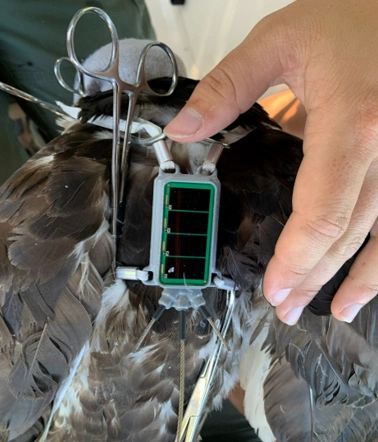

 Meet Patty, an osprey with an incredible migration story!
 How Do We Know Where Patty Traveled?
 From Maryland to Brazil, Patty’s journey is helping researchers unlock the mysteries of one of the Chesapeake Bay’s most iconic birds.”


