P3 hatches at Cornell…late Saturday in Bird World

9 May 2026

Hello Everyone!

Thank you so much for your lovely comments and notes. I am so glad you enjoyed the post about those amazing female raptors! They are truly incredible.

Jill was up early Saturday morning catching a breakfast fish for her and the kids. It is hard for her – Big and Little are growing leaps and bounds and eating more and more and she still must maintain her own strength in order to go and fish for all of them. The nest cannot count on Jack who has an odd pattern of fish deliveries.

‘PB’ caught this great screen capture of Jill coming in with that early fish. She really is quite amazing.

An osprey in flight carrying a fish with its talons, surrounded by trees and a glimpse of a road below.

I don’t recall worrying so much about a hatch at Big Red’s nest. It must surely be because we lost the first one and the nest has been so soggy this year with all the rain. The little one did make it! Thank goodness. There is so much prey. No one ever goes hungry on Big Red’s nest and never will unless there is a physical reason they cannot eat!

A Red-tailed Hawk sitting in a nest made of twigs and branches, with visible chicks in the nest.
Two young red-tailed hawk chicks resting in their nest, surrounded by twigs and feathers.
A red-tailed hawk tending to its nest with several hatchlings visible among twigs and branches.
A red-tailed hawk feeding its chicks in a nest made of twigs and branches, with urban scenery visible in the background.

Saturday was always Ferris Akel Day. We watched and often chatted every Saturday during or was it after? the pandemic. I miss being able to sit and go on a bird tour with Ferris who is incredibly knowledgable. Today, I stepped in for a few moments. He was at the Blue Heron rookery and they had babies!

A close-up shot of two birds near their nests in a tree, surrounded by branches and foliage.
A bird perched on a branch near its nest, which contains chicks, surrounded by tree branches in a natural setting.

Ferris is a great distance away, which makes these images just that more special. Check him out on YouTube.

A work of art ‘Ghost Sky Dance’ that documents the illegal killing of the Hen Harriers in the Yorkshire Moors.

Some good news and some bad from Knepp Wilding about Turtle Doves.

Turtle doves are back!
This year our most longed-for winter migrants have been bang on time. Our first turtle dove was recorded at Knepp on 24 April. Already we’re hearing several male ‘turtle’s doing their territorial ‘turr-offs’ from dead trees in the Southern Block. 
Once common in the 1960s, the UK now has fewer than 3,000 turtle doves, thanks mostly to the loss of protective habitat and the wildflowers which provide them with tiny, protein-rich seeds to eat. Numbers at Knepp remain around 20 singing males every year – that’s a quarter of the population in Sussex. 
Last year, however, just as their numbers were beginning to recover, the European Commission overturned a ban on hunting turtle doves in parts of Western Europe. Every turtle dove arriving in the UK is a tiny miracle.

The parents have returned to the nest and brought fish to the Dale Hollow Eaglets. One had fishing line and the AEF team was able to remove it.

Three young birds nestled in a nest among tree branches, with green leaves in the background.
Three young bird nestlings resting in a nest among green leaves and trees.
A live stream image capturing a nest of young bald eagles resting on a tree branch, surrounded by green leaves.
Two young eagles resting in their nest, surrounded by green leaves and tree bark.

The Sandy Steers Celebration of Life will be on 13 June 2026. It will be live streamed. Check their FB page for details.

Banner for Sandy Steers' Celebration of Life event, featuring a scenic background of Big Bear Valley and an image of a smiling woman.

Forestry England has another nest that has a streaming cam.

A close-up image of an osprey sitting on its nest, surrounded by twigs and foliage, overlooking a lush green forest and lakes in the background under a partly cloudy sky.

Olivia was not getting fish deliveries at the Severna Park Osprey platform in Maryland. She, like so many others last year, has abandoned her eggs, which have been eaten by crows. This is the first nest on a streaming cam in 2026 that the adults have had to abandon due to a lack of food. Please if you live in Virginia, please help those rally to stop the commercial fishing of Menhaden which is vital to the ecosystem for that entire area – including Maryland!

I want to give a shout-out to all those folks who are designing ingenious ways to feed the ospreys that live near or on their property. I won’t ever tell who you are, but I hope that what you try works and that those adults and babies thrive. You are my heroes.

Geemeff’s Woodland Trust daily summary for Loch Arkaig Saturday 9th May 2026

Today was pretty much a repeat of yesterday, a calm routine of fish deliveries and incubation changeovers. Exactly what’s needed as life develops inside those beautiful speckled eggshells, moving slowly towards hatching day sometime in the first half of June. Louis delivered three fish for Dorcha taking the Nest Two tally to fifty, and Garry LV0 delivered two fish to Aurora 536 taking the Nest One tally to fifty three. Ospreys are migratory birds and this weekend celebrates International Migratory Bird Day, therefore tonight’s bonus item is a programme on bird migration. 

Today’s videos:

https://youtu.be/W5LTMlv0XbA N2 Dorcha’s dulcet tones ring out as she summons fish one 05.27.59

https://youtu.be/8A0rloqPT3U N1 Aurora refuses a fish, did she have one during cam down time? 09.11.42

https://youtu.be/cedJn2Xd8tU N2 Louis gets to egg-sit when Dorcha leaves with fish two 12.38.38

https://youtu.be/zsNnPyCm_Zc  N1 Aurora doesn’t pass up fish number two  17.26.03   

https://youtu.be/HJ6GBAbxGKI  N2 Dorcha transfers fish three to her talons in mid-air 18.44.11

Bonus listen on International Migratory Bird Day – an ‘In our Time’ episode on Bird Migration (thanks MTL)

https://www.bbc.co.uk/sounds/play/b08wmk5j

Blast from the past, this day in previous years:

https://youtu.be/NqE_YC8NTWQ  N1 Graceful Aila does a fishy flypast 2020 (slo-mo)

https://youtu.be/AlayYBTfRbw  N1 Louis leaves the eggs to chase an Intruder Osprey 2020 (slo-mo) 

https://youtu.be/gTF4db9pYiQ  N1 Hurricane force gust nearly blows Aila off the nest 2020

https://youtu.be/Tt0NmWwPiAw  N1 Male & female Siskin pay an early morning visit 2021 (zoom)

https://youtu.be/Z_f1lAL9g68  N2 Undignified upside down Dorcha 2022 (slo-mo)

https://youtu.be/Q4KTtgMN_mI  N2 Ouch! Dorcha crashes into the nest 2023

https://youtu.be/fju0tKjGYbg  N1 On again, off again male visitor LV0 visits 2023

https://youtu.be/261d7botW24  N1 Garry pays a 20-second flying visit 2024 (zoom)  

https://youtu.be/SjXAu0qtxe4 N2 Fish number two does a fast flypast before landing 2024

https://youtu.be/3ersPiqRQ9I N2 A cuckoo calls as Louis brings breakfast 2025

https://youtu.be/5tHDrDx6lpw N1 Aurora leaves her perch to grab Garry’s second fish 2025

https://youtu.be/RPVpjzsMhKA N1 Handsome Garry bathed in the light of the setting sun 2025

Come and join the friendly folk at Woodland Trust’s Osprey forum – everyone’s welcome!

https://www.woodlandtrust.org.uk/trees-woods-and-wildlife/osprey-cam

The osplets at Lake Murray are doing great according to Heidi – and the little one has just the cutest bottom. Nice, round, and fat. This is all thanks to the new male at the nest!

An osprey family in their nest, with two adult ospreys feeding their three chicks. The nest is made of sticks and branches, surrounded by leaves.

The American Bird Conservancy (ABC)’s bird of the week, The Yellow-breasted Chat. Have a good read – see how much you can learn about this special feathered friend.

One of the things that I love about my tiny urban plot is that it is home to so many species of wildlife. Every year, we try to plant more shrubs and flowers to attract more bees and butterflies while making certain there are always decaying logs scattered about the property, providing a home for insects and a feast for so many of the birds. I can’t fight the big commercial enterprises that are destroying our planet, but I can make a difference right where I live – and so can you! It only takes one plant, specifically designed for your region and the bees or butterflies that live there, to make a difference. Why don’t you find a spot to plant something this year so that you can sit and watch the visitors come? And remember – please leave out water. It is the gift of life.

In London, the Queen Elizabeth II garden is attracting all manner of creatures! Enjoy the images.

A new haven for wildlife: London’s Queen Elizabeth II garden opens to the public – in pictures

https://www.theguardian.com/environment/gallery/2026/apr/28/new-haven-wildlife-london-queen-elizabeth-ii-garden-opens-public-aoe?CMP=share_btn_url

It has been a week of ups and downs at our house. The weather is not helping. I find that warm days when we can be outside, even if it’s just sitting on a chair on the deck, are so beneficial to one’s mental health. As I have mentioned many times in recent years, Don is now in his fifth year of being diagnosed with Lewy Body Dementia. For those that are unfamiliar, it is different than Alzheimer’s. This AI overview is rather good:

Lewy Body Dementia (LBD) and Alzheimer’s differ primarily in their initial symptoms and progression: LBD features early hallucinations, significant cognitive fluctuations, and Parkinson-like movement issues, whereas Alzheimer’s typically begins with memory loss. LBD often progresses faster and includes REM sleep disorders, whereas Alzheimer’s is generally slower and affects memory first.

Key Differences at a Glance

  • Initial Symptoms: LBD often starts with attention, executive function, and visual-spatial issues, while Alzheimer’s starts with short-term memory loss.
  • Fluctuations: LBD patients experience drastic, daily, or hourly changes in alertness and attention; Alzheimer’s symptoms are usually more consistent.
  • Movement: Parkinsonism (rigid muscles, slow movement, tremors) appears early in LBD, often within one year of cognitive decline. Movement issues appear in late-stage Alzheimer’s.
  • Hallucinations: Early, detailed visual hallucinations are common in LBD, while they typically occur in later stages of Alzheimer’s.
  • Sleep: REM sleep behavior disorder (acting out dreams) is a common early indicator of LBD, not Alzheimer’s. Alzheimer’s Association +4

Brain Pathology and Progression

  • LBD: Caused by abnormal deposits of alpha-synuclein proteins (Lewy bodies) that deplete brain chemical messengers.
  • Alzheimer’s: Caused by Amyloid plaques and tau tangles.
  • Progression: LBD tends to progress faster than Alzheimer’s, with a survival rate often averaging 5 to 7 years.

Why Diagnosis Matters
An accurate diagnosis is critical because LBD patients may have severe adverse reactions to certain antipsychotic medications commonly used to treat behavioral symptoms in Alzheimer’s.

Many of you have written to me about a family member or partner that is suffering from memory loss. Please, please get them to a doctor for a diagnosis. The earlier, the better. It is incredible what treatments and medications they have now that they didn’t have five years ago!

Don’s disease is beginning to progress rapidly now. We enjoy every good moment as his apathy and hallucinations grow. I always remind everyone to also enjoy life as much as you can. Don’t sit and cry over what happened a year or ten years ago or more or worry about next year. Enjoy your life right now. You never know what is coming around the corner.

I will end there. Thank you for being with us today. Please take care. I am going to take tomorrow off. See you Monday evening.

Thank you to all of the contributors today – those great people with their daily summaries, videos, articles, and investigative reporting. Thank you to ‘PB’ and Heidi for keeping track of the US ospreys and to the owners of the streaming cams and UK Osprey Information FB.

Early Saturday in Bird World

15 October 2022

It is 0500 on the Canadian prairies and the sky is solid clouds with a temperature of 5 degrees C. I am surprised at how toasty warm it is in the conservatory and how quiet it is. No cars, no people, no geese honking, or songbirds. Quiet.

The situation at Port Lincoln has had me up and down most of the night. I had so hoped that Little Bob would get some more food during the day but Big has made sure that Little and Middle are so frightened of eating that Little wouldn’t hardly raise its beak. It is a worry. If Big is going to calm down, it should begin to happen. What I witnessed on Saturday was a huge sibling demanding all the fish including any that would go to Mum. I am up early today because one of the things that relieves stress is to go for a walk in the forest and that is where I will be headed. As much as I would like to remove Big from the entire situation at Port Lincoln, I can’t. You can’t. Sometimes it is simply hard to watch abuse.

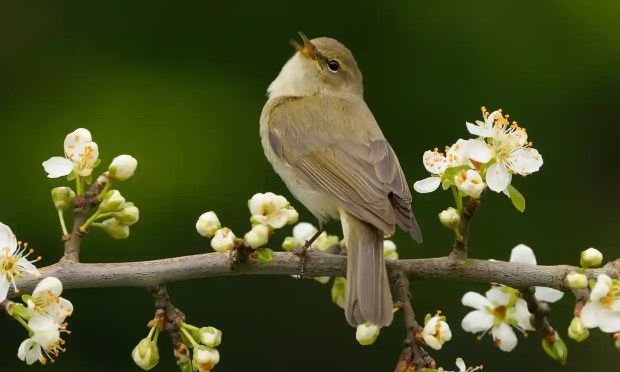
A sweet story about Blue Herons by an 11-year-old, how weather changes might impact Chiffchaffs, and a couple of videos to start the day:

https://www.theguardian.com/environment/2022/oct/15/young-country-diary-grandmas-favourite-walk-was-to-see-the-herons

Besides the little warblers in the article below, how many other birds will be impacted by weather?

https://www.theguardian.com/environment/2022/oct/12/weatherwatch-chiffchaff-garden-winter-breeding-population

Before we go and get the round up of the days events in Australia, Lady Hawk made a very short video of Samson and Gabby for all of us who are missing them!

And for those who cannot wait until the next season of Royal Albatross begins, Sharon Dunne aka Lady Hawk, made a much longer video of the albatross arriving at Taiaroa Head. I wonder who the Royal Cam family will be?


Oh, I had so hoped that Big Bob at Port Lincoln was ‘cooling her jets’ and settling down. The breakfast meal on Saturday went well. Big filled up. Middle got quite a bit, and Little got a couple of bites and then was able to get fed some fish before the tail area. Everyone settled down. As the anticipation of another fish arrival grew, Big ‘decided’ to remind Middle and Little Bobs with some savage beaking and pulling at the neck and some tossing that – she – and only she – was to eat first.

As the morning wore on with no additional fish delivery, Big got increasingly angry. The chatters who were watching the live stream were urging Little Bob to just not make a sound. Big is in a frenzy. Will Big be one of the exceptions to the rule of calming down? Middle and Little would gladly be fostered about right now. No matter what size the next fish is, it is Big’s. And no one will have any peace until there are several fish deliveries in a row that are huge…deliveries that have a late one and then an early one the next morning. Gracious.

Neither sibling is spared. The meal was over. Both Middle and Little were minding their own business and Bob decided to go after them.

At 11:50 Little Bob insists on cuddling with Big Bob – right under her neck. Interesting. Big Bob gave Little ‘the look’ but, didn’t beak.

It is windy and choppy. No fish delivery yet. It is after 1330. It could be quite nasty with Big on edge. I sure hope it is a monster of a fish.

There will be two more fish deliveries at Port Lincoln. The mid-afternoon delivery saw Bob terrorizing both Middle and Little again. Does anyone remember the days when Big only went on a rampage between meals and everyone got to eat? It has been a long time since that happened. Now, both Middle and Little are fearful of eating. Little Bob did not get anything to eat. Middle did a do around and pulled some pieces of fish from behind Mum.

On the PLO nest there was a late fish delivery at 20:13:24 but Little did not get anything to eat. Middle got to enjoy some fish. It is very clear that Big Bob has scared Little from eating. Let us hope, beyond hope, that he gets some food Sunday morning. Of course, the other miracle would be that Big would slow down in the aggression. Will this happen?

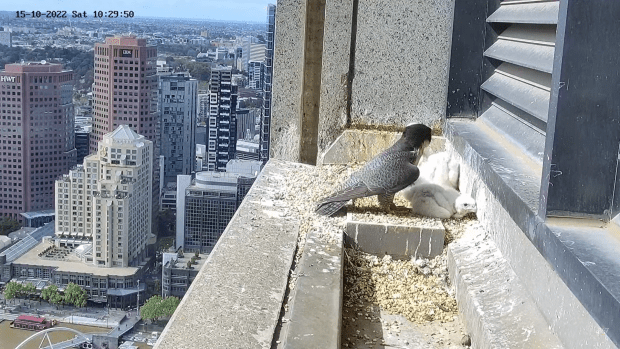
At 367 Collins Street, Mum returned after Dad had fed the chicks. The prey that he brought in was identified as a Sulphur-Crested Cockatoo. You can just see a few of the yellow feathers remaining. Apparently these are very dangerous birds for the falcons to catch as they can break the tarsus.

So we can be clear. The prey breakfast that Dad brought was not the pigeon that Mum caught and brought to the ledge. From the look of her enormous crop when she returned, she must have been ravenous and finished off that entire bird.

Mum cleaned up pieces of prey in the scrape, stayed with the chicks for a bit, and then left. Dad returned when the chicks were panting to try and shield them from the sun. Again, this is the strangest Peregrine Falcon scrape I have ever seen.

The eyases have grown so much that little Dad has a hard time just shading one of them. We are still about a week away before they can run down the gutter to the other end when it is in shade.

Top 2 images of Mum shading the chicks when she returns. Why didn’t she stay? It is so hot for them.

Little Dad comes and does his best. Look at how big they are. Oh, the shade cannot come quick enough and my calculations are that is 2 hours away.

I have included this ‘behind the scenes’ view of what I believe is the oldest or next oldest of the chicks. Just look at the feathers coming in, that huge tail, and yes, that fat little bottom and legs. It will not be long til this one is running up and down the gutter.

The Melbourne Four are eating well. The last delivery arrives around 1725. Dad comes in with a nicely prepared piece of prey. None of the four will be going hungry!

After Dad feeds them, Mum returns to brood the eyases.

Diamond fed Rubus and Indigo again around 10:17. Oh, she must enjoy facing away from the camera so we cannot possibly count the bites each of them gets! Of course, now that Rubus can see better and is more stable, there is no cause to worry. Rubus gets fed! And so does Indigo. She had an enormous crop when Diamond left the scrape with leftovers at 10:32.

We have to assume that with how well the feedings have been going that Rubus was full as well as both chicks will go into food coma.

Rubus had a really good feed at noon. At 1209 Diamond was insisting that he eat this huge piece of prey but, he tried and tried and couldn’t. Eventually Diamond ate it giving Rubus lots more bites after. The feedings are going so well now.

At the last feeding of the day, Indigo had an enormous crop and Rubus had a wee one. When you are watching a feeding at Orange, turn the sound up. Rubus is sooooooo loud!

Migration:

Here is a link to the interactive Bird Map showing ospreys, Black Storks, and other raptors on their way to their winter homes:

https://birdmap.5dvision.ee/index.php?lang=en

I will bring news of Karl II and his family – Kaia, Waba, and Bonus as soon as new transmissions are received.

Bird Cast shows us the changing nature of migration through North America.

As the sky begins to lighten, I can smell the coffee. Once upon a time I had a cat named Duncan. She knew that when the morning and evening coffees came, she would be able to go outside. She would sit at the edge of the counter waiting for her harness to go on and we would sit, enjoying the beautiful outdoors. What a great friend she was! I am not sure what the birds would make of having a cat outside but, as the sky turns a light grey, the Dark-eyed Juncos are arriving in droves. There are, perhaps, 40 of them this morning searching for any Millet left from yesterday. It looks like that is my reminder to feed them before I enjoy that coffee. The songbirds have arrived and broken the silence…and it is wonderful. A single Blue Jay has arrived as well. Time to get moving!

Let us all send the warmest wishes that we can to the Port Lincoln barge. May there be so many fish that Big gets sick of seeing fish and allows Middle and Little to eat, unharmed.

Thank you for being with me today. Take care all. See you soon!

Thank you to the following for their stories, posts, videos, and streaming cams that form my screen captures: The Guardian, Lady Hawk, Port Lincoln Ospreys, 367 Collins Street by Mirvac, and Charles Sturt Falcon Cam and Cilla Kinross.