Mr Blue Jay outwits Dyson!

Yesterday I revealed how we had finally figured out who was stealing Mr Blue Jay’s corn cobs. After several days of the cobs disappearing, we were able to catch the small Grey Squirrel in the act yesterday! We just had to look all over the garden to find the little thief!

To take the cob of corn, Dyson had to drag it for about 2 metres, pull it down steps and then 2 flower boxes. Once on the ground, he had moved it about 3 metres out of sight of the Blue Jays – and us.

I had no idea that these little squirrels were so strong. Persistent, yes, when it comes to food but, strong? The corn cobs are heavy when they have almost all the kernels on them. And this cob had only a few bites taken out of it before Dyson started moving it.

The Blue Jay family could not figure out what happened to their corn.

The real question was how to stop this activity. Dyson has lots of food – year round. Him and the other two grey squirrels have been coming to our garden for many years – 2016 for one of them. We have learned to identify them through different markings on their fur and we do keep a log. I have no idea how long urban Grey Squirrels normally live but having a penthouse (our shed) and readily available food, the vet told me she bet these three could live to be ten years old. They have no real predators other than the neighbourhood well-fed cats. The hawk that visits the garden is a Sharpie and him and his mate only take a small bird or nestling. So to cut to the chase, Dyson does not need to take Mr Blue Jay’s corn!!!!!!!!! There is never any chance that he would starve – he is just being a squirrel.

As all of you know, Blue Jays are part of the Corvid family, like Crows. These oscine passerine birds include crows, Mr Blue Jay and Company, Ravens, Magpies, Rooks, Jackdaws, Choughs, and nutcrackers. Most just say Crow Family.

Corvids are super intelligent, problem-solving birds. It seems that Mr Blue Jay was figuring out how to stop the squirrel, too, and he devised a very good method! I believe this is how it worked as I watched with camera in hand today for nearly three hours.

One of the three Blue Jays would land and watch the corn from the lilac bushes, about two metres away.

In this instance, Dad is watching from the lilac branches. He is ready to fly at Dyson if he comes near the deck where the other two are eating the corn.

Two of the Blue Jays would go down to the corn. This is Mum and their ‘baby’. Mum is nearer the corn cob.

When Mum finished eating, she flew away.

Junior went over to eat the corn under the watchful surveillance of Dad who remained in the lilacs.

While Junior ate, Mum was watching to make sure that Dyson did not come up on the deck, too.

When Junior finished, he flew off with Mum.

Would Dyson try and get the corn cob?

No way! Dad flew down to eat off a second cob of corn that I had put out. He was hungry too!

Junior flew back down to work on the other cob at the same time. Mum watched from the lilacs.

Sometimes Mum would fly down to be beside Junior and eat some corn, too.

They shared the one cob while Dad claimed the other.

There was no way that they were letting Dyson get their corn if Mum had to stand on it all day!

All of a sudden the pair become alert! They stop eating. Do they hear Dyson coming?

They look around.

Mum goes back to eating but Junior seems to think that Dyson might be coming up the other side of the deck. He seems to be listening and looking.

Junior turns all the way around.

Then all of a sudden Junior flies off.

It happened so fast I could not get a picture. Dyson had crept up to the other corn cob after Dad had left and had grabbed a kernel. Junior flew at him and sent him through the flower box over the edge of the deck.

Dyson did not come back all afternoon!

The Blue Jays were able to finish their corn cobs in peace. They figured out a wonderful way to get to eat their corn working together – way before this human came up with a plan. It was quite amazing to watch over several hours. I was truly impressed.

Wonder what will happen in the garden tomorrow?

Thank you for joining me this Friday. I hope that you are all well. Be happy. See you soon!

Who Stole Mr Blue Jay’s Corn?

It started out as a grey, damp, raining on and off again day in my neighbourhood and then…the sun came out, the sky turned blue, and the garden was a flurry of activity. As it happened, it also helped us solve a mystery: Who was stealing Mr Blue Jay’s corn cob?

Mr Blue Jay has been suspicious, too. Today he more or less stood guard while his partner ate her fill.

They had no more than begun their morning breakfast and the corn cob disappeared! So who is taking it? The largest of the grey squirrels was not around and even if Little Red’s ego would make him think he could shift that cob, he couldn’t. So who is it? For several days now we have not been able to catch the culprit but, today we did!

Look who has the corn! It is the smallest of the Grey Squirrels. It worked really hard to get that big cob full of kernels off the lower deck and around to the other side of the garden.

The cob has fallen in a little hole and the squirrel is able to dig its nails in and lift it.

Oops. It is falling down again.

He stopped to eat some of those prize kernels and then he began nibbling them off and burying them in the grass.

We left him to it and went and checked on the ducks at the local pond. When we returned the corn cob was gone and he was madly filling his cheeks with the nuts from the deck.

Just watching him I laughed and said that he was like a vacuum cleaner – and there you have it. That is how the smallest Grey Squirrel came to be re-named Dyson on 28 October 2021.

The duck pond was relatively quiet. Normally you cannot hear yourself think for the honking of the geese. The parks department has turned off the fountains and there were people raking leaves from the edge of the pond into a truck.

There were a few Mallards remaining along with 10 Wood Ducks. Apparently, 10 is a high number for Wood Ducks to still be at this location. Thankfully, I could prove to Cornell’s eBird Submit that there were 10 just through the photos!

It was cold walking around the pond and hopefully these remaining waterfowl will decide to move on to more warmer climates shortly.

Besides about 40 Canada Geese and Cackling Geese, there were a few Mallards. There was, however, one special little duck swimming around with all the regulars – a visitor. She was a female Ring-necked Duck. They are sometimes called a Ringbill.

Ring-necked Ducks breed across Canada during the summer and in a few northern US states. They live in freshwater marshes or near shallow ponds and lakes. You can apparently see thousand upon thousand of these ducks near Rice Lake in Minnesota during the fall migration.

They are dapper divers. This means they are quickly in and out, diving in shallow water to feed on aquatic plants, tubers, and invertebrates. They also eat worms, leeches, midges, and flies, etc.

There is a very distinctive grey head. The forehead slopes down and in a few of the images you can see the peaked rear crown. Because she has been diving, it is not as prominent as it might be when dry. The female has a white ring around its eye. The back is a gorgeous dark brown with a paler brown underpart. You can see the distinctive ring on the bill. That is not, however, what gives the duck its name. The males have a light chestnut coloured ring around their necks….something that is very hard to see I am told.

The colouring on this duck is simply gorgeous.

She really stood out

Sadly, there is another injured duck. This time it is a male Mallard in eclipse plumage. We will try to retrieve it tomorrow to take it to the rehabilitation clinic and that, for me, is always problematic. These two were inseparable all the time I was at the pond. Ducks do not form life long bonds but the bonding is seasonal. Still, it ‘feels’ bad to break the pair-bond but still necessary if this duck is to survive. It appears that it has a broken wing just like the female Mallard a couple of weeks ago.

Hopefully some food will lure this young man out of the centre of the pond tomorrow. Wish us luck!

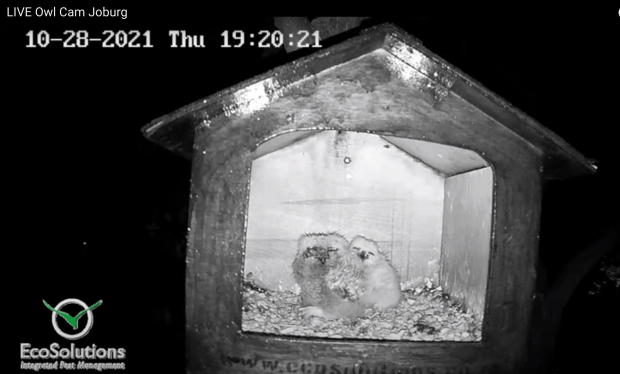
Before I leave, I also want to introduce you to another streaming cam. Last year there was a lot of excitement when the two Great Horned Owls named Bonnie and Clyde stole the Bald Eagle’s nest on the grounds of Farmer Derek. We all watched in awe has Clyde hunted and Bonnie fed the two owlets. Well, I have another owl box for you to watch. This one is in Joburg, South Africa. It is the home of a Spotted Eagle Owl. On 13 October two eggs hatched. Today they are 15 days old. What makes this nest box interesting is that there was an orphan owlet placed in the box on the 22nd of October. It is 5 days older than the resident pair. No one knew if the female would accept the orphan – but she did. She is raising it as her own!

Just look at how adorable they are waiting for Mum to return with a meal.

There she is feeding all of them.

I think you might really enjoy seeing these three owlets grow up.

It turned out to be a great day for the birds. It is a relief to finally find out who is taking Mr Blue Jay’s corn cob. We are going to have to figure out a way to thwart Dyson. And then there is the injured Mallard to deal with – tomorrow.

Thank you so much for joining me today. I hope everyone is well and enjoying the birds. Next week they will be ringing the three osplets at Port Lincoln and in two weeks the Collins Four will be fledging. After that it will only be a week until Yarruga is ready to fly. Take care!

Thank you to the following for their streaming cams where I took my screen captures: EcoSolutions Joburg Owl Cam.

Oh, Little Bob!

The birds in my garden are always aware when I am watching them especially Mr Blue Jay and family. Sometimes he will stop and look right in the window and fly up into the lilacs and down to the corn as if he is teasing me. Other days he might sit on top of the deck chair calling to remind me that the corn cob has disappeared. Or maybe he is saying hello! Today, it was the youngest of the trio staring at me as he flew in and out to get kernels off the cob. Dad, Mr Blue Jay, was observing from the lilacs.

How do I know this is the youngest? He is a bit thinner and his legs are a charcoal grey, not black. I can also identify them by their facial markings and I still don’t know, after several years, where they roost or which is the male or the female. All I do know is that in exchange for a corncob, some peanuts, and some seeds, this family of three brings me year round joy.

Of course, the birds on the live streaming cams have no idea there are hundreds of people, sometimes thousands, watching them. Many have caught their reflection in the camera’s dome. I recall Izzi, the peregrine falcon eyas at Orange, and the little Golden Eagle in Romania liking to look at themselves. It is very cute.

Today, Little Bob was having some fun. It is a good thing he is not conscious or caring of anything to have to do with humans!

Yes, that is Little Bob. He is fanning out his tail like a peacock. While we are not able to see it clearly yet, Little Bob’s tail will have stripes, alternating white and espresso. This same type of barring will also be seen on the secondary feathers. The secondary feathers are those after the primary or wing tip feathers.

In studying other birds of prey, those dark stripes are often counted with the understanding that on a Red-tailed Hawk, for example, the nestling needs at least 5 dark bands to fledge. It is simply a way of gauging the length of the tail because tail length is one of the elements necessary for flight.

In the image below, Little Bob has lowered his tail a bit and is stretching his wings in what is known as the ‘W’ pattern. It will be familiar to you as it is the shape that gets tightened up when ospreys dive head long into the water.

The nest on the barge at Port Lincoln is getting crowded as these young ospreys grow. There is Little Bob looking out standing in front of Mum. You can clearly see that dark espresso line (it is neither brown or black) that runs from the beak, across the eye and down to the nape of the neck. This dark strip is your word for the day, it is the auricular. Many believe that this helps to stop the glare of the sun so the birds can see better.

There is a lot of speculation on the streaming cam chat as to the gender of Little Bob. Ospreys need strong legs and feet in order to fish and pull their prey out of the water. They grip their prey with their long black talons using those ‘scratchy pads’ – specialized barbs -on the bottom of the feet to hold the fish secure. They also are the only raptor to have a reversible outer toe which helps them secure their prey. They will, most often, position the fish so that the head is facing in front which is a help with wind resistance.

Ah, but back to telling the males from the females. Measurements will be taken when the three get their Darvic rings. Females tend to have thicker leg bones than males. A good example were the measurements taken of Laddie and NC0’s two fledglings, LR1 and LR2. With females being at least 20% larger than males (normally), the first to hatch and the largest was ringed LR1. The wing measurement of 337mm and weight of 1.51kg led the bander to state that LR1 was a female. The second chick was three days younger and had a wing measurement of 276mm. It weighed 1.4kg and was said to be a male. The differences are slight and the only real way to determine gender is through a DNA test or by seeing an egg laid.

Note: LR2, the male, is the fledgling that has been seen several times over the last week in Spain. Fabulous news!

That said there are a lot of people who believe that Little Bob is really Little Bobbette.

One of the other ways that people believe females are different is through their darker and wider ‘necklace’. Unfortunately, I believe this idea to be unreliable as there are a number of known males with very elaborate and dark necklaces. One good example is Blue 022 the ‘maybe’ mate of CJ7 at Poole Harbour.

It is often difficult to establish which chick is which on the nest. As my concern is in the third hatch, I have paid particular attention to Little Bob. Look at the top of his head. Whether you say Little Bob has a white V or a round circle on its head doesn’t matter – both apply. Look carefully at his head in the image below. One of the things that will not change over Little Bob’s lifetime will be the pattern on its head.

Oops… there Little Bob goes again!

Oh, my. This time he is going to spread his wings, too. Somehow I do not think Big Bob is going to be happy about that. Did I say this nest was getting crowded? Just wait til they all start flapping and hovering at once.

Just like Mr Blue Jay and family, Little Bob continues to delight me. I am so glad that he doesn’t know how many of us are watching his every move.

Take care and thank you for joining me. My newsletter will be late tomorrow. It is time to pick up a large order of birdseed and corn cobs for the garden animals for the winter.

Thank you to the Port Lincoln Osprey Project for their streaming cam where I took my screen shots.

Corn Cob Show Down

It has been an interesting morning in the garden. First, it is wet and cold – again. 8 degrees with a cloudy sky.

Because of the recent rain, all of the old seed and shells were cleared off the deck and put into the bin. Birds can get sick from eating wet mouldy seed. Wet seed encourages bacteria to grow and the diseases can be fatal. I would like to think that birds know better than to eat that wet, sometimes smelly, seed but they do not always, especially if they are ravenous. Over the years we have experimented with many different ways to keep the bird seed dry. Putting a roof or a dome over the feeder works best. Other people recommend mesh feeders so that there is air circulation. I have found that these work best in conjunction with some type of a roof or dome.

The garden birds do not like it when things are cleaned up. Today was no exception! Some of the bowls were left to be cleaned while others were filled. The House Sparrows arrived wanting baths – yes, they take baths when it is 8 degrees C! Others were dismayed to find their bowl empty. We warm the water for them in a heated bird bath during the winter but it is only enough for then to drink with wooden slats placed across so they will not bathe. Thank goodness they do not weigh enough to move those boards about! It is really important to remember as the cold days of fall and winter set in that birds need water to drink. If you put out seed in the winter, they also need water. Yes, they eat the snow but they often need more. See if you can figure out a way to provide it for them.

This is one of the sweetest little House Sparrows. It along with the one above wanting a bath were just darlings.

Grey Squirrel (Bushy) joined everyone on the blocks eating his favourite seeds with big nuts and fruit.

The Slate-Coloured Juncos are still here and they like that fruit and nut seed just as much as the Millet. Sadly, with the wet on the deck and their favourite red carpet, the Millet turns to mush and might make them ill. So it is fruit and nuts today! Hopefully the weather report is right and the sun will be out tomorrow and we will be back to non-seasonal temperatures for a few days so everything can dry.

The plumage of the Slate-Coloured Junco is quite extraordinary when you begin to look closely to the variations of rusty brown over the slate grey.

Mr and Mrs Blue Jay came for the corn cob but were joined later by another Jay. The reaction to that bird seemed to signal that it was an intruder.

Blue Jays are often overlooked. Many dislike them as much as they do House Sparrows. As for me, I adore them both but – because Mr and Mrs Blue Jay have been coming for several years and each summer they bring their surviving fledglings to show us, I am especially attached to them. They eat their corn and love it if they can get a peanut ahead of one of the squirrels.

I found a woman who loves Blue Jays, too. She made a great little video explaining their courtship behaviour. Have a look!

I love the drawing on the top left and the saying: Birds Make Me Happy. As all of us know, that is absolutely true. They bring such joy.

Thank you so much for joining me today. I hope all of you are well and happy. See you soon.

Happy Canadian Thanksgiving from my garden to yours

It is 17 degrees C, clear blue skies, and the birds are chirping their heads off. After two days of grey damp rain, everyone is happy to celebrate and we are all thankful for the wonderful weather.

Thanks to the birds or squirrels there are sunflowers popping up around the planters. The Vermillionaires are for the hummingbirds, and the Cosmos for the bees and butterflies. The thicket in the back of the garden is a favourite place for hiding or cooling off.

I am thankful to each of those that live in or visit our garden every day. There are three different Blue Jays, one Red Squirrel (Little Red), three Grey Squirrels (Baby, Scraggly, and Monk), Mr and Mrs Wood Pecker (he is missing from the images today), Mr Chickadee, and Hedwig, the garden rabbit.

The joy they bring is immense. The Blue Jays have been demonstrating the many ways to clear the kernels off their corn cobs before Scraggly takes the entire cob. Everyone else has also had special seed or suet over the weekend to thank them.

It seemed that half of our City was at the local park today enjoying the beautiful weather and having picnics instead of big elaborate dinners. You could hear laughter all around the pond. Sadly, there was one female Mallard that has a broken wing. I am waiting for someone to bring me the proper pole with netting and we will be out to attempt a rescue to Wildlife Haven.

Of things to be thankful for today, is not only the joy that all of the birds have given me but also for those that dedicate their lives to trying to mend them and get them out in the wild again. Wildlife Haven is certainly one of those!

The trip had been to check on the little Wood Ducks. The one below is an adult female in her summer/fall plumage. Note her striking white eye patch and the yellow line around her eye. She does not, however, have the red iris of the male. She has white streaking on her breast. You can see the blue secondaries.

Indeed, it is very difficult to ID the Wood Ducks at this time of year because there are so many variations occurring.

We know this to be a male because of the red Iris. There is stunning secondaries. In this instance, they look iridescent green at this angle. This is a first year male in his winter plumage.

I was looking for the adult male. The last time I checked he was almost finished his moult and it would be so nice to see him in his magnificent plumage before they leave the pond for their winter homes. He is sleeping up on the bank of Duck Island on the left. You can get a glimpse of how gorgeous he is. Indeed, most of the wood ducks were having a nap. Perhaps they do not like all the people walking about, laughing, having fun.

From my garden to yours, I hope that like us you have family, friends, and critters who delight you and for whom you can say ‘thank you’ every day! Wildlife is wonderful.

Thanks for joining me today. Wish us good luck in getting that female Mallard out of the pond! Take care everyone. See you soon.

Late Friday in Bird World

It is 10:16 in Australia as I begin this short newsletter.

The osplets on the Port Lincoln barge had a small fish between them around 06:15. They have had nothing since and Big Bob is getting a bit restless. Sadly, he has been pecking Little Bob’s neck and Little Bob is going to have to learn to use his backside to protect himself when this happens. So far the beaking has not been too bad but, as all of you know – this Osprey nest makes me nervous. I will not be able to relax until Little Bob is a little older. It seems that Big Bob is trying to establish nest domination. Tiger Mozone wondered on the chat about DNA causing excessive aggressiveness in the chicks. Certainly this nest has a history of that type of behaviour. I also wonder about toxins in the water that enter the fish and stay in the tissue of the Ospreys.

Mom was hopeful around 09:45 and the chicks were in line to eat. Their crops have dropped from the small fish three and a half hours earlier.

The chicks are being fed more fish and for a longer period. What was six minutes a week ago has stretched into 45 minutes at the table. And these chicks will be fine today if a big fish does not come on the nest for a few more hours. The issue is Big Bob who seems to want to press his authority by fighting with the other two. Middle Bob is the clever one (so far) and seems to be able to stay out of the way but Little Bob still needs to learn how to protect itself.

The two older chicks are moving straight into the rapid growth period where they need lots of fish. Little Bob is following as quickly as he can. You can see that he is moving into the reptile phase himself. The dark feathers are coming in and he is losing the down on his head. Big Bob is awfully dark and a bit scary looking! He is the one holding his head the highest and looking towards you.

It is nearing noon, nest time. Dad has come to the nest without a fish. Is there a predator in the area? I actually thought that this nest was relatively free from predators unlike those in Europe and the US that have to deal with Goshawks, Great Horned Owls, etc. Or has Dad arrived to get the meal order from mom?

I couldn’t help myself. I had to check. Dad must have been taking the fish order at 11:25 because he delivered a fish to the nest around 12:25. Thank goodness. Big Bob behaved himself and everyone is getting to eat.

Look at who has his little mouth open wide!

Little Bob ate first. You can see from the crops. Middle and Big will eat next and by the time they finish, Little Bob will be hungry again. I hope that fish is big enough!

The big news over in New Zealand is that Tiaki has fledged on 25 September. She was 244 days old. Both her and Plateau Chick left the headland but, it has not been completely determined when that was. By the sat-pak it seems that Tiaki might have fledged at night but sometimes that sat-pak GPS requires adjustment. We all wish her a wonderful safe life, full of fish, and a return to us in five years time.

You can follow her satellite GPS. I will put the link below the fledging video.

Cornell Bird Lab caught the moment:

Here is the link so that you can check on Tiaki. Her satellite tracker should continue working for a year until her first moult. You can follow her dad, LGK also. His tracker should be good til he moults – another couple of months. There are only six chicks remaining to fledge.

https://my.wildlifecomputers.com/data/map/?id=6008d9ba31af59139976bcfe

The migration continues in Manitoba with everyone is excited. There are dawn breakfasts and evening dinners celebrating the arrival and departure of the Canada Geese – and, of course, the swans and all the other ducks and birds. Today marked the return of the Dark Eyed Junco to Winnipeg. Oh, people are so happy to see these adorable little birds. There are several sub-species of Junco and the one that visits Manitoba in the summer to breed is called the Slate-coloured Junco.

The Juncos love my red outdoor carpet. Tomorrow or the next day there will be 50 or more hopping about on it and jumping in and out of the dill. They love it if we ‘intentionally’ spill some seeds on the carpet. They are better than a vacuum clearing them up if we do. They do not feed at the feeders but are also seen on the ground for invertebrates. Isn’t this a real cutie? It was definitely not shy. The image was shot through a triple pane of glass so as not to disturb the bird. It seemed to not notice me.

Today, Mr Blue Jay had two other Blue Jay male visitors that wanted to help him eat his cob of dried corn.

By the time dusk arrives, the Jays and the squirrels – both red and grey – had made a real mess of the seeds. I think one of the squirrels wanted some of that corn but the Blue Jays were not having it. They would eat 3 or 4 kernels and then take some away in their beak. It was fascinating watching them through the windows.

Little Red decided it was easier to get up in the lilac bushes and balance himself on the bird feeder and eat his dinner there. Contending with three male Blue Jays was not something he wanted to do. So he kept quiet and ate and ate. He also doesn’t get on with the Grey Squirrels. He has picked a good place to eat in peace and quiet.

Awwww. Look at those tiny little nails.

It was a good day. All of the garden wildlife save for the rabbit were accounted for. There were also several new species of sparrow in the lilac bushes eating seeds. There were Chipping sparrows as well as Clay Coloured Sparrows today.

Hatch watch is coming soon for the 367 Collins Street Peregrine Falcons. WBSE 27 and 28 are doing well. 28 actually managed to get a prey delivery today. Here is a short video showing 28 mantling the prey and then wanting to share it with his big sib. They have their beautiful juvenile plumage and are so adorable.

I also checked in on the Bald Eagles who are working on their nests. Will put in a report some time this weekend. I know that many of you are anxious for Samson and Gabby, Harriet and M15, as well as Jackie and Shadow to get those nests built and those eggs laid! And while the last of the Albatross are fledgling, it will not be that long til the other adults return to Taiaroa Head to make their nests and lay their eggs for the 2022 season. Sometimes time feels like it melts in front of our eyes.

Thank you for joining me. I have promised myself that I am not going to worry about the Port Lincoln Ospreys tonight. The crazy thing is that I wish the winds would pick up. Dad seems to be able to fish better when that is the case. Yes, I know. That is a crazy idea. Take care all of you. Stay safe. See you soon.

Thank you to the following for their streaming cams where I took my screen shots: Port Lincoln Osprey Project, Cornell Bird Lab and NZ DOC, and Wildlife Computers.