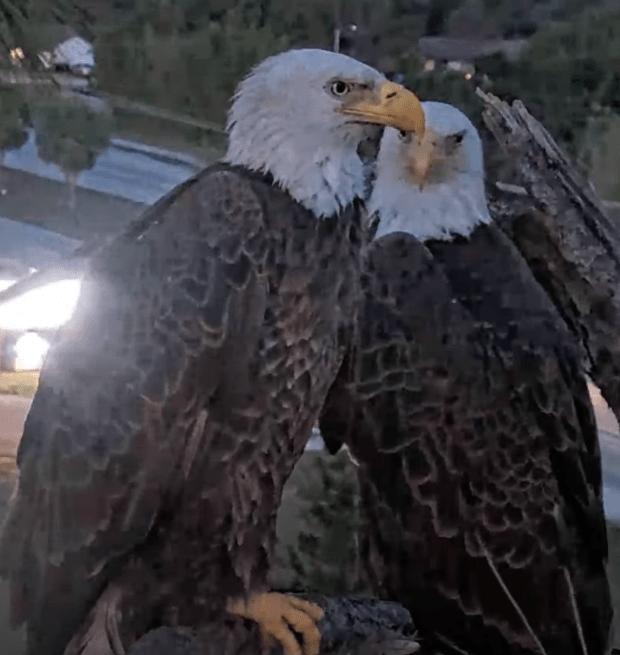
5 August 2026
Hello Everyone,
We are having another cool day. It is fantastic! We hope that you are as well.
Heidi is meticulous in keeping data records for all the osprey nests that she monitors and she has been doing this or the International Osprey Data Project (my long term study in osprey mortality) for the past three/four years. Heidi posted this detailed information about a few of the nests that she has observed and documented this year. You will learn a lot from reading this.
“Keep in mind, there is a great deal of older osprey educational material available in print and online. The older materials present a typical osprey family lifestyle as being similar to old TV shows like Ozzie and Harriet, Father Knows Best, The Donna Reed Show, and Leave It To Beaver. The dads worked, and the moms stayed at home. I have watched dozens of osprey nest cams for a few years, and that has rarely been the case. An osprey nest where the female never fishes is uncommon, in my experience. If you do your research online, artificial intelligence will glean information from the out-dated articles as well as some newer information.
First, we shouldn’t assume that Miles has ‘succumbed’ to anything or became injured or died. That’s a bridge too far. Since we only know what we see on cams, it is important not to go too far in our ‘what if’ theories. We do know that there is a shortage of fish, primarily due to menhaden overfishing.
It is not unusual for both parents to fish. Many females do typically start to fish for the family to supplement the male’s contributions, when the chicks get older. That’s what Hennie did. The females are not necessarily supposed to provide most or all of the fish, but that is what I have been seeing at many nests. However, don’t forget that the males can also become preoccupied at times with defending the nest and surrounding area against intruders, and then they will spend less time fishing. When fishing becomes poor for our on-cam osprey families, it becomes poor for all of the fish-eating birds in the area, like other ospreys and eagles. This may result in a greater chance of one of ‘our’ osprey’s catch being stolen by other hungry birds. It stands to reason, that kleptoparasitism would increase in times of fish shortages. You can imagine for example, Miles spending a lot of time trying to catch a fish, he finally catches one and then it is stolen. He later catches another fish, and he eats it because he is expending a lot of energy and he is starving. Miles (and all the other males and fishing females) may have also had to travel further away to find better fishing than what they were finding at their usual local fishing spot. That would mean more energy expended just to get to the new fishing area, and then to fly home with the fish. The male can try to do this all day long, and the end result may be that the male has brought very few if any fish to the nest that day for his family.
Osprey nest ground monitors have been noticing that many females are abandoning nests earlier in their nesting season than in previous years, and that some males have been leaving early also. From what I have seen on cams, many of the males are leaving before the females. Leaving does not mean migrating. It could mean that they simply have reached their own maximum degree of malnutrition and exhaustion that they can tolerate, and they simply had to become self-focused to save their own lives.
What I have seen on nest cams this season:
For some nests, the ‘food stress’ for the ospreys presented itself early enough in the season that the eggs were abandoned. The male ospreys stopped coming to the nest with fish for the females, so the females had to leave to fish for themselves. This was not the first year we have seen this. We noticed this at the Severna Park, MD nest two years ago, last year the cam was down, and this year Oscar and Olivia abandoned their eggs again due to lack of fish.
Last season at the Forsythe, NJ nest, the male could not support the female by bringing her enough fish, so she abandoned their eggs. This season, the food stress presented itself much later, and two chicks hatched. The male, Oscar, stopped coming to the nest several days prior to the female finally giving up on the chicks. Opal had a long history of being a fishing osprey mom. But, unlike several years in the past, the she did not bring any fish to the nest for her chicks this season. She did however, spend many hours off cam and would return with a crop and empty talons. One would assume that she fished to save her own life, but probably also tried to fish for her family, and she simply wasn’t able to do so. How far did she have to fly to find fish? Opal finally abandoned the chicks and they perished. Both parents were seen at the nest a few times in the days after their chicks died.
Last year at the South Cape May nest, Hera abandoned her eggs when Zeus had been unable to provide enough fish to her. This season, Hera was last seen at the nest when Uno was only 38 days old. There had been a significant slowdown in fish deliveries to the nest. Hera had already been fishing for a couple weeks, and was providing 1/3 to 1/2 of the daily fish totals to the nest. After Hera’s departure, Zeus continued to support Uno for several days by delivering fish, mostly very small menhaden. July 26, was the last day that Zeus was seen at the nest. On 7/28 the cam was turned off and NCNJ began to place fish on the nest for Uno.
The Wetlands nest is a special case. Their only chick would not allow mom to feed it, repeatedly attacking her very severely, and attacking the dad as well. However, the male continued to make fish drops, and Rascal learned to self feed. But, fish counts were down significantly compared to earlier in the season. In the end, both parents abandoned the nest altogether, and Rascal passed away.
At Dewey Beach last year, both parents abandoned their only chick and it died at 50 days old. Dad left several days before Mom did. We did see the mom on the nest a few times after her chick passed. This season they had a new female, and she started fishing when Sassy was young. The last couple weeks of their season, Mom was catching most of the fish, and it was almost entirely small menhaden. Dewey Dad stopped coming to the nest when Sassy was 54 days old. Mom continued to provide for Sassy for four days after Sassy fledged. Mom was last seen on 7/17. We saw Dad again on 7/18 with a fish, Sassy flew in to take the fish, but Dad flew off with it. Mom has not been seen since 7/17, but I continue to see Dad at the nest, guarding against intruders. I last saw him on 7/30. Sassy has not been seen since 7/19.
The Cape Henlopen nest: Miles was last seen at the nest on 7/28 at 10:28 when he delivered a small menhaden. The fish count had been way down from a few days earlier. I believe that Miles had reached a breaking point where his body told him that he had to take care of himself. He was probably exhausted from trying to fish, fighting off kleptos trying to steal his fish, and trying to guard the area from intruders. In addition, Miles may have been flying further away to try to find fish, using up even more energy. He may have only been able to eat a couple tiny menhaden a day, or a dogfish, which wasn’t enough to support his energy requirements. I think it is possible that Miles may have left to find better fishing at a different location, so that he could regain his weight and strength. The adults also know that they have to migrate in a month or so. Starting from a depleted physical state, they know they have to begin to rest and fatten up before undertaking the immense challenges of migration.
Hennie had begun fishing fairly early in the season, and her contributions were very significant. There were no fish brought to the nest on 7/29 and 7/30. Hennie arrived in the evening on those days with a crop. The fact that she had eaten but not brought a fish to her youngster was quite shocking to some viewers. It was similar to what Opal had been doing at Forsythe, arriving with a crop but no fish. I believe that Hennie had tried to bring fish to her youngster, but it simply didn’t work out with the challenges of finding fish and surviving fish thieves. Hennie brought three fish to Chick1 on 7/31. On 8/1 Hennie brought a small menhaden to the nest for Chick1 at 11:14. It was approaching too late in the evening to expect another fish, so I knew Chick1 would not have another fish that day. The eagle took Chick1 that evening. We heard Hennie alarming from a nearby tree during the eagle attack. Hennie never abandoned her chick, and Chick1 was not dying. See the videos of the chick being active throughout the day on 8/1. I counted several very good ps’s by Chick1 on 8/1. But, Chick1 needed more fish, and if the eagle predation had not occurred, I don’t know if Hennie would have been able to catch enough fish for herself and her chick, so that Chick1 could fledge. We will never know. I do know the last few days that Hennie was seen on camera, she looked very thin, tired and depleted.
There are those that have said if Hennie or Miles had been at the nest the eagle attack would not have happened. That is not necessarily true. If Hennie had been on the perch, it may have deterred the eagle, or it might not have. In 2021 on an osprey live cam in Washington state, a bald eagle swooped down on an osprey nest and took two osplets at once. The osprey parents were both at the nest at the time.
Fish: I have monitored fish at many regional on-cam nests this season. The catch has overwhelmingly been small menhaden. Menhaden comprise the bulk of an osprey’s diet along the mid-Atlantic coast, and the northeast coast. Large adult menhaden have a very dense caloric content due to their high concentration of omega fatty acids. Small menhaden, while still food, lack the nutritional value of larger menhaden. They are not old enough to have accumulated and stored the high concentrations of omega oils. Other fish I have seen at the nests include lots of bluefish earlier in the season (very few later in the season), a lot of dogfish, a few croaker, scup, spot, mackerel, and even one black sea bass from Miles. Zeus at Cape May, brought several fresh water species to the nest this season (bass, sunfish varieties). We thought that would be a boon for that nest, since Zeus had an alternate location to fish. But, in reality, it pointed to the fact that their primary food source, menhaden, was missing. I have only seen a few large menhaden this season at Wetlands, Dewey Beach, Cape Henlopen, and South Cape May. Due to overfishing by an industrial reduction fishing fleet, the adult menhaden along the east coast have been almost entirely wiped out.
The photo is from June 13.”


In the Tweed Valley in the UK, one of the osplets was being attacked by its older sibling who had made sure the younger one did not eat. It was rescued so that it could survive. This is the latest update:

There is more news from Tweed:

In Australia, George and Hope are raising their three osplets alone this year – without their older sister helping!

People make a difference and this is a marvellous change to a very long standing tradition. This year Gannet chicks will not be clubbed to death.
Please remember that collectively we can make change – and I am hoping that one of those changes will be the absolute elimination of the industrial fishing for Menhaden that is causing an entire ecosystem to collapse and the death of our dear ospreys (amongst other wildlife).

People are helping ospreys in trouble. It warmsmy heart.

Geemeff Woodland Trust daily summary for Loch Arkaig Tuesday 4th August 2026
Plenty of drama today – Dorcha saw off a persistent intruder Osprey who kept over-flying Nest Two, then intruded on Nest One herself, and was swiftly chased off by Aurora 536. Less than ten minutes after Aurora drove her away, she returned to Nest Two bringing a fish! Early in the season before Louis returned, Dorcha had brought two fish to the nest. She’s now doubled that total with her delivery of a trout yesterday and another today. The chicks were on and off the nest throughout the day competing for fish, and while attempting to keep her fish away from her sister, Amber accidentally achieved a milestone and flew with her fish for the first time. However, she still needs to perfect the other half of that skill, which is to keep hold of it, as on returning to the nest, she crashed through the branches at the side, and landed with empty talons. Garry brought one fish for Aurora, taking the Nest One tally to one hundred and ninety two, and the Nest Two tally rises to three hundred and seventy five with five fish from Louis and one fish from Dorcha today. As forecast, there were heavy rain showers and strong gusts of wind during the day and the wet weather is set to continue with light rain showers and a low of 14°C overnight, changing to thundery showers and a yellow warning for thunderstorms tomorrow, with a high of 17°C.
Today’s videos:
https://youtu.be/lqX0uWRACTo N2 Amber achieves another milestone and flies with fish 13.10.42 https://youtu.be/IkQf6Ot_E1g N2 Unringed intruder seen off by Dorcha 13.28.18 https://youtu.be/J7o7_cWLtnE N1 Dorcha intrudes on Nest One and is chased off by Aurora 14.15.43 https://youtu.be/PdoihiOsSic N2 Dorcha delivers fish number two and an almighty stramash breaks out 14.24.37 https://youtu.be/KFShvMNpdLM N2 Amber fends off Juniper and keeps fish three 14.40.28 https://youtu.be/lRqs6vluU6I N2 Dorcha gets fish four from Louis but feeds Amber when she begs 16.49.53 https://youtu.be/Vf-8L9oKHp4 N1 Garry stays to feak his beak after Aurora leaves with fish one 17.12.29 https://youtu.be/zUJcgT5sgWw N2 Juniper grabs fish five and moans at Dorcha’s presence 18.03.15 https://youtu.be/U46zajCBEXw N2 Three females on the nest calling loudly for fish six 19.27.30Bonus retail therapy – bag yourself a bargain and stand up for trees at the same time, Woodland Trust’s sale is now on:
https://shop.woodlandtrust.org.uk/sale
Everyone’s invited to join the lively community at Woodland Trust’s Osprey forum, it’s friendly, free and you’re all welcome:
https://www.woodlandtrust.org.uk/trees-woods-and-wildlife/osprey-cam
================================================================
There was a fledge this morning at the Minnesota Landscape Arboretum nest. Gosh what a good nest to watch this year with new adults!
Heidi reports “Oyster Bay is having a good day. Mom had not been seen for 2 days, but she’s back. Five fish so far (3 Dad, 2 Mom), both chicks have been eating.”
The update on Colonial Beach chick that was electrocuted and taken into care. It is able to stand up but did not eat well yesterday. Send your good wishes, please, to this baby.
At Hellgate Canyon, Wensi is really working his or her wings and well, there could be a fledge any time. Proud Mama Iris watches every move. Iris is looking a little rough. I sure hope she is able to spend the next month fattening up and getting into good condition for migration.


If you missed the hour discussion on the Hellgate Osprey Season 2026 here it is: https://www.youtube.com/live/T1-QR1RyDlc?
Thank you so much for being with us today. Take care. I will be back with you on Friday. Taking a day off tomorrow (Thursday).
Thank you to everyone who sent me information, to Heidi for that great synopsis of some of the nests she is watching, to Geemeff for her videos and summary, Cornell Bird Lab, all who post on FB and the streaming cam owners who allow us to watch these amazing birds.