Is it a hatch or two for Diamond and Xavier?

The Guardian is hosting its 2021 Australian Bird of the Year competition and the Peregrine Falcon has made it to the final 20. The voting started out with 50 birds with 5 eliminated each day. The falcons are down to the wire! Here is the link to cast your vote for your favourite bird but Xavier and Diamond really hope that you will vote for the Peregrine Falcon!

Oh, Mom, Dad, and the four eyases on Collins Street in Melbourne really hope that you will also vote for the Peregrine Falcon! No pressure. LOL.

https://www.theguardian.com/environment/ng-interactive/2021/sep/27/australian-bird-of-the-year-2021-vote-now-for-your-favourite

It is not even dawn in Orange, Australia. Diamond has been restless all night. Is there a hatch? a pip? Most bets were for a hatch on 7 October and that is today!

Xavier always arrives around 06:00. Today it was 05:56. He approached Diamond cautiously. She is not going to budge. Something is happening! Diamond is sure not giving away any hints. Xavier is making sounds like a squeaky door. I wish I could speak falcon. Must be an eyas under there breaking out of its shell. Yippee..confirmation to come later.

Remember, you can watch the action here:

WBSE 27 and 28 are awake as dawn approaches. Both have been joining in the morning duet with their parents. Just precious. Both are healthy. WBSE 27 will be 10 weeks old on Thursday and WBSE 28 will be 10 weeks old on Saturday.

In the 10th week, the sea eaglets are fully feathered. There could be some downy feathers still developing under their wings. All of the feathers should be out of the blood quill and hard pinned now. The two will do much more wing flapping. Watch for them to stand more on one leg. The eaglets can self-feed but Lady does love to feed them, too. Flapping up to the branches is called branching and this can occur at any time as can fledging, the first flight.

I hope that the Pied Currawongs do not chase them out of the forest. They need to imprint the way back to the nest so they can get their flying better. Fingers crossed.

There appears to be a problem with the streaming cam of the Port Lincoln Ospreys. I can tell you that three fish had been delivered to the nest before I went to bed last night. The first was at 9:00:06, the second at 12:02, and the third was at 14:09:33. Everyone was really full with that last feeding. Based on the past history of fish deliveries that would have been at least two more fish deliveries if not three before the day was over. The nest is doing really well.

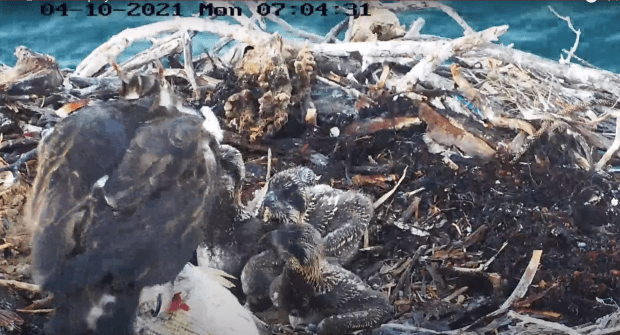
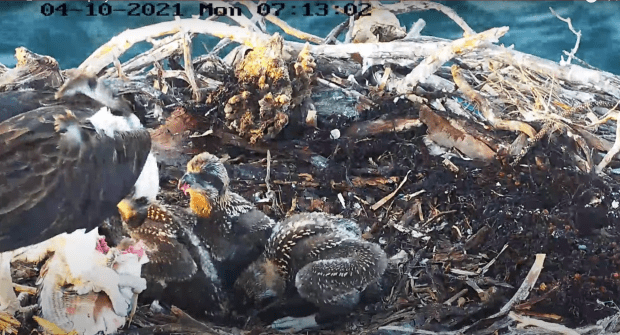
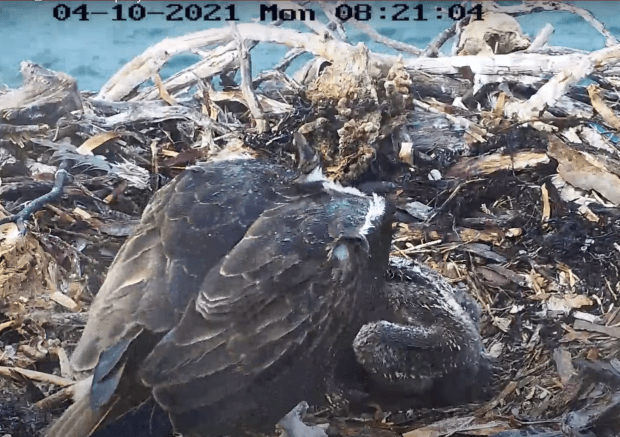
All three had big crops like these two. The third osplet has passed out behind the two still looking hopefully at mom to see if there is anything left.

Wonder what those brown things are in the nest?? What has Dad brought in?

Remember to vote for your favourite bird and also mark on your calendar 9 October for the Big Bird Count. I will remind you again how to participate the day prior.

Thank you for joining me. We are definitely in for a hatch or two or three today at Orange. Xavier is waiting anxiously! Take care. Stay safe!

Thank you to the following for their streaming cams where I took my screen shots: Port Lincoln Osprey Project, the 367 Falcons by Mirvac, the Falcon Cam by Charles Sturt University at Orange and Cilla Kinross, Sea Eagle Cam @ Birdlife Australia Discovery Centre.

Gold Star for PLO Dad – again!

It was a gorgeous day to be outside clearing up after the birds and replenishing their feeders and bowls. The gossip around the City is that the Robins are making their way through and stopping over for a bit before heading farther South. I don’t blame them. The wind is hardly blowing, the leaves are now golden, and the sky is blue. It is 24 degrees F. I would enjoy a vacation here if I didn’t live here, too!

It is nasty down in Port Lincoln, Australia. It is 11 degrees with 37 mph winds. Not as bad at the moment as yesterday but, the waves were fairly high and rough a bit earlier. That said I am just gobsmacked by the Port Lincoln Dad. A really nice fish hit the decks of the nest on the barge at 7:00:33. From some of the flapping going on, it appeared to be still alive. Little Bob doesn’t care! He just wants breakfast. I am certain that he currently has no idea of the effort his Dad went to getting that prize on the table.

There is a wee bit of chaos on the nest when the fish arrives. In front, with those lovely light grey stomach markings, and ‘staring’ at the fish is Little Bob. Oh, he does love his fish.

It really helps to get in the right position for Mum to see you. Little Bob keeps his eye on Mum and that fish. He needs to get himself up to the table and Big Bob is in the way.

Ah, Little Bob moves up. He is in the foreground or on the left of the choir but it is not a good place to be. Mom is feeding from the front of the fish. Little Bob really does like to go first. Will he move or stretch his neck?

They are all lined up nicely.

OK. Little Bob has relocated. He wants Mum to see his wide open mouth and fill it with fish. Do you think this is a better spot?

Bingo. The sun shines down on the ‘Golden Child’. The two older sibs look like they would rather lay down and not have the wind hit their faces. Little Bob prefers to eat.

Both Eyes wide open as well as beak open.

Yes! Little Bob is in the perfect spot. The others don’t seem to care. Indeed, they could well be used to him going first. There is always lots of fish to go around.

I wish you could see the smile on my face. Remember the day that Big Bob wanted to push her weight around and try and be dominant? You will recall that it didn’t work. Some of these third hatches are just brilliant. Little Bob is one of those. He doesn’t want to take ‘no’ for an answer so he figures out a strategy. Moving worked today.

Something happens. Mum starts feeding the big sibling in between Little Bob and the fish! Little Bob opens his mouth wide over and over again to try and get Mum’s attention.

It looks like the same image below, it isn’t. Little Bob tries over and over again. “Hey, Mum. Look, my mouth is open. Right here”.

Will his persistence pay off?

Finally!

Little Bob is getting some good bites. You can see the fish on his beak.

Little Bob is still opening wide. He has dropped the little crop he had and he is wanting more fish. Mum and Dad might have different ideas about that.

Did Dad want fish left for another feeding in case he couldn’t catch another one for awhile? It is unclear. At 7:32:57 Dad comes to retrieve the fish.

Every chick ate. Little Bob wanted some more bites but Mum said it was time to stop.

Surprise! Dad ate some of the fish and brought it back to Mum and the kids at 8:09:50.

It is difficult to see but it looks like everyone is crowded around Mom. The nest looks wet and cold. Hopefully that sun will come out and dry it tomorrow.

Is there someone still eating?

There is no telling who got what or how much. It is really windy and I bet chilly on the nest. Mom has them tucked in tight. The worst thing would be to get a chill in that damp nest.

Despite the cool windy weather, the chicks have had two feedings off that nice fish in the space of an hour and a half. Mom has them tucked in and they will be super toasty. Everything is fine on this nest. Just fine.

Mum and Dad are busy getting groceries for the four little falcons. My goodness they are growing and seem to be getting bigger and stronger by the hour. All you need to do is to take a look at the size of that wing in the image below to see the growth in a couple of days. Wow.

Xavier got a chance to incubate the eggs this morning so he was super eggcited.

WBSE 27 and 28 had an early feeding and they are both perfect – strengthening their legs and wings and getting very interested in the world outside of the nest. This has also been a great family to watch this year, just like the Port Lincoln Osprey family. No big dramatic events in either.

That is it for me today. I hope you had a very good weekend no matter where you are or what time it is. Take care everyone. See you soon!

And a last reminder. Mark you calendars. 9 October is eBird count day.

Thank you to the following for their streaming cams where I took my screen shots: Sea Eagle Cam @ Birdlife Australia Discovery Centre, Port Lincoln Osprey Project, 367 Collins Street Falcons by Mirvac, and Charles Sturt University Falcon Cam at Orange.

Late Saturday and early Sunday in Bird World

Everyone at the Sydney Sea Eagle Cam, Birdlife Australia, and The Discovery Centre are working hard to provide videos and updates on the White-Bellied Sea Eagle Cam in the Sydney Olympic Forest. A number of days ago I simply had to quit watching the live camera feed. The level of prey had dropped coming into the nest and WBSE 27 was overly aggressive to WBSE 28. It appears that the current delivery of prey items is quite good and, 28 has figured out how to wait and watch and then get fed. These are all good things and helped our Ospreys, Tiny Tot Tumbles and Tiny Little survive.

In the image below, both WBSE 27 and 28 are full to the brim. This is excellent. Soon WBSE 28 will be too big and any worries of siblicide should evaporate. Fingers crossed for this little one.

Gorgeous light on these two. 27 is quite large compared to 27. But both are full and clown feet are coming!

Diamond, the female at the Peregrine Falcon nest in Orange, Australia continues to think about laying that first egg. It is Sunday morning in Canada and I just checked on Diamond. Still waiting for that egg.

If you missed it, the female at 367 Collins Street laid her fourth egg.

My goodness what a beautiful morning in Wales. I wonder what impact the streaming cams will have on tourism when the world can travel again?

I love seeing the cows going in from the fields. It is all so serene.

These little birds seem to be all around the nest. Do you know what they are?

Aran came to visit the nest before the mist was gone.

He looked around every direction and then left. Yesterday he was on the perch with Mrs G. This morning, Sunday, Aran was at the nest around 6am. He will probably leave when Mrs G does. They may be staying longer to make sure Aran is fit for migration – every day of healing helps – or they may still be protecting that nest against Monty’s kids. Maybe they will wait for them to leave!

Yesterday, both of the boys, Idris and Dysynni, were on the nest at Dyfi. Dysynni was 100 days old. This morning all is quiet. Are they still around? Telyn migrated on 21 August with Ystwyth following on the 24th. There are sure lots of people including Emyr Evans watching the Dyfi nest this morning to see if either Idris or Dysynni or both show up.

Idris has arrived with a nice fish for his son. He is looking around. Doing his duty. Idris flies off the perch with the fish looking for Dysynni. Will he find him? has he left? It is about 6am.

Idris arrived back in Wales on 29th of March. He is reputed to always be one of the last Ospreys to leave Wales. What a fabulous dad he has been. With all the sadness this year, Idris raised one-quarter of all Wales’ hatches to fledge. You are a great dad, Idris. I remember those whoppers you brought in this year. Incredible. You deserve your break now.

It is equally quiet up at The Loch of the Lowes. The Scottish Wildlife Trust has issued their official statement that Laddie, LM12, Blue NC0, LR1 and LR2 have departed for their migration. Stay safe all.

Rutland Manton Bay’s Osprey nest seems very lonely as well.

Are you interested in Goshawks? Here is a lovely six minute video I found of a compressed breeding season. It is quite nice. I love when the three are learning to self-feed. So cute.

We have Northern Goshawks that live in Manitoba year round. They only come down to the southern areas of our province if prey is limited in the north.

My heart skipped a beat. There is an Osprey on the Foulshaw Moss nest! Is it Tiny Little? No. It is White YW also doing his duty, like Idris, to make sure that his chick has breakfast. White YW has been looking about and calling. There is no Tiny Little rushing to the nest to tear at his toe or grab the fish. While he waits, White YW decides to do some nestorations. Gosh, it must be hard trying to figure out if they are just over at the river or have left.

White YW flies away from the nest. Will this be his last visit to check on Tiny Little? Blue 463 – our fantastic Tiny Little – could be in Brittany by now.

My garden is filled with birds this morning. It is a roar to go out to the feeders. Today we may have to fill them up four times. The delight, however, came in the form of a male Ruby-throated Hummingbird at the Vermillionaires. Did you know they are capable of speeds up to 100 km per hour. Their wings beat up to 1200 times a minute – which is precisely why it is hard to get decent photographs of them.

We are just so delighted to see them.

If this is a normal year – and so far it has been anything but, the hummers will be gone by 3 September.

We did not put our the sugar water for them this year because of the wasps. Our City has been consumed with them and they take over the feeders. The wasps do not, however, bother with the Vermillionaires.

Soon all of the Ospreys in the UK and Europe will be making their way to Africa. We wish them good winds, great feeding places enroute, and a safe arrival. Thank you so much for joining me today. I hope you have a fabulous Sunday or start to the week depending on where you are. Take care everyone.

Thank you to the following for their streaming cams where I take my screen shots and video clips: Bywyd Gwyllt Glaslyn, Dfyi Osprey Project, Cumbrian Wildlife Trust and Foulshaw Moss, 367 Collins Street by Mirvac, Charles Sturt University Falcon Cam and Cilla Kinross, Sydney Sea Eagle Cam, Birdlife Australia, and The Discovery Centre FB Page, LRWT Manton Bay Ospreys, and the Scottish Wildlife Trust and Friends of Loch of the Lowes.

Waiting for diamond to lay her first egg, 2021

Diamond laid her first egg of the 2020 season at 04:16:09 on 27 August! She looked uncomfortable during the day with her rear all puffed up. How grand! Here is the video of that magical moment last year. If you have never seen a bird lay an egg, have a good look. They go into labour just like human females. The egg inside is very soft. You have probably noticed that the female birds do not immediately begin incubating the egg once they have laid it. This is so the air can harden the shell. In fact, Diamond is not going to start serious hard incubation til all of the eggs are laid. This is so the eyases will be born closer together, be a similar size, and not have the issues that eagles and ospreys have with the tiny third hatch.

There are now two Peregrine Falcon nests in Australia on streaming cam. If you miss Annie and Grinnell then please check out either of these. This is the link to Diamond and Xavier’s camera. There is a chat and excellent moderators. There is also a FB page.

We continue to wait for the 2021 egg!

The other Peregrine Falcon nest is on Collins Street in Melbourne and that happy couple are already incubating three eggs. Last year they raised triplet girls. I just love this couple.

And before everyone gets nervous, don’t. There is more of a ledge in front of this scrape box than in Diamond and Xavier’s.

Falcons are amazing to watch raise their clutches. You do not get the sibling rivalry like you do in WBSE, Eagles, or Ospreys. That again is because the eggs are not hard incubated until all of them are laid. So sit back, relax and watch the fun!

Here is the link to their camera. There is no chat.

Tiny ‘Not so Little’ is still around! She was eating a nice fish after 20:00 last night. Some are beginning to wonder if she will be too heavy to fly for migration! LOL. She certainly will be well prepared. Tiny Not so Little is a very clever girl. Let those others go first. Let dad work and stay a little later, too.

Tiny Little, there are so many people who admire you and cannot wait for you to return in 2023. Meanwhile I keep thinking that you might be like the Sharp-shinned Hawk that frequents my garden in the winter. He is an anomaly. Are you?

Migration is really in full swing here in Manitoba. There will be a number of celebrations beginning in a week as the various species make their way south to get away from the harsh winters of northern Canada. I headed off to one of the biggest environmental projects in our City – Fort Whyte. More about that later. Surely there would be ducks and geese and other species. Well, not so many. A very cranky male Canada goose did not like me within 13 metres or about 40 feet of his two juveniles and the female. He kept a good close eye on what I was doing.

It was early afternoon and the geese were obviously very thirsty. Their goal before the male noticed me was to get to the pond and have a big drink.

Some of them did this sort of gargling motion!

This beautiful little female mallard didn’t seem to mind my presence across the boardwalk. She watched me for awhile and then began preening.

And if you ever wondered, mallards are dabbling ducks. Much of the time this afternoon they were busy searching for food.

Often nature centres have special events surrounding migration. Our first is on 2 September but the one that I really look forward to is later in September or early October. It is the Goose Flight dinners at this very nature reserve I visited today. Enjoy a great meal with local ‘everything’ and then enjoy the thousands of Canada geese that fly in at dusk. It is unforgettable.

We are now putting out extra suet cylinders and topping up the feeders during the day plus all the water bowls. Just like Tiny Little needs a nice layer of fat reserves, all of the migrating birds need to eat well to help them be successful.

Brush up on the difference between the terms environmentalism and conservation. We are going to play a game in my blog on Saturday!

Take care everyone. Thank you for joining me today. Stay safe.

Thank you to the following for their streaming cams where I took my screen shots: Cilla Kinross and The Falcon Cam at Charles Sturt University in Orange, 367 Collins Street by Mirvac, The Cumbrian Wildlife Trust and the Foulshaw Moss Osprey Cam.

The featured image is Xavier in the scrape box.

The Great White Egret

Sometimes there are birds that seemingly get forgotten as I rush to find out if Tiny Little beat the big older siblings to the fish or to check on Malin’s feather growth. Clearly one of those has been the Kakapo. There are now only 202 Kakapo, parrots that cannot fly and who love to eat Rimu, on a couple of small islands near New Zealand. They are continually monitored and all have satellite transmitters. They get health checks and are flown off island for care, if needed.

The Kakapo Recovery has partnered with On the EDGE Conservation to create the Kākāpō Run game. As a player you can help the Kakapo evade their predators will collecting Rimu Fruit. Because it is filled with facts about these amazing birds, it is a good way to learn about them. You can download the game here:

https://play.google.com/store/apps/details…

https://apps.apple.com/us/app/kakapo-run/id1569861836

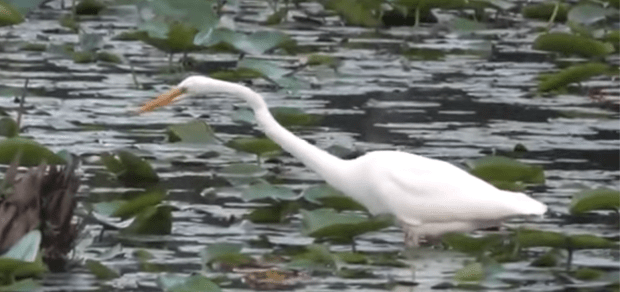
Ferris Akel spent most of the Saturday tour at Sapsucker Lake near Ithaca, New York. It was magical. We never made it to see Big Red and her family at Cornell University but it was a great time. One of the highlights was a Great White Egret which is rare to Sapsucker Lake.

Great Egrets are also called the Common Egret or Great White Heron.

Great Egrets will generally stand and wait to see their fish. They also slowly and quietly wade through the water until their neck snaps quickly and they get their fish.

Patience. Quiet. The Great White Egret gets its dinner.

Great Egrets nest in trees.

The beautiful white plumage that adorns these graceful wading birds was used for women’s hats in the late 19th century. Those silky white plumes are called aigrettes – which gives the bird its name. At the beginning of the 20th century, an ounce of Great Egret feathers was worth $32 USD, more than an ounce of gold according to the authors of Birds of Canada. People were so outraged that some of the first legislation to protect birds and their feathers was because of the Great Egret being brought to near extinction for hats!

In Canada, the Great Egrets nest in a very small number of places – in the very southern parts of Saskatchewan, Manitoba, a small part of southeastern Alberta, and southern Quebec. They are found in the Americas, Asia, and parts of southern Europe.

“Great egret rising” by wolfpix is licensed under CC BY-ND 2.0

The Great Egrets are large birds. They are 94-104 cm (or 37-41 inches) with a wing span of 1.3 m or 4.2 feet. They weight about 1000 grams or 2 pounds. They are all white with black legs and a yellow bill like the one shown above. During breeding season, a patch between its eyes turns neon green and long plumes grow out of its back.

“Great Egret Pointing the Sky” by TexasEagle is licensed under CC BY-NC 2.0

Non-breeding Great Egrets have a small yellow patch between its eyes and bill.

“Great Egret on nest with chicks” by Photomatt28 is licensed under CC BY-NC-ND 2.0

Great Egrets build a flat nest or platform of twigs and sticks. They will lay between 1-6 eggs which are incubated for a period of 23-26 days. It will be another 21-25 days til fledging for the youngsters. Aren’t they cute!

I am getting so excited for Peregrine Falcon season to begin in Australia. The male at the 367 Collins Street Nest also known as the CBD Nest arrived with prey for the female today. He is just such a cutie. The nest camera that streams on YouTube is not up and running. It will begin operations after the eggs are laid (normally). For now there is a camera operated by the owners of the building, Mirvac. Here is the link:

https://367collins.mirvac.com/workplace/building-overview/falcons-at-367-collins?fbclid=IwAR3vGCMkdnScju_KTKjhCrcHRnbsYxJm3kAKTLIOzylSVe8PX3UmwaJEn-s

The other Peregrine Falcon nest is that of researcher, Dr Cilla Kinross, at Charles Sturt University. The scrape box is home to Xavier and Diamond and they have been working on the scrape for some time now. We expect eggs at both nests by the end of August.

If you watch both nests you will get a good glimpse into the difference between a falcon nest on a high rise building in a major city, Melbourne, and the more open rural area of Orange, Australia. The prey is very different!

As it turns nearly midnight on the Canadian prairie, the day is just starting on the Foulshaw Moss Osprey nest in Cumbria. No doubt our beautiful Blue 463, Tiny Little, will fly out from where she is roosting on the branches of the tree in the distance, to the nest. White YW has a trio of big Osprey fledglings to feed. He has demonstrated that he is perfectly capable of feeding a family of five.

Thank you so much for joining me. Take care everyone. I hope to have some local images of bird life in Manitoba for you shortly.

Thank you to the following for their streaming cams where I get my screen shots: Ferris Akel and Cumbrian Wildlife Trust and the Foulshaw Moss Osprey Nest.

Feature Image Credit: “Great egret (Ardea alba) in flight at sunrise at Venice Rookery, Venice, Florida” by diana_robinson is licensed under CC BY-NC-ND 2.0