The Great White Egret

Sometimes there are birds that seemingly get forgotten as I rush to find out if Tiny Little beat the big older siblings to the fish or to check on Malin’s feather growth. Clearly one of those has been the Kakapo. There are now only 202 Kakapo, parrots that cannot fly and who love to eat Rimu, on a couple of small islands near New Zealand. They are continually monitored and all have satellite transmitters. They get health checks and are flown off island for care, if needed.

The Kakapo Recovery has partnered with On the EDGE Conservation to create the Kākāpō Run game. As a player you can help the Kakapo evade their predators will collecting Rimu Fruit. Because it is filled with facts about these amazing birds, it is a good way to learn about them. You can download the game here:

https://play.google.com/store/apps/details…

https://apps.apple.com/us/app/kakapo-run/id1569861836

Ferris Akel spent most of the Saturday tour at Sapsucker Lake near Ithaca, New York. It was magical. We never made it to see Big Red and her family at Cornell University but it was a great time. One of the highlights was a Great White Egret which is rare to Sapsucker Lake.

Great Egrets are also called the Common Egret or Great White Heron.

Great Egrets will generally stand and wait to see their fish. They also slowly and quietly wade through the water until their neck snaps quickly and they get their fish.
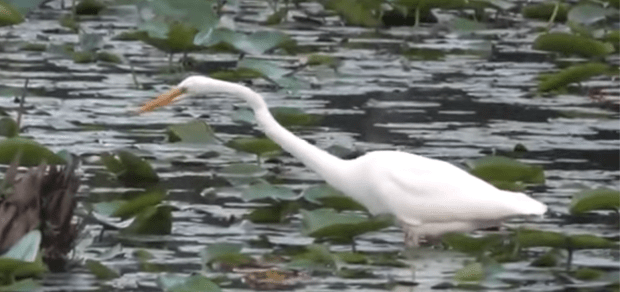
Patience. Quiet. The Great White Egret gets its dinner.

Great Egrets nest in trees.

The beautiful white plumage that adorns these graceful wading birds was used for women’s hats in the late 19th century. Those silky white plumes are called aigrettes – which gives the bird its name. At the beginning of the 20th century, an ounce of Great Egret feathers was worth $32 USD, more than an ounce of gold according to the authors of Birds of Canada. People were so outraged that some of the first legislation to protect birds and their feathers was because of the Great Egret being brought to near extinction for hats!

In Canada, the Great Egrets nest in a very small number of places – in the very southern parts of Saskatchewan, Manitoba, a small part of southeastern Alberta, and southern Quebec. They are found in the Americas, Asia, and parts of southern Europe.

“Great egret rising” by wolfpix is licensed under CC BY-ND 2.0

The Great Egrets are large birds. They are 94-104 cm (or 37-41 inches) with a wing span of 1.3 m or 4.2 feet. They weight about 1000 grams or 2 pounds. They are all white with black legs and a yellow bill like the one shown above. During breeding season, a patch between its eyes turns neon green and long plumes grow out of its back.

“Great Egret Pointing the Sky” by TexasEagle is licensed under CC BY-NC 2.0

Non-breeding Great Egrets have a small yellow patch between its eyes and bill.

“Great Egret on nest with chicks” by Photomatt28 is licensed under CC BY-NC-ND 2.0

Great Egrets build a flat nest or platform of twigs and sticks. They will lay between 1-6 eggs which are incubated for a period of 23-26 days. It will be another 21-25 days til fledging for the youngsters. Aren’t they cute!

I am getting so excited for Peregrine Falcon season to begin in Australia. The male at the 367 Collins Street Nest also known as the CBD Nest arrived with prey for the female today. He is just such a cutie. The nest camera that streams on YouTube is not up and running. It will begin operations after the eggs are laid (normally). For now there is a camera operated by the owners of the building, Mirvac. Here is the link:

https://367collins.mirvac.com/workplace/building-overview/falcons-at-367-collins?fbclid=IwAR3vGCMkdnScju_KTKjhCrcHRnbsYxJm3kAKTLIOzylSVe8PX3UmwaJEn-s

The other Peregrine Falcon nest is that of researcher, Dr Cilla Kinross, at Charles Sturt University. The scrape box is home to Xavier and Diamond and they have been working on the scrape for some time now. We expect eggs at both nests by the end of August.

If you watch both nests you will get a good glimpse into the difference between a falcon nest on a high rise building in a major city, Melbourne, and the more open rural area of Orange, Australia. The prey is very different!

As it turns nearly midnight on the Canadian prairie, the day is just starting on the Foulshaw Moss Osprey nest in Cumbria. No doubt our beautiful Blue 463, Tiny Little, will fly out from where she is roosting on the branches of the tree in the distance, to the nest. White YW has a trio of big Osprey fledglings to feed. He has demonstrated that he is perfectly capable of feeding a family of five.

Thank you so much for joining me. Take care everyone. I hope to have some local images of bird life in Manitoba for you shortly.

Thank you to the following for their streaming cams where I get my screen shots: Ferris Akel and Cumbrian Wildlife Trust and the Foulshaw Moss Osprey Nest.

Feature Image Credit: “Great egret (Ardea alba) in flight at sunrise at Venice Rookery, Venice, Florida” by diana_robinson is licensed under CC BY-NC-ND 2.0

Tuesday 20 July in Bird World

It has been a very strange day. We had a tiny bit of rain during the middle of the night on Monday with lots of thunder and lightning. It was not enough rain to help anything. South of where I live in a town called Morris, Manitoba, the river is practically bone dry. Dead fish is all you see and dirt. Old timers are starting to talk about the days of the Dust Bowl. I think about all the birds that depend on the water and the fish. A follower wrote to me and asked me if I knew anything about the ospreys at a nest in Wisconsin – the Collin Marsh Osprey Nest. It is not a nest that I follow but I did check. Just as ‘S’ had noted, the only chick on the nest looks a bit thin. As it turns out there were originally three relatively healthy chicks. Now there is only one. They are not sure what killed two of them. I am hoping that the Neustadter Nature Centre will be doing a post-mortem. It could well be the heat. A bander in Wisconsin said that they had found many dead chicks in the nests. That is very very sad. In England, many of the nature areas that were closed during the pandemic were taken over by the wildlife only to open and have humans scare birds off their nests and chase animals out of the area along with purposefully setting fires. What in the world is wrong with humans? Sorry. It just seems that you go two steps forward and three backward sometimes. Very frustrating.

As you know, I really admire Ferris Akel. He has a regular tour of the Montezuma Park area, Wildlife Drive, Sapsucker Lake, and the Cornell Campus every Saturday. Ferris has someone editing his videos and they are simply excellent. Today, he posted the Red Tail Hawk highlights from his tour on 16 July. It’s OK to say, ‘Oh, my, aren’t they cute!” Have a look:

The Royal Cam princess, Taiki, on Taiaroa Head, New Zealand was weighted today. Las week she weighed 8.2 kg. Today, her mum, Lime-Green-Lime came in to feed Taiki right before weighing. Taiki is 177 days old and today she weighted 8.8 kg or 19.4 lbs. No worries about any supplemental feeds! Taiki’s mother has been in to feed her every day for the past six days. That means that she is foraging very close to Taiaroa Head which is in the very south of New Zealand near Dunedin.

Every year the New Zealand Department of Conservation bands the chicks born on Taiaroa Head. This year the bands will be white. Last year they were green. The banding is very important. It allows the rangers and all other interested parties to identify the birds when they return as juveniles, when they select mates, and when they return to breed. That banding will take place between 11-4pm NZST.

Many of you will have heard the term ‘translocation’ in relationship to the Ospreys in the United Kingdom and many of the projects of Roy Dennis and his Wildlife Foundation. There is news of a different translocation project, an extremely complicated one. To save the Black-footed Albatross on Midway because of rising sea waters, eggs are being transported 6000 km from Midway to Guadalupe Island in Mexico. The researchers say it was their only option. The waters are rising fast and soon Midway will flood.

“Black-footed Albatross” by tombenson76 is licensed under CC BY-NC-ND 2.0
“Black-footed albatross chick. Photo credit: Eric VanderWerf” by USFWS Pacific is licensed under CC BY-NC 2.0

They hope that the Laysan Albatross foster parents will accept the chicks and eggs and that those chicks will fledge and return to Mexico to breed – not Midway Atoll. So far 93% of the hand-reared albatross, in other projects, have fledged. Let us hope that this project has such a high success rate! Here is an article on this incredible project:

https://www.sciencemag.org/news/2021/06/they-were-destined-drown-how-scientists-found-these-seabirds-new-island-home?fbclid=IwAR0ZtdwlPW1PElHy6uW5c1zW-Ojt4JC825Ccgor8f_imnjxVgs1COq5NolY

Of course, rising waters and seas heating up and fish dying are not the only threats to the albatross. Another is the level of plastic garbage in our oceans. It is estimated that by 2050 if humans do not curtail their use of and dumping of plastic, there will be more of it in the oceans than there is water.

“Black footed albatross chick with plastics. Photo credit: Dan Clark/USFWS” by USFWS Pacific is marked with CC PDM 1.0

Black-footed Albatross is exclusive to the North Pacific Ocean living and breeding at the Midway Atoll which is part of the state of Hawaii. Some nest off of Japan. They breed around the age of five years. Like other albatross, they forage off of what they can find on the surface of the ocean such as squid, fish, and crustaceans. They have been known to eat refuse and carrion. When they intake the water, you can see in the image above, that they also ingest plastic floating in the ocean. It is not, of course, just the plastic that you can see but the chemicals that keep the plastics soft that are appearing in the eggs of the birds. Those chemicals are known as phthalates. These are found in the yolk of the eggs of the birds. An ongoing study on gull eggs may reveal the damage that will be done to the chicks. I will keep you posted.

Did you know that at the turn of the century it was fashionable to have an entire dead bird decorating your hat? Etta Lemon campaigned against the use of feathers of any kind in the fashion industry.

Many of the species that I write about were made or almost made extinct because of this practice – the Albatross and the Osprey – are only two.

It is 4:30 in the morning at the Foulshaw Moss Osprey Nest. Tiny Little is waking up. You can see the silhouettes of the other two siblings and the parents on the tree in the distance.

After missing out, at 13:30, Tiny Little figured out what he had to do to eat. When White YW comes into the nest with a fish, you claim the fish as yours! And TL did that. Yeah for Tiny Little!!!!!! This is a good lesson to learn. In the world of Osprey you need to be a little assertive even if you would rather not.

Thanks, Dad! So glad no one else is here!

Tiny Little has the fish between his talons and he is going to eat it. Dad took the head off so he doesn’t have to deal with those annoying bones like the ones around the eyes.

It is now 16:34 on the Foulshaw Moss Nest. Tiny Little is standing on the big stick and 464 is eating a fish. Will there be any left for Tiny Little? or will Tiny Little take off flying?

Thanks so much for joining me this morning. It is raining again where I live. The sky is light grey, the trees and plants are green and it is wonderful! It is 18 degrees, a much more normal summer temperature for us. They even say we have a chance of rain tomorrow. This will not fill up the Morris River but it might help the grass, the trees and the flowers the nectar eaters need. Take care all. Stay safe. See you soon.

Thank you to the following for their streaming cams where I get my screen shots: Cumbrian Wildlife Trust and the Foulshaw Moss Osprey Nest, and the Cornell Bird and NZ DOC Royal Cam Albatross.

The credit for the featured image is: “Black footed albatross chick with plastics. Photo credit: Dan Clark/USFWS” by USFWS Pacific is marked with CC PDM 1.0

Adventures in Ospreyland and other bird tales 16 July 2021

Imagine that you have one child. Everyone is happy – it is easy to provide for the one. Then imagine one day you blink and think you are seeing double. But you aren’t. There are two children. Now imagine that you are away from home and return to find three. Osprey families have the same difficulties in providing for multiple children just like humans. The adults at the Patuxent River Park in Upper Marlboro, Maryland, Osprey nest number 2 now have that challenge! The pair had only one chick of their own and are now fostering two chicks about the same age as theirs.

Cathy Cohen of the Jug Bay Natural Area posted the following image on the park’s FB page today of the mom and the three chicks. The first foster chick was placed on the nest on 30 June. Nest 2 was chosen because the foster chicks are about the same age as the one hatched on the nest. There they are. It is incredible. They look like a perfect match. How wonderful to give those two lucky ones another chance. Intervention can be a good thing.

The foster Mom was said to have welcomed the chick who had fallen from a barn silo with open wings yesterday! Here she is looking over the babies while they are sleeping (or supposed to be sleeping).

And here they are this morning. It is getting warm and the new babies are getting shade.

Most of the time if I say the name ‘Iris’ everyone knows who I am talking about. If you don’t, here is a mini-bio. Iris is an Osprey. She is 26-28 years old. This makes her the oldest Osprey in the world. Iris has her nest at Hellgate in Missoula, Montana. The platform was put up for her and her mate, Stanley, to save them from getting electrocuted on the hydro lines. When Stanley did not return from migration, Iris bonded with Louis. They have only had one chick survive. That was a female, Le Le, in 2018. The reason for this is that Louis has another mate and another nest at the ballpark. For years, people have watched Iris perfect the renovations on her nest, catch magnificent fish, mate with Louis, lay her eggs and then either have the ravens steal and eat the eggs or have the chicks die because the female cannot protect them and fish at the same time. Individuals are very vocal in their support of Iris. They want her to have another mate and to be able to raise chicks. I have always thought maybe she could retire with dignity and just take care of herself during her summers in Montana. At the same time you know just seeing her work on the nest and the fish she brings in that she would be an amazing parent. The issue is one of territory. Iris’s nest is in Louis’s territory – according to Louis. Louis has protected Iris on a couple of occasions this summer from intruders. Iris has also managed on her own to thwart them. She is strongly independent.

When someone posted an image of Iris sitting on a branch with another Osprey on Twitter 15 July 2021, people got excited.

The notion that Ospreys mate for life is not consistently true. When Blue 5F, Seren, got tired of laying a nest full of eggs only to be abandoned by Aran because he also had a nest with Mrs G at Glaslyn, she left Aran’s territory and found another mate, Dylan, at Clywedog. According to Google Maps, Seren moved a distance of 67.4 miles. Seren and Dylan are the proud parents, this season, of fledgling Blue 396 otherwise known as Only Bob.

It will be very curious to see how things develop over the end of the summer.

We all worry about Tiny Little. It is easy to forget looking at Blue 463 that at one time his older siblings kept him from eating and were quite aggressive. Because of that Tiny Little is hesitant to engage with the older siblings and, in particular, Blue 462. So there are worries that he will not get enough to eat. Today White YW brought in a fish and within about 15 minutes he brought in another fish. Blue 35 took that one and fed Tiny Little while the other two were eating fish pieces. What a beautiful image of Mum and her three chicks on the Foulshaw Moss nest having a nice meal of fish.

People have been asking if Tiny Little has been flapping. OH, yes, he flaps those wings all the time.

If you want to join in the fun watching Tiny Little prepare to fledge, this is the link to the Cumbrian Wildlife Osprey Cam:

https://www.cumbriawildlifetrust.org.uk/wildlife/cams/osprey-cam

Erick Green with the Montana Osprey Project posted some images of chicks who were entangled with baling twine. They saved three chicks a week ago but sadly one had died. Another chick had twine cutting into his right leg to the bone. Dr Green reported today that the chick is doing fabulous today. In his posting I learned something interesting. He says, “One thing that seems to work in their favor is that ospreys (and all birds) have very high body temperatures – about 105 degrees Fahrenheit. These high body temperatures help birds fight off many bacterial infections.”

Only Bob, Blue 396, has gotten really good at flying and zooms in when Dad Dylan does a food drop. Poor Seren might have to discuss Dylan bringing in an extra fish for her. Only Bob can finish them off pretty good! Look at how big this fledgling is. Wow. Dylan delivered the fish around 13:09.

At the Dyfi Nest, Idris and Telyn are waiting for Ystwyth to fledge! So is her brother Dysynni. He is sitting there urging her to come on and join in the fun while the parents are up on the camera perches watching. Ystwyth was getting some really good height to her hovering and she will go soon if not today. She is 53 days old.

Here is Ystwyth hovering. Isn’t she great?

Other nest news:

There is sad news coming out of Taiaroa Head, NZ. One of 33 Northern Albatross chicks died yesterday. The chick was not gaining weight and the NZ DOC rangers gave it a supplementary feeding. When the chick died following this it was discovered during the necroscopy that it had a piece of charcoal stuck in its trachea. As Sharon Dunne notes, charcoal floats on the surface of the ocean and it can easily be taken in by the parents when they are out fishing for food for their chick. I never imagined charcoal! Everyone is distraught. The rangers do such an excellent job taking care of these parents and chicks. Condolences go out to all of them including the albatross parents.

Our little Golden Eagle, Zenit, has had a prey delivery – a bird – and is beginning to stand really tall and strong on its legs – adult style. All good news! The Golden Eagles eat the bones – absolutely every part of their prey so Zenit will have something later. Still, having lots of meat is what this young eaglet needs right now. Excellent news.

Ferris Akel has posted a nicely edited version of his tour on Wildlife Drive on the 14th. The editing is well done and there are discreet bird names in case you do not recognize what you are looking at. There are some really nice shots of a Black Tern. Here is that short clip.

My friend, ‘T’ tells me that there is a stork with an injured food that is getting a prosthesis. Will try and find out all the news on this incredible intervention.

And speaking of storks, there are still three White Storklings on the Mlade Buky nest in Czechoslovakia:

That’s a short morning round up of happenings late Thursday night and early Friday morning at some nests. Remember that Ferris Akel does his tours on Saturday. He begins at noon NY time and ends up at the Cornell Campus. It is a great opportunity to see the Red tail fledglings in action. They have now moved from flying near to the nest to other buildings farther away. Big Red and Arthur do this with prey drops gradually to expand their territory. It will not be too long til they are down by the barns at Cornell. Always fun. You can search Ferris Akel Livestream on YT. Thank you so much for joining me. Take care everyone.

Thank you to the following for their streaming cams where I get my screen shots or add their videos: Ferris Akel Live Tour, Patuxent River Park Ospreys, Montana Osprey Project FB Page, Cumbrian Wildlife Trust and Foulshaw Moss Osprey Cam, Dyfi Osprey Project, CarnyX Wild and Llyn Clydewog Osprey Cam, Capi Hnizdo- Mlade Buky, and Asociatia Wild Bucinova.