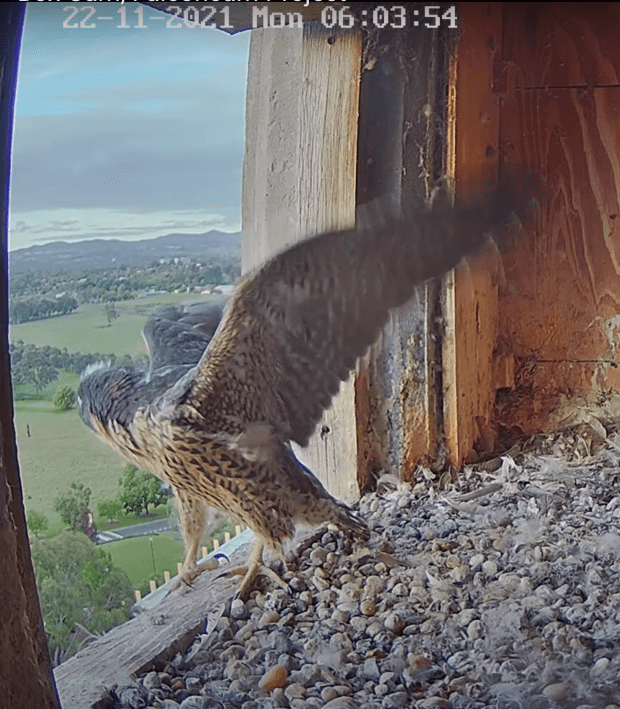
As many of you are aware, Yurruga has not been seen since last Thursday. Cilla Kinross saw him on the top of a building in the pitching down rain and later, university workers also saw Yurruga on the same building. Cilla sent me a short note this morning because I had written to her earlier about Yurruga’s 2nd right tail feather still being contained by the quill. The local vet did not think this was a problem but, like Cilla Kinross, was concerned about a lack of feather development on the little falcon. What impact this might have had will never be known. Cilla has looked and looked in all the places Yurruga might be and others but she is concerned and has posted a note that has been placed on the FB Page for the Orange Peregrine Falcons. I was very touched because she referred to Yurruga as a ‘poor little lamb.’ Every day is a test for our birds. Even the strongest have challenges. It is difficult enough for fledglings but compounded with unkind weather for numerous days, well. Yurruga should be flying around screaming at his parents for food and the conclusion is that he is no longer with us.
The parents, Xavier and Diamond, had an extremely long – fifteen minute or more – bonding session in the scrape yesterday morning at 05:15. This is simply not something that would normally happen with a fledgling needing prey and training. Considering the work of Marc Bekoff (Emotional Lives of Animals), Jane Goodall, the observations of Hob Osterlund with the Laysan Albatross, the bonding behaviour of Xavier and Diamond should be considered alongside grief. While we have only a limited view of the falcon’s behaviour, it might be assumed that the couple have now grieved for their wee one and are, with the weight of that loss, reconfirming their love and commitment to one another. We cannot do a brain scan on Diamond’s hippocampus (area of brain in human animals for emotion) to see if it lights up, Barbara J King in her book, How Animals Grieve, would tell you that the investment in the mating, the making of the egg, the care and incubation, the care and feeding after and training, she says that ‘grief comes from love loss.’ There have been roadside funerals of Crows, Ospreys who have mourned the loss of their chicks by predators. Other bird species and drowned themselves after the death of their mate. And, of course, all of you reading my blog, will know about Arnold and Amelia, the two Canada geese. Arnold and Amelia lived at the pond on the grounds of the clinic (fortunate for them!).* Arnold had one of its digits severed by a snapping turtle and required surgery. Amelia went to look for Arnold and watched through the glass, finally sharing a meal and a pen til Arnold was released.
So, today, we grieve with Xavier and Diamond over the loss of little Yurruga.
It was a beautiful morning when little Yurruga flew for the first time.Diamond and Yurruga bathed in the golden glow of the sun the morning Yurruga flew.Xavier feeding his baby.Xavier brings prey for Yurruga.Diamond and her baby.Xavier feeding Yurruga. Xavier loved getting a chance early on to feed his little one.
What an adorable little eyas. Fly high little one. Fly high.
I am so sorry to bring this terrible news to you. We join Xavier and Diamond, Cilla Kinross and the team at Orange in their mourning.
Thank you to Charles Sturt University and Cilla Kinross for the streaming cam where we get to share the joys and the sorrows – and where I took my screen shots of this lovely Peregrine Falcon family.
I say this because many do not consider the mate when one is taken into care. Arnold and Amelia were extremely lucky.
Diamond laid her first egg of the 2020 season at 04:16:09 on 27 August! She looked uncomfortable during the day with her rear all puffed up. How grand! Here is the video of that magical moment last year. If you have never seen a bird lay an egg, have a good look. They go into labour just like human females. The egg inside is very soft. You have probably noticed that the female birds do not immediately begin incubating the egg once they have laid it. This is so the air can harden the shell. In fact, Diamond is not going to start serious hard incubation til all of the eggs are laid. This is so the eyases will be born closer together, be a similar size, and not have the issues that eagles and ospreys have with the tiny third hatch.
There are now two Peregrine Falcon nests in Australia on streaming cam. If you miss Annie and Grinnell then please check out either of these. This is the link to Diamond and Xavier’s camera. There is a chat and excellent moderators. There is also a FB page.
We continue to wait for the 2021 egg!
The other Peregrine Falcon nest is on Collins Street in Melbourne and that happy couple are already incubating three eggs. Last year they raised triplet girls. I just love this couple.
And before everyone gets nervous, don’t. There is more of a ledge in front of this scrape box than in Diamond and Xavier’s.
Falcons are amazing to watch raise their clutches. You do not get the sibling rivalry like you do in WBSE, Eagles, or Ospreys. That again is because the eggs are not hard incubated until all of them are laid. So sit back, relax and watch the fun!
Here is the link to their camera. There is no chat.
Tiny ‘Not so Little’ is still around! She was eating a nice fish after 20:00 last night. Some are beginning to wonder if she will be too heavy to fly for migration! LOL. She certainly will be well prepared. Tiny Not so Little is a very clever girl. Let those others go first. Let dad work and stay a little later, too.
Tiny Little, there are so many people who admire you and cannot wait for you to return in 2023. Meanwhile I keep thinking that you might be like the Sharp-shinned Hawk that frequents my garden in the winter. He is an anomaly. Are you?
Migration is really in full swing here in Manitoba. There will be a number of celebrations beginning in a week as the various species make their way south to get away from the harsh winters of northern Canada. I headed off to one of the biggest environmental projects in our City – Fort Whyte. More about that later. Surely there would be ducks and geese and other species. Well, not so many. A very cranky male Canada goose did not like me within 13 metres or about 40 feet of his two juveniles and the female. He kept a good close eye on what I was doing.
It was early afternoon and the geese were obviously very thirsty. Their goal before the male noticed me was to get to the pond and have a big drink.
Some of them did this sort of gargling motion!
This beautiful little female mallard didn’t seem to mind my presence across the boardwalk. She watched me for awhile and then began preening.
And if you ever wondered, mallards are dabbling ducks. Much of the time this afternoon they were busy searching for food.
Often nature centres have special events surrounding migration. Our first is on 2 September but the one that I really look forward to is later in September or early October. It is the Goose Flight dinners at this very nature reserve I visited today. Enjoy a great meal with local ‘everything’ and then enjoy the thousands of Canada geese that fly in at dusk. It is unforgettable.
We are now putting out extra suet cylinders and topping up the feeders during the day plus all the water bowls. Just like Tiny Little needs a nice layer of fat reserves, all of the migrating birds need to eat well to help them be successful.
Brush up on the difference between the terms environmentalism and conservation. We are going to play a game in my blog on Saturday!
Take care everyone. Thank you for joining me today. Stay safe.
Thank you to the following for their streaming cams where I took my screen shots: Cilla Kinross and The Falcon Cam at Charles Sturt University in Orange, 367 Collins Street by Mirvac, The Cumbrian Wildlife Trust and the Foulshaw Moss Osprey Cam.
I want to thank everyone that took the time to write to me and tell me how much Malin meant to them. My inbox was overflowing with letters expressing love and concern for Malin. Everyone wanted to know if there had been any word. Mom and Dad have both been on the nest with fish and today Marsha (mum) was there around 13:00. She did not have any fish that visit. During her morning visit she called out for Malin. So far there has been no sighting of Malin.
After going through the FB postings of the Nature Center, we were able to determine that Malin was the middle hatch. The youngest just disappeared from the nest and the eldest died in the middle of June leaving Malin, the chick that hatched on 18 June, alive. Malin was then the middle hatch of 18 June. Malin then was 63 days old at fledge. The average age for ospreys to fledge in Wisconsin appears to be 55 days. That would make Malin’s timing within range. Most ospreys spend at least 2 weeks flying and letting their parents feed them. Many stay much longer. Two examples that I give are Tiny Tot and Tiny Little because they were both hatches that suffered from lack of food. Tiny Tot stayed on the nest for a total of four months or 120 days. That is more than twice as long as Malin. Tiny Little remains on the nest in Cumbria. She will probably fledge before Tiny Tot’s 120 days – but she could be on the nest for 90 days.
There is disagreement over whether Malin simply flew or whether or not Malin was frightened off the nest by an intruder. Experts on both sides see that exit differently. It is unfortunate. The result is the same – Malin has not returned to the nest. The reactions to looking for Malin are different depending on which you believe. If Malin just flew because he wanted to then no one would go and really look for him. If one believed that Malin was frightened off the nest, they might worry that he was injured and look harder. Something that has to be kept in mind is that Osprey feed their fledglings on the nest – it is preferable. They do sometimes feed on a branch but I haven’t found an Osprey expert that has ever seen an Osprey parent feed their fledgling on the ground. In fact, if a fish falls off a nest they will not go and retrieve it. Have you ever seen an Osprey eat or feed its chick on the ground?
The research continues to stress that the more food and the longer fledglings stay on the nest the higher the success rate. That is the reality. This nest is really empty. Malin defied the odds – he survived and thrived. We hope that the name we gave him carries him on into his life and that he is somewhere safe eating a fish.
Collins is looking down like he might be seeing Malin.
One of the last times the entire family was together on the nest. It was a real privilege to watch little Malin survive and then – thrive. Let us all continue to send this family positive energy.
19 August 2021. Malin, Marsha, and Collins.
It is about 7am in Latvia and Estonia as I write this. The Black Storklings are waking up and like all birds are a little more energetic than they are at mid-day.
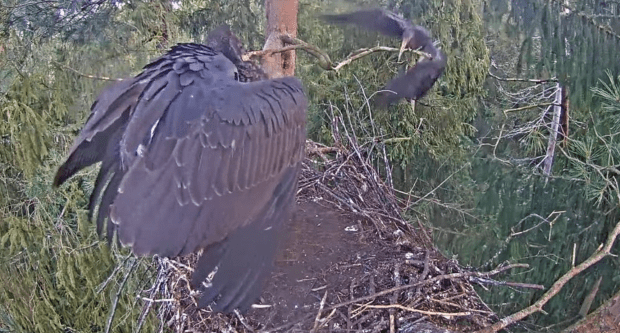
The two images below are from Grafs and Grafiene’s nest near Sigulda, Latvia. At least one of the storklets has fledged. Perhaps today they will all fledge and find the feeder area with the beautiful Grafiene decoy.
It is now just after 9am in Latvia and there is only one storkling on Graf’s nest near Sigulda. This means two have fledged just like my source had indicated. The second fledge is the oldest at 7:43 am. He is 70 days old today. The youngest fledged at day 66 after hatch.
This was not the smooth flight of the youngest. The oldest hit the branch on the other side of the tree. There is concern about the condition of that wing. I will update you as soon as there is any information. Send your strong and positive wishes. I hope it looks worse than it was. How terrifying for this young bird to have that happen.
Even so, I hope that both of the storklings are at the feeder filling themselves with fish – just like we hope Malin is doing the same.
There is now only the middle hatch. Perhaps it will go today. They are 68 days old.
When I checked on Jan and Janika’s storklings in Estonia’s Jogeva County, no more fish have been delivered to the nest. It looks to me like every scrap of the old fish has been eaten – I thought that yesterday. Perhaps one really packed down in the nest is there, the one the storkling on the left is pecking at. All of the birds need food.
Hopefully all of them will fledge and find the feeder set up for them, too.
They are so beautiful with the sunlight filtering through the trees. The storks are 67 and 68 days old today. The average for fledging is 68-72 days. I wonder if Urmas will deliver some more fish?????
Do you watch the peregrine falcons, Xavier and Diamond? If you do, then you will know that part of the pair bonding ritual is Xavier presenting a prey item to Diamond. Diamond is not that particular but, she does not like Starlings. She cannot stand them. She has turned Xavier away when he had a Starling for her. They must taste terrible!
Well, today, Xavier hit the jackpot. Diamond was completely excited about her lunch – although some of you might not be. Xavier had a Superb Parrot for his beautiful Diamond. Make sure your sound is turned up.
Superb Parrots are also known as Green Leek Parrots or the Barraband’s Parakeet. These little beauties are native to southeast Australia living in the dry woodlands of New South Wales and Victoria. They were once considered vulnerable in terms of conservation and have been listed as Least Concern since 2012. Loss of habitation due to timber logging might well see this bird back as being vulnerable.
They are medium sized, growing up to a little over 15 cm or 16 inches in length. The bird in the image below is a juvenile. How do I know that? It has brown eyes while the adults have yellow-orange eyes. The adult male has a bright yellow face and throat while the female looks like the plumage that the juvenile has below. They eat fruits, berries, insects, as well as grains and nuts.
WBSE 27 and 28 continue to charm the socks off of everyone. That beautiful fluffy white down is in transition. They look a little like old terry cloth towels sleeping in their nest this morning in Sydney.
Look closely along the edge of the wing of WBSE 28 on the left. You will see the little pin feathers coming.
The pantaloons are growing too.
Just look at that sweet baby, WBSE 28, looking up at its parent. How adorable.
They are so young and yet, both of them know to pancake when there is an intruder near the nest. They hear their parents alarming and down they go. Look at the concern shown in the eye of WBSE 27 on the left. You can also see the black pin feathers coming in on both in this image better than the other one. But look – their cute little tails are growing!
You cam almost see them growing right before your very eyes.
Tiny Little still makes my heart skip a beat. Oh, what a wonderful bird you have turned out to be. You were so very tiny with that big older siblings but just look at you waiting for your breakfast to arrive.
Oh, you have that ferocious look like Mrs G. I have said that a couple of times but you do, Tiny Little. I hope you live as long as Mrs G and have lots of successful hatches. You really are quite amazing, Tiny Little.
Tomorrow is Saturday but there is no Ferris Akel tour this week. I was hoping to catch up with what is happening with Big Red and her family. It was raining yesterday but the Hornings were able to spot all four of them so we know that K1 and K3 are still with us – how grand, the 21st of August.
I am researching ‘Climate Driven Evolutionary Change’. If you know of bird arrivals or departures that are earlier than normal or later than what has been the norm, please let me know. It is much appreciated.
It is so nice to have you here with me. The rain is still falling – and that is a good thing. Please continue to send your positive wishes to Malin and all the bird families. Take care of yourselves. See you soon.
Thank you to the following for their streaming cams where I took my screen shots and video clip: The Falconcam Project at Charles Sturt University and Cilla Kinross. Collins Marsh Osprey Nest, Cumbrian Wildlife Trust and the Foulshaw Moss Osprey Cam, The Eagle Club of Estonia, The Latvian Fund for Nature, and the Sea Eagles Cam, Birdlife Australia, and The Discovery Centre.
Lots of people keep track of hurricanes and tropical storms. Most watch because they or their loved ones, or both, live in the line of the storm. Bird watchers also track weather systems. There are currently two systems that might impact our beloved Big Red and family as well as the birds that are migrating over Hawk Mountain, PA.
Henri is going to give some heavy rain and wind. Ithaca is west of the darkest green band but could get some rain.
Tropical Disturbance Fred will also give some heavy rain in the same area. There were flash flood warnings for Ithaca last night. It is 1:03 am Thursday morning in Ithaca and there are rain drops dripping off the metal supports of the light stand that Big Red and Arthur’s nest is on. The rain does not look heavy at the moment. There is also a peculiar corn plant growing out of the centre of the nest!
Heavy rain will impact the hawks ability to hunt. They would have felt the pressure system coming and hopefully caught more food yesterday.
This isn’t the beginning of the season. Hurricane season runs until 30 November.
Baby Kindness (I wonder if she would mind if I call her that?) is not worried about hurricanes. Today, she is 83 days old. Kindness branched yesterday and all she has on her mind is ___________________. If you said flying you are 100% correct. She has really been putting on a show for the people watching the live stream today.
Oh, she really gets some nice air under those wings going back and forth from the branch to the nest.
Wow. Look at those wings. Magnificent.
Kindness has spent a lot of time considering what is below that branch she is sitting on. Sometimes she gets the branch to bouncing a bit and that seems to unnerve her slightly and she flies back to the nest.
For several days, I have been talking about the migration of Ospreys in Wisconsin, like Malin, or those living in the United Kingdom or in Northeastern Europe. The Bald Eagles in Alaska do not migrate south of Alaska unless there is no food. In 1972, the State Legislature established a long stretch of the In Chilkat River as critical bald eagle habitat. The goal was to protect the birds, some 4000 of them, that move from the interior to the Chilikat River Valley where they feed on the Chum Salmon run during the late fall and winter. The juveniles normally eat spawned and dead salmon or the carcasses left behind by bears.
The Glacier Gardens Rainforest Adventure is located in the Tongass National Forest just fifteen minutes away from Juneau. This is where Liberty and Freedom have their nest and where Kindness will fledge. There are meadows, forests, and glaciers. What a spectacular place to be a Bald Eagle!
Liberty, Freedom, and Kindness are not far from the Chilikat River Valley and the Alaska Chilikat Bald Eagle Reserve.
In the spring, many of the Bald Eagles will head to areas rich with Herring and Eulachon. These include the Stikine River, Copper River Delta, Silka Sound and Kenai Bend. You can see some of those on the map below. The Copper River flows from Prince William Sound while Silka Sound is closer to Juneau on the far right bottom.
Kindness is fortunate to live in such a beautiful state with what we all hope are abundant resources for her and all the wildlife forever.
There are so many worries in the world. The birds bring so much joy to each of us filled with nail-biting anxiety and that bittersweet moment when our friends fledge to begin their lives off the nest.
Malin is beginning to feel the wind beneath his wings. For so long I did not believe that Malin’s feathers would develop and he would fly – but here he is preparing just for that. Joy.
Like other birds, Malin is doing much more wing strengthening flapping as fledge approaches. The energy from the fish he is eating gives rise to lots of exercising after a feed.
For tonight though, Malin is sleeping like a duckling dreaming of fish.
While Kindness and Malin are dreaming of fish and flying, Xavier and Diamond are constantly pair bonding while preparing for their 2021 eggs and hatches. After doing their courtship dance in the scrape box today, they sealed the deal with a kiss – peregrine falcon style.
Can you think of a better way to end this newsletter? I can’t!
Want to catch the adventures of Xavier and Diamond, here is the link:
Well, what could be better than a Peregrine Falcon kiss? Three Black storklings eating the fish that Urmas brought them. That is actually cause for a big celebration!
When the storklings woke up at dawn and found the fish gift from Urmas, they began to eat.
The feeding of the storklings is a success! Congratulations.
Thank you for joining me this morning. Have a wonderful Thursday. Take care all.
Thank you to the following for their streaming cams where I took my screen shots: Cilla Kinross and the Falconcam Project Charles Sturt University, Collins Marsh Nature Centre, Glacier Gardens Rainforest Adventure, Google Maps, Cornell Bird Labs Red Tail Hawk Streaming Cam, and the National Hurricane Centre.
Wow. At 00:52:40, Mom goes into labour. She is the female Osprey on the Port Lincoln Osprey Barge in Australia. Dad is sitting right at nest side in support. It was magical. The minute the egg was, Dad was off. My time said 00:57:58. And with that single significant event, the Port Lincoln Osprey season for 2021 is underway!
Mom looks very content in the early morning Australian sun.
I was very glad to see Dad there. Last year Dad just about ended my love of Ospreys. The death of Tapps, the third hatch in 2020, practically cemented that. The Achieva Osprey nest brought back the pain but the triumph of Tiny Tot gave me faith. It also has made me question the entire notion of ‘survival of the fittest’. So this year I am wishing for consistent fish drops when the eggs hatch – Dad, that means enough fish for everyone every day with no breaks.
The Northern Hemisphere fledglings are preparing to migrate (if they hatched in an area where the birds travel to warmer climates during the winter) so for all Osprey lovers this is a chance to start at the very beginning again — in Australia.
The adults spent a lot of time bringing in new twigs and lining the nest cup with bark. It is quite beautiful. This nest looks like someone cares!
Of the chicks that have fledged from this nest, Calypso (2019) fishes and is seen regularly in the Port Lincoln area. Solly (2020) was fitted with a satellite tracker as well as a leg band. It is reassuring to know that she is well. There have been no reported sightings of her brother, DEW, that I am aware of.
Solly is 317 days old and she is at her favourite place, Eba Anchorage.
The two eggs have hatched at the White-Bellied Sea Eagle cam in the forest of the Sydney Olympic Park. They are WBSE 27 and 28. Both are doing fantastic. Dad has been bringing in Bream, Pigeon, several other types of birds, and Eel-tailed Catfish. The chicks are not wanting for food or variety!
The link to the Sea Eagle Cam is here:
Are you a Peregrine Falcon lover? There are two excellent nests in Australia on streaming cam. One is on all year round and has covered the antics of Xavier, his mate Diamond, and their son, Izzi. The scrape box is on the water tower on the grounds of Charles Sturt University in Orange, NSW. This family is part of a research project of Professor Cilla Kinross.
I should tell you that this nest is hilarious. Xavier is such a sweetie and he is courting Diamond now even though they have been a bonded pair for a number of years. He brings her gifts of prey to the scrape box and they do a courtship dance. Sometimes Xavier forgets and brings Diamond a Starling. Diamond hates Starlings and refuses to accept the gift from Xavier! And then there is Izzi. Izzi is like the cutest almost one year old falcon. He should not be at the nest but he is. You see, Izzi fledged three times. The first was accidental so he was taken back up the 170 stairs to the scrape box on the water tower. The second was a good fledge but he ran into a window. He was in care for several days and returned to the scrape box. The third time was the charm. The problem? Well, Izzi should have left his parent’s territory before the beginning of 2021. Yes, it is now August. That is the problem.
I mean seriously – could you tell this cutie pie to leave home?
Both Diamond and Xavier have been ‘scraping’ in the scrape box. The indentation they are creating is where Diamond will lay the 2021 season eggs. The couple have already been mating on the top of the water tower.
This is Xavier. The yellow around the eyes, the cere (part above the beak), and the legs and feet are a deep yellow when falcons are adults. Look at the beautiful plumage patterning.
This is Xavier scraping in the scrape box.
This is Diamond scraping in the scrape box. Notice the colour of the stones. In his book, The Peregrine, J.A. Baker states that “Peregrines bathe every day…The bed of the stream must be stony and firm…They favour those places where the colour of the stream-bed resembles the colour of their own plumage.” Absolutely. Camouflage. But why do they take so many baths? Baker believed that it was so they would not transfer any lice or other parasites from their prey onto them that could cause illness or disease. The same is true of the scrape box. Peregrine falcons lay their eggs in gravel and not on a twig nest to avoid illness or disease.
Here is a very short but loud pair bonding in the scrape box. Have a look at the dance that Xavier and Diamond do together. Xavier is the smaller of the couple. Falcons, like other raptors, have reverse sex size diamorphism – meaning the female is larger.
Here is the link to the box camera. There are in fact two cameras: one looks at the inside of the box as above and the other is positioned to look forward from the back taking in the ledge and a bit of the outside world. That is cute little Izzi looking out to that big world beyond.
The chat feature has moderators, often Professor Kinross, as well as a FB Page where you can get great information.
The second is the Collins Street Falcons better known as the CBD Falcons in Melbourne. The camera is not operational yet. There are many videos from last year if you search for Collins Street Falcons on YouTube. In 2020, the couple had triplet girls. Triplets? Three eggs hatch within a period of 24 hours. These girls grew like crazy. They grew bigger than their dad.
I am including one video of the male delivering a pigeon to feed them. I just love this tiny little male. He melts my heart every time I look at him.
The diet of the two falcon families is different. The Melbourne falcons are urban. Their diet is almost exclusively pigeon. In contrast, the falcons in Orange are rather rural with a more varied diet including Starlings (remember Diamond dislikes those), Galah, sometimes a Supreme Parrot, other parrots, and birds. One thing that eyases love are cicadas. They hold them in their foot and eat them like a popsicle. It is crazy. In one day last year, Izzi ate 17 cicadas in a row. There had to be a swarm of them! It was incredible.
As night comes to the Canadian prairies the sun is rising on a new day in Europe for all of the birds. The rain falling in the Latvian forest where the three Black storklings nest sounds wonderful.
It was reported today that my city had only 1/10 the average amount of rain in July. It has been 150 years since this small amount of rain was last recorded. We long for a day just to listen to the sound of rain falling like it is here on the Black Storklings in Latvia:
Thank you so much for joining me today. It is wonderful to have you with me. Take care everyone!
Thank you to the following for their streaming cams where I took my screen shots: The Latvian Fund for Nature, Sea Eagle Cam, Birdlife Australia and the Discovery Centre, Charles Sturt University and the Falcon Cam Project, Port Lincoln Osprey Project and PLO FB Page for Solly’s transmitter data.
Note: The next newsletter will appear late Tuesday.