Mom was in labour for about seven minutes. This is a short clip of the last minute. You can see how she is contracting.
The time was 10:20:11 on 29 August 2021.
Dad, you are going to be so busy!!!!
Oh, Dad, you are the cutest. Look at you incubating those three eggs just half an hour before the 4th arrives.
You can watch all of the action in Melbourne here:
If this is the last egg to be laid, Mom and Dad will begin hard incubation.
Last year Mom and Dad at 367 Collins Street hatched three big females – triplets born within a single hour. They all fledged. Poor Dad. He was mobbed by them when he brought prey.
Congratulations Collins Street Peregrine Falcons. We can’t wait.
Thanks for joining me on this quick announcement. I am soooooo excited. I love this falcon family and you will, too.
Thanks to 367 Collins Street by Mirvac for their streaming cam where I took my screen shots and video clips.
Oh, my goodness. The male at the Collins Street Peregrine Falcon nest is nothing short of adorable. I spent all last year wanting to scoop up this stealth fighter in my arms and cuddle with him. Or dreaming of a Peregrine Falcon onsie. Wouldn’t that be cute on a toddler?
The first egg of the 2021 season has been laid on 21 August. Wow. It is eggciting.
You might be asking why the female is not incubating that egg. The female will not start incubating the eggs until the last one is laid. This is because the adults want the nestlings to be about the same size for the first fortnight so that there is no rivalry over food. Last year, the three big girls all hatched within a 24 hour period. There was never any sibling rivalry – that is what I love about falcons and kestrels. Once the last egg is hatched, they will be incubated for 32-40 days.
Mom looks so proud of herself!
These are some images from last year:
Mom brooding the triplets.
Dad feeding the girls when they are a little older – before they lose all that fluffy white down.
This year Mirvac, the property owners, are in charge of the streaming cams of the Victorian Falcon Project. You can watch these falcons from the very beginning.
Telyn at the Dyfi Nest, Wales. 20 August 2021
Some more great news. The Season of the Osprey will premier on PBS October 27 at 8pm! Please check your local stations for the exact time in your area. This is what they are saying about this documentary:
“Birds of prey exist in myriad shapes and sizes. Scores of eagles, hundreds of hawks and countless kites and falcons have all adapted form and behavior to fit diverse habitats. But in all the world, there is only one osprey. Following a single evolutionary path, it has conquered every continent save Antarctica. One bird, one design, unchanged. It is the only truly aquatic raptor, the sole member of its own taxonomic family. This one-hour, blue-chip special brings viewers into the life to this incredible raptor with a depth and intimacy never before attempted. Shot in and around Great Island Marsh, where the Connecticut River meets the Long Island Sound, cameraman Jacob Steinberg has achieved unlimited access to an osprey nest and captured the struggles, failures and triumphs of a single osprey family.”
Oh, I can’t wait!
I am afraid that I am having Malin withdrawal. A week or more ago I took a few video clips of Malin being fed by Marsha. I would like to share one of those with you now.
And another one of Malin exercising his wings.
It is so much easier when you know that the little one fledged, returned to the nest for food for 36 days or so, and then flew off to find their life. There is a level of anxiety when it doesn’t happen that way. I sure miss that little one. I have not, as yet, received any images of the two Osprey chicks found or any other news. I am hoping for tomorrow or Monday. It is a busy time of year for the wildlife rehabbers.
Two of the storklings have fledged at the nest of Grafs and Grafiene near Siguldas – the youngest was first and then the oldest yesterday. Only the middle remains. All have returned to the nest safely. The one that had its wing up against the far branch seems to be alright as well. That is good news. I have heard of no feedings since Grafs came in with some very small fish for the trio on 19 August. That means that if the storklings did not find the feeder – the two that fledged – they have had little food but nothing for two days. This is critical. There is concern that Grafs has left for his migration — it was the very initial concern. I want to remain hopeful.
Jan has fed his storklings but the meal was only tiny fish or worms. Urmas has not brought any more fish to the nest. Since he has fed them once and they accepted the fish, I hope that Urmas will do this again (he also left fish when he banded them and put on the trackers). It is not clear whether the anxiety of starvation is worse than having a human bring food to the nest.
These are very difficult times for everyone but they are especially difficult circumstances for these six starving Black Storks – rare Black Storks!
At the Black Stork Nest in the Karula Forest in Estonia, Karl II was still in the nest area. His transmitter told us. The two early fledges, Tuul and Udu, headed the wrong direction due to weather concerns and then turned south. Pikne travelled south from the beginning. New tracker information should be coming in soon. Safe travels all of you!
Oh, this youngster can really scream for food on the Loch of the Lowes nest. What a beauty. This is another good example of a ‘normal’ fledge. The chicks return to the nest to be fed and fattened up for migration.
I really want to put a plug in for the administration of the lochs in Scotland. No one is allowed on those lakes from April to the end of September so that humans do not disturb the birds. It means that motor boats with their leaking fuel are not chasing the Ospreys and making the water toxic. Gosh, I hope that only human powered boats are allowed. What a great idea – leave the lakes to the birds during breeding season. Three cheers for Scotland! This could well be the case throughout England and Wales also. I will try and find out.
And look what is on the Foulshaw Moss Nest. It is a flounder for the lucky chick that makes it to the nest first. Tiny Little!!!!!!!!! Where are you Tiny Little?
It’s a few minutes later and I missed that lucky fledgling that snagged that flounder! It’s gone. That leads me to believe that it was probably Blue 464, the male, the first to fledge. He likes to take the fish and eat it on the branch of the parent tree.
Thank you so much for joining me. I hope that you are looking forward to those falcons hatching as much as I am. Take care. See you soon.
Thank you to the following for their streaming cams where I took my screen shots and video clips: Scottish Wildlife Trust and Friends of Loch of the Lowes, Mirvac Corporation and the Collins Street Falcon Cam, The Cumbrian Wildlife Trust and the Foulshaw Moss Osprey Nest, The Eagle Club of Estonia, The Latvian Club for Nature, Collins Marsh Nature Centre, and The Dyfi Osprey Project.
Sometimes there are birds that seemingly get forgotten as I rush to find out if Tiny Little beat the big older siblings to the fish or to check on Malin’s feather growth. Clearly one of those has been the Kakapo. There are now only 202 Kakapo, parrots that cannot fly and who love to eat Rimu, on a couple of small islands near New Zealand. They are continually monitored and all have satellite transmitters. They get health checks and are flown off island for care, if needed.
The Kakapo Recovery has partnered with On the EDGE Conservation to create the Kākāpō Run game. As a player you can help the Kakapo evade their predators will collecting Rimu Fruit. Because it is filled with facts about these amazing birds, it is a good way to learn about them. You can download the game here:
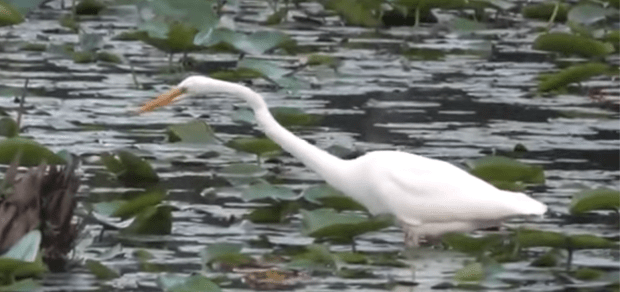
Ferris Akel spent most of the Saturday tour at Sapsucker Lake near Ithaca, New York. It was magical. We never made it to see Big Red and her family at Cornell University but it was a great time. One of the highlights was a Great White Egret which is rare to Sapsucker Lake.
Great Egrets are also called the Common Egret or Great White Heron.
Great Egrets will generally stand and wait to see their fish. They also slowly and quietly wade through the water until their neck snaps quickly and they get their fish.
Patience. Quiet. The Great White Egret gets its dinner.
Great Egrets nest in trees.
The beautiful white plumage that adorns these graceful wading birds was used for women’s hats in the late 19th century. Those silky white plumes are called aigrettes – which gives the bird its name. At the beginning of the 20th century, an ounce of Great Egret feathers was worth $32 USD, more than an ounce of gold according to the authors of Birds of Canada. People were so outraged that some of the first legislation to protect birds and their feathers was because of the Great Egret being brought to near extinction for hats!
In Canada, the Great Egrets nest in a very small number of places – in the very southern parts of Saskatchewan, Manitoba, a small part of southeastern Alberta, and southern Quebec. They are found in the Americas, Asia, and parts of southern Europe.
The Great Egrets are large birds. They are 94-104 cm (or 37-41 inches) with a wing span of 1.3 m or 4.2 feet. They weight about 1000 grams or 2 pounds. They are all white with black legs and a yellow bill like the one shown above. During breeding season, a patch between its eyes turns neon green and long plumes grow out of its back.
Great Egrets build a flat nest or platform of twigs and sticks. They will lay between 1-6 eggs which are incubated for a period of 23-26 days. It will be another 21-25 days til fledging for the youngsters. Aren’t they cute!
I am getting so excited for Peregrine Falcon season to begin in Australia. The male at the 367 Collins Street Nest also known as the CBD Nest arrived with prey for the female today. He is just such a cutie. The nest camera that streams on YouTube is not up and running. It will begin operations after the eggs are laid (normally). For now there is a camera operated by the owners of the building, Mirvac. Here is the link:
The other Peregrine Falcon nest is that of researcher, Dr Cilla Kinross, at Charles Sturt University. The scrape box is home to Xavier and Diamond and they have been working on the scrape for some time now. We expect eggs at both nests by the end of August.
If you watch both nests you will get a good glimpse into the difference between a falcon nest on a high rise building in a major city, Melbourne, and the more open rural area of Orange, Australia. The prey is very different!
As it turns nearly midnight on the Canadian prairie, the day is just starting on the Foulshaw Moss Osprey nest in Cumbria. No doubt our beautiful Blue 463, Tiny Little, will fly out from where she is roosting on the branches of the tree in the distance, to the nest. White YW has a trio of big Osprey fledglings to feed. He has demonstrated that he is perfectly capable of feeding a family of five.
Thank you so much for joining me. Take care everyone. I hope to have some local images of bird life in Manitoba for you shortly.
Thank you to the following for their streaming cams where I get my screen shots: Ferris Akel and Cumbrian Wildlife Trust and the Foulshaw Moss Osprey Nest.
Elsa was a category 1 hurricane when she bore down on the Southwest Florida coast last evening. The two chicks on the Sarasota Bay Osprey Nest had their talons anchored, riding out the gusts and the rain. This was the pair of them at 23:08 Tuesday, 6 July.
Whew! No chicks blown off the nest just a good soaking.
As the gusts calmed some in Sarasota, they were picking up at the Achieva Osprey Nest in St Petersburg. It is nearly midnight. What is surprising are the number of cars on the streets and even people walking. The nest perch weaves back and forth. Oh, I am ever so glad that Tiny Tot is not on this nest! Indeed, I can see why the birds might choose to migrate north for the summer to get away from hurricane season.
All of this made all of the aunties and uncles relatively nervous. We can’t do anything but watch which is precisely the problem! And none of us knows what kind of damage the storm will do.
Instead of drinking coffee and eating way too much chocolate, I turned my mind to Peregrine Falcons.
Peregrine Falcons. The fastest animal on the planet. Speeds up to 390 kph or 243 mph. They are flying killing machines attacking their prey in the air instead of on land. They are magnificent creatures who appear in art, literature, culture, and sport.
Falcons appear on the shoulders of the terracotta figures, the haniwa, on the Kofun (mound tombs) in Japan from 300-555 CE. These were royal tombs. The haniwa were not placed on the inside of the tomb but, rather, on the top of the mound as if in a ceremonial parade. They served many functions. One of those was utilitarian – they kept the soil from eroding as they would have their bottom portion pushed into the the ground.
Using Google Earth, satellite images show you the distinctive ‘keyhole’ design of these ancient burial sites. Forests now cover the sites but originally, they would have been cleared. These hollow clay figures covered the surface. Were they there to protect the deceased? did they tell about the status of their life on earth? No written records exist but we know that over time simple clay cylinders developed into very elaborate human and animal shapes like the falconer, above.
Falconry was known to be practised by the aristocracy in Japan. Taka is the Japanese word for falcon. Taka means strength and bravery. It is no wonder that the art of falconry, takagari, was adopted by the warrior class, the samurai.
The military class ruled Japan during the Edo era. During the Tokugawa Shogunate, 1603-1858, local war lords (daimyo) and the Shogun hired painters to depict the falcons on crests, screens, textiles such as boy’s kimono, in hangings as well as in single sheets or albums.
The image below is one of many woodblock prints depicting falcons. This one is Falcons with nestlings in a pine tree at sunrise by Utagawa Kuniyoshi.
Falconry is still practiced in Japan today. Here is a lovely short video about a woman who desired to take up the sport.
As it happens, I have just finished reading Queen of the Sky. That is probably why falcons are on my mind. In fact, this beautiful little book is sitting next to me. The illustrations are gorgeous.
What a marvellous little book written and illustrated by Jackie Morris. It is the story of Ffion Rees’s rescue of a Peregrine Falcon off the coast of Ramsay Island. It might be easy for someone to think, on the surface, that it is a condensed version of H is for Hawk by Helen MacDonald. If so, they would be missing the book’s heart. It is about love. “Come and see what is in my kitchen” Ffion urges Jackie. It is a story that weaves the lives of the women and the bird – love, loss, and friendship – together in a book that you will not wish to set down. Morris draws you in – you can smell the sea and the land, you can hear the gulls and you want to escape into the wild that is Ramsay Island. Required with the book are at least half a dozen tissues.
Morris tells us that the Peregrine Falcons hatched on Ramsay’s Islands are believed to be the fastest and most fierce in all of the United Kingdom. The kings of England kept many birds from Ramsay.
As a child do you recall the nursery rhyme about the Four and Twenty Blackbirds baked in a pie? Can you conjure that image? Like the one in the old coloured drawing below?
But did you know that King Henry II (1133-1189), known as Henry the Falconer, allowed his noblemen to bring their falcons with them whenever there was a feast? And adding to that, did you know that Henry’s chefs made special pies full of live songbirds (they could not have baked them!) and when they were opened the birds flew out as fast as they could while the owners took the hoods off the falcons?
Hoods protect the eyes of the falcon and help to keep it calm. They can very elaborate. This one is in the collection of the Victoria & Albert Museum in London, England. It dates from the early 17th century and is made of leather which has been incised and gilded. There is silk velvet embroidery with silver thread along with silver breads and a tuft. It is typical of the type of hoods used in Europe at the time. Isn’t it gorgeous?
@Victoria and Albert Museum, London
Can you see it in those cold stone castles with their long wooden tables, pies full of birds flying and thrashing about being chased by stealth fliers? Plucked feathers flying all about and landing in the food?
Falcons raise their eyases in scrape boxes or on the sides of cliffs or in caves. The scrape are shallow and contain gravel. It is believed that the falcons developed this method of raising their chicks to keep away the pests and diseases associated with twig nests.
There are several falcon scrapes that have streaming cams. One of the most famous couples in the United States is Annie and Grinnell who have their scrape box in the Campanile of the University of California at Berkeley. They have just fledged three boys – Fauci, Kaknu, and Wek-Wek. At this time of year, if you want to watch falcons hatch and fledge, you have to go to the falcon streaming cams in the Southern Hemisphere. Two are the CBD Peregrine Falcons otherwise known as the Collins Street Falcons in Melbourne, Australia and the scrape box of Xavier and Diamond on top of the water tower on the campus of Charles Sturt University in Orange, Australia. The CBD Peregrine Falcon Cam is not up and running yet. I will let you know when it is.
Here is the link to the live streaming cam with Diamond, Xavier, and their nine-month old son, Izzi, who refuses to leave home!
I am very happy to say that the two chicks on the Sarasota Bay Osprey Nest survived their very first hurricane. Here they are at 10 am, Wednesday, 7 July.
Tiny Tot’s nest held up perfectly well, too. No one was on it but one of the adult visitors this morning for a bit. We all assume that the impact of the storm had no harmful effects on our beloved Osprey family in St. Petersburg.
The question of who this bird is has driven me a little nuts. The bird has the white ‘V’ and the rounded white heart shape that Tiny Tot has. It has the black patch on the rear of the head that Tiny has. It has Tiny’s short thick legs. But, this is an adult!
Thank you for joining me today. Many of us are quite tired having stayed up to ride the hurricane out. It is such a relief that it has passed. If today’s blog is a little disconnected – that was the state of my mind last night. It will all pass (we hope). Take care all!
Thank you to the following for their streaming cams where I took my screen images: The Bay Sarasota Osprey Cam and the Achieva Credit Union in St Petersburg, Florida.