Checking on the Aussie Birds

Everyone is still waiting for any sign of a pip or a hatch with Xavier and Diamond’s eggs at their scrape box on the water tower on Charles Sturt University at Orange. It is now mid-afternoon on the 7th of October. Diamond has been restless but she sure is not revealing anything to anyone!

Meanwhile the week-old chicks at 367 Collins Street are growing by leaps and bounds. It was really hot today and Mum was a great ‘Mumbrella’ to keep the heat off their pink skin underneath all that white fluffy down. Mom was panting, too.

Those four are really getting stronger too. Each of them can easily sit with their neck held relatively still. It is so much easier for the parents to feed them.

This is Mom feeding.

The baby or the 4th hatch is doing great too. There it is on the right. Their eyes are open wide. Such cuties. Just notice how much of the scrape box they take up today. We will compare this with them next week. It should be interesting.

This is Dad feeding. If you have trouble recognizing them, one of the best ways is to look behind the legs and between the tail. Mum has lots of long dirty feathers from brooding the chicks. Dad doesn’t. Dad has more yellow on the eyes and is, of course, much smaller. But the feathers behind the legs are a giveaway that it is Mum.

The Port Lincoln Osprey Cam was offline for a good part of the early morning. I do not know when the three osplets were fed but each had large crops when the stream returned. I think they must have had a really good feed.

If you are wondering how Little Bob is doing, well that ‘ps’ of his in the image below says it all.

Everyone is waiting for a fish, snoozing in the sunshine of a beautiful Australian afternoon. It is 17 degrees C and the winds are blowing at 16 kph.

The Sydney Sea Eagles are incredibly beautiful. We are getting near and nearer to branching. This nest has been full of wonderful surprises this year, just like the Port Lincoln Osprey Nest.
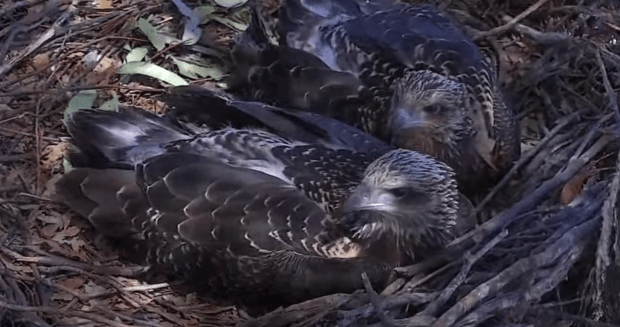
Lady Hawk did a 5 minute video of some of the cuteness that these two WBSE have gotten into. Have a look:

I took a drive on a very hot day to check out the number of Pelicans and Cormorants still around and to see the geese come into the fields. They begin around 15:00 and continue to dusk.

Manitoba has one-third of North America’s American White Pelicans during the summer season. There are often 100 or more on our Red River near the dam at Lockport Heritage Park. Today, there were only four Pelicans and two Cormorants. There were, however, quite a few Greater Yellow Legs. The birds were back lit and more than a football field away so the images are not as good as I had hoped.

This is a non-breeding immature Greater Yellowlegs.

The Double-crested Cormorant had just landed on the water and was drying off its wings. There were fish jumping and everyone will eat well today, if they already haven’t.

There are always lots of Ring-billed Gulls.

I have one last thing to share with you. Sandhill Cranes. I missed seeing the hundreds of them when they landed south of Winnipeg about a month ago as they began their migration. On Saturday, during Ferris Akel’s tour, he filmed a number of Sandhill Cranes at Montezuma. They are such beautiful birds. He has posted that edited video. Here is the link:

Thank you so much for joining me. I had hoped to have hatch news for you but we wait, just like Xavier does. Take care. See you soon.

Thank you to the following for their streaming cams where I take my screen shots: The Port Lincoln Osprey Project, The Falcon Cam at Charles Sturt University at Orange and Cilla Kinross, Sea Eagles @ Birdlife Australia Discovery Centre, and 367 Collins Street Falcons by Mirvac.

Fall Migration on the Prairies

There has been a lot of noise in the Winnipeg birding community about a Green Heron at a park south of our City. People love to watch the herons fish and the sheer gracefulness of their movements.

There was no heron. We had missed it by half an hour but, it was a beautiful place to walk. The only thing you could hear was the chattering of a Red Squirrel.

Groups of Canada Geese were in the fields where the farmers had harvested the grain.

As we continued down the gravel road, overhead two skein of geese in the typical ‘V’ formation flew in front of us. Did you know that by flying in the ‘V’ formation, the geese not only conserve some of their energy by it is thought that their hearing and sight are enhanced. We decided to try and locate where the geese were going.

There were geese everywhere. They cannot read the sign!

Besides geese, there were Double-Crested Cormorants, Ring Billed Gulls, and a few Mallards.

Oh, this one was a beauty. He has been in the water and was drying his wings. Those feathers are not waterproof. To help them underwater, they have sealed nostrils, great underwater vision, and look at that tail – it functions as a rudder.

I thought he was a rather attractive bird.

The plumage of the Double Crested Cormorants below is lighter than the one above which is a breeding adult. I believe these two are immature.

There is always one very cute little female Mallard.

The Ring Billed Gull had a few friends in the water. I had a very hard time determining the colour of this one’s bill. If it is yellow with the black tip, it is an adult. If it is pink with a black tip, it is a juvenile. Are its legs and feet also pale pink? If so, it is a juvenile.

The birds continue to travel through our City as fall migration continues. All of the birding organizations in my province are gearing up for fall workshops. If you live in Manitoba, you might want to check these two out. If you live elsewhere – as I know most of you do – check your local birding associations.

Near me have been fields of Sandhill Cranes, many of them dancing. Someone spotted three Moose together on a farmer’s field, too. Because of the fires and the drought, all of the animals and birds are hungry.

There has been no word from Sharyn Broni, the Ranger at Taiaroa Head about Tiaki. Her GPS indicates that she has fledged but she is on land!

Here is the link to check on both Tiaki and her dad, Lime Green Black (LGK):

Chicks have been rescued if they got off to a rocky start on their fledge. I want to wait and hear what the rangers say about Tiaki.

Thank you for joining me. I hope that wherever you live you can get outside and enjoy some beautiful fall weather with the birds. Take care. See you soon!

Wednesday Happenings in Bird World

Gosh, it was just a gorgeous ‘fall’ day. No, it isn’t officially fall but the leaves appear to be changing and there is a ‘nip’ in the air. The birds are flying south and others are arriving home from their summer forays. One of those returning to her breeding area and nest is Gabrielle, Gabby for short, the mate of Samson at the Northeast Florida Bald Eagle nest near Jacksonville. It was right around 14:48.

She looks good. Oh, Samson is going to be so excited!!!!!!!!!

Samson you are such a cutie. As my friend ‘T’ said when she heard the good news, ‘Love is in the air.’ She is absolutely right.

It was a gorgeous day to go and find some pelicans and I was hoping for a cormorant or two. The waters of the Red River near St. Andrews did not disappoint.

Pelicans are the longest native bird in North America measuring in at 2 metres or 6.56 feet. The California Condor is the only bird in North America with a longer wingspan. The pelican’s wings measure 2.7 metres or 9 feet from tip to tip. In other words, these are large birds!

This is a small hydroelectric dam. These American white Pelicans often work together to get the fish ’rounded up’. Here they wait for them to come over the dam. There were six fishing together.

The pelicans dip and scoop for fish. They are able to hold as much as 12 litres of water which goes out the sides of their mouths before they can eat the fish. They spent a lot of time bobbing up and down.

Manitoba is the summer home of the largest number of American White Pelicans. They spend their winters in California or areas around the Gulf of Mexico. In late April to early June, they return to their summer breeding grounds here in Canada.

With the changing climate, it is believed that the American White Pelican will gain areas in Canada while losing them in the US.

Some were fishing while others slept and preened.

There were a few Double-Crested Cormorants with the pelicans today.

I just loved the silhouette of their wings against the water.

Manitoba is also home to a huge number of Double-Crested Cormorants in the summer. Did you know that Cormorants lack the ability to waterproof their feathers? Because of this they can dive deep because they are less buoyant but it also means that they can become water-logged and have a struggle reaching shore.

There were lots of gulls flying above the water. This lonely Ring-Billed Gull caught my eye. In the city they are constants around the garbage dumps. I did not know that they eat the eggs of other birds as well as little goslings, carrion, insets, rodents, etc. They are real scavengers.

Look carefully and you will see the black ring near the tip of its bill. That is what gives this gull its name.

This is the mystery duck. It was all alone. There have been several discussions as to whether it is a female Ruddy Duck, a female Northern Pintail, or a female American Wigeon. Or is it an anomaly? A Black Duck? If you have any idea, I would love to hear from you! I know that it is not a Mallard, not a Wood Duck, and not a member of the Merganser family but it is alluding all of the Manitoba and Canadian bird books. Maybe you are a juvenile. Someone really does need to do a more comprehensive book of Manitoba birds with excellent images.

The sun, fresh air, and climbing up and down gravel banks to the water has sure made me tired. If you have trouble sleeping, I highly recommend it as a remedy. One of my birding friends wrote just now to say that they had seen ‘my Ospreys’ today – so if it doesn’t rain tomorrow, I am heading north to check it out. They will be migrating soon!

There is little news in Bird World. Diamond has yet to lay another egg. The two little sea eaglets are eating well and behaving themselves. The majority of the Ospreys in the UK have begun migration. Aran was still at the Glaslyn nest this morning. The Black Storks from Latvia and Estonia seem to be making their way without hiccups now to their winter homes. It is just a nice calm Wednesday save for the arrival of Gabby back at The Hamlet. That caused great cheers.

Take care everyone. Thanks so much for joining me.

Thank you to the NW Florida Bald Eagle cam and the AEF streaming cam where I took my screen shots.