Late Monday in Bird World

It has been a wonderful day in Bird World. It is a good time to reflect on how much joy the birds bring into our lives, how much they teach us as we observe them and, as always, what else we can do to enrich their lives like they have ours. I cannot even begin to imagine what my life would have been like. First was the feeding of the songbirds in our garden and then there was the arrival of Sharpie’s mate. All of that was followed by watching Red-tailed Hawks in New York City and in Ithaca on the streaming cams. Years later the pandemic hits. Two years ago we had barely returned from a trip to Quebec City to celebrate my retirement and the first discussions of a deadly virus were swirling about. It was not long until we learned about the cases in PRC and, of course, all of that is now history. The first hawks that I watched in New York City are no longer with us (secondary rodenticide poisoning) but Big Red is still going strong up in Ithaca. She gave so many a reason to get up in the morning and, at the same time, reasons for us staying up all night as well – worrying. The birds taught – and continue to teach – me many things including empathy and patience.

Today, the Hilton Head Eagles, Harriet and Mitch, had their second hatch. The nest was discovered in October and the Hilton Head Trust held a contest for names for the couple while also setting up a streaming cam. Harriet is named after Harriet Tubman, nurse and spy for the Union army, and Mitch is for Civil War General, Ormsby Mitchel. Tubman actually led 700 slaves to their freedom, 100 of them to Mitchelville, a community established by the General for formerly enslaved persons. Thus, the names have a connection to one another and also to the community where the nest is located.

They are just adorable – littl eaglets with their soft grey natal down and spiky hair. Look how strong they are in the image below. It is so reassuring when they hatch and are strong and ready to go! Have a look:

I have been watching M15 and Harriet and the hatch of E19 most of the day. If you missed it, I updated my earlier blog identifying M15 as the adult on the nest when E19 hatched. That hatch was at 12:43:04. Harriet saw her baby for the first time at 14:46. The couple have each had turns feeding their first hatch of the 2021-22 season.

Look how wide E19 is opening its mouth. Harriet is pleased.

M15 stands guard over his nest with mate Harriet, E19, and yet-to-hatch eaglet, E20.

All of these eaglets will spend 75-85 days in the nest, depending on where they hatched. Here are the three standard divisions of the eaglet’s development. The first stage, 35-40 days, is called ‘structural growth.’ This is when the eaglets rapidly gain weight. They seem to be eating all the time. They are building bones and muscles as well as their tissue, toes, claws, etc. The second stage is related to the eaglet’s future ability to fly. The eaglets are born with natal down. Next is thermal down, then their juvenile feathers come in, and over the course from fledge to the time they are five years old, they will go through stages of feather development resulting, finally, in an adult with a beautiful white head, gorgeous brown body and yellow legs and feet. The thermal down will begin coming in around day 10. Juvenile flight feathers begin growing between 24-27 days. You will notice the eaglets doing wingercizes which help them develop the muscles in their wings. Right now these eaglets do not have much control over their heads and beaks. They will, as their neurological coordination increases, begin to stand on their feet instead of scooting around on their tarsi. They will learn to tear food, holding the prey down with their feet and pulling with their beak. Instead of being clumsy unfocused bobble-heads, they will turn into beautifully focused chocolate feathered raptors.

Within the last hour, another GHOW strike has happened at the SWFlorida Eagle Nest. These attacks are occurring much more frequently. Several nests including one Osprey one at Hog Island employed lights and clothed dolls to thwart the GHOW attacks. Thank you for that information, ‘L’. Maybe it is time to consider lights for Harriet and M15.

The Kakapo Recovery posted the cartoon of their infamous bachelors about two weeks ago.

Well, the staff no longer have to wait for breeding season to begin on Whenua Hou Island. The Kakapo kicked it up into high gear starting on 24 December. Oh, let there be many baby Kakapo!

Over at Port Lincoln everyone is eating well. Bazza found a fish before day break on the floor of the barge, then Bazza received another fish. Did I say I think Bazza will never leave home? Ervie has been over on the ropes eating a fish that it appears he caught and when he couldn’t eat another bite, Falky took over. Wow. Sibling sharing. How nice!

Ervie is at the top and Falky is eating the rest of the fish Ervie caught on the ropes near the bottom of the image.

Diamond slept on the Cilla Rocks last night. It is comforting to see her sitting on the ledge of the scrape at first light.

As I approach the end of the day, the sun is waking up on the deserts of Africa. The little birds are flitting about the bore hole in Namibia getting drinks. What a beautiful view. So peaceful. So warm compared to the cold snowy weather of Manitoba!

Good Night everyone. Thank you so much for joining me this evening. Stay well, stay safe. See you soon.

Thank you to the following streaming cams where I took my screen captures: Hilton Head Eagle Cam, SWFlorida and D Pritchett Eagle Cam, Port Lincoln Osprey, Charles Sturt University Falcon Cam and Cilla Kinross, Nambia Cam, and Kakapo Recovery FB Page.

Thursday in Bird World

The camera for Daisy’s nest is offline. This is the last image and it was raining at the time. Daisy will come to the nest just as she has done for the first 7 days to lay egg 8 today. It will become increasingly difficult for Daisy to cover the eggs as the number increases unless there is a miracle on the nest and a bunch of leaves fall for her to gather. As I pointed out in an earlier blog, Daisy had much more down last year and this was helpful but – it is not helpful in the rain as it shrinks and is for naught. We can only hope that Daisy’s luck continues but we must be prepared that it is a long slog for our little duck until these eggs hatch. Anything and everything can happen.

I will bring a brief update on Daisy later this evening if the camera starts streaming. Just wish our little duck all the luck you can.

There are wonderful reports coming from Jean-Marie Dupart in Senegal. The Osprey count is more than he would have imagined and he is having to report early. Dupart believes, by the end of the month, that he might have counted 1000 individual Ospreys!

At the Kalissaye Reserve, there were 127 for the entire month of November. Already in December for one week, the count is 160. Saloum Park had 64 birds for all of November and now already there are 90. Dupart is overjoyed.

The Kalissaye Reserve is a small nature centre or reserve near the Casamance River. The Casamance Region is know as ‘The Green Garden of Senegal’.

Wet lands and the Casamance River in the background. This is the area of the Ospreys. Wikimedia Commons.

This is Saloum Park or Delta in Sengegal. These look like perfect places for our Osprey to over winter.

Wikimedia Commons
Wikimedia Commons

The Port Lincoln Lads had plenty of fish yesterday. Ervie had the first two fish at 06:19 and 08:39. Bazza had the next four deliveries! At 14:22, 15:58, 17:33, and 20:40. Falky did steal one of Bazza’s fish so he did get something to eat yesterday. Mum delivered the 14:22 fish to Bazza – she even looked like she might have even fed her big boy! I think Bazza is indeed Mum’s ‘baby’ despite the fact that he was the first hatch.

The Captiva Osprey Pair, Andy and Lena, arrived back at their nest early.

I will give you this link to watch this nest but there is a word of caution. Andy and Lena have had many successful hatchlings but have never fledged any Osprey. The reason is that the Crows come and eat the chicks. That is so sad. Maybe this year Andy and Lena will have good luck like Port Lincoln.

The Kakapo Recovery has announced that 2021 adoptions are closing today – that is the 10th of December in New Zealand. If you are a supporter of the Kakapo Recovery, you might wish to adopt one of the non-flying parrots as a holiday gift to all your family.

There are two eggs at the Captiva Bald Eagle nest with Connie and Clive and two eggs with Anna and Louis at the KNF nest in central Louisiana.

Connie’s new mate, Clive, looks at the two eggs.

You can watch Connie and Clive here:

Louis is just a great dad down at the KNF Bald Eagle nest. Last year he was so excited when Kisatchie hatched that there were 18 fish on the nest for the eaglet and Mum. There was no way they could eat all of them. This year he is really helping to build up a really cosy nest!

This is Anna and Louis’s second breeding attempt. Last year they fledged Kisatchie. They are in a very old nest in the Kisatchie National Forest. It had belonged to another Bald Eagle couple who had fledglings up to 2013. Kisatchie, last spring, was the first eaglet to fledge from the nest in 8 years. It was a wonderful event.

Here is the link to Anna and Louis’s nest. I promise they are a fun couple.

Thank you for joining me today. It is so nice to have you stopping in to check on the birds. Isn’t that a great count of Ospreys in Senegal? Wow. I am hoping that Blue 463 might be spotted — our very own Tiny Little Bob from the Foulshaw Moss nest in Cumbria. Take care everyone.

Thank you to the following for their streaming cams or their FB Pages where I took my screen shots: the Kakapo Recovery, the KNF Bald Eagle Cam, the Captiva Bald Eagle Cam, Port Lincoln Osprey Project, Sea Eagles @Birdlife Australia Discovery Centre, Wikimedia Commons, Captiva Osprey Cam, and Jean-Marie Dupart for his report on the Ospreys in Senegal.

WBSE Release

Here is an image of WBSE 27 being released last week. It was determined by the scale lines in her toes that the bird was in fact, 27 not 28. So happy that ID was solved! The day the bird was released was the first day that the parents were not at their River Roost. I hope the three connect! There is a video of the release and it shows 27 as a really strong bird. I hope she thrives in the wild for eons. What a gorgeous bird.

The following was posted on the FB page of the Sea Eagles:

Here is a news report:

https://www.9news.com.au/videos/national/incredible-moment-sea-eagle-returns-to-wild/ckwd1mylj000n0go2tpq6dkcs?fbclid=IwAR1LEfr-N1vKUIgUAawVmy477RlTUb7sTU0yFDQwedhjs2gAW9t_FQQJva0

The Kakapo Recovery are doing their annual fundraiser. As many of you know, we started out the pandemic with 208 Kakapo in existence. There are now 202. Dedicated individuals do wellness check ups which mean they have to find these elusive non-flying parrots. The only way to do that is with a transmitter. The transmitters and batteries require check ups and replacements (batteries) on a regular basis. Medical treatment, etc. If urgent and life threatening, the bird is flown to Dunedin, NZ for veterinary care.

Many are considering doing one special gift on behalf of their family to help wildlife and the planet (as opposed to fast fashion that winds up stacked in the deserts of Africa). The Kakapo Recovery is hoping you might choose them.

Last year we adopted Rangi! He happily lives in the living room plants when he is not cuddling up with Pippa the Albatross or Big Red the Red-tailed Hawk!

It is something everyone needs to think about even if it is $5 to a streaming cam that you love. It can make all the difference. You can also adopt other types of birds. Last year there was a huge rush to help Aran and Mrs G at the Glaslyn Bywyd Gwyllt. You might recall that two horrific events came together in the perfect storm at Glaslyn. A heavy rain storm with cold temperatures hit the area when the chicks hatched and Aran got in a territorial fight and injured his wing and he could not fish. The community came together and provided a fish table for the family. Sadly the chicks did not survive but Mrs G and Aran did and Aran got his strength and migrated on time. To help that cause many went to the website and adopted Aran and his family.

You will have your own list as well. Other ways that you can help is to check with your local wildlife rehabilitation clinic. They often post a list of items that they need. You would be surprised but clean old towels are usually at the top of the list! So next time you are looking at a pile of towels and old sheets, think of your local clinic for wildlife! It doesn’t cost anything but getting the items there and often the clinics have volunteers that pick up for them.

Books for children and teens on how to help wildlife thrive are, of course, invaluable in building the next generation to care for our beloved birds.

Holly Parsons posted an update on Yurruga on the FB page for the Orange Australian Peregrine Falcon:

“Post from Cilla approx. 5pm 24 November:I haven’t seen Yurruga since I placed him in the tree, but I’m pretty sure he is still there as the parents have been coming and going with prey and giving me warning calls if I approach too close. I only check once a day and the foliage is really thick so hard to find him if he’s quiet.”

That is great news coming out of Orange! That is the kind of news I wish were coming out of Sydney with WBSE 27 – that the parents have been feeding it. Fingers crossed.

This is a short update. It is extremely quiet in Bird World now that the falcons and ospreys and WBSE in Australia have fledged. Eggs are happening in the Bald Eagles nests in the US and there will be lots of action around the holidays in December.

Take care everyone. Thank you for joining me.

Thank you to the following for their streaming cams or FB pages where I took my information: Orange Australian Peregrines FB, Kakapo Recovery FB, and Sydney Sea Eagle Cam.

Late Saturday in Bird World

It is difficult to try and describe the weather we have been having to someone who might never have experienced it. Someone took a video of the blowing snow on the highway, a huge buck, and some of the issues people face trying to drive on the road in a storm. When you cannot see the road for the blowing snow, we call it a ‘white out’. This is the time of year we also call ‘the rut’. The bucks dig and spray marking their territory. We are seeing many in the fields around the city and in larger treed forests within the City.

Ah, but I am not here to talk about the horrible winter weather we are having.

My last blog focused on Ervie, the third hatch at the Port Lincoln Osprey barge in South Australia. Ervie managed to get the first fish of the day. He only left the tail for Falky. To show how congenial these three are, Ervie did not even try to get the 10:48:28 delivery from Dad. Instead, Bazza (Big Bob) snatched it.

There he is enjoying his fish.

The camera is zoomed out in case one of the lads decides to fledge. Oh, I do hope they stay a little longer – another week, maybe.

Little Yurruga at the Charles Sturt University falcon scrape had 5 prey items for breakfast today. Yesterday was not a good day for feedings but, Diamond and Xavier have made up for it today. I am thinking that the parents might be teaching Yurruga that there are days with little food and some days with a lot.

Yurruga was really hungry when Xavier came with breakfast! Really hungry.

Yurruga has just finished that breakfast. Another prey item sits on the scrape, a Starling, and Xavier has brought more food. Notice that Yurruga is not running up and tackling Xavier to get the prey. Yurruga is probably wondering why there is so much food today.

Diamond came in to help Yurruga finish up that delivery. The Starling is still where it has been all morning. Diamond really dislikes Starlings!

Yurruga has an enormous crop. It isn’t her crop that interests me, however, but, the change in her plumage. Much of the fluff has disappeared. Peregrine Falcon juveniles have beautiful banded chests. Their bars are vertical. When Yurruga is an adult, the bars will be horizontal. Notice also the beautiful dark head and the tip of the wing. Oh, she is morphing right before our eyes into a very beautiful juvie.

She does not seem to be interested in the Starling that she pulled over to the rocks earlier. Oh, wait…maybe she is!

The feathers are almost off the left side of Yurruga’s head. Notice her beak. We get a chance to see how it has developed in this profile image. Yurruga is becoming very ‘falcon like’. Those chest feathers – that coppery brown – are just lovely. She looks like she has a feather boa around her neck – something she might need where I live today.

Oh, Yurruga means business. She is going to do something with that Starling.

She is showing us how strong she is! There are still some soft pantaloons but the down is coming off with every flap of those wings. Is there anything cuter than a little peregrine falcon at this stage in their development?

She is dragging that old bird back into the centre of the scrape.

There is our Peregrine Falcon with her large beak standing victorious on her prey. This pose really reveals how much Yurruga has grown. All of the feathers necessary for flight are growing in. Amazing.

Awww. Yurruga gave up on that old bird. No one seems to really want it. Wonder if Starlings have ‘Best Before’ dates on them?

WBSE 27 @Chris Bruce

If you missed it, here is the latest update on White Bellied Sea Eagle Fledgling 27, three days ago:

I wanted to bring you an update and some good news. The Port Lincoln Osplets are doing fine and I am certain that Falky will have a fish before the end of the day. Yurruga has already eaten enough to last her well into tomorrow. It also appears that WBSE27 is doing extremely well in care. The last update on Grinnell was on 10 November. He was getting to go into foster care for a few days before being released. All of the Kakapo are alive and the NZ DOC Rangers at Taiaroa Head will not decide which Royal Albatross couple will be on the Royal Cam until all eggs are laid.

Thank you. It is really nice that you are joining me. Take care wherever you are. Stay safe.

Thank you to the following for their streaming cams or FB news where I took my screen captures: the Port Lincoln Osprey Project, Sea Eagle Cam, Charles Sturt University Falcon Cam and Cilla Kinross.

Good News in Bird World

There is a lot to celebrate in Bird World this evening. Everyone on the Taiaroa Peninsula and perhaps the whole of New Zealand are celebrating the arrival of the 2021 Royal Albatross Cam Princess, Tiaki, at the feeding grounds just 70 km off the coast of Chile – safely! This really is amazing. As was pointed out on the Royal Albatross FB page, this young bird fledged on 25 September and arrived in the waters off the coast of Chile, 8500 km away, in 35 days. Incredible. Congratulations!

For those watching the return of the Royal Albatross to Taiaroa Head for the upcoming breeding season, OGK has flown off the peninsula to feed. He continues to wait for his mate, YRK. I have asked and been told that OGK is not the only male still waiting for its mate. That gives me some hope that this adorable couple will still be reunited. They were the parents of last year’s Royal cam princess, Pippa Atawhai.

There has been no new tracking data for Karl II but, on the 28th of October, he had reached Umm Harazat in the Sudan close to where he winters. Udu was at the Farafa Oasis in Egypt on the same day and Pikne was along the Red Sea. I expect that Udu and Pikne could be further into Africa by the time the next transmission comes in.

The Farafa Oasis is an area known as the White Desert.

Udu made a splendid flight across the Mediterranean Sea. The White Desert is home to a number of wells and there is farming in the area. It is most know for its white rock figures.

Pikne’s position:

Karl II’s position:

Moving away from the migrating birds back to Australia, little Yurruga took some big steps today. What a sweet little falcon! Here is a short clip I made of this momentous event.

Yesterday, Dad fed the 367 Collins Street Four in an area that could be viewed easily. There are, of course, concerns that the falcons will fledge from the end where there is no camera view. The owners of the cameras have stated that they will not change the direction of the camera again as it is too disturbing for the birds. That is quite understandable at this stage. No one wants to frighten these lovely eyases and have them fly and fall to their doom. And there is no telling which end of the ledge they will fledge. We just simply wait. They are so strong and healthy. Mum and Dad have been heroic in their efforts to sustain them. So please keep feeding the pigeons in Melbourne – our falcons need them!

There has been no word from the vet team about the condition of WBSE 27 since it was attacked by the Pied Currawong and found on pavement near to the Sydney Olympic Forest.

The Sydney Sea Eagle Cam FB page had originally posted WBSE 27 on the pavement unconscious. This disturbed some people so it was replaced with the image below. I have said that no news is good news but this has been several days since the incident. Send all the positive energy to this beautiful bird that you can!

There is good news at the Kakapo Recovery. The team has discovered that the eggs that are laid but do not hatch are not always infertile. Since the beginning of trying to help the Kakapo to recover numbers, it was always believed that the eggs were simply infertile and that is why there was no chick to hatch. The chicks are dying at an early stage. If they can figure out what is the cause, they might be able to assist these lovely non-flying parrots to have more successful hatches. Here is the posting on the Kakapo Recovery FB page. It talks about their efforts with the University of Sheffield to understand the issue and be able to have more live births of this critically endangered bird. Bravo!

The ospreys on the PLO barge are doing great. Little Bob is 45 days old today. Fledging is coming soon. Oh, how I am going to miss this wonderful trio. They have delighted hundreds and hundreds of people this season. Pure joy!

Look at Little Bob showing off! Besides loving to eat Little Bob really does like to give those wing muscles a go. I don’t think Big Bob is very amused.

In the image below, from left to right: Middle Bob (2), Little Bob (3), and Big Bob (1). If I were to have to base a guess on their gender due to the legs, I am afraid that I would have to change my prediction.

Middle Bob’s legs are definitely shorter and stockier than either Little Bob or Big Bob. Big Bob’s legs look like those of a male. That leaves us with Little Bob that I continue to believe is a female. Oh, I cannot wait for those measurements. They are not 100% certain but, perhaps, they will also do DNA testing on the three when they ring them!

Little Bob gives its two older siblings a big hug.

There is Little Bob looking off to the left after the morning breakfast. Three gorgeous nestlings. Ringing, naming, and measuring will take place the week of 8 November. I will keep you posted to the more exact date when I find out.

Thank you so much for joining me today. I hope that you are all well. Take care!

Thank you to the following for their streaming cams where I took my screen shots, video clips, and maps: Port Lincoln Osprey Project, 367 Collins Street Falcons by Mirvac, Charles Sturt University Falcon Cam at Orange and Cilla Kinross, Birdmap, Kakapo Recovery FP Page, Wikimedia Commons, and Wildlife Computers.

The Great White Egret

Sometimes there are birds that seemingly get forgotten as I rush to find out if Tiny Little beat the big older siblings to the fish or to check on Malin’s feather growth. Clearly one of those has been the Kakapo. There are now only 202 Kakapo, parrots that cannot fly and who love to eat Rimu, on a couple of small islands near New Zealand. They are continually monitored and all have satellite transmitters. They get health checks and are flown off island for care, if needed.

The Kakapo Recovery has partnered with On the EDGE Conservation to create the Kākāpō Run game. As a player you can help the Kakapo evade their predators will collecting Rimu Fruit. Because it is filled with facts about these amazing birds, it is a good way to learn about them. You can download the game here:

https://play.google.com/store/apps/details…

https://apps.apple.com/us/app/kakapo-run/id1569861836

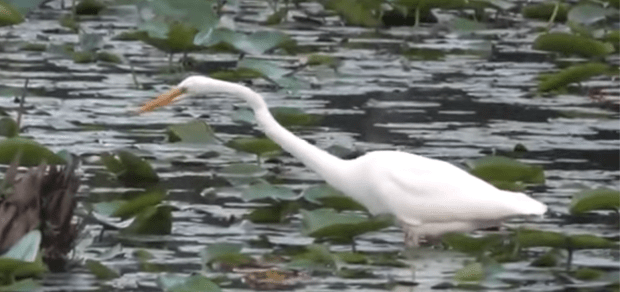
Ferris Akel spent most of the Saturday tour at Sapsucker Lake near Ithaca, New York. It was magical. We never made it to see Big Red and her family at Cornell University but it was a great time. One of the highlights was a Great White Egret which is rare to Sapsucker Lake.

Great Egrets are also called the Common Egret or Great White Heron.

Great Egrets will generally stand and wait to see their fish. They also slowly and quietly wade through the water until their neck snaps quickly and they get their fish.

Patience. Quiet. The Great White Egret gets its dinner.

Great Egrets nest in trees.

The beautiful white plumage that adorns these graceful wading birds was used for women’s hats in the late 19th century. Those silky white plumes are called aigrettes – which gives the bird its name. At the beginning of the 20th century, an ounce of Great Egret feathers was worth $32 USD, more than an ounce of gold according to the authors of Birds of Canada. People were so outraged that some of the first legislation to protect birds and their feathers was because of the Great Egret being brought to near extinction for hats!

In Canada, the Great Egrets nest in a very small number of places – in the very southern parts of Saskatchewan, Manitoba, a small part of southeastern Alberta, and southern Quebec. They are found in the Americas, Asia, and parts of southern Europe.

“Great egret rising” by wolfpix is licensed under CC BY-ND 2.0

The Great Egrets are large birds. They are 94-104 cm (or 37-41 inches) with a wing span of 1.3 m or 4.2 feet. They weight about 1000 grams or 2 pounds. They are all white with black legs and a yellow bill like the one shown above. During breeding season, a patch between its eyes turns neon green and long plumes grow out of its back.

“Great Egret Pointing the Sky” by TexasEagle is licensed under CC BY-NC 2.0

Non-breeding Great Egrets have a small yellow patch between its eyes and bill.

“Great Egret on nest with chicks” by Photomatt28 is licensed under CC BY-NC-ND 2.0

Great Egrets build a flat nest or platform of twigs and sticks. They will lay between 1-6 eggs which are incubated for a period of 23-26 days. It will be another 21-25 days til fledging for the youngsters. Aren’t they cute!

I am getting so excited for Peregrine Falcon season to begin in Australia. The male at the 367 Collins Street Nest also known as the CBD Nest arrived with prey for the female today. He is just such a cutie. The nest camera that streams on YouTube is not up and running. It will begin operations after the eggs are laid (normally). For now there is a camera operated by the owners of the building, Mirvac. Here is the link:

https://367collins.mirvac.com/workplace/building-overview/falcons-at-367-collins?fbclid=IwAR3vGCMkdnScju_KTKjhCrcHRnbsYxJm3kAKTLIOzylSVe8PX3UmwaJEn-s

The other Peregrine Falcon nest is that of researcher, Dr Cilla Kinross, at Charles Sturt University. The scrape box is home to Xavier and Diamond and they have been working on the scrape for some time now. We expect eggs at both nests by the end of August.

If you watch both nests you will get a good glimpse into the difference between a falcon nest on a high rise building in a major city, Melbourne, and the more open rural area of Orange, Australia. The prey is very different!

As it turns nearly midnight on the Canadian prairie, the day is just starting on the Foulshaw Moss Osprey nest in Cumbria. No doubt our beautiful Blue 463, Tiny Little, will fly out from where she is roosting on the branches of the tree in the distance, to the nest. White YW has a trio of big Osprey fledglings to feed. He has demonstrated that he is perfectly capable of feeding a family of five.

Thank you so much for joining me. Take care everyone. I hope to have some local images of bird life in Manitoba for you shortly.

Thank you to the following for their streaming cams where I get my screen shots: Ferris Akel and Cumbrian Wildlife Trust and the Foulshaw Moss Osprey Nest.

Feature Image Credit: “Great egret (Ardea alba) in flight at sunrise at Venice Rookery, Venice, Florida” by diana_robinson is licensed under CC BY-NC-ND 2.0