Oh, it is a gorgeous autumn day on the Canadian prairies. Technically, it is still summer, but it feels like fall. We have had our walk and Don has gone with Ann to get a blood collection (he also has hemachromatosis) and a walk in the park. Toby and I cleaned up the laundry room, cleaned the bird baths, and made sure the birdfood was filled. There are so many! Last night we were shocked when, after sitting on the deck for at least half an hour, a hawk flew out of the huge prairie rose bushes! He had been sitting hoping for some dinner. I think we ruined those plans when Toby when down the steps.
This is the time in Bird World when we have a bit of a lull. The newest babies are the little sea eaglets at the Olympic Park nest in Sydney. Iris, Clarke, and Wensi are still at Hellgate Canyon. Blue 33 is the only osprey at Manton Bay, I believe. C22 and Charlie were fishing at Roger’s Place. Beau waits for Gabby’s arrival.
She is a beauty just like her great-grandmother, Maya, mate to Blue 33 at the Manton Bay nest at Rutland.
Even Geemeff’s reports for the Woodland Trust are getting shorter and shorter as the ospreys disperse.
Woodland Trust daily summary for Loch Arkaig Tuesday 25th August 2026
The RAF sent five aircraft flying down the loch, they were nearly as noisy as Juniper, whose voice seems to get more strident by the day. That will stand her in good stead when she has her own nest, for fish calling and warning intruders away from her chicks. Louis brought her two fish today, taking the Nest Two tally to four hundred and sixty, and she managed to protect both of them from the marauding Hoodies, one of whom was bold enough to nip her tail feathers. The weather was mostly dry and settled today with sunny spells and it should be dry and calm overnight with a low of 13°C continuing bright and clear tomorrow with a high of 22°C.
Second egg at 367 Collins Street as we await the arrival of the first egg at Orange. SK Hideaways has it: https://youtu.be/kRjyyXG3krA?
Osprey babies are being rescued worldwide as they struggle to find food and stay healthy.
#2 at Boulder County is a beauty and she is heading south. Great image, Holly!
Hope and George are not getting any breaks this year. Now dangerous fishing gear – . Needs to be removed from that nest!
I love this tribute to the Usk Valley male osprey in Wales.
Thanks so much for being with us today. It is ‘Dog Day’ and I cannot tell you how much I adore my Toby. He came as a tiny little puppy and has grown and grown. He is the light of my life and the beat of my heart.
With his much loved and chewed Lamb Chop!
Take care all. See you soon.
Thank you to Geemeff and SK Hideaways for their summaries and videos, to those who posted information on FB with or without images, to Raptor Persecution UK, and to the owners of the streaming cams that let us watch these amazing birds.
Happy Canada Day to all of us who celebrate. We had a wonderful time with our son and daughter-in-law visiting our local Farmer’s Market today. They are off for more celebrations this evening and tomorrow; my daughter and Tammy, DIL, are coming to take Don out for a few hours so I can have some time to myself. I feel blessed. How kind of them!
For the next few days, I want to focus on a couple of topics in each blog instead of running through all of the nests. I will, of course, try to bring you up to date on what is happening every 4 blogs. Today, I want to focus on this Menhaden issue and the ospreys dying, and I want everyone to write to the Governor of Virginia, the Honourable Abigal Spanberger. Her e-mail is: Abigail.Spanberger@governor.virginia.gov.
Tomorrow, I have a wonderful article by Wes Melkner in Smithsonian Magazine. Wes is an intern, and his research and first two articles have taught me a great deal. I do hope you enjoy the one I will be posting.
Friday, I will be giving you the link for a very special documentary to view over the weekend and a look at the current status of one of my favourite friends with feathers, the Condor.
Oh, I am really on a rant. Every day I check to see if Little Dewey is alive. Little Dewey is the poster child for this battle against industrial fishing and the murder of ospreys in this region of the US.
Little Dewey is gorgeous. I want her to thrive. Her parents have worked hard to find fish for her and their survival. We are not out of the woods yet but please, please let this nest be successful this year.
The first fish today did not arrive until 1311. I am unclear of any follow up deliveries. Please let me know.
This is staggeringly sad and reflects what is happening all over the region of the NE US:
“Survey my friend and I did in CT today of a small island with 30 osprey platforms. Raw data in image. XXX indicates the platform was abandoned and we did not go pro it. Fishermen are reporting no bunker again in the CT sound. Synopsis: 30 total platforms. 13 platforms abandoned. Only 7 young on island. Only 3 appear to be strong and healthy. 8 dead young found in nests. Almost no bunker gill plates by perch posts. Many platforms have been abandoned in the surrounding towns as well but not part of our study group.”
I realize that Heidi and I have been making comments on the demise of the osprey in this region for three years. I am glad that there is more attention coming to this topic, but I fear that we are late- perhaps too late. I never want to give up hope, so I have to look at what the UK did to reintroduce ospreys that had been wiped out. For example, CJ7 and Blue 022 had the first chicks in the south of England for 250 years. The first chick to hatch in the Usk Valley in Wales for a similar period was last year. Now, I want you to think about what I am saying. It is not decades; it is perhaps centuries before this biodiverse region is balanced again. People can blame whales and Bald Eagles if they want to hide their heads in the sand, but the truth is, it will show that it was industrial fishing unchecked by any oversight that caused the damage for years and years by a single company (not the net fishermen) but a Canadian company, Omega Protein. If I could sue the company and all the officials on behalf of the ospreys, I would. Someone who lives in the US should work with Animal Justice to do just that.
Today, Omega Protein went fishing and didn’t find much. Perhaps they have taken all of the adult Menhaden. Maybe they will be forced to shut down their operations. However, if you live in other NE States, including Maine, beware. Keep your eyes open. Many in Maine say that the Menhaden have left the shores and gone deep into cooler water. I just hope they are hiding from the nets!
Others checking elsewhere.
I believe on survived but has not been fed so the story will be much the same, sadly.
The one surviving chick at Great Bay looks to be alright. This one pushed another off the nest about a week ago – they were all starving. It is a sad fact.
Santiam Canyon is doing alright.
The smallest of the two on the Osoyoos osprey platform died today of starvation.
While today is about the impact that humans can have – in a negative way by overfishing and knowing it – and killing off an entire eco-system, it is also about the fact that humans must come to grips with the damage that we have caused our planet and help when help can be of benefit.
I was asked by a reader to post a rather long statement by a rehabilitation/rescue group. After reading it twice, I think that it is very appropriate to put it in this blog about the deaths from siblicide/starvation that have been caused by a lack of food due to human activity.
This comes from Annette at Wild Heart Ranch in Oklahoma and was sent to me from ‘J’ in Berlin:
I have never given parents advice on how to raise their “human” children, and I probably never will again, so please read this and pass it along. It needs to be said. (Rehabbers, if you agree, just applaud in the comments.) 😉 The photo is an oldie of “January,” a calf brought to me years ago with spina bifida and navel ill, crawling on her knees because her legs were useless. It took months, but I got her up, cured, walking, running, and eventually she grew into a full-grown heifer without any obvious problems. She found the perfect forever home. January WANTED to recover, and there was nothing I could see that would prevent it. She just needed an unbelievable amount of splint work, braces, physical therapy, and support to get there. She wasn’t going to one day be released into the wild. She was going to be somebody’s pampered pasture pet for the rest of her life if I could save her… and she is. She’s still watched over daily for complications her condition could cause as she ages or gains weight. I didn’t have to know she’d be 100% at the end of treatment. I just needed her to become pain-free and mobile on legs that would eventually support 1,400 pounds. But that isn’t the case for wildlife.
I absolutely love when you bring your kids with you to Wild Heart to drop off animals. If we’re going to raise the next generation to support wildlife rescue, they need to see the process. They need to witness compassionate people willing to drop everything for an animal they’ve never met. That matters to me because the future of wildlife rescue is in the hands of today’s children, and the way you handle that handoff matters more than you may realize. It matters because every year there are more roads, more windows, more fishing line, more cats, more cars, more toxins, and more hazards that WE bring into their world. And because, despite my best intentions, I may not actually live forever. I know… shocking. So there is one thing I ask, beg, and plead…
Please don’t promise your children that we are going to save an injured, hypothermic, maggot-infested animal, then ask us if that animal can be saved in front of them UNLESS you have prepared them for the TRUTH. I am not going to lie to your children before you do. I am going to follow your lead, and if you set me up to crush a child, I may have to step away for a minute to compose myself before I can provide that animal the peaceful, gentle ending it deserves. If you care about the animals, please be kind to the rehabber. DO YOU HEAR THE WORDS THAT ARE COMING OUT OF MY MOUTH? (My best friend uses that sentence. It is VERY effective!) Wild animals are masters at hiding pain. In the wild, looking sick or injured is basically putting up a billboard that says, “Eat me.” So they keep moving until they physically can’t anymore. That’s why you see a squirrel that’s “just sitting there all calm and content,” and I see a spinal injury or a pelvis that’s been crushed. You see the bunny your cat brought home that “doesn’t look that bad,” and I know it has a fifty-fifty chance of surviving the two tiny puncture wounds where your cat injected a potent bacteria cocktail into its back. Looks are deceiving.
The parents who want to protect their children from the hard realities—and I completely support that—usually hand me the animal, smile, and say, “We know you’ll do what’s best.” The kids thank me for helping, they climb back in the car, and I get to begin triage… treatment… or sometimes mercy. But this is how it sometimes goes for me: A six-year-old has rescued, temporarily cared for, and named a squirrel Kevin. Kevin has big plans. He’s going to leave our care, climb trees, raise a family, pay squirrel taxes, and peacefully die at the ripe old age of 97 surrounded by his squirrel grandchildren. AWESOME. I am all about happy endings.
Meanwhile… Kevin has dislocated hips, at least one spinal fracture, a pelvis that’s in four pieces, and internal injuries that make me wonder how he even made it to my door. The back half of him has been run over by a car, and any minute now the front half is probably going to stop working too. Then everyone turns and looks at me and an adult asks, with complete sincerity… “So… is he going to be okay?” Wonderful. (Just shoot me.) While I’m trying to rush this intake so I can put poor Kevin out of his misery, I now get to decide whether I lie to your child or explain euthanasia to someone who still sells their teeth to a fairy. That is WAY above my pay grade. And I don’t WANT to lie to anybody. So please… either have that hard conversation before you come, or avoid putting us in that position. My instinct is to protect your child’s enthusiasm for helping wildlife. I don’t want to be the lady who unintentionally convinces them that “future Kevin” should be hidden in their bedroom because “that rescue lady will just kill him.” Tell them Kevin is hurt. Tell them he is probably in a lot of pain. Tell them you’re taking him somewhere that people will do whatever is best for him. Leave it there… Or have the harder conversation before you arrive.
People sometimes think euthanasia means we gave up. It’s actually the opposite. It would be emotionally easier on us, in that moment, to keep trying. To turn a rescue into what I call “an experiment in heroics” which is by no measure okay unless there is FAR more hope than hurt. It’s much harder to look at an animal we desperately want to save and admit that the kindest thing we can offer is peace. I will NEVER be okay providing treatment only to find an animal dead in a cage later, knowing I could have spared it that experience. That is not acceptable when I KNEW the chances were slim. That is not rescue. That is denial. Sometimes we don’t know, but when we do know, we had better beat death to the punch or we have avoided the only act of care that was reasonable, responsible, and KIND.
A quick, painless, chemically induced death is kind when life without suffering isn’t in the prognosis. There are far worse things than death, and I see them daily. A responsible wildlife rehabilitator chooses what is best for the animal no matter how disappointed we are, YOU are, how many people are following the story on Facebook, or how much public backlash we might receive. NONE of that comes into play when I am evaluating or treating an animal. The ONLY factors that matter are the animal’s current physical suffering, past case experience, advice from my veterinarians, the animal’s probable ability to live independently after recovery and release, and my conscience. If my conscience EVER starts sounding the ego alarm, I am DONE. I know this about me. I will NEVER keep an animal alive because it’s popular or because it brings in donations. I was accused of that almost daily while working with January. I received hate mail from veterinarians all over the country. It was hell because I ALWAYS listen to the advice of veterinarians, but in this case they weren’t here seeing what I was seeing: a strong will to live and a calf that wasn’t going to give up. So I helped her fight. Not to prove anyone wrong. (ego) That never entered my mind during treatment. (But I gloated like hell when that calf charged me across my yard and knocked me flat on my ass!)
But I can promise you my motive is always the same. I believe in an animal’s ability to recover—or I don’t. I believe in my ability to support that recovery—or I don’t. The minute I lose hope that an animal can have an acceptable quality of life, I stop. No matter how much it hurts. No matter what people think of me afterward or what they say about me. (With two million followers, I see the comments. There is always someone who can’t WAIT to screenshot the nasty ones and send them to me, which by the way, it just hurts me and changes nothing else so keep them to yourselves friends) Fortunately for my motivation to keep going, I have almost as much compassion for ignorant people as I do suffering animals. 🙂
Here’s something else to keep in mind. The more experienced the rehabber, the more likely they are to make a judgment call immediately. Why? Because when we were new, we tried to save everybody. Experience teaches you where hope exists… and where it doesn’t. Trust that we have seen these injuries hundreds of times. We’ve learned from our mistakes, our veterinarians, our mentors, and the animals themselves. That being said… Many of my volunteers have zero medical training. They may be the smiling face that accepts your animal before it reaches someone doing triage. They see what you see. If you ask them what they think, they’ll honestly tell you, “I think he’ll be okay.” Then you call later and find out the animal was euthanized immediately. Please don’t assume we lied, didn’t try, or didn’t care. Just ask to speak with the person who actually performed the triage. I promise you, if that decision was made here, it was made because it was the most merciful option available.
Every intake gets our best. Every single person here hates euthanasia, but we are grateful that mercy exists. We remember those animals. We especially remember your child’s face looking at us like we’re monsters without a heart. It’s bad enough when we’re powerless to save a life, but when we’re judged for showing mercy? That destroys us. It destroys me. Last week it happened over and over and over again. It was so bad that I finally stopped going to the front door to do quick intake triage and personally thank the finders because I simply couldn’t do it anymore. Most people are absolutely wonderful. And then… There’s little Kevin’s family. Mom tells me to build Kevin a wheelchair so he can live here forever and “the kids can come visit.” All lies, little dude. All lies. And I just can’t be part of that story.
Those moments don’t stay here when we lock the doors at night. We take them home. They haunt us. They keep me from the sleep I need so badly that I end up writing lengthy educational Facebook posts trying to work through the frustration. So please… help us tell the whole story. Teach your children that rescue doesn’t always mean recovery. Teach them that there are worse things than death, and suffering without hope is one of them. Teach them that love and care are two very different things. Love is an emotion. Care is an action. Sometimes the most loving action is letting an animal go instead of asking it to suffer because WE aren’t ready to say goodbye. Because if I have to tell your child Kevin isn’t going to make it, I’d much rather be reinforcing a lesson you’ve already started than accidentally becoming the stranger who convinced them that bringing injured wildlife to professionals was somehow the wrong thing to do.
If your child cries, that sadness is empathy. Empathy is exactly why they picked Kevin up in the first place, so maybe I don’t have to live forever after all. Maybe there are little humans growing up right now who understand what wildlife rehabilitation is truly about and will support it one day. With time, with funding or even put on their poop shoes and get to work! There are thousands of wildlife rehabilitators scattered across this country making impossible decisions every single day and doing what is best, struggling to stay afloat so the animals have a place to go. I am working on a way to help keep them going with funding. It will take about a year, but in the meantime, let’s all be aware of the things people may never consider that slowly erode their motivation. I promise you I am not the only rehabber whose day is destroyed by someone bringing in an animal that should not be saved and then confronting us over our honest opinion-especially in front of children. The goal isn’t to teach our children that every rescue story has a happy ending. The goal is to teach them that every wild animal deserves compassion. “And we all suffer the same” Maybe that’s something worth thinking about. Thanks for reading.”
I think Annette said many things that I also needed to hear.
Geemeff has posted her summary from Loch Arkaig and I will include it here.
Woodland Trust daily summary for Loch Arkaig Wednesday 1st July 2026
The weather was wet and windy as forecast but that didn’t stop Louis who delivered five fish, taking the Nest Two tally to two hundred and fourteen. However, the first fish was quite small and the delay of over five hours before the next one saw the hangry chicks having a pop at each other. The aggression didn’t last long and a steady supply of fish, including a large late supper at 10pm, saw the chicks off to bed with full crops and Dorcha struggling to fit them underneath her. Garry brought a single fish for Aurora, a small one which she chose to eat on the nest, which took the Nest One tally to one hundred and forty five. Nest Two cam has been zoomed out ready for fledging which is probably at least two weeks away, and before that the ringers will visit, meantime we get to enjoy the panoramic views again. More wet weather is forecast with light rain, gentle breezes and an overnight low of 12°C, continuing tomorrow with light rain showers, a moderate breeze, a high of 17°C and occasional sunny spells.
Thank you so much for being with us today. Please take care all. See you tomorrow!
Also, if you are enjoying the blog, please hit the like button. It moves us up in the algorithm, so maybe more people will learn about what is happening to our raptors and want to get involved in helping make their lives less challenging. Thank you.
Thank you to ‘J’ for sending me the text from Annette, to Geemeff for their daily summary of activities at Loch Arkaig, for those that posted information and images on FB, and the owners of the streaming cams mentioned that allowed us to follow the lives – the good and the sad – of our feathered friends.
Oh, my goodness. It is pouring down rain again and Toby has his thunder shirt on! Thanks to ‘P’ I have discovered they also make these calming jackets for cats. Missey is the other one that was soooooo anxious during the recent storms so that I have now ordered one for her. The running joke amongst us is that the animals have more outfits than we do! It’s true. They are the glue that holds our mental health in place along with the garden and its wildlife.
Our neighbourhood is very concerned. Neither Brock nor Charlie, the cat with the frozen folded ear, have been seen and they disappeared at the same time. I do not believe in coincidences. Neighbours have adjusted their cameras and put out bowls o food in an attempt to see if we can spot them on camera. Don, Toby, and I have called and banged on every shed and garage and one house that is vacant with work being done for fear they are locked in. Brock would not easily go into a trap. I tried him many times but, he might be lured into a house or a space to go to sleep and then someone close the door and not come back. Jane and I are beside ourselves with worry.
P1 fledged at the nest of Big Red and Arthur on the Cornell Campus on Thursday. Congratulations. P2 is ready, but P3 isn’t. How can you tell? To properly fly, we should be able to clearly see five or six dark bands on their tail.
Can you tell who is the youngest by the number of bands? Laura Culley taught me this.
Clark came to say hello, then delivered a stick for the cot rails, and then within a few minutes returned with a breakfast fish for Iris and baby.
Now that industrial fishing has begun in the NE, it appears there are fewer and fewer fish for males to find and deliver to their nests. There have been deaths in the last few days, including Forsythe. I was inherently sad before this osprey season began, and I feel as if someone just punched me in the gut really hard at the start of each day. Heidi and I predicted this more than three years ago. The decline is happening swiftly. The adults who hatched babies cannot find enough fish to feed themselves and their chicks. They also know that even if a few live, they won’t find fish when they fledge. I had hoped that the ospreys would choose not to breed at all, as Duke and Daisy did a couple of years ago at Barnegat Light. What you are watching is the slow extinction of a species in a region of the US that should not be happening. While some might wish to point to all manner of causes – Bald Eagles eating millions of tonnes of fish so the osprey don’t have any – the real culprit is the industrial trawling using spotter planes of the fish that is the basis of the ecosystem in the Chesapeake Bay and surrounding areas. Menhaden. You are witnessing this. It is not going to get any better. What we must do is celebrate the chicks that survive, find a fairy or two to help Little Dewey, and make it rain fish for those that are still alive. In other words, a miracle.
We have another female who is going out fishing to try and keep her babies alive – Hennie at Henlopen State Park. Thanks, Heidi.
The weather at Dewey Beach has been very bad and Little Dewey has had no fish in at least 24 hours.
Has Mum gone fishing, too? I hope so!
At 1600 Mum returned with literally a minnow for Little Dewey. He has had only this snack in more than 24 hours. I really wish someone would drop fish on this nest. If this chick starves to death in front of us like the one last year, it is going to be hard to deal with. The cause of the lack of fish is manmade – industrial fishing – cannot someone do something?
Mum might determine that there is no fish for her baby as he gets older and abandons the nest. This is an acute possibility. We have to be prepared.
Every nest I have checked needs fish in the US – it would be good to see 5-7 fish on these nests where the chicks are in the Reptile phase or later. Dewey is getting feathers. Minnesota Landscape Arboretum babies seem tiny.
The nest is so full of human debris and it appears only one egg that Bety is incubating – it just doesn’t feel right this year at Mlade Buky. Maybe it is just me.
Finnish nest 4. Two chicks in reptile phase doing well.
Beautiful juvenile feathers on the trio at Finnish nest 1.
Two tiny tiny little osplets at Ilomansti Finnish 2 nest.
Three at Oyster Bay getting their juvenile feathers.
Three covered with feathers at Clark PUD in Washington.
Chick 2 is calling for prey, and Mum fed at the Lesser Spotted Eagle nest in Estonia. We can only take this nest one day at a time as Lesser Spotted Eagles practice obligate siblicide (the oldest chick kills the younger).
This black stork nest is doing so well in Estonia that a foster storklet has been added.
Bobby Bach (third Bob) is doing find according to the folks at Glaslyn. There was some concern after the recent removal of fishing line but they have been monitoring the situation with their own special cameras closely and conclude he is alright. The weather has been terrible, but Teifi has been delivering fish, regardless. Here is Bobby Bach right up front and using its crop as a pillow.
Syfadden has been bringing in the fish to the Usk Valley while Clogwyn has made certain – despite their size that they are kept warm and dry in the bad weather of Wales.
At Rutland Manton Bay’s nest of Maya and Blue 33, the osplets, fully feathered, enter their fledge window in less than a fortnight from 28th Jun – 11 Jul. I wish every osplet in the US had the chance for fish that this nest has!
That is a nest full of osplets – four of them – at Poole Harbour – doing just fine. CJ7 and Blue 022. Amazing. They will probably break Maya and Blue 33s record of fledging four (I must check – it could be this clutch!).
I feel like I am the bearer of bad news. Despite the understanding, several years ago, that Heidi and I had that this would happen if the industrial fishing of Menhaden was not curtailed, it is still more than difficult. It doesn’t have to happen. Every person reading my blog, their friends, anyone who loves ospreys should be calling Audubon, anyone in the State of Virginia including the Governor, and every TV, radio, and newspaper channel.
Thank you for being with us. I keep saying that I am going to take a break and it might just be this weekend that I do. It is a little overwhelming seeing so many babies and parents starving. Take care. There are fledges to come on the Channel Islands and P2 at Cornell.
Thank you to everyone who posted information on FB and images, the owners of the streaming cams, and to each of you for your comments and information sent to me by other means.
First up. Some good news. At the NCTC nest of Bella and Scout, RJ got a fishhook attached to a stick stuck in its talon. That chick did the ‘shake, shake, shake’ and got rid of that nuisance. Well, it is more than a nuisance. Could have caused permanent harm or death. Here is the video: https://youtu.be/Kx5Fw2LwQT8?
Sad news coming from the Salmon River Bald Eagle nest. ‘PB’ writes, “1:41 Salmon nest baby 2 gone confirmed with Idaho Fish and Game. Parents brought more twine in, and Sweet #2 was by mom’s foot when she left, took the twine and the baby with her. He managed to hang on to the far left side before falling, and they had someone check, and he was confirmed dead.”
More information from the Missoula team:
Cutie Pie waiting for some more fish.
Clark brought several fish and then a mid-afternoon whopper!!!!!!!
Oh, my heart.
Wide open. Iris seems to be getting more fish around its beak than in its mouth.
I hope that baby got some fish – it is definitely hungry.
More fish for Iris! Clark, I want to hug you. This time Clark ate the head but the fish is big and it is getting late.
Baby gets feed while Clark keeps watch over it and Iris.
Two precious babies and baling twine on the Charlo Montana nest. Please make some calls if you are in the area. Try the biologist for the Fish and Wildlife Service and the Audubon Society. This is human-caused!
I dislike the camera at Coeur d’Alene, Idaho. No rewind. There are babies. You can see movement but that is all I know.
Just look at the temperature on the nest at Dewey Beach today and our precious Little Dewey.
Menhaden are a big deal for the ospreys that live in the NE.
D3 and D4 nearer and nearer to fledging at Decorah.
Geemeff’s Woodland Trust daily summary for Loch ArkaigFriday 12th June 2026
Today was much calmer after the upset of losing little Chick3 yesterday. Early this morning Dorcha removed the body and disposed of it in the forest, leaving the two remaining chicks more room and a cleaner environment. There were some minor intruder alarms but none came close enough to be caught on nest cam, and both males had ample time to fish, and in Garry LV0’s case, to take over egg-sitting duties and release Aurora 536 to eat and stretch her wings. Sadly it does look like their hard work might be in vain because today is Day 43 and Osprey eggs usually hatch between 37-42 days. However, there is still a very slim chance that their egg might hatch, many eyes are watching Nest One hoping for a chick for them this year. Aurora returned to the nest with fish shortly after the cam came online, almost certainly caught by Garry and with his other delivery, the Nest One tally now stands at one hundred and fourteen. Louis brought three fish today and the Nest Two tally now stands at one hundred and thirty two. The thunder didn’t materialise but the showers did, with frequent dry spells throughout the day. However more rain is forecast for tonight and tomorrow, with an overnight low of 10°C and a high of 14°C tomorrow.
Bonus Osprey longevity info – for those who feared Louis was too old to return when he was late back this year, at thirteen or fourteen years old he’s not even half as old as the world’s oldest known Osprey – Iris of Hellgate Montana. She’s been nesting there since 1999, and yesterday, at the grand old age of thirty or thirty one, she hatched another chick! First hatch of her clutch of three eggs. Congratulations Iris and new mate Clark!
Come and join the friendly community at Woodland Trust’s Osprey forum, it’s friendly, fun, and free!
You need to be vocal. Not only is the price of timber causing habitat loss at a time when we need trees more than ever, but tourism and luxury hotels are now threatening wildlife and our precious birds. In Manitoba, our Premier and everyone I know have been protesting AI data centres. I am glad our leader is Indigenous. I am proud that he is protecting wildlife habitat in the north. But I still need to be vigilant because my City seems to be doing the opposite! Please have your say when you hear about new developments – with strong united voices, we can invoke change. We just have to be patient sometimes. We cannot give up!
Quiet Eagle brings us an update on little eaglet Snow that was in the nest that slid at Traverse City and survived! https://youtu.be/j756uY1hbZE?
I want to close with an image of one of our local ospreys. My grandson, Jeremy, sent it to me. It is a short video and this osprey has a fish.
We have a growing number of osprey in our City. People are putting fish into the retention ponds for them. That might be an idea for some of you in the US, where there is a fish shortage. :))). I can’t seem to post the video so here are some screen captures. Look at the size of that fish. Wow.
We have rain or storm clouds brewing overhead. So much rain! There should not be any wildfires, and the trees and shrubs are doing incredibly. It is a green paradise with a touch of pink or red! There are now four fledgling Starlings – I probably said. They fascinate me. Tonight they are eating a New Zealand dog nugget that is a whole meal – Toby said he didn’t mind since we ran out of minnows and hot dogs! The weather is cooler – 14 C. I wonder if that makes them need more food to stay warm?
It’s too grainy. I so wish I had my long lens camera!
They are so cute and have entertained us all day.
I want to thank you for being with us today. Please take care. We look forward to having you with us again soon.
Thank you to everyone who posted information on FB, with or without images, and to Geemeff for her daily summary of the activities of the two nests at Loch Arkaig, Scotland. I want to thank the authors of newsletters and articles that provide us with a wealth of information. To the owners of the streaming cams, we are grateful to be able to watch the lives of our feathered friends and their growing families. I also want to thank the Guardian for their continued reports on the environment and wildlife and last, but not least, Jeremy, for remembering me and sending me that great osprey video to share with you.
This continues to be the most important story coming out of the US when it concerns ospreys.
Ben Wurst writes today:
Last week, I flew along the entire 130 mile coastline of New Jersey.
What I saw was alarming.
The goal was to locate schools of Atlantic menhaden, a historically abundant forage fish found in New Jersey’s nearshore waters. Menhaden have long been a primary prey species for coastal nesting ospreys, as well as many predatory fish, marine mammals, and seabirds. They also support the largest fishery by volume on the East Coast and are harvested for bait and industrial reduction products (oil + meal).
I teamed up with my friend and pilot, Adam Sherer, for the survey. It was my first time flying in a Cessna and conducting an aerial survey along the coast. Spotter planes are commonly used by large-scale bait and reduction fisheries to locate schools of menhaden. Some aircraft fly weekly from Reedville, Virginia, to Sandy Hook to assess the presence and abundance of fish.
After what we observed with osprey reproduction last year, I felt it was crucial to gather independent observations on menhaden presence, or absence, off New Jersey. As far as I am aware, there are no dedicated public surveys conducted along New Jersey’s coast to assess nearshore menhaden abundance.
Conditions for our flight were ideal: light north winds, excellent visibility, and calm seas. We flew from Barnegat Inlet south to Cape May, then north to Sandy Hook, surveying waters approximately 1–3 miles offshore at elevations between 1,500 and 2,500 feet above ground level.
Throughout the entire flight, we did not observe a single school of menhaden.
Schools of menhaden are highly visible from the air, often appearing as large dark patches near the water’s surface. They are frequently accompanied by predators such as bluefish, striped bass, tuna, dolphins, whales, and seabirds like northern gannets, all of which feed on these important forage fish as they move along the Atlantic coast.
Adam is an experienced pilot who knows how to read the water. Given the conditions, I am confident that if substantial schools of fish had been present, we would have seen them. The coast was so calm and quiet that it felt eerie. Aside from several small pods of dolphins, we observed very little marine life. There was also surprisingly little fishing activity.
Meanwhile, many osprey nests in New Jersey remain empty because females never laid eggs this spring. Without adequate food resources, females are not able to reach breeding condition. Many nests that do contain eggs were initiated later than normal and often have smaller clutches, both potential signs of food stress.
As chicks hatch and adults shift to feeding young, abundant prey becomes even more critical. If food remains scarce, we may see increased food stress, brood reduction, and nest failures, similar to what we documented last year when menhaden appeared scarce along portions of the coast and what many osprey pairs are experiencing on the Chesapeake Bay, which has always been considered the most important nursery grounds for menhaden on the Atlantic coast.
Another concerning observation is the condition of nesting females. While photographing a female leaving her nest, I was struck by how pronounced her breastbone appeared through the viewfinder. Her mate was absent, likely out searching for prey. Similar reports and observations are coming from throughout the coast. This is not what we typically expect to see during the nesting season.
Perhaps most concerning is that fisheries managers continue to rely heavily on fishery-dependent data to estimate menhaden abundance, while warning signs from dependent predators like ospreys receive far less attention. What we are seeing at nests all along the coast is that something is out of balance.
In addition, reports indicate that the reduction fleet in Virginia has remained at the dock for much of the spring while spotter aircraft search vast stretches of coastline from North Carolina to New England looking for fish.
Taken together, these observations raise serious concerns about the condition of the marine ecosystem and the forage base that supports whales, dolphins, ospreys, game fish, commercial fisheries, and coastal economies.
If you care about our coast and the wildlife that depends on it, now is the time to pay attention. We need better monitoring, greater transparency, and a stronger commitment to understanding and protecting the forage fish that serve as the foundation of our marine ecosystem. Follow groups like the Theodore Roosevelt Conservation Partnership, Menhaden Defenders, Chesapeake Bay Foundation and the Forage Fish Campaign to get involved and stay informed.
Very grateful for this opportunity to help better understand what is happening along our coast. Thank you, Adam.
Heidi and I have been warning about this collapse for three years, along with others from William & Mary College, including Michael Academia. This is VERY serious. It is not only the osprey that are starving, but also the other fish that depend on Menhaden and even tarrapins. The entire ecosystem is dead or dying. Some might point to multiple conditions, but for me, there is a single major cause: Omega Protein, a Canadian company that turns millions of tonnes of Menhaden into chicken and salmon feed, based in Reedsville, Virginia. They are also gutting the schools in the Gulf. This has to stop. I urge each of my readers to write in support of a three-year moratorium on commercial-industrial fishing in the Chesapeake Bay and all the waters from Long Island, around New Jersey, Delaware, Maryland. Please note that mile limits have caused Omega Protein to use helicopters in at least one instance to get the schools to flee back to deeper water where they can net them!
You can use the wording from Ben Wurst’s letter. He is the Conservation Officer for New Jersey. You might also want to educate yourself before writing by examining the posts on the FB group – Menhaden – Little Fish, Big Deal.
I am very concerned about Little Dewey at Dewey Beach in Delaware. And I want to make clear that if any of the birds on streaming cams are starving, the cause can be argued to be human-caused, a reason for intervention! Remember I have said that we might have to have a test case to prove that this is human caused.
This image, from Heidi and PB, shows the tiny Menhaden that Baby Dewey had for breakfast. This precious family might need help, and the USFWS should permit fish to be placed on the nest for them, since the absolute decline in the Menhaden population has caused issues and endangered ospreys to the point that they might not exist in this region as they did during the time of DDT. The Ospreys are the ‘Canaries in the Mine’ warning us of disaster.
In other news, ‘PB’ reports that both Jack and Jill have been at the Achieva Credit Union Osprey nest with fish but no Big and no Little to eat. Please return you two. You are still a little young to be out on your own, Little.
SK Hideaways Videos, week of 31 May 2026
FOBBVCAM Eagles ~ Big Bear Valley, CA ~ Jackie, Shadow, Sandy, and Luna Courtesy FOBBVCAM | Friends of Big Bear Valley Nest Cam: https://www.youtube.com/watch?v=B4-L2nfGcuE Wide View Cam (Cam 2): https://www.youtube.com/watch?v=41eq4VzCYc4 Live Recap & Observations https://bit.ly/3Md8TSz Sandy & Luna Play Tug of Fish🦈🪢 Jackie & Shadow Steal Away (2026 Jun 3)When Shadow brought a whopper to the nest, Sandy and Luna got to work consuming their fair share. While the eaglets pulled the fish from each other time and again, the 90-minute meal was more a tug-of-peace than a tug-of-war, as they both got plenty to eat. Abundance makes for peaceful mealtimes. Once the eaglets were in food comas, Jackie met Shadow on the Simba Tree for a most picturesque rendezvous. Hatch dates: Sandy, 4 April; Luna 5 April Video: https://youtu.be/ki-gZ6sEY6M Fraser Point Eagles ~ Santa Cruz Island, CA ~ Cruz, Andor, Sasha, Zuma, and Ryder Courtesy Institute for Wildlife Studies | explore.org | Fraser Point Eagles Cam Ops Nest Cam: https://www.youtube.com/watch?v=OY4V_AppZ6s Sasha Branches Cruz Approves ✅ Sasha Returns (2026 Jun 5) Congratulations to Sasha on an easy branching to and from the left branch at 69 days Video: https://youtu.be/jFYnyJCpC_E
Eaglets Show Big Wingers🪽and Jumps🦘➕Nonstop Eating (2026 Jun 4)At nearly 10 weeks old, Sasha, Zuma, and Ryder will be branching and fledging any time now. We wondered how they’d all fit on the nest once fully grown, but they’re managing just fine and even allow Cruz and Andor to visit ~ as if they have a choice. We checked on their progress as they displayed their beautiful wings, made some impressive jumps, and ate… incessantly. What a joy to watch these triplets thrive. Video: https://youtu.be/0-PBOvkuCX0
Party in the A.M.🎉Party in the P.M. 🍾 Things Get Raptoresque(2026 Jun 5) The boys met on the roof for the first fete of the day, which left them loafing in the afternoon. Come 5 p.m., they were right on time for happy hour on the nest ledge. They even let Monty stay… for a while. Then the rave kicked into full gear and things got raptoresque. Video: https://youtu.be/EiemTOD-YGI
Chicks Vie for Cutest Raptor Fledgling Championship🏆 You Decide (2026 Jun 4) This day-in-the-life video includes an opportunity for you to cast a completely unofficial vote for the Cutest Raptor Fledgling amongst a selection of raptor types in Northern California, where this falcon family lives. The rest of the video is a collection of the day’s poses and shenanigans, which all contribute to my own personal vote. Enjoy the fun and your own personal contest. Video: https://youtu.be/-aE-lEcDHSE
Chicks Present, Accounted For,📋and Even Cuter (If Possible) (2026 June 3) Despite the fact that fledge watch has completed, we are all compelled to check on the boys. Happily, all four are present and accounted for as end of day today. They seem to get more adorable by the minute. Video: https://youtu.be/ZtjQtjaK9L0
Chicks Take Over Fledge Watch 👀 Hartley & Monty Bond in Nest (2026 Jun 2)Jet and Walton took up their post on the roof to observe early morning aerial activity. I don’t know if they knew the featherless giants (with occasional long black eye protrusions) were gone, but they did seem to take responsibility for the skies above city hall. Meanwhile, Hartley and Monty took a moment to bond in the nest box; perhaps reveling in another wildly successful breeding season. Video: https://youtu.be/tce7draJcbg
All 4 chicks returned to the nest 🎉 Monty hung out with his boys (2026 May 31) The four boys gave fans a real treat ~ thanks to a steamy San Jose day ~ and spent nearly the entire day and overnight in and around the nest area. They found shade in the nest box and along the sides of the runway to keep cooler. Along the way were visits from Hartley and Monty, giving us the bonus of seeing the entire family together. It was fascinating to watch Monty spend a good amount of time with the boys, despite their occasional protestations; a very different response than when his offspring have been larger females. Because this is a rare and unique event, I captured a substantial part of the day, allowing us to savor the waning moments of seeing this special family together. Video: https://youtu.be/-j4K_dqhkgM
Fledge Watch 2026 👀 Day 3 Highlights (2026 May 30) A collection of images from the San Jose City Hall Peregrine Falcon cam, my phone camera, and my phone camera through one of the scopes atop fledge watch HQ chronicling the highlights of fledge watch 2026 day 3. It was a thrilling couple of days for this avid fan, who continues to be humbled by the magnificence of our falcon family. I am equally humbled by the wisdom, dedication, and compassion of the fledge watch team and photographers, who show up day after day, year after year in support of these special birds. Video: https://youtu.be/slTtVRA98TI
‘AK’ was watching nest 5 in Finland when this lynx went up to the nest. No chicks yet, just eggs. ‘AK’ notes that the adults were able to frighten it away. I have never seen a lynx climb a nest!
‘AK’ adds: This happened at 02:51:50 Finnish time.
Geemeff’s Woodland Trust daily summary for Loch Arkaig Saturday 6th June 2026
Today’s big event was the overnight arrival of Louis and Dorcha’s third chick. The exact time was difficult to determine as Dorcha was blocking the view, doing a good job of keeping the chicks warm and dry despite the constant rain, but eventually the time of 00.49.09 seemed the most logical based on glimpses of empty eggshells (thanks LizB). Dawn gave us and Louis a good look at the little hatchling, although Louis seemed more interested in snaffling a bit of left over fish, until Dorcha returned and made him give it up for the chicks. He delivered only one new fish to day but it was massive, and the Nest Two tally now stands at one hundred and fourteen. Nest Cam One has been zoomed in ready for those magic moments when the egg pips and the little hatchling emerges, but there’s no news yet – the egg shows no sign of pipping. However it’s only day 37 and hatching is possible right up to day 42, especially as Aurora 536 delayed incubation for the first couple of days. Garry LV0 brought her two fish and his tally now stands at one hundred and three. It was another damp day and set to continue with light rain overnight and a low of 10°C, changing to thundery showers and a high of 15°C tomorrow.
Telyn looks well. May she live a long and healthy life – and may we, humans – clean up after ourselves so that wildlife do not have to suffer.
It’s raining in Missoula (again). Is Clark having trouble fishing? Is there a pip in an egg?
Posted on Montana Osprey Project FB:
I mentioned that Lola had returned to her nest that she shared with Charlie raising chicks. When she arrived (after a month of healing), Charlie was incubating the eggs of his current mate.
The premier, Wab Kinew, of our province has turned down a request to build an AI Centre next door to our now only Wildlife rescue and rehabilitation centre, Wildlife Haven.
There are many places fighting the building of AI centres including the Nashville Zoo.
Thank you for being with us today. It is very hot, and we continue to have a yellow heat warning. It is the temperature and humidity that are causing this. My sidekick, Toby, is right here with me. Don is doing better today. He had a bad fall yesterday and had been unwell for several days. He is so much better that I am feeling a little bit like a human being today. We are staying in, hoping it will be cool enough for Toby to go outside with his cooling vest and boots. Remember, if you have a dog, the pads of their feet can burn and crack from the heat of the sidewalk. If you need shoes, so do they!
Take care. We will see you soon.
Thank you to SK Hideaways for their great videos, to Geemeff for their daily summary and videos, to Heidi and PB for their news, to AK for the image of the lynx and alerting me to this new danger to our ospreys, and to everyone who posted news on FB or elsewhere. Thank you to the owners of the streaming cams that let us watch the lives of these incredible bird families.
Can you believe it? It is New Year’s Eve in Australia and Asia while in North and South America and in Europe it is the 30th. 2023 is almost here and for many, it feels like we were just welcoming the birds back to Canada in the very late spring and early summer. What will the New Year have in store for all of us and our feathered friends?
It has warmed up on the Canadian Prairies but it isn’t that nice. We are having sleet which makes driving or walking rather hazardous. Still, I got out and the birds and the house fur balls have food for another month. The birds don’t like it especially since I decided to break up a large cylinder of suet and scatter it around. The sleet has managed to make certain that the pieces are difficult to unlodge. Still, I cannot complain and won’t…although Canadians really are known for complaining about the cold and then when the heat arrives, equally complaining about it! But, right about now, I wouldn’t mind sitting outside listening to the birds or heading for a coconut ice cream and watching the Magnificent Frigatebirds dive for fish in Grenada.
Mr Blue Jay taking flight with a peanut – taken with iPhone.
A video with really good images of Blue Jays and 10 Fun Facts about one of my favourite garden birds.
We have all been waiting for an update on WBSE30 with nothing appearing and many fearing the worst. Well, our sleuth ‘H’ found an update with a video on FB showing WBSE 30 flying in its aviary. Fantastic news. Thanks, ‘H’. The key is to go to the Raptor Recovery Australia FB page it seems.
I cannot think of a better way to end the year than to know that that both 29 and 30 will have a chance at a full life in the wild like WBSE27. This news and knowing that it is the same team that gave 27 such a commanding start to her life in the wild is so reassuring.
What everyone down in the Sydney Olympic Park needs to consider – based on 27, 29, and 30 – is that the minute the sea eagles can be picked up after fledge and taken into care, the better. I know. It sounds ridiculous but, the Pied Currawongs and Magpies will not allow them to thrive. If they are found at all, they are emaciated and sometimes injured. They have had no time to perfect their flying skills or to be taught how to hunt by their parents. Indeed, when did you last hear of Lady and Dad training a fledgling to fish down by the Parramatta River? have they ever? No, the nuisances drive them out of the forest to their death OR they are picked up and taken into rehabilitation. So instead of pondering it, just do it! Pick them up the minute they are seen on the sidewalk or in someone’s yard and give them to the rehabbers for 27 and 30 to train.
Now how is 29 with that break?
Climate change and the extreme weather conditions that are striking some areas of the Earth are the subject of an article in The Guardian. It is really a good read and we must, we absolutely must, realise that climate not only impacts humans but everything on the planet – especially our feathered friends. How long will we ignore it? and what can we do to help? If everyone in the world woke up on the 1st of January resolving to not buy a single new thing in 2023 unless it was essential (and I really do mean absolutely essential), turned down their heating 3 or 4 degrees, did not waste any food thus cutting down their purchases by 30-40%, resolved to feed the birds (purchase of birdseed can come from food not purchased that would be wasted), cut down on car travel and thus reliance on fossil fuels ——–would it make a difference? Surely during the pandemic we saw the most noxious skies in places like New Delhi and Beijing clear as well as animals coming to life. We need curious, determined, and ‘efficient’ people to help us get motivated to really get on with what needs to be done. And we need ‘paid’ influencers – I don’t need to tell you who is on my list not to ever be persuaded by but their names end with a ‘K – banned from the air waves. I really do not want my kind and empathetic granddaughter to ever think that being beautiful requires altering every aspect of her body! Enough of a rant. I am going to read Bill McGuire’s Hothouse Earth. An Inhabitant’s Guide again this week.
And now that we have completely lost our train of thought, a good look at a woman who ties the knots of weather disasters together to give us the whole view.
So in the world of hungry raptors and other feeders of carrion, who will win? The Red Kite, the Crow, or the Magpie? There is a pheasant lunch waiting for one of them!
You might remember that I wrote about Beauty and the Beak, a book chronicling the Bald Eagle who lost her beak and could not feed herself. Deborah Rose and Jane Veltkamp worked to give her a new life with a 3D printed bank. And now, there is an update from ‘J’ on Beauty who is part of the Birds of Prey Northwest in Idaho:
“Beauty is doing very well. Her upper beak has slowly regenerated some growth, which pushed the specially-fitted prosthetic beak off. The GREAT news in this is that the beak growth now allows Beauty to feed herself. We cut strips of salmon (one of her favorites) and lay them out, and she is able to scoop them up to eat on her own. We are in a wait and see pattern before determining any kind of new prosthetic beak, which is dependent upon any continued regrowth. Beauty continues to live in her own large aviary where she moves about, spreads her wings during short flights, perches on large tree limbs, and looks out over forested mountains and a lake. She remains a stunning, very special bald eagle, and a reminder that beauty comes in all shapes and sizes.”
Port Lincoln has published a video on the life of Zoe, the only surviving Osprey chick at the barge near the marina in Port Lincoln. It was really bittersweet watching it – there was Little Bob and Middle. So, I suggest having a tissue handy.
This morning Zoe was screaming for Mum to bring her a fish. ‘R’ and I could not help laughing. Poor Mum and Dad. I wonder if Zoe is going to sit on that nest for the next couple of months screaming for fish! Go get a Puffer, Zoe! Let Ervie show you how. Give Mum a break.
If I was hoping that E3 – 01 would be nice to E3 -02, it was just wishful thinking. The oldest sibling at the E3 nest on Kincaid Lake in Louisiana took great exception to its younger sibling being in front when the food was being dispensed! The little one wasn’t even 12 hours old.
It’s blurry but he is dispensing the beaking at the back of the little one’s head. Hopefully this dominance issue will be settled quickly. My problem is I know how it can end and we have seen too much siblicide during 2022. I would just as soon start out 2023 on a positive note).
There is lots of food and everyone will be well fed. Still, the beaking can continue regardless. ‘A’ wrote that she hopes that the first hatch is a male and the second a female – that would certainly level out the field!
Andria will brood the eaglets because the natal down they are born with does not allow them to regulate their own temperature. By about the 9th or 10th day, the two eaglets will have a grey thermal down. Andria will not have to brood the eaglets after this period but, she will. That is her instinct to keep them warm and dry. She can be off for longer periods. By 21 days, the eaglets will be entirely covered with a grey thermal down that looks like an old carpet! We will start to see the juvenile feathers emerge from the wing tips, the back, and the tail. The growth of the thermal down should be fully complete by 30 days when the juvenile feathers will begin to grow on the breast of the birds and their head. Believe it or not, in 6 or 7 winks – yes, if you blink too much near Valentine’s Day you will be shocked. These two will be covered entirely with juvenile feathers. Unbelievable growth. Right now they will be fed often, usually every hour, a little food. As they begin to eat more and hold food in their crop, they will be fed less. I do not know about Andria but Anna at the E-1 nest had so much fish on the nest that she just stuffed her last two eaglets!!!!!!! I think this might happen here at the E3 nest, too.
A later feeding by Alex and both eaglets got bites. E3-01 has a ‘huge’ crop for such a little gaffer and so does its smaller sibling. Now this was Dad, Alex, feeding. Well done, Alex.
It sure looked like the eagles had been visiting the MN-DNR nest the last few days. Last year Harry and Nancy hatched two eaglets before Harry was injured/killed at this nest. Later you will remember that food was scarce- Nancy had to hunt, protect, and keep away intruders, impossible – and E1 pushed E2 off the side of the nest not long before fledge. E2’s injuries were such that it was euthanised. So is Nancy with a new mate? or is this a new couple? I am not completely sure. We do know that Nancy did have a new mate in the early fall. I await confirmation from the MN-DNR or Pat Burke who knows Nancy well and will be able to ID her.
Caught Thunder out on Tor Thursday morning. Oh, what a beautiful view! I would not mind being in warm Southern California right now sitting there on top of that rock looking out at the water. I wonder how many would like to join me?
Staying with the Channel Islands eagles, Andor and Cruz were both at the Fraser Point nest today.
Ron has been bringing gifts to Rose including part of a squirrel. Both have been working on the nest but whether or not there will be eggs is unknown. Maybe next year?? Bald Eagle season in Florida can go into May so it isn’t too late for both Rose and Gabby.
There is definitely a defined egg cup at the NEFlorida nest of Gabby and the new mate, V3, today. Does this mean anything? We will have to wait and see.
New grasses have been added for softness and Gabby has tried out the bowl.
Gabby and V3 were working on the nest again late Thursday evening. Well they are a beautiful couple and if my math is correct, this is the 5th night that V3 has spent with Gabby at the nest. I would say the deal is being sealed…and no other intruders appear to be about either. Fingers crossed for a long productive union. They really do make a handsome couple.
The snow had disappeared (but it will return today) at the Big Bear Valley nest of Shadow and Jackie. Both of them were at the nest moving sticks before the new snow started falling. Here they are around 0715.
Eagles have been at the nest in Decorah, Iowa near the trout hatchery working on the nest cup today, too. I couldn’t help myself. The close ups of the eagle were incredible. What a wonderful place to have a nest and so different from that of Jackie and Shadow high up in the mountains east of Los Angeles.
You should begin to look at the different materials that the eagles use for their nests. The Decorah eagles love corn stalks!
It was really a treat to move over to the Decorah North nest and find not only a juvenile but also Mr North and Mrs DNF! At last. Everyone has been worried about them and here they are just fine.
There was a visitor to Decorah with a backpack. You can see the sat pak if you squint hard). I hope that I did not confuse any of my identifications up with this eagle. I will write Raptor Resource and check!
Here is the announcement. The visit was on the 28th.
Oh, it is frustrating trying to see those two eaglets at the Superbeaks nest in Central Florida. A ‘ps’ has really clouded the camera and until they get a good rain, the view will stay this way. The little ones are really growing. Here you can see the beak of one being fed.
In this video from a couple of days ago, Lady Deeagle shows us the pair exercising their little wings and cheeping away. ‘H’ tells me that if you click on the YouTube symbol at the bottom left it will take you to the YouTube channel where you can read the description.
And a feeding where you can see them:
We have a few more days before the eggs at SWFlorida and KNF E1 or Captiva hatch. Gosh, there is Pa Berry and Missy, too. Too many Bald Eagles nest to keep track of…soon, it will be time to check on those Florida Ospreys.
Thank you so much for joining me today. Take care everyone. See you soon.
Thank you to the following for their streaming cams, their videos and announcements, and their letters: ‘H’, ‘A’, ‘J’ and ‘R’, Lesley the Bird Nerd, Superbeaks, Lady Deeagle and Superbeaks, Raptor Resource Project FB, Raptor Resource Project and Explore.org, FOBBV, NEFL-AEF, IWS and Explore.org, MN-DNR, Port Lincoln Ospreys, KNF-E3, The Guardian, and Raptor Resource Australia.
The rain has not really stopped. Perhaps I realize it more now that I am literally living in a glass room (and loving it). My neighbour corrected me as I referred to ‘the sunroom’ being nearly finished with a smile – ‘conservatory’. Yes, of course. Mr Blue Jay and the Crows would not be able to stand above me – smiling – telling me that all of the peanuts are now gone if that was a solid roof. I knew the peanuts and cheesy sausages were sparce as one of them picked through the leftovers – it was Little Red! Little Red has come to get peanuts. You have no idea how absolutely happy that makes me feel…having felt guilty for months for tearing down his penthouse so I could have this lovely space. I wish I could share photos – between the heavy rain and the window screens it is impossible.
Making News:
Avian Flu is not going away anytime soon. Farmers are calling for a vaccine for ‘the invisible enemy’ in this article in The Guardian.
Virologist Thijs Kuiken would say that it is the factory farming of poultry that is the case and that the solution is to not farm animals. Dr Kuiken graduated with his PhD from the University of Saskatchewan in Saskatoon and is now with the University of Erasmus at Rotterdam. He is a world authority on Avian Flu and I met him when the two White-tailed Eagles in Estonia contacted H5N1 in the spring of 2021. This is an article that he wrote to help non-scientists understand Avian Flu – its origins and consequences for humans.
The Ferris Akel Tour is early this Saturday. Ferris is at the Cornell Open House at their raptor centre and guess who was there?!!!! E3. One of Big Red and Ezra’s eyases that was injured from 8 years ago. She is a beautiful ambassador!
There was a gorgeous Peregrine Falcon ambassador.
And a lovely owl…
You can tune in to Ferris Akel’s tour. The ambassadors are at the beginning. There are Blue Herons and Green Herons, too!
Nest News:
The big news of the day arrived in my inbox a second ago from ‘H’ – there is a pip at Port Lincoln at 20:53:40!
The pip in the back egg is larger and it is possible something is happening in that front egg closer to the screen. We wait.
Mum is sleeping. She is going to get terrifically busy after incubating these eggs – soon!
View of the eggs: pip, 21:32, 22:03, 22:19, 22:43, 22:57, 23:42, 23:54, 00:01, 00:10, 0:20 so far.
You can catch the action at Port Lincoln here:
I cannot think of a better shorter blog this morning than the hatch watch now at Port Lincoln. I couldn’t wait to tell you so you can tune in and watch some of the action as we wait for Ervie’s siblings to hatch!
Thank you to The Guardian, Ferris Akel, and to Port Lincoln Ospreys for their streaming cams where I took my screen captures this morning.
Thank you for joining me. I will be back either later today or tomorrow from Toronto. Please take care. See you soon!!!!!!!
What happened to August? It seems as if we blinked and it flew by. Despite the heat there is a look about the leaves on the trees and the wilting of the tomato plants despite their being well watered that is alerting us to the end of summer, not just the calendar. There is another 9 or 10 days before the teachers and students are back to their classrooms in Manitoba. It is a reminder that it is time to get a small delivery of firewood. There is something so cosy about a wood fire on a crisp autumn morning and if August is any indication, autumn will be here in two blinks.
The colour of the light and the water of the pond seemed to be taking on the hues of autumn.
The rain started in the early morning hours of Monday and everything has turned green in the garden again…it is raining so hard! And for once, I am so glad to see it! Monday will be a good day for reading the small pile of books accumulating on my desk.
In the Mailbox:
‘N’ writes: “Do all falcons incubate the eggs the same no matter where they live? Do all ospreys?” Oh, what an interesting question! I am not a specialist on incubation, the term used for the behaviour whereby adult birds keep the eggs warm until they hatch. My experience watching the nests of different species is that birds are very individualistic and even within a single species, the attention that they give to their incubation duties varies. I found a paper that actually discusses the different approaches to this important task. It is not a recent one but it is quite interesting. The author covers some birds that are unknown to me but, I believe the findings and the data can enlighten us as to the full answer to your question, ‘N’.
RSPB created an extremely short video about Avian Flu killing the White-tail Eagle chicks on the island of Mull. What is so intriguing is the landscape of the island and the beautiful chicks so alive in the nest. It is clearly not the be all- end all informative presentation but it was nice to see where these eagles live.
Just a couple of months before Avian Flu began killing the White-tailed Eagles on Mull, this beautiful 7 minute video was made showing them on their island setting. Have a watch:
The attempt to rid Gough Island of its House Mouse problem has hit a wall. The eradication of the mice that were biting and killing Tristan Albatross chicks and adults is now being viewed as a failure. Everyone had such high hopes that the island would be rid of these invasive mice but an unknown problem presented itself – the slug. Have a read:
In his newsletter, David Hancock of Hancock Wildlife just posted the following information about the Delta 2 nest in British Columbia, Canada: “Firstly, both Ma and DM have gone on their migration. Ma was last seen at the Delta 2 nest/territory on July 25th. DM (taking his new role as Ma’s mate very seriously) hung around for another week keeping an eye on things. He was last seen there on August 1st. Thanks to all who donated to the GoFundMe campaign, as well we received a a few private donations which are greatly appreciated. These donations are going to cover the costs associated with the installation of a sturdy new nest pole and two (2) new cameras at Delta 2.”
Nest News:
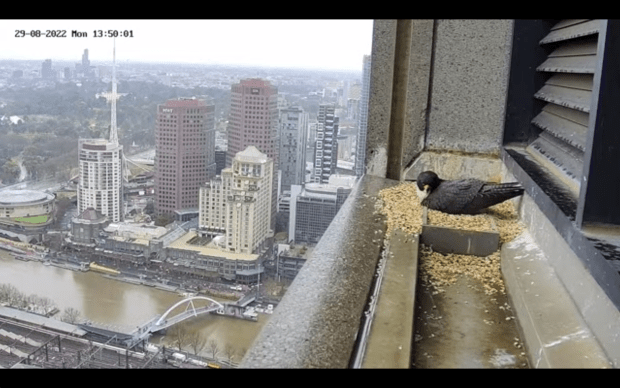
It is egg 4 for the Melbourne Peregrine Falcon couple on the ledge of 367 Collins Street! Oh, my goodness. Dad you are going to so hope that the pigeon population of the city is very plentiful!
Here is a video of that last egg being laid:
It was a prey drop and a chance for Dad to get himself acquainted with how you have to wiggle around to get 4 big falcon eggs under so they can stay warm.
It is a lot easier for Mum to get those four eggs tucked in tight. Do you think there will be a 5th?
We have a ways to go before hatch for Melbourne and Diamond might not be finished laying eggs. Incubation is a time for the females to rest. It is going to be very hectic if all the hatch at Melbourne! And exciting.
The Sydney Sea Eagles are developing right to schedule. Their plumage continues to come in and they are picking up sticks in the nest and preening. SE29 is standing and walking better each step. They really are gorgeous. The Monday morning feeding saw both 29 and 30 with nice crops full of fish. I have seen no concerning aggressive behaviour on the part of 29 to 30 that would cause me to worry.
We are about 3 weeks away from hatch watch at Port Lincoln. Mum and Dad continue to take turns incubating. That said, Mum will always have night duty and Dad will provide Mum with her meals.
You would think that Mum would be very stiff incubating the eggs all night. Dad has arrived and is nudging her off so he can have a turn. Mum goes away for her breakfast and a break, returning in about half an hour.
You are doin’ good, Dad.
There has been an unknown male visit Annie in the tower.
There is a notable change in the behaviour of the female Ospreys in the UK this year. Normally they would depart the nest about 10-14 days prior to the fledglings leaving on their migration. This year it appears the majority are choosing to remain on the nest while some or all of the fledglings depart. While we will not know the specific reason, I wonder if it is, in part, due to the raising of these large female chicks and the Mums needing more time to get in top shape. Or could it be that prey is plentiful, the weather is nice in the UK, and they just want to be home for a little longer?
Idris, Telyn, Padarn and Paith are still at the Dyfi Osprey nest in Wales as of Sunday the 28th. Idris has stayed on the perch all night. Pedran was last seen on the 11th of August at 0905.
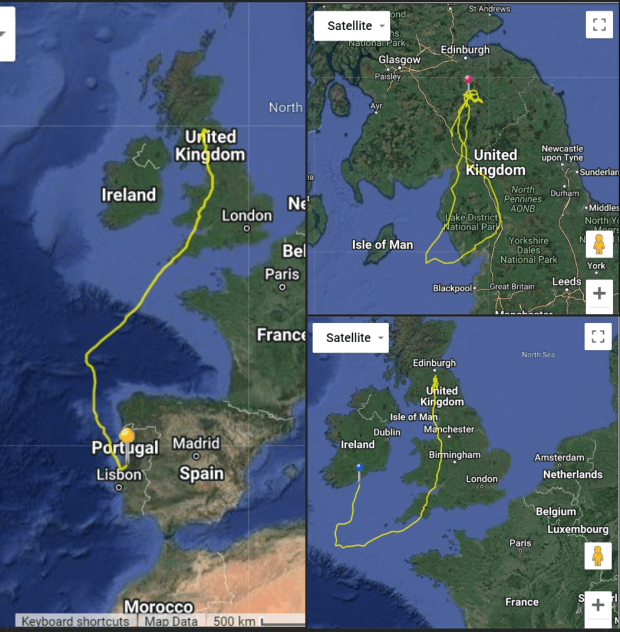
If you follow Tweed Valley, the three fledglings are going in very diverse directions including Glen who remains on the nest. Kirk is in Ireland having flown south and turning back to the land. Tweed is nearing land in Portugal.
Ruthland is updating us on their second hatch at Manton Bay, 1H2:
Tiger Mozone says that the fledglings need good DNA and luck. 1H2 certainly has great DNA. Let us all hope she has some awfully good luck, too.
1H2’s parents, Blue 33 and Maya, along with older sibling 1H1 were all still at the Manton Bay Nest at Rutland on the 27th and there is no news of either 1H1 or Maya departing since.
Seren was on the Llyn Clywedog nest early this morning and Dylan even popped in for a few minutes to join her later.
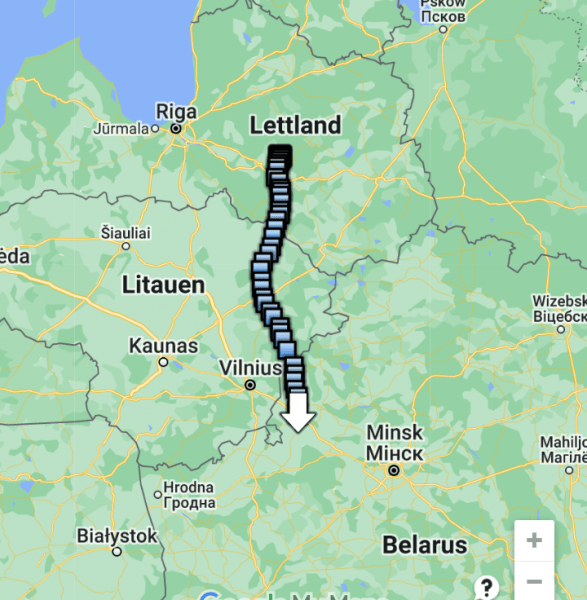
It is just incredible. Bonus continues to prove that he is a very special Black Stork! He flew from the nest in Estonia and spent the night in Latvia on the 27th. He has now flown through Lithuania and is in Belarus near Minsk. That was a total of 279 km.
Kaia, Bonus’s foster mother, remains in Belarus in the Prypjat Wetlands near Shestovicy.
So what intrigues me is this. If Kaia remains where she has been for the last several days since she flew north out of the Ukraine, is it possible that Bonus might also wind up in the same wetlands? Or will Bonus fly into the Ukraine? and remain there? or turn back north like Kaia? We should have our answer in a day or two.
Here is the distance shown by Google Maps:
Waba has begun the journey also and the tracker shows that he crossed into Latvia from Estonia on 28 August. He then flew a short distance.
I have received word that Karl II has left the nesting area in the Karula National Forest and has begun his migration. More on that to come tomorrow.
Victor has done so well since Dr Sharpe travelled to the Two Harbours nest on the Channel Islands to take him to be treated for zinc toxicity at the Ojai Raptor Centre. He has now been moved out to the big flight area! It just doesn’t get too much better than this until he is released. Wow. Victor. Way to go!
Looking forward to Lena and Andy at Captiva next year? or Connie and her mate? Window to Wildlife posted a 7 minute video about updates changes to the cameras, etc with some lovely pictures of Lena feeding the wee nestlings last year.
Thank you so much for joining me today. Please take care of yourselves. See you soon.
Thank you so much to the following for their streaming cams, their videos, and their posts that make up my screen captures: RSPB, 367 Collins Street Falcons and Mirvac, Charles Sturt Orange Falcon Cam, Sea Eagles@Birdlife Discovery Centre Sydney Olympic Park, Port Lincoln Ospreys, Cal Falcons, Dyfi Osprey Project, Tweed Valley Ospreys, Rutland Osprey Project, LWRT, CarnyxWild, Looduskalender, CIEL, and Window on Wildlife.
Sadly, the attacks by Goshawks on Osprey nests is becoming more common than one would like. Today, Dylan had no more than brought a fish in for the three fledglings and left – followed by the two – than the Goshawk that has been seen in the area knocked Blue 553 off the nest along with the fish. It was only 8 days ago that another Goshawk attack – this time in Poole Harbour – took the life of 5H2.
Here is the video of that attack in real time at Llyn Clywedog:
Here is that attack in slow motion:
The nest remained empty for the night.
There are two fledglings on the Llyn Clywedog nest this morning. One of them is Blue 554. I cannot read the other Darvic ring.
The attack happened so late at night. It is unclear if Blue 553 has been located or what the situation is but John Williams should be letting us know as soon as he can. He keeps very good track of Dylan and Seren and the chicks.
It is 05:54 and two are waiting for Dylan to arrive with breakfast.
There are new pictures of Victor looking rather bright eyed! The Ojai Raptor Rehabilitation Centre and Dr. Sharpe & Co really gave Victor a chance at a second life. They did not give up on him! You are doing great Victor.
Just look how clear and bright his eyes are – oh, Victor, we are all cheering you on to good health and a successful release ——– and a long life.
Titi has not returned to the Janakallan nest since fledging. This is a huge worry with the goshawk around the forest and the nest. If you know of any visits by Titi, please do let me know. I am concerned that he has fallen victim to the goshaw who would have lured him into the forest.
I lost about 2 hours of work – it flew off into the sunrise with all the fledging ospreys! I will include that news tomorrow but will put in two that survived on my screen because they are hugely important.
Kaia is now in the Ukraine. Kaia is the mate of Karl II, the Black Storks in the Karula National Forest in Estonia. She is in very dangerous territory – if migration were not enough! Please send her your warm thoughts.
SE30 had a nice big crop in the mid afternoon feeding. Lady is feeding it in the top image. Look at that crop. You can tell SE30 because it is whiter with less wing feathers showing. SE30 got a top up in the nest feeding. All is well at the Sea Eagles nest! Breathe.
Please send all the birds your best wishes! They are all fattening up in the Northern Hemisphere for migration – a challenge in itself without the local goshawk attacks. Thank you for being with me. Take care everyone. See you soon.
Thank you to the following for their streaming cams and/or posts which formed my screen captures: CarnyxWild, Ojai Raptor Center, Finnish Osprey Foundation, Looduskalender, and Sydney Sea Eagles at Birdlife Australia Discovery Centre Sydney Olympic Forest.
This is just a quick evening report. There is some news that you might not have seen.
Here goes. Isn’t L4 handsome? There has been an update on L4, Big Red and Arthur’s youngest and it is good news. A soft tissue injury. He should be up and about in a few weeks if all goes well. Here is the announcement from the Janet Swanson Wildlife Hospital.
My beef continues to be that Cornell is a leader in the study of Birds. They should have the best anti- bird strike buildings in North America! By doing that, Big Red and Arthur’s fledglings would have less fatalities and injuries.
SF Ospreys has posted a video of Brooks’ visit yesterday.
The ospreys at the Mispillion Harbour Osprey Platform do not visit nearly as frequently as they did even a week ago. Nevertheless, Dad was on the nest and defended it valiantly against another Osprey interloper today. Thanks ‘H’ for the head’s up!
Later there was a parent with a fish on the perch and one of the fledglings visiting the nest.
There will be no word about the Poole Harbour Osprey Nest until tomorrow. Everyone is hoping to see the family back on the nest after the Goshawk attack.
The Pitkin County Trails Osplet that was pulled off the nest (its sibling died) when Mum was tangled in monofilament line continues to do well in care.
Want to see more images of Little Bit 17? Then go to the Notre Dame Eagles FB page. There is a clear video. It is THE place to get the latest news on our beloved fledgling.
This is a capture of 17 from a video that Doreen Taylor posted. Thank you Doreen for your images of Little Bit. 17 is looking very well, indeed! I like the crop that is storing some food. So proud of you, 17. We always knew that you were a resilient survivor if given the chance. Thanks Humane Indiana Wildlife.
Beautiful Lindsay has been napping on the ledge near the scrape at The Campanile on the campus of UC-Berkeley. So nice to see you, Lindsay!
A friend just sent me the following article. Ireland has been working with Norway to translocate White-tailed Eagles back into their country. The first release was in 2006. The second was today! Thanks, ‘R’. Here is the article.
Thank you for stopping in. There is not a lot happening in Bird World but it seems it is dramatic when it does. Lots of intruders about. Take care everyone. See you soon!
Thank you to the following for their postings, videos, or streaming cams where I took my images: Notre Dame Eagles FB, SF Bay and Golden Gate Audubon, Cornell Hawk Chatters, and Mispillion Harbour Ospreys and the DDNR and Cal Falcons FB. Thank you to Doreen Taylor and the Notre-Dame Eagles. I used their image of Little Bit as the cover photo.