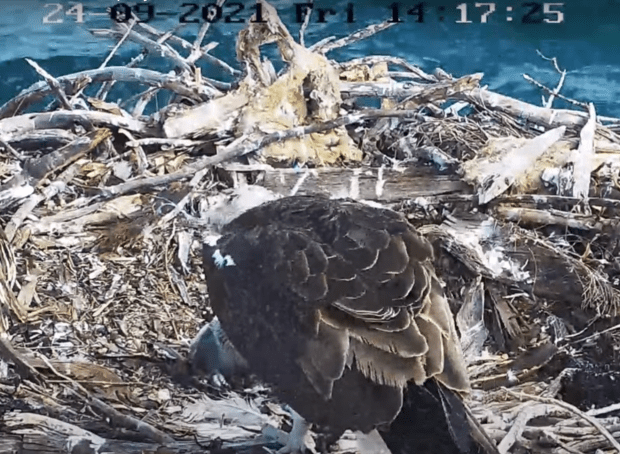
I just watched the Dad at the Collins Street Peregrine Falcon scrape trying to feed a huge piece of pigeon to “the four”. He tried several beaks to see if any of them could handle it and then ate some and tried again. Bingo! Then he did it again. Bingo! These two are just amazing – the parents. It is a lot of work to feed 4 instead of the usual 3. I can’t even imagine what it will be like when each one wants their own pigeon! Makes me tired thinking about it.
The eyases are able to eat larger and larger pieces of meat.

Ah, so sweet. Open wide.

Here are some pictures of a beautiful mom a few hours earlier. The eyases have doubled in size. It is getting more difficult to brood them.

Notice how careful Mum is raising her leg to get off of the eyases, turn, and get to the ledge to take a break.

Whew. Oh, just look at how big those the chicks are that are sitting straight. If Victor Hurley could get to the scrape box and weigh and measure the wings of the eyases next week, he might have a good idea which are female and which are male. This, of course, will not happen. He does not wish to disturb them in any way. But a Peregrine Specialist can from those two measurements differentiate between the males and females at that early age. For us, when they are about 24 days old we should be able to tell the males from the females. The females are approximately 50% larger. According to the research, even though the females are so much larger they do not substantially require more food than the males, just about 25% more.

Ah, you will often see them playing with one another’s beaks. Beaks of course mean food! They will not hurt one another. They are much stronger today than they were yesterday and you will continue to see significant growth and strength.

Cutie Pies.

And, yes, all four are there! It is 22 degrees C in Melbourne. That is 71.6 in F. A really nice warm day.

Mom is taking another break. Sometimes if you listen very carefully you can hear Dad calling her. She has to eat, too, and Dad is in charge of filling the pantry. She will often pick up the food for the chicks and bring it to the nest.
You will notice that the parents do not normally leave food in the nest. You will also see Mum eating bits of old food left in the scrape. She doesn’t want to attract insects or anything that could harm the chicks. That level of cleanliness has evolved for millions of years.

Mom has now been gone for 12 minutes (my current screen time). The chicks are nice and toasty stacked up on one another on a beautiful warm Melbourne Day. Rest assured, the adults are not far away. There is someone nearby at all times despite the fact that there really are no predators in the area.

The Port Lincoln Osplets had their first feeding at 9:00:06. It was a really nice fish and very one was stuffed, leaving the table with a nice crop.

Just look at that crop on the chick in the foreground. My goodness. By my reckoning that is Little Bob. He might have had a bit of trouble getting into the right spot yesterday but it certainly looks like he did well this morning.

A half hour later and the chicks are still working on that fish.
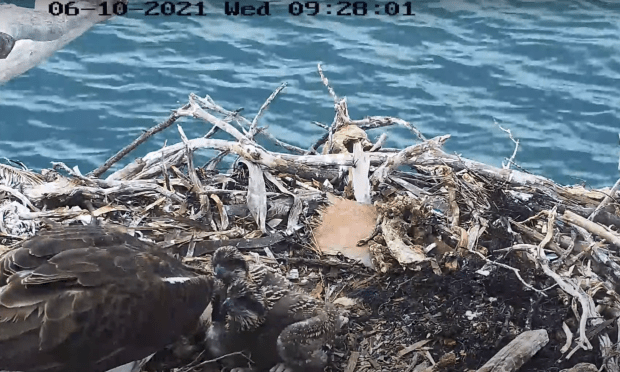
Right before 9:30, the fish is completely finished. There is nothing left. One of the older siblings is looking at Mom. You can see their nice crop, too. Little Bob is the one with its head near Mom’s tail.

The second fish of the day arrived on the nest at 12:02. It was entirely consumed and the feeding fished at 12:20. My goodness.

The chicks are all lined up nicely for Mum. Everyone will be fed and the feeding will end with each of the three having a crop. If you are just joining us and are wondering what the word ‘crop’ means, it is like a pre-stomach stomach storage area in raptors. They can ‘drop their crop’ when they need food and energy. It really helps because out in the real world, away from mom and dad feeding them, the birds might not be so successful at fishing or hunting. This way if there is plenty they can eat lots and kind of store it for when there isn’t.

Little Bob is in the middle. You can see the ‘dot’ on his head in the image above and the stripe down his back is not as wide as the two older siblings. The length of the copper-red feathers coming in on the head and neck appears to be the same length now on all three. The tail feathers of the older two are longer.

At the end of the feeding the three were still lined up as they had been. This nest is so civil. Just causes smiles, big ones.

Oh, this has been such a great year to watch. Last year this nest was the one that almost made me stop watching Ospreys altogether. I am mystified but overjoyed. The only explanation is the closeness in the hatch. No one of the osplets is significantly smaller than the other- or the reverse, none is significantly larger than the others. Not like Tapps and Solly. In this instance, Little Bob is also tenacious and has not let Big Bob’s occasional attempts at dominance rattle him in any way.
In this short blog, so far, you have read about two Australian Birds. The Guardian newspaper out of London, UK is holding its voting for Australia’s Bird of the Year. You do not have to be Australian to vote. I will post the link. Please note that the Peregrine Falcon is still in contention! There is no Osprey to vote for but the Galah is still in contention. There are many other birds and you might have a different one you like. It doesn’t cost anything and every day some birds are knocked out of the competition. You can vote every 24 hours til the end. Please take part. It is a bit of fun!
Also mark 9 October on your calendar. That is the big e-Bird count for the fall that helps in understanding where the birds are with regard to migration. Last year Cornell reported that 32,000 people from around the world submitted 80,400 check lists with 7, 128 species observed.
I am certainly curious about this year’s migration because today it was 28 degrees in my City today. That is a temperature that years ago we never even hit in the summer. It has become more normal over the past four years but not digging into October. So please do take part. Here is the information and instructions on how to do so.
https://ebird.org/news/october-big-day-2021
It is hatch watch for the Orange Falcons, Xavier and Diamond. Diamond has been letting Xavier do some of the incubating today. I hope she is spending some time enjoying herself in the sun. These two parents are going to be really busy very soon.

Royal Albatross male, OGK, spent the night on Taiaroa Head waiting for his mate YVR to arrive for the 2021-22 breeding season. Oh, he is such a handsome but sweet male. The amount of time and care he gave to his daughter, Miss Pippa Atawhai, when she was the Royal Cam chick a year ago won the hearts and minds of anyone who saw them together. He never rushed when he came to feed her. Always doing more than a few skycalls, OGK would often sit with his chick for long periods of time preening her and chatting. Sometimes he would even sleep!

It will be a joyous occasion when the two are reunited after being apart since before Miss Pippa Atawhai – their daughter and the 2020 Royal Cam Chick – fledged last September. I think OGK is anxious for his sweetie to arrive. Send all the positive wishes for this amazing couple. Maybe the NZ DOC will decide to have OGK and YRK has the Royal parents again this year. Wouldn’t that be amazing?
Take care everyone. It is getting late and I want to go and check out my book on duck ID. Thank you for joining me. Stay safe, watch the birds and be joyful! Vote for your favourite Australian bird and be sure to register for the big bird count!
Thank you to the following for their streaming cams where I took my screen shots: Port Lincoln Osprey Project, 367 Collins Street Falcons by Mirvac, Falcon Cam at Charles Sturt University in Orange and Cilla Kinross, the Cornell Bird Lab and the NZ DOC.