Eggs, Coots, and more…it is Thursday in Bird World

12 January 2022

Good Morning Everyone,

I hope that the week has been good to you. I think of everyone in the paths of the storms that I am reading about and I hope that all of you are safe.

I am repeating the story of Jackie laying her first egg. 3884 people were watching the nest at the time. It went up to over 4000. Incredible. Jackie and Shadow are much loved. It just made me giddy and all of us wish this couple the very best of luck this year. Let us hope for good weather, no predators and nothing untoward.

From the Bookshelf:

I continue to sing the praises of Slow Birding. It is my pick of all the books I have read so far as being one of the most informative and easy to understand. If you like picture books, it is not for you!!!!! Last night I tackled the chapter on American Coots. They visit us and last summer I had the privilege of seeing several at the ponds around our city on a daily basis. I want to share with you what I learned – it is fascinating.

Coots are not ducks. They are rails but they spend their time in the water – like a duck. Their bodies are a deep espresso brown black, the head a darker shade than the body. Their bill is white with a shield that ranges in colour from a deep red-brown to brick red. You can see this below. They have red eyes. Stunning. Their secondary feathers have a white trim and there is a tiny white line going down the middle of the tail to its tip. Their feet have toes and those toes have evolved over time to have phalanges that help them to swim.

American Coot (Fulica americana)” by Jacob McGinnis is licensed under CC BY-NC 2.0.

In the image below notice the red on the head of the chick.

Mud Hen or American Coot (Fulica americana) feeding her baby” by Peggy2012CREATIVELENZ is licensed under CC BY 2.0.

Some interesting facts about Coot behaviour:

  • Baby Coots have red heads. When predators are about they will stick their heads deep into leaves or into the nest so the predator cannot see them. As they age they can dive and camouflage their head by being under water. There is, on average, a five day spread between the first hatch and the last.
  • Adult Coots can tell the parasitic eggs (eggs laid by another Coot in their nest) from their own eggs due to patterns on the shell.
  • Adult Coot parents divide up the brood – older chicks with fading red heads and younger ones with red feathers. Chicks who kept their red feathers were the favourites of the adults to be fed. Unlike ducklings who can forage themselves, baby Coots are fed by the parents.

Making News:

Did you know that the Kakapo Recovery group check out the Rimu fruit, essential for Kakapo survival, to determine when breeding will begin? I didn’t.

More raptors are arriving in wildlife rehabilitation centres now that they are having to scavenge for food. Often this means that they are eating the innards left from hunters in the fields and woods – those are loaded with lead and it sends them right into care if they don’t die first. Sadly, this Golden Eagle got help but it was too late. This is entirely preventable. Write your representatives and urge them to ban all levels of lead in fishing and hunting equipment! Now. Thank you.

I would give just about anything to see a pile of ducks quacking away in my local park’s pond. They will return in the late spring. For now I have to rely on stories of others. I hate no idea, however, that Wigeons whistled, did you?

https://www.theguardian.com/environment/2023/jan/11/birdwatch-whistling-wigeons-winter-highlight?CMP=share_btn_link

Nest News:

How many of you worried and fretted that Connie had not fed the little eaglet? I sure did! Connie has now fed the eaglet – about 24.5 hours after it hatched! Yippeee. Oh, I bet that first bite of fish tasted good! Little one holding its head up nicely. There is no sign that the second egg is pipping but it could be. Perhaps the egg that hatched was actually the second one laid. We wait. The raptors will teach us patience whether we like it or not!

Connie fed the little one again at 13:39 and at 14:20. I am making an assumption that the feedings will be nearly hourly from this point onwards for a few days during daylight hours. Clive has brought in Mullet and Trout. Good job, Dad.

Thursday>. No obvious pip in the second egg at Captiva.

Oh, that little one at the KNF E1 nest of Anna and Louis is just a cute little butterball. Will that second egg hatch? I cannot see a pip there either. Oh, those little wings. Adorable. Just adorable. No signs of a pip in the other egg.

I do not see a pip on the second egg at KNF-E1 Thursday morning either but it could be there.

One big difference that you might notice is that Andria feeds her eaglets more often than Anna. That is a really good thing for those two eaglets especially the second hatch as it remains much smaller than the first. Both are being civilised and both are well fed and cared for – no worries here.

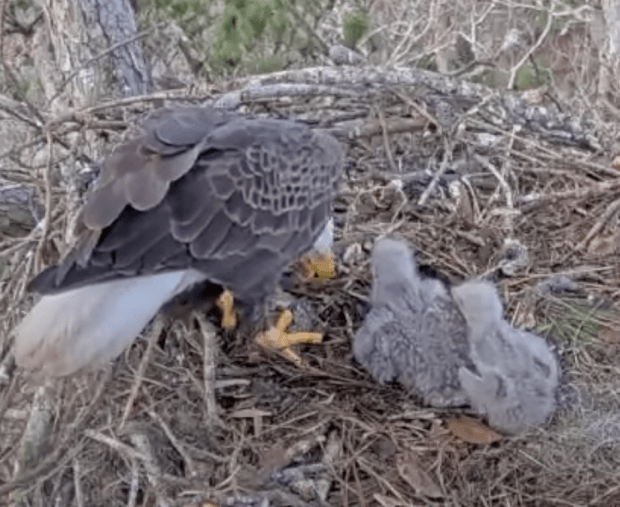
Jack and Diane were bringing in bark to the nest in St Petersburg Florida. I am sure hoping that they leave it as a liner to cover up that hole. Last year their eggs rolled in there and with the help of Crows, the couple had no osplets. The year prior they fledged three. Diane’s leg appears to be improving daily.

Both PePe and Muhlady have brought in fish to the nest. These eaglets, Pearl and Tico, are so lucky. What a great source for fish their nest has.

Pearl is really getting her juvenile feathers.

Just look at this beautiful eaglet.

Gabby and V3 were both at the nest this morning. V3’s talons have really taken a beating but they appear healing or healed. Then off to secure the territory while Gabby stays home! What a guy.

Gabby lets out a big cry at 09:46.

Both V3 and Gabby are at the nest tonight on their respective perches watching for intruders and probably hoping to get some rest.

We have all noticed the large number of intruders at Gabby’s nest – and, of course, no Samson is what started all of this. The Centre for Conservation Biology has noticed that Bald Eagles spend more time guarding than they did 20 years ago due to the growing number of eagles in the area. Here is an article that arrived in my inbox today. It really sheds some light on what could be happening in The Hamlet.

They continue to work on the nest at Big Bear. With body temperatures of 105 degrees, Jackie and Shadow can melt the snow on the nest very quickly. Keep an eye out for any fluff being brought to the nest bowl. That will signal egg laying.

Well, goodness. I said watch for the eagles to bring in soft nesting material and look what happened late Wednesday afternoon!

That nest bole has been occupied for longer than an hour. I am not ready for this! But it just might be that Jackie is!!!!!!!!!!! She certainly wouldn’t listen to me.
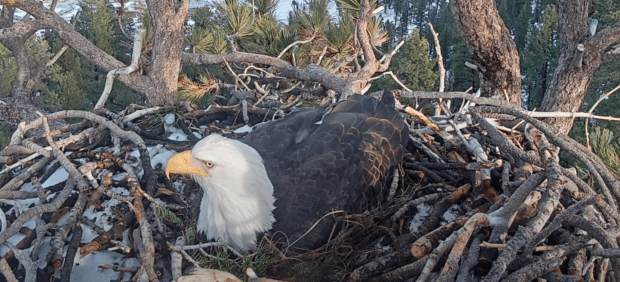
Oh, tears. Jackie just laid her first egg. Beautiful. Between 1557 and 1600. Jackie made it look easy.

There is a fully history of the Big Bear nest under the streaming cam. It is very possible that Jackie is the 2012 hatch of Ricky and Lucy. In 2019, Shadow arrives at the nest and refuses to leave. Eventually, Jackie’s mate Mr BB leaves the area. Jackie and Shadow fledged Cookie and samba in 2019. Tragedy strikes for the pair in 2020 and 2021. Last year Jackie laid eggs on 22 January and 25th. One of those hatched. It was Spirit who stole our hearts and who fledged on 31 May.

Jackie was still keeping that precious egg safe at 1800.

E21 and 22 are really enjoying the fish that was brought in on Wednesday. they are cuties. Both M15 and Harriet fed the little ones fish and both were nicely behaved. Yes.

Indigo loves bringing beetles into the scrape that he has caught. Today there were four that Elain caught in her video! Indigo is so proud of his catch.

Ron and Rose are still working on the nest in Miami-Dade. Today, Ron brought Rose a fish in the nest. How sweet.

I am waiting for the pip watch at Berry College for Pa Berry and Missey. Last year they raised a strong eaglet B15 that stayed in the area and entertained people well into the fall with his flying skills. They are not on YouTube. You must Google Berry College Eagle Cam.

The eagles are working on the nest at Duke Farms.

And the new couple at the Captiva Osprey nest, MO and FO, are working on eating a catfish (or is it a shark?) and mating at the same time. Good luck with that.

Thank you so very much for being with us today. Please take care. See you soon.

Thank you to the following for their posts, videos, tweets, and streaming cams that make up my blog: Openverse, Kakapo Recover, Terry Carman and Bald Eagles Live Nest Cams and News, The Guardian, Window to Wildlife, NF-E1 and E3, Achieva Credit Union, Superbeaks, NEFL-AEF, Centre for Conservation Biology, FOBBV, SWFL Bald Eagles and D Pritchett, Charles Sturt University Falcon Cam and Cilla Kinross, Elain and Charles Sturt Falcon Cam, WRDC, Berry College Bald Eagles, and Duke Farms Bald Eagles.

Sparrows, Samson, Rita and more in Bird World

23 December 2022

Oh, good morning to everyone!

What a blistery week it has been. The garden animals are all poofed trying to keep warm in the chill winds and -21 degree C temperatures. It has gotten a little warmer!!! And by next week, it will be absolutely balmy at -2 on Wednesday. Crazy. We can adjust our clothing and footwear. These poor babies.

We have called Dyson the ‘monk’ for a long time. When she comes to the window with her little paws folded, it is a sign that all of the food for her is gone. Time to refill! No pressure, right? Just look at that sweet face.

I continue to be impressed with the book, Slow Birding. The chapter on House Sparrows really opened my eyes. They live where we live and the first sentence of the chapter asks, ‘Who Doesn’t Love House Sparrows’? I surely do and get quite irked at those who try specifically to feed other prettier birds (to them) and thwart the sparrows. Like falcons, they exist on every continent but, Antarctica. There are fossils dating back 400,000 years in the Middle East where the sparrows followed the progress of agriculture. They would eat the seeds left in the plowed fields. Today, the planting seasons have turned topsy turvy and they are on The Red List. They were traditionally planted in the fall not in the spring and that single change would help the birds survive in the UK. To add to that, the cessation of using pesticides and herbicides would benefit the ability of the parents to feed their young. No insects, no food for the little ones. Did you know that once they hatch, the chicks need 3000 to 4000 thousand insects to eat til they fledge. This is approximately 200 to 300 trips a day, in and out of the nest, to feed the wee ones. This will continue for two weeks. Today, in North America we are lucky to have them and their beautiful songs in our gardens. Feed them! And don’t use chemicals on your lawn. Promote insects by leaving your leaves in the fall. Help these wee ones out whenever you can!

I know that many of you will remember that one or the other of Diamond and Xavier have brought in a Green Parrot to the scrape at Orange. Here is an interesting story from The Guardian about them and the numbers that have flown to Tasmania for breeding season.

https://www.theguardian.com/environment/2022/dec/20/record-numbers-of-critically-endangered-orange-bellied-parrots-in-tasmania-for-breeding-season?CMP=share_btn_link

Please do not think that birds are ‘bird brained’! Just trying getting a Rowanberry from one of the lovely and fierce Redwings.

https://www.theguardian.com/environment/2022/dec/22/country-diary-the-redwing-is-bird-brained-but-far-from-stupid?CMP=share_btn_link

Today, Samson would be nine years old ——way too early to be gone ——and a YouTube video honouring his hatch day is making the rounds. Thanks ‘J’ for bringing it to my attention.

It is so difficult to catch a peek of the two little eaglets at Superbeaks but, that said, everything seems to be going just fine. Food is plentiful and both parents, PePe and Muhlady, are extremely attentive.

Glad to have a final and definitive word on the status of Rita. Things get carried away in chats and on FB. Terry Carman gives us the latest:

Always so happy to have one of Elain’s videos of the Orange Peregrine Falcon scrape to share:

A brief look at one of the Audubon Center’s Ambassadors who lived their life in car for 31 years. Incredible. And still going strong. If you ever get near enough to Maitland, Florida – on the west coast near Fort Myers – stop in and visit the Audubon Center for Birds of Prey. You will sadly not see Smedley but you could see Bailey, his long term Osprey mate. You might also see many of the other ambassadors.

So here is Francis from a wee nestling in care to being all grown up. Oh, I miss those little eaglets. Can’t wait for Harriet and M15’s two to hatch. Let the beaking begin!!!!!!! And it will. There is no doubt about it but, it will stop.

Oh, what a delight. Andor and Cruz were on the Fraser Point nest today. You might remember that these are the parents of Victor who went into care and Lillibet from 2022. So good to see you!

They refused to pose nicely but who cares. So lovely to see both of them together at the nest!

With that luck, I thought I would check on Thunder and Akecheta and there they were together! What a great day with our Channel Islands Bald Eagles. There they are, sitting together, looking out over the water into the sunshine on that high cliff to the left. I believe it is called Tor.

I ran out of luck at Two Harbours. No Chase or Cholyn when I checked.

The cams came back up at the Northeast Florida nest. V9 flew in and chortled but no Gabby. He waited for ten minutes and flew off. I wonder if they will both return to the nest tonight? We wait. Lady Hawk caught V9 flying in.

Gabby has been at the nest and she has brought some new greenery in. We wait, watch, and hope for our girl.

‘A’ sends word that there has been a changeover at the Taiaroa Head Royal Albatross nest. These two are doing so well. The sky calls are like nothing else. Oh, how I loved the little ones doing sky calls with OGK. Tears.

Zoe is certainly developing her diving skills and it is only a matter of time before an unlucky fish comes along and she snaps it up. It would be fantastic to see her bring one in to the nest that she caught right from the natal barge. Her love of fish will certainly be a motivator!

Speaking of fish, Dad is doing an amazing job feeding Zoe. Today she had no more than finished one fish than he flew in with another quite nice one. Her crop will pop!

You can see Zoe’s crop. I sure hope that Dad is eating himself!!!!!! He is really taking excellent care of his ‘little’ girl.

Thank you so very much for being with me today. Please take care. See you soon!

Thank you to the following for their notes, their videos, their posts, and their streaming cams that make up my screen captures: ‘J’ and ‘A’, Port Lincoln Osprey, NZ DOC and Cornell Bird Lab, NEFL-AEF, Institute for Wildlife Studies and Explore.org, Audubon Center for Birds of Prey, Elain and Charles Sturt Falcon Cam and Cilla Kinross, Superbeaks, Bald Eagles Live Nest Cam and News and Terry Carman, and The Guardian.

Ron has a mate or two?…and more news from Bird World

20 December 2022

Good Morning to All,

Today is hair cut day in our house and the hairdresser is coming to us! I knew a wonderful woman who started this service when I lived in the UK. It would have been perfect during the pandemic and we wish this young person well. I am thrilled not to have to dig my car out of the snow! Nonetheless, the sun is trying to poke out of the clouds and blue skies are coming. It is now -21 degrees C and either a good day to stay in as planned or a day for a heavy coat and boots!

Nest News:

It seems that we are still waiting to see things settle down for Gabby. However, Ron is looking younger and feistier than ever with his new gal. It was a big surprise when I got a note from ‘H’ in the mail. It seems that Ron in the Miami Zoo was busy courting while we wondered if he was out fishing. Busy working on the nest. We all thought he was pining away for Rita! Well, it appears not. There is a new woman and as ‘H’ suggests, it looks like he has been cultivating the relationship for awhile now.

Here is a short video clip of the female bringing in a stick to the nest. Ron didn’t mind. It was as if he was expecting her. I suspect he has been courting her for some time before asking her home!!!!!! He wants it to go well.

Well, my goodness. You are a sly one, Ron! She is a beauty. We are all so happy for you knowing that we knew Rita could not return. It looks like you knew that as well. Congratulations! I hope she loves your Papadam nest built by Ron Magill and friends! For a long, long time. Some are suggesting her name is Rose. I do not yet know if that is official but, there is talk about banding future eaglets from the nest so we can learn of their dispersal. That would be wonderful.

Well, just when we thought it was settled for Ron there is a new female in the nest this morning! Goodness.

Things still do not seem to have settled at the nest of Gabby. Oh, how we all wish to wake up and see a handsome lad on that nest who can not only win Gabby’s heart but keep all of the other intruders at bay.

Lady Hawk caught the interaction between V4 and V6.

The AEF got it, too:

As night falls, it appears that V6 is back on the nest with Gabby.

There were some chortles happening when the IR camera came on and V6 flew to another branch (or off the tree altogether).

To be continued….Gabby and the Revolving Nest!

Iowa has received its share of snow. The landscape is lovely and the Eagles at Deborah are working on their nest today despite the weather.

This is the nest over at Decorah North today.

Liberty and Guardian were checking on their nest today, too. It was early morning in California! Everyone it seems is starting to think of breeding season! So nice to see you Liberty and Guardian.

Port Lincoln did a 23 minute close-up video of Zoe. She is really beautiful and I hope her and her pink bracelet thrive. Her flights are not going far from the barge. Perhaps in the new year.

I have to give Pepe and Muhlady a big hand. What a great parents they are. Pepe keeps huge fish coming on to the nest and Muhlady continues to care for the eaglets. It seems that even Pepe has turned out to be excellent at feeding those chicks. You can hear them and we are beginning to get better glimpses of their little heads. I am always reluctant to recommend a new nest but, I am going out on a limb and suggesting you might want to watch this one! I will put the camera link below.

Well, that is what it does to me every time I try to copy their link. Go to YouTube and search for Superbeaks Eagle Nest. You will find them!

Pepe has just brought in another one of his sharks and he seems to be quite hungry. The little ones are asking for fish, too and he is happy to oblige.

Connie and Clive have beautiful weather to incubate their two eggs on Captiva Island, part of the Barrier Islands hit so badly by Hurricane Ian.

I didn’t see Jackie and Shadow at Big Bear today but you can hear the snow dripping as it melts slowly up in the mountains east of Los Angeles.

Here is the link to their new cam if you do not have it.

One of my favourite nests is E-1 in the Kistachie National Forest of Anna and Louis. Two years ago this young couple hatched and fledged the first eaglet off this nest since 2013. Louis is a tremendous fisher – Master Class all around. He piles the nest up. They had a fledge in 2020 and another in 2021. Let’s see what happens this year. We can be sure that Louis will bring in a lot of fish (our there is something seriously wrong) and Anna will be equally hungry – she loves her fish, too. There is a chat and a great team of moderators including Tonya Irwin and the rangers, Cody and Steve.

From the Mailbox:

‘G’ sent me a link to a nest in South Africa that has new babies, just hatched. The nest was built for Bush Babies but the feathered friends took it over.

So what is a Green Wood Hoopoe? I didn’t know and this is what eBird says, “An elongated, metallic-green-black bird with red feet and a long, decurved, red-orange bill. Juveniles have dark bills but are often in the company of adults. It flies heavily, with the long floppy, white-tipped tail dangling behind. Pairs and groups of up to 14 birds are highly social, occupying savanna, woodland, riverine forest, and gardens, where they nest and roost in natural cavities. Clambers in trees, probing bark and crevices for insects and small vertebrates. They communicate using a strong cackling chatter that sounds maniacal. The almost identical Grant’s and Violet woodhoopoes (with which it sometimes hybridizes) differ from Green Woodhoopoe only by having a coppery-purple (not glossy greenish) metallic sheen.

This nest will be fun to watch. Great timing too.

Migration News:

Checking on Karl II and his family. There has been no news from Karl II and Kaia since they arrived in Africa. Kaia was in Chad and it is assumed that Karl lost contact and is safe in his winter grounds. All contact was lost with Bonus when he flew over the Eastern Desert. The only one of the Black Storks from Karl II’s family still transmitting is Little Waba who continues foraging around the Nile River. The joke is he went down one side and is going back up the other. The fear is he will land in Khartoum.

Still, he is safe, he is eating, and he is moving. That is what counts right now!

The area is near the eastern shore of the huge Merowe Reservoir.

Let us hope that the entire family of Karl II has a good winter and returns safely to their nests in Estonia in the spring.

‘J’ wrote to ask me how the book was going. Well, Slow Birding is highly recommended! I was not distracted to go to one or another projects and I am about a third to a half finished with it. The writing is excellent and covers birds such as the Blue Jay, Cooper’s Hawk, European Starling, Cedar Waxwing, Northern Flickers, White-throated Sparrows, and American Coots amongst many others. I had no idea that there is not a State in the US that does not have a Blue Jay for its ‘bird’. How could this be? The author, of course, asks the same question. Just watching Junior and the three nestlings grow to fledge this year with the little ones tapping on the window when the peanuts were gone was incredible. They brought laughs and big smiles every day. Their noise does not bother me. Indeed, like the Crows, they are most loud when the cats come around wanting to harm the other birds. The author obviously loves her garden birds and did, when she was teaching, have her students undertake slow birding. There are activities within the book but, I promise you will never look at a House Sparrow the same way you did before reading this volume. I do highly recommend it and if you have a birding friend that needs a gift, it would be a welcome one to their library. There are no beautiful coloured photographs which is fine. I prefer a good read. There are some lovely black and white drawings and it is the text that is so remarkable!

For those who have marvelled at Alden and Xavier helping out with the eyases or the new M2022 at Melbourne, many scientists did DNA tests on quite a large number of nests of the different birds in the book. Many males were found to be caring for the chicks of another! This includes European Starlings. The book is full of similar findings that are quite intriguing. There is something to learn on every page.

It is a lovely sympathetic book bringing out things about the most common of birds that are relatively unknown. I think you will appreciate these garden birds much more after reading it. Sadly, it focuses on the US and I know my friend, ‘J’ who has never seen a Blue Jay in Germany would love to! Maybe someone will do a backyard study of European birds. I would enjoy learning about them, too. Perhaps it is you. But please do not think, for a second, this book would only be useful or of interest to Americans. There is plenty of science and cultural traditions weaving their way through the pages and mention of other countries that I think anyone would find it a great read – and useful to return to as a reference. There are few volumes I can say that about.

Speaking of books, here is an announcement that might be of interest to some of you:

Thank you to everyone for being with us today. Take care all. See you soon!

Thank you to the following for their posts, their videos, their notes, streaming cams, etc that make up my screen captures: ‘G’ and ‘J’ for their notes and suggestions, Pacific Rim Conservation, Looduskalender Forum, Live Nest Cam and the Green Wood Hoopoe, KNF-A1, Window to Wildlife, FOBBV, Superbeaks, Port Lincoln Ospreys, Redding Eagles, Deborah North and Deborah, Explore.org and Raptor Research, Lady Hawk, WRDC, NEFL-AEF, and J Strassman, Slow Birding.

The Rufous hornero wins the World Cup of Birds…more visitors to Gabby’s nest and news in Bird World

19 December 2022

Good Morning!

The fluffy snow is still here – thankfully the sun is going to try and come out today and it has stopped falling. The garden is beautiful – still a wonderland.

Dyson (bottom photo) has been stocking up on Black Oil seed while two of the three babies are going after the peanuts.

Dyson is so clever!!!!!! She sits on that perfect branch and eats for hours!!!!!! Her own automatic vending machine for seed. The sparrows will never bother her.

The Starlings arrive every day around 1330. They will sit on the top branches and if it is sunny you can see them turn their little bodies around warming every side.

Mr Crow has been in a bit of a mood. The wee squirrels are taking ‘HIS’ peanuts!

Of course, the House Sparrows are always around. The way the light was falling made this one look blue in spots. He is quite a handsome male with that little white collar and blue-black bib.

It is now official. The Rufous Hornero has beaten the Gallic Rooster in penalty kicks! What a close pair these two were. Who would have thought?

Note the curve of the beak, the dark eye, and the white throat. The female is much the same as the male while the juvenile’s have lighter plumage.

Rufous Hornero (Furnarius rufus), nesting pair” by Allan Hopkins is licensed under CC BY-NC-ND 2.0.

Rufous Hornero (Furnarius rufus)” by berniedup is licensed under CC BY-SA 2.0.

Wikipedia gives this description, “The rufous hornero is a medium-sized ovenbird in the family Furnariidae. It occurs in eastern South America, and is the national bird of Argentina. Also known as the red ovenbird, it is common in savannas, second-growth scrub, pastures and agricultural land and is synanthropic.”

It not only lives in the countryside. It can be found in urban areas too. It is a rusty red above with buff plumage underneath, a white throat and a tiny little eyebrow. Note the dark rust coloured tail feathers. This bird builds its nest out of mud on trees as well as buildings and any other human structure it can find that is suitable.

It was a pretty quiet Sunday in Bird World – thankfully. We can still use some of these days to recuperate and prepare for all the eagle eggs and hatches that will be coming soon enough.

I was delighted to see Thunder and Akecheta on the West End nest. Checking often with little results or seeing the pair in the distance on those two big outcrops but…today came up gold!

It was a beautiful sunrise on the Northeast Florida nest of Gabby.

It wasn’t even 0700 and there was a suitor waiting to see if he had any chance with our Gabby.

Gabby flew off at one point seemingly tired of the youngsters appearing. She even kicked some off the nest! Some worry that Gabby will leave – this is her nest. She just needs a good mate.

Well, Gabby did return and she is telling this one on the branch to ‘get going’! It is pretty clear she is NOT happy! The looks get more and more stern.

He is not leaving!!!!!!! Notice that they are sitting pretty close together. When Gabby and Samson became a bonded pair, Samson was 4 years old. They had Romey and Jules the following year. Will Gabby pick a younger male? Remember. We have no idea how old Gabby is. Nothing is known about her. She could be nearly as old as Harriet for all we know! This ale is being called V4. Apparently, V5 was a female. Gabby booted her. She hasn’t booted this one, yet. Now if he would bring her a good sized fish.

He is not too young. Looks like a 4 year old like Harry at the MN-DNR nest. There have been other 3 and 4 year old Bald Eagles breed successfully, too.

The Stand Off with some vocals about a minute in:

Oh, dear. It seems Carole’s singing ‘Rudolph the Red Nosed Reindeer’ scared V4 off. Or did he chase an intruder? Will he come back? Will Gabby stay the night? We wait.

Yes! Gabby is roosting and can be seen on cam 1. V4 can be seen on cam 2.

It was the 1.5 year old juvenile that has caused me wonderment. How many times did we look into your eyes, Legacy. I am pretty certain it is you! No one else. You gorgeous girl.

It was this side that gave it away that this visitor is not a suitor but Legacy.

At the nest of Ma and Pa Berry, Pa Berry wound up having to defend the nest and eggs against an intruder!

Otherwise, life in Bird World is very, very quiet.

Elain provided another of her good videos of the Orange scrape as a summary for yesterday. Thank you Elain! Indigo is still home!!!!!!!!

At the Port Lincoln Osprey barge, Zoe was over on the ropes. She made a couple of flights over to the shore. She certainly looks ‘wet’ in the image below like she might have been fishing but, what you should be noticing is that amazing necklace!

No worries. Ervie is still at Port Lincoln. He has been fishing at a place called Greyhound Road, according to Port Lincoln Ospreys.

In the mail, the book Slow Birding. The Art and Science of Enjoying the Birds in Your Own Backyard has arrived! It is going to be my project today – a cup of tea, a nice wool blanket, and this book. Hope to report back tomorrow.

Thank you for being with me today. Take care everyone. See you soon!

Thank you to the following for their posts, videos, and streaming cams that make up my screen captures: NEFL-AEF, Explore.org and IWS, Port Lincoln Ospreys, Berry College, Elain and Charles Sturt Falcon Cam and Cilla Kinross, and OpenVerse.