New Year’s Day in Bird World, late edition

New Year’s Day started off wonderfully with the uniting of Annie and Grinnell. Cal Falcons posted a note that the interloper that had injured Grinnell and sent him into rehabilitation on 29 October has not been seen in the past two weeks. It appears that our little Grinnell watched, got stronger, and got rid of him! That is a good thing. Grinnell is far too experienced a mate and knows how to take good care of the eyases – that is invaluable to Annie. I only wish Daisy had a mate half so invested in the eggs and nestlings!

10,600 people have watched Annie and Grinnell ring in the New Year together! Look closely at the image. Notice just how much bigger Annie is than Grinnell. That is reverse sex-size dimorphism – in raptors, the female is normally 30% larger than the male.

These little falcons like to live on the highest buildings so they can have a great view if anyone larger than them should want to arrive at their scrape box. Thousands of years ago they lived on the highest cliffs (some still do in certain geographical regions) but, like other birds they have adapted as humans take over their space. They have adapted to our skyscrapers like this perfect building on the University of California at Berkeley, The Campanile.

Oh, what a beautiful sight first thing in the morning. So happy. This is just such a relief.

The White-Bellied Sea Eagles were up on the branch together to sing the morning duet. They had a rough night of it. They were chased and harassed by the Pied Currawong first. The Curra are the birds that injured WBSE 27 – gathering in a group to fly and hit its head. The Curra are also the birds that chase the eagle fledglings out of the forest before they have learned from Lady and Dad how to fish and survive. I really do not like them and their numbers have grown in the forest over the past few years. They are more than a nuisance. They can be deadly.

As soon as the Curra were in bed, it was not long until BooBook Owl and its mate started their silent attacks. They spent five full hours harassing the WBSE. They are also dangerous. One injured Lady’s eye last year and she could have been blinded.

Here is a video of the attacks with the eagles falling off the branch.

To my knowledge, the WBSE do not eat the hatchlings of either the Curra or the Owls. These little birds just want the big Apex raptors out of the forest and they will do everything they can to accomplish this.

The pair sang The Duet and promptly left the forest. I wonder if there is another nest location for them? The old nest of Dad’s collapsed but there could be other suitable sites.

I made this video clip a few months ago in mid-September. I love the beauty of Lady and Dad singing their song to wake up the forest. Scroll your mouse or tracker over the left hand corner and then click on the arrow to play.

I have never liked this nest because of the Currawongs and now Boo and his family are older and bolder. It is not good for the eaglets who hatch or for Daisy. My eyes in that area tell me that the Ravens have also been coming to the nest to check for eggs every couple of days. So sad. If Daisy does return, I have no hope for her eggs hatching. I just do not want her to get injured if a large number of Ravens would come at the same time.

This morning on the Port Lincoln Osprey Barge Bazza was on the nest when the fish arrived at 08:09. Falky flew over from his perch hoping to get it but Bazza was the clear winner and kicked Falky off the nest! You will remember that yesterday Bazza flew in and took the fish right when Dad brought it in. Bazza is going to be called Bold Bazza for sure. He is getting street smart for sure – all good survival skills.

Here comes Dad with the fish. Bazza can see him and he is prey calling louder and louder.

Bazza is starting to mantle the fish (on the left side of the nest). Mantling is when a raptor spreads their wings over the food item so that others cannot get to it. It is almost like hiding it. Falky is on the right edge of the nest. Ervie is up on the perch and Mum is on the ropes.

What interested me was not Bazza getting the fish or Falky trying to take it but, Ervie’s behaviour. Ervie did not move off the perch. He did not care. He was not hungry. This tells me that Ervie had already been out fishing for his morning breakfast. He will continue to get more and more independent.

E19 was being a bit of a stinker today. His attacks on E20 were frequent and sometimes brutal.

So what do Harriet and M15 do when this happens? Well, often, they will ‘sit’ on the chicks but, at other times, they will do a tandem feeding. That is precisely what happened today. M15 stepped in to help Harriet with the cantankerous two.

Just lovely. Both eating at once. They will learn, over time, that everyone gets fed. No one goes hungry in Harriet and M15’s house.

Ferris Akel held his tour today. Viewers were treated to the sightings of five Snowy Owls at the Finger Lakes Airport.

Snowy Owls are moving south from their home in the Arctic to find food. They mostly eat rabbits, grouse, mice, weasels and small waterfowl and marine birds. Open fields, golf courses, or small airports like this one are perfect for them to find food.

Not far away were what seemed like a thousand Sandhill Cranes. Some were feeding in the fields, some were in the marsh, and some were flying from the fields to the marsh. There seemed to be Sandhill Cranes everywhere!

The adults have grey bodies with a distinctive crimson red cap. Their long legs and necks immediately tell us that these are ‘wading’ birds. They stand 90-122 cm tall or 36-48 inches. They have long pointed beaks for finding food in the muddy waters of wetlands. They also have a ‘bustle’ or tufted tail. You can see those tufts on the cranes in the image below.

The Sandhill Cranes migrate during the winter leaving their summer feeding grounds in the Arctic and Northern Canada in large groups. They will gather in the thousands in staging areas.

With their long beaks they probe in the waters feeding on plant tubers, roots, seeds, and small invertebrates. In the image below you can see how their long legs and neck really assist them in finding food.

Oh, these cranes are so gorgeous. Sandhill cranes have been the subject of Japanese art for centuries. They are a traditional symbol of immortality because it is believed that the cranes live for a thousand years.

The panel below is called Cranes in a Winter Landscape. This is clearly a good wish for longevity.

The screen below is part of a series of two six-panelled screens done in the 1700s. Typically the backgrounds would have been painted gold. Both the old twisted pine and the crane signal immortality or wishes for a long life. These would have typically folded and divided rooms.

Thank you so much for joining me. Stay warm, stay safe. See you soon.

Thank you to the following for their streaming cams where I took my screen captures and video clips: SWFlorida Bald Eagle cam and D Pritchett, Port Lincoln Osprey Project, UC-Berkeley Falcon Cam, and Ferris Akel.

Everyone’s favourite Duck and Falcon are back!

The last time we saw Daisy the Pacific Black Duck was when she returned to the White-Bellied Sea Eagle nest on the 23rd of December. She brought Mr Daisy with her to show him that her eggs were missing or destroyed. Daisy pushed all her down into the egg cup after walking all around the nest quacking. She arrived at 20:22:52 and left at 20:34:56. My heart broke for Daisy that day. After dealing with the possum in the early morning and the rain, Daisy was forced to leave for her morning break late. It just happened that three Ravens decided to venture out early that day. Daisy returned to her fertilized eggs missing or broken. She was frightened and confused.

This was the second time that Daisy had attempted hatching ducklings on this nest. The previous time had been in January of 2021.

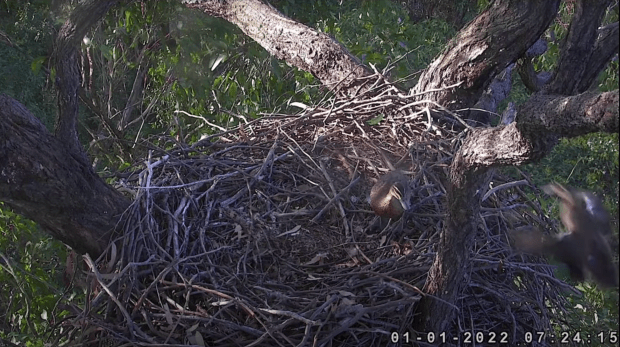
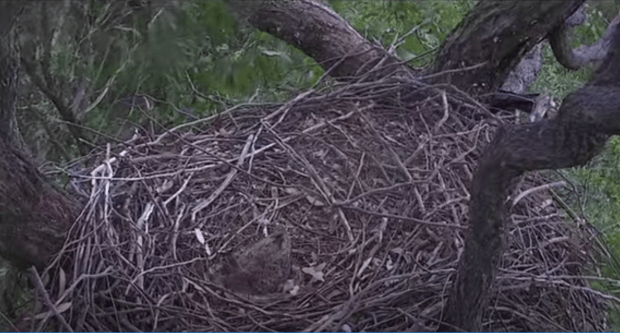
Now, on 1 January 2022, Daisy and her mate have returned. When the eggs are broken, the intermission between then and the ducks mating again can be as little as ten days. It has been 9 days.

If Daisy decides to use the WBSE nest again, and it appears that she will, January will be complicated because Lady and Dad, the Sea Eagles, will be spending more time at the River Roost and more time checking on their nest.

The Sea Eagles will not be a direct problem. They might pull all the down off the eggs and might break one but they had no interest in destroying the eggs before. No, the predators are the Ravens.

If only Mr Daisy would step up and help!

Daisy arrives.

Mr Daisy arrives.

Our beautiful Daisy.

I had so hoped that she might try her luck down on the ground.

And so, we all realize the worst but hope for the best for this precious little duck that just wants to be a Mum.

There will be a lot of sleepless nites and tears. Get the tissues ready! Here are 2 video clips of Daisy and Mr Daisy arriving and inspecting the nest.

Another big surprise and a most welcome one is the return of Grinnell to The Campanile today. Here is the video clip of that moment:

Wow. Two huge surprises. I have to say that I am more than delighted to see Grinnell up on the ledge of the area that him and Annie use to raise their chicks at The Campanile on the grounds of UC-Berkeley. This is just fantastic. On the other hand, I do wish that Daisy had a safe place to lay her eggs so that she could experience the hatching and the leading of her little ones to the water. I cannot think of anything that would make all of us happier.

Thank you so much for joining me. I am thrilled to bring you this news. Take care. See you soon! Wonder what else is in store for us?

Thank you to the following for their streaming cams where I took my screen captures and video clips: Sea Eagles@Birdlife Australia Discovery Centre Sydney Olympic Park and UC-Cal Falcons. I also want to thank ‘P’ for alerting me to Daisy’s return. I would have missed it otherwise.

Daisy and the Unkindness

It has been a day of great heartbreak with Daisy losing her eggs to the Unkindness. Although she will never know the thousands of people who were quietly (or loudly) cheering her on. As ‘B’ in the UK says, ‘She was doing so good.’ She was. This morning Daisy did not like the rain hitting her bill and head. She would toss her head about trying to get the drops off. She had puffed her feathers so that they would cover the down on the nest so it would not get wet. Whether the showers contributed to Daisy deciding to leave late, we will never know. And will will never know if it was the end of the showers that prompted the Ravens to come to Daisy’s nest in the hope she would be away.

Last season some wondered if Daisy’s eggs were fertile. This year we could tell that they were. Some old timers reviewing Daisy’s incubation – she stayed on the eggs for most of the day before she finished laying the 8th egg – felt looking at the one egg that Daisy flew away with that hatch could have been 10-11 days away. It was not to be.

Daisy returned to her nest at 07:50:02 to find her nest and eggs destroyed. I simply cannot imagine how she must have felt seeing that precious down scattered all over the nest – and then to see some egg shells – and one large portion of an egg. It was immediately clear that there had been a duckling developing in that egg – it was not simply a yolk. Daisy gathered up that portion of an egg and flew off the nest with it at 07:51:10. Six minutes later at 07:57:19, Daisy returns to the nest.

On this return, Daisy surveyed the entire nest. She found some shells, she went to the rim of the nest where she normally flies off, and hesitates. It is 07:59:07. She goes back near the egg cup. Daisy gathers some of the down and looks for more shells. At 08:07:21 Daisy again walks over to the rim of the nest. She stands looking out for nearly a minute. At 08:08:19 she goes back to the nest cup. At 08:08:27 Daisy lays down on the nest cup. She begins tucking and rolling – it would have been easy to imagine that the Ravens might have missed some of the eggs due to our little duck’s behaviour.

Daisy continues to gather up down, tucking, and rolling what would have been eggs with her strong legs and webbed feet.

While Daisy was on the nest, there were periods where she froze just like she would do when the Ravens came on the nest. I have three separate incidents and there could have been more. One instance was 17 minutes long.

Daisy flew off the nest in the old Ironbark Tree for the last time at 09:10:45.

I wish I could look at the nest and pretend Daisy is just off foraging.

As I am reminded, the odds against Daisy hatching these ducklings was only 15%. This season was so different. Daisy was not playing tag with Dad, the White-Bellied Sea Eagle. Indeed, the Sea Eagles had visited and paid no mind they were so busy with the Pied Currawong attacking them. There was then this hope that developed especially since Daisy so valiantly defended her nest against the Ravens twice.

Daisy might begin laying eggs for her second clutch in 47 days. The laying of eggs and the incubation period really puts demands on the body of the hen. It takes some time for her to regain her health in order to begin the process over again. There are only two clutches per season.

It has been a difficult year for each of us. Your list will be different than mine but mine began first with the loss of Malin, then K2 Big Red and Arthur’s second hatch, then ‘Little 4’ of 367 Collins Street Falcons, and last but not the least of them, Yurruga at the Orange Falcon scrape. There were, of course, others – the Finnish Ospreys and their Mum, Milda’s two chicks…the list grows longer thinking about it.

Take some time to breathe. Daisy was a remarkable duck and we all began to believe that she would overcome the odds. I have asked a friend who is often down by the Discovery Centre to find Daisy and send us a picture if she would. It would give us each some closure to see Daisy in her element paddling around and eating.

Thank you to everyone that wrote to me. It is so touching that so many people care about this wonderful duck. It will take me some time to answer each of you but, I will. For now please take care of yourselves.

Thank you to the Sea Eagles@Birdlife Australia Discovery Centre Sydney Olympic Park for their streaming cam where I took my screen shots and video captures.

The Daisy Chronicles, Day 20 The Raven Came

I had no more than posted my last blog thinking that the rest of the day would be quiet like the beginning. That changed with the arrival of a single Australian Raven at 18:08:21. You could hear it before you could see it. Daisy froze!

The cawing was singular so it was only one Corvid on the nest. In the distance there was, at one time, what sounded like another Raven. To my knowledge it never flew to join the other Raven in the branches of the Ironbark Tree.

Daisy keeps her bill under that one twig – not moving. I once saw Little Woodpecker cling to a suet holder for 45 minutes when Sharpie, the Sharp-shinned Hawk was sitting on a branch under it pretending to be a bird feeder. Little Woodpecker was terrified. You could tell it only from his eyes.

Daisy is quick. The Raven flies over to the branch. She turns quickly so that she can keep an eye on it.

At one point the Raven hid behind the big branch. you can see its tail on the right. Did it think Daisy would think it was gone? and move off her eggs?

Daisy lunges and the Raven moves to the other larger branch to the right.

Daisy knows the Raven is still in the tree. Every once in awhile it will make a very eerie sound.

Daisy watched and listened. She did not relax until 16:21. That was a total of 13 minutes.

Whew! I must remember not to take anything for granted. Our brave little duck is doing the absolute best that she can.

The weather forecast for Daisy is not good. There is a 40% chance of rain beginning shortly. It looks like there are chances of showers increasing to 70% probability after midnight. There could be a thunderstorm around 10:00 tomorrow morning. Sadly Daisy might not be able to stay dry. It looks like there could be showers on and off for the next week.

Thank you for joining me. We forget what a challenge laying the eggs, incubating them, and then finally the hatching is for Daisy. She is just doing so well that sometimes I need a good reminder that this is not easy. Send her all your good energy! I certainly am. She is very brave despite being frightened.

And if you want to know what this might look like should those eggs hatch, here is a cute little video of a female Mallard and her ducklings – from hatch to freedom. OK. The distance is very different but these fuzzy yellow ducks are so cute and look how their Mum knows when one of them is missing. It is amazing —– and they don’t have a 75 foot jump!

Thank you to the Sea Eagles@Birdlife Australia Discovery Centre Sydney Olympic Park for their streaming cam where I took my screen captures.

The Daisy Chronicles, Day 20

Daisy flew off the nest – very early – at 02:56:25 for her early morning foraging trip. She did not return until 07:05:08. It was an anxious time waiting for her to fly back to the nest. Sunrise was at 05:38. As always, I worry about the Ravens. They are such intelligent birds. They know there are big delicious eggs in that nest and they want them. So far they have flown by or landed on the upper branches of the Ironbark Tree in the Sydney Olympic Forest checking to see if Daisy is there. The Ravens do have a routine – arriving between 08:30 and 10:00 – but, that is not to say they would not come early!

To my mind, Daisy has had an unusually quiet day after returning to the nest. She has moved leaves, shifted back and forth turning the precious eggs over, and she has slept.

The cam operator has checked a couple of times and the Sea Eagles are not at the River Roost – but, we should all remember that anything can change in an instant.

The camera operator has also given us some really nice close ups of our adorable duck!

It is now almost 16:00. All is well. It has been such a quiet day. Sometimes all you could hear was the hum of the camera and the traffic. It almost seemed like all the birds had left the forest! We will take it. Hopefully the remainder of Day 20 will be completely uneventful! She has one more foraging trip. I will report on that tomorrow.

Before I close, Judy Harrington has given an update just minutes ago on WBSE 27: December 22 latest report on SE27 – a Seasonal message. “SE27 is doing as well as can be inspected for the short time she has been in care. She is building up her confidence and her weight and when the weather clears will be moved into the larger flight aviary.” I think she meant ‘expected’ not inspected. It is wonderful to hear 27 is improving. I hope that when 27 leaves it has the confidence that Iniko has!

Thank you so much for joining me today. It is so nice to have so many people sending their love and positive energy to this darling little duck. Take care everyone. See you soon.

Thank you to the Sea Eagles@Birdlife Australia Discovery Centre Sydney Olympic Forest.

The Daisy Chronicles, Day 19 late-20

It is after lunch in Sydney, Australia and Daisy is fast asleep incubating her eggs. The morning has been quiet.

Daisy has 8 eggs in her clutch that she has been hard incubating. Daisy laid egg 1 on 3 December nest time. The 8th egg was laid on 10 December. She began hard incubation on 10 December if not December 9. Today is 22 December – the summer solstice – for Daisy. Daisy has been incubating her eggs for 13 days. Hatch will be 3-6 of January in Australia should the eggs survive.

Daisy really had a quiet afternoon. I could see nothing happening. The cam operator checked several times to see if the WBSE were at the River Roost but they were not.

As I remind everyone, there is no reason to believe they would do anything to Daisy from their behaviour last year which was curiosity about the down and Dad going into territorial protection wanting to catch who was using his nest. He was mesmerized by the eggs and at one time everyone thought he might incubate them. It was like he went into some kind of a ‘trance’ — seeing eggs in that place immediately reminded him of Lady’s eggs. It was quite interesting behaviour. He finally broke one but he did not like the taste. I am hoping that he remembers that if he scares Daisy off the eggs again this year.

Throughout the afternoon, Daisy kept gathering up leaves that she could see. She would stretch her long neck and pick them out from under the twigs. You could hardly see her on the nest when the shadows crossed over where the egg cup is located.

Every once in awhile she would see a piece of a leaf and pull it towards her using her bill as a kind of shovel.

Daisy began to cover the eggs around 18:03.

Daisy flies off the nest at 18:03:18 for her evening meal content that her eggs are covered enough to keep predator’s eyes away from them.

It is almost precisely two hours before sunset. Daisy is taking a chance that the Ravens will not come this time of the evening! On the other hand, the Sea Eagles might and that would be a good thing if she were not on the nest. Remember Lady was chased by the Currawong and was so busy watching them so they would not hit her head that she landed on the nest, honked a few times and flew off – she didn’t even look at the nest bowl and see the down. Oh, Daisy is lucky.

Daisy returned at 20:25:39.

It was – what appears to be – a relatively quiet day and evening for Daisy.

I was surprised, however, when Daisy prepared to leave the nest at 02:56:25. I say surprised because of the visit by the Bushtail Possum in the wee hours of the morning before.

I was even more surprised when Daisy walked straight forward, instead of taking the right turn she normally takes, to fly off. It then occurred to me that Daisy might begin to check places to leave the nest for the ducklings to follow. Could this be why?

She flew off the parent branch. Maybe it is a cleaner drop? If you look at the side she normally flies from there is a large piece of the nest with all its bits and pieces of twigs and branches extending out that the little ones might get caught in.

Sunrise is at 05:41.

Daisy returns from her foraging at 07:05:08.

The solstice is upon us. It is ‘winter’ in the Northern Hemisphere and ‘summer’ for Daisy in the Southern. It is the longest ‘dark’ day for us or the longest ‘light’ day for Daisy. In Canada, we look for the light that each day stays with us a little longer. The word Solstice comes from the Latin meaning the time when the ‘sun stood still’. Today, the sun is at its most southern position from Earth. It seems to stop and stand still at the Tropic of Capricorn only to then reverse its direction. It is a turning point in the seasons. It is a symbol of the Earth’s rebirth.

Wishing the rebirth of the sun to fill your lives, your home, your garden, and your heart with warmth and happiness…. Happy Winter Solstice to each of you. And to Daisy, our most favourite adorable duck, Happy Summer Solstice. We wish you an uneventful, boring day.

Take care everyone. Thank you so much for joining me. I will continue to monitor Daisy throughout the day with a brief posting later today on the day’s events. Take care. See you soon!

Note: Congratulations to Samson and Gabby on their second egg which was laid yesterday at the NE Florida Bald Eagle Nest.

Thank you to the Sea Eagles @Birdlife Australia Discovery Centre Sydney Olympic Park for their streaming cam where I took my screen shots.

The Daisy Chronicles, Day 19 morning

Daisy flew off the nest at 05:07:04. Then the camera went offline. Thankfully Dasha moved the Twitch streaming cam so that we could see Daisy instead of a wide view of the nest tree. It is unclear when Daisy returned precisely but she was on the nest and dry at 07:29.

The cam operator (I think it was Dasha – thank you) gave us some beautiful close ups of our favourite duck. Daisy is just so beautiful.

This first image with the wee bit of sunlight falling really shows off Daisy’s plumage and that amazing down.

That blue bill really differentiates the Pacific Black Ducks from the ones in North America.

There is that beautiful distinctive creamy tan line from the bill above the eye and then the wider one below.

Oh those bits look like twinkle stars. I never knew Duck down was so beautiful — just warm!

Sometimes you can hardly see Daisy on the nest.

It has been a very quiet morning for Daisy as it nears noon. I can hear the Noisy Miners in the forest but, there appear to be no Sea Eagles over on the River Roost.

What a blessing! I do not believe the Sea Eagles will harm Daisy and I don’t even think that they will mess with the down because Lady doesn’t like it. But Daisy would leave quickly and she would not be able to cover her eggs leaving them in view of predators.

Of course, Daisy being a very intelligent duck would wait in a nearby tree for the WBSE to leave and then she would fly over quickly, right?

Daisy doesn’t often stay in the same position for a long time. She is twisting and moving about, turning the eggs, tucking in down.

You can see the shadows moving over the nest at noon. It will be a hot day for our girl and those eggs. Hopefully she will not leave the nest too early this evening.

Daisy has moved a little. It is noon and all is well.

It is a little after noon. Daisy is rolling eggs and reaching out to find leaves underneath the branches and twigs. I really hope she is not thinking of a break. Oh, please, Daisy. Just stay put for six and a half more hours, please.

I will continue to monitor Daisy til she leaves for her evening foraging and then will check on her periodically. I am hopeful that nothing untoward will happen. Fingers crossed.

In other nest news, OGK has flown in and replaced YRK on the Royal Albatross Cam in New Zealand. Also a 2017 hatch, Royal cam chick, Tumanko, landed on Taiaroa Head. This is amazing. He is four years old and has survived. As a chick he was not always well so this gives us all hope for all the birds. Over at the Port Lincoln Osprey Nest, Falky has been trying his hand at fishing. He made two dives off the barge this morning. The first was at 07:04:41 and the second at 07:20:07. In the image below, you can see the nice form Falky has. It will not be long until he catches his own fish. Mum looks on proudly while Bazza is on the nest waiting for his fish. Is it really Bazza Baby??? Ervie is off flying!

Here are a couple of lovely morning views of Diamond, the Peregrine Falcon female at Orange. She is adorable.

It has been a good day in Bird World. M15’s injury from the GHOW is improving and we wait for Gabby’s second egg — oh, and it is getting close to hatch watch at SWFlorida with M15 and Harriet. Oh, I am in dire need of some bobble head action! And if you are missing the Ospreys, her is a great image of Aran, the male at the Glaslyn Nest who was injured during the storm that hit Wales at the end of May. The community was so generous. They brought out a fish table for him and Mrs G – allowing them to grieve the loss of their three osplets and heal. Oh, Aran is a handsome one – and he is also a good fisher. Three and a half more months – Osprey action in the UK!

Take care everyone. Thank you so much for joining me. See you soon.

Thank you to the following for their streaming cams where I took my screen captures: Port Lincoln Osprey Project, Sea Eagles @ Birdlife Australia Discovery Centre Sydney Olympic Park, and Charles Sturt Falcon Cam and Cilla Kinross.

The Daisy Chronicles, Day 19

Daisy only took an hour break last evening (Day 18).

It was extremely hot on the nest reaching to more than 98 degrees F on the forest floor or 37 degrees C. Did you know that extreme heat can kill the embryos? just like extreme cold? My friend told me that the layers of down that Daisy folds over can protect the eggs from either. Daisy was awfully not yesterday. She was often seen panting.

Daisy had a few hours reprieve from any intruders after she returned from her foraging. After midnight they arrived. Then at 00:41 she had to defend her nest and eggs from a Bushtail Possum! Daisy lunged at the Possum just like she did the Ravens. Gosh, our little duck mother is very protective and brave. Someone caught the action of the Bushtail Possum, the Ringtail Possum and a Lizard! My goodness.

“Bushtail Possum eating” by yinzhou1 is licensed under CC BY-ND 2.0

There appears to be no consensus as to whether or not the Bushtail Possums will harm the eggs. Many say they ‘hiss and look scary’ (my friend) but won’t be interested in the eggs while many individuals in Australia believe that the Bushtail have taken their eggs from the hen house.

The main streaming cam, cam4, that I watch continues to go offline. The cam operator for Twitch has moved it to focus on Daisy. Thank you. The Ringtail Possum continues to climb around the tree. Daisy may not take her break before sunrise because of them but after sunrise she runs a risk of the Ravens. That also applies to the afternoon if she leaves too early.

Here is a video – the image is grainy – of the Ringtail Possum coming up the tree to pester Daisy. I believe Daisy will wait to leave for her morning break until this possum goes into its nest and quiets down.

Daisy first started thinking about leaving for her morning foraging at 05:03 when she began tucking the down around her body. Then she stopped. Then she started again.

Wee get a wee peek at the eggs in the first image.

Daisy is very thorough.

She will move around the nest several times scooping up and pulling down and leaves over those 8 eggs.

She is almost done. This is her third swing around the nest.

Satisfied that the eggs are covered as best she can, our lovely little Duck – this brave duck – heads off for a quick breakfast.

She’s gone.

Sunrise is at 05:41 today. The temperature in the forest will range from 21 degrees C which it is presently to 31 degrees C mid afternoon. The wind is only 2 km/h so no creaks on the old Ironbark Tree today for Daisy! It could be a perfect day for the Sea Eagles to come and check on their nest. That is a horrible thought but they are due and the weather is good. Hopefully they will come when Daisy is away from the nest. Otherwise, she will flee leaving the eggs exposed.

While we wait for Daisy to return, there is some good news. When the camera maintenance is undertaken on the WBSE nest, there will be an attempt to remove the monofilament fishing line. They can’t go up while Daisy is incubating so it will not help the legs of her tiny goslings should they hatch and make their way to get off the nest. It could frighten Daisy and she might not return to the nest. It will, however, help the Sea Eagles – all of them. It must have come in one of the fish deliveries. This fishing line is so dangerous – along with the lead and the hooks.

It is cold on the Canadian Prairies which means the sun is shining! It is -17 C today. A good day for reading and hot tea. The summer solstice will occur at 02:58 on Wednesday the 22nd of December for Daisy. For North America the winter solstice is at 09:58 tomorrow, 21 December.

Thank you so much for joining me today. I will continue to monitor Daisy on the nest throughout the day and evening. Let us all hope it is boring and uneventful! Take care everyone. See you soon.

Thank you to the Sea Eagles@Birdlife Australia Discovery Centre Sydney Olympic Park for their streaming cam where I took my screen captures and also for their videos. Thank you to Pat for the alert about the possums and Dasha for turning the Twitch cam on Daisy instead of the wide view of the tree while the main cam is down. Much appreciated.

The Daisy Chronicles, end of Day 18

Daisy had a relatively quiet day on Monday, the 20th, in Australia.

The wind broke a small branch loose that had some leaves on it and it fell right by Daisy’s nest! Seriously, this is one lucky duck.

By mid-morning the sun was making Daisy hot. In the image below she is panting to thermoregulate her temperature.

The camera operator checked to see if the Sea Eagles were at the River Roost. They were not.

Daisy spends some of her time removing more down and tucking it in.

Everything was pretty quiet until 15:55 when Daisy froze. I could hear the Ravens but they went quiet. They had to be sitting on the tree branches out of view of the camera. Daisy stayed in the same position until 16:03:30 when she relaxed.

Daisy kept her head down but she was looking and listening.

Every once in awhile the Ravens would make intimidating sounds.

Daisy relaxed and then she froze again at 16:13:10.

She has relaxed.

Daisy worked on the down, twigs, and leaves and bits and bobs to cover the nest for more than three minutes before she felt certain her precious eggs were covered well enough to leave.

Daisy did not leave as early as she did yesterday. She flew off at 17:34:21. It is still light and you can still hear some birds in the forest. She is counting on the Ravens not returning. It is two and a half hours until sunset at 20:04.

It is nearing 01:00 on the Canadian Prairies and I am going to take a leap of faith that Daisy will get home and her eggs will be in tact and toasty warm under the down, the heat of the nest, and the rays of the sun.

Thank you for joining me. It is wonderful that so many people care for this wee duck who has laid her eggs in this enormous nest in the forest. Take care everyone. See you soon. — Look for my next posting mid-afternoon on the Canadian Prairies tomorrow.

Thank you to the Sea Eagles@Birdlife Australia Discovery Centre Sydney Olympic Park streaming cam where I took my screen shots.

The Daisy Chronicles, Day 18

At 03:43 in the morning I was waiting for Daisy to return home, like a parent waiting for their teenager to the first time they borrow the family car. My math wasn’t good at all. So, let’s go back and get this right. Daisy laid 8 eggs. She began hard incubation (perhaps on Day 7) but for sure on Day 8. That is 11 days. The duck eggs require 26-30 days of incubation. So, as of today, we have 15-19 days left.

Daisy is, of course, starting to drive me a little bonkers. She was so careful with the timing of her foraging trips until a couple of days ago. During that time, Daisy left the nest after sunset and took her morning break before sunrise. That guaranteed that she would miss the Ravens and the Sea Eagles. They are diurnal – daytime hunting birds. Now, she is gambling. She left for her break last evening at 15:30 – two and a half hours before sunset. She was simply lucky that those Ravens did not fly by and see her gone.

Daisy returned at 19:11:56. The beautiful glow of the setting sun makes Daisy and the nest look ‘rose gold’.

Isn’t she gorgeous?

This morning, sunrise was at 05:40. Daisy did not leave to go foraging until 05:43:21.

Daisy put considerable effort into concealing her eggs underneath that thick layer of down.

She walked around the nest several times tucking and poking.

Certain that everything was to her liking, Daisy flew off for breakfast.

You can just see her flying out of the right hand side, middle ground.

Seconds after Daisy left, the camera went offline. The wind is blowing at only 10 km/h and the current temperature is 21 degrees C. It will go up to 29 C today in the Sydney Olympic Forest. The time is 07:23. I hope our darling Daisy has returned or will return soon. The Ravens do tend to come in the morning.

Daisy is home! Whew!

The Rainbow Lorikeets have flown in to say good morning. They are so colourful and what a nice voice they have.

It looked like there were 7 or 8 visitors. Several seem to be curious about the Ringtail Possums hole on the right side of the nest below the top of it. There is a Lorikeet close to the entrance.

They come in a ‘migraine’ (that is what a group of Rainbow Lorikeets is called) and leave together just as quickly moving on to other areas in the forest.

Daisy looks really comfortable in that fluffy down nest.

Daisy removes some down.

It is 09:10 on the nest and for the moment, everything is fine! That is a good thing.

But at 09:31:11, Daisy raised her head from a sound sleep. Her head shot up! She is alert. Is there a predator around?

Whatever it is, is now gone and Daisy is back in her relaxed mode.

So, as of now, everything in Daisy’s world is calm. It is often very tense watching Daisy – that is because we know that anything could happen at any moment. Right now thought – everything is fine. Daisy is safe and so are her eggs. Can hour at a time.

Other Bird World News: Ferris Akel’s Tour located a large group of Sandhill Cranes and Red-breasted Mergansers. The images are quite ‘soft’ but I think you can see the beauty in the birds. The cranes flew and went to an area of water after feeding on the fields.

There were also Red-Breasted Mergansers. I have never seen them. I checked my Waterfowl book and they say that the Red-headed Mergansers will often completely jump out of the water when they are diving. At other times they slip straight under the water without even making a splash. They are known as the ‘wolves of the water’ – they ‘cruise the water’ in packs in an effort to catch fish. There are two males below and a female. The males have the dark head, red bill, and the lovely white collar. The females have warm brown heads and grey bodies with a red bill. They are found in various locations in North American and Asia but they really like the coastal waters and lakes. Known for their elaborate courtship rituals, unlike other ducks, they do not mature until they are two years old.

It has warmed up. It is only -5 C on the Canadian Prairies but it is a wet cold that goes all the way to your bones. Daisy is now 24 degrees C going up to 29 C this afternoon for our little duck. She will be happy for that evening swim. No storms and no rain forecast. Yippeeee.

Thank you so much for joining me today. I will continue to monitor Daisy throughout the day and report any issues if they happen. If it is quiet you can expect to hear from me tomorrow. Take care. Stay safe!

Thank you to the following for their streaming cams where I took my screen shots: Ferris Akel Tour and Sea Eagles@Birdlife Australia Discovery Centre Sydney Olympic Forest.