Hatch underway at Royal Albatross Colony…Monday in Bird World

19 January 2026

Good Morning,

We hope that you had a good weekend! It was ——– cold here. You can use whatever word you like. The wind blew so that even in the City there were whiteouts. I cleared off the two tables beside Brock’s feeding station to see how much snow actually fell. Have a look!

The young lad clearing the snow has certainly been busy. We are now under an extreme cold warning and some forecasts say that we will have between -38 and -42 C temperatures this coming weekend. I cannot even imagine it.

Toby was finally able to get the mats off his tummy after his stay at the vet, but the groomer had to shave him. Now Toby likes to go outside to do his ‘business’. Potty pads are for little baby training – you can almost hear him say that. Poor fella. He flew outside, did the job, and got right back in. I had a warm towel waiting for that bare stomach of his. Can dogs get frostbite?

Neighbour came up with a solution – we are going to try doggie long johns on Toby tomorrow for his walk with Ellen.

The big worry at the moment is Brock. He has not been seen since late Thursday. This is unlike him. One of the neighbours and I are keeping a close eye on our feeding stations and others have joined in to check for prints – but with the blowing snow prints are not always present. I fear he has gotten snowed in his bolt hole and cannot get out even by clawing. Oh, please let him be alright.

Bird World? What is happening.

The egg has been switched and the hatch for the Royal Cam chick is underway in New Zealand! Liznm has the switch on video: https://youtu.be/Ab_hrAB1jp8?

There is also a hatch underway in the Kistachie National Forest in the first egg at E1 nest in Louisiana.

At the E3 nest, the eggs are ​​28 and 25 days old today.

SK Hideaways has a great line up of videos for the week.

SK Hideaways Videos Week of 11 January 2026

AEF-NEFL Eagles ~ Northeast Florida ~ Gabby, Beau, NE32 & NE33
Courtesy American Eagle Foundation/NEFL Eagle CamOps https://nefleaglecam.org/
Nest Cam 1 https://www.youtube.com/watch?v=ouWBQoVFegI
Nest Cam 2 https://www.youtube.com/watch?v=hQrJv_Dt4tY
Cam 3 (Approach view) https://www.youtube.com/watch?v=ImHK7o8UHXE
Nest Cam 4 https://www.youtube.com/watch?v=Gkln9bA4CwE

NE33 Comes to Terms with New Clown Feed & Flappable Arms
 (2026 Jan 17)
As 18-day-old NE32 napped, 17-day-old NE33 looked down only to discover very large appendages at the end of its legs that seemingly sprouted overnight. Yes, the clown feet phase has arrived along with more exuberant baby wingers. This is going to be fun. 
Video: https://youtu.be/ydq-njzJr7I


Channel Island California Eagles
Livestreamed nests:
~ Fraser Point ~ Santa Cruz Island ~ Cruz & Andor
~ Sauces Canyon ~ Santa Cruz Island ~ Audacity & Jak
~ Two Harbors ~ Catalina Island ~ Cholyn & Chase
~ West End ~ Catalina Island ~Resident in flux

Two Harbors: 22 Years Wed ~ Cholyn & Chase Still Bump, Beak, and Cuddle
 (2026 Jan 13)
Cholyn and Chase filled their morning nestorations with lots of bonding bumps and beaking. Though some might call “anthropomorphism” on us, the frequent direct physical contact made by these 28-year-old wonders could only be described as cuddles (by us). Nearly 23 years as a mated pair and the romance lingers on. 
Videohttps://youtu.be/njM08jBvYNU
Courtesy Institute for Wildlife Studies, explore.org, Two Harbors Eagles Cam Ops
Eagle Cam: https://www.youtube.com/watch?v=E5T2eHM8tcI
Overlook Cam: https://www.youtube.com/watch?v=2yx7RKxpyzQ

West End:  Possible Haku Return Followed by 3-Way Chase Around the Tors
 (2026 Jan 15)
A third eagle appeared at the West End, who looks a lot like Haku. A positive ID awaits her visiting the nest, where field marks are clearer. The pair that has been around for a while sat together away from this third eagle. 

As sunset approached, there was a remarkable chase scene that seemed to involve minimal physical contact. All three eagles were seen flying after that, so all is well. Who knows what will transpire tomorrow. 
Videohttps://youtu.be/XiDDW4QvFpA

FOBBV Eagles ~ Big Bear Valley, California ~ Jackie & Shadow
Courtesy FOBBVCAM | Friends of Big Bear Valley

Nest Cam: https://www.youtube.com/watch?v=B4-L2nfGcuE
Wide View Cam (Cam 2): https://youtube.com/live/LCGYWfbyBWc
LIVE Recap & Observations https://bit.ly/3Md8TSz

Jackie Brings Another Tree to the Fortress ~ Shadow Shakes His Head
 (2026 Jan 13)
Jackie is very focused on creating a fortress to protect the eaglets we hope will come along in this nesting season. To that end, she brought an even bigger “tree” to the nest than before. Shadow wasn’t too sure about all the big new furniture, but in his easygoing way, just helped “fix” the placement once Jackie stepped aside. They also both pancaked in the nest bowl to test the comfort level. 
Videohttps://youtu.be/rmGaHA-YRtM

Jackie Adds Large Furniture ~ Alters as Needed ~ Shadow Steers Clear
 (2026 Jan 12)
Shadow thought evening nestorations would be minimal, but Jackie arrived with a massive, complex branch. Shadow mostly stayed out of the way as Jackie tinkered away ~ whittling and snapping branches. Final placement of the big, new furniture is pending. 
Videohttps://youtu.be/EMnEs2oLQ74

Redding Bald Eagles ~ Redding, California ~ Liberty & Guardian
Courtesy of Friends of the Redding Eagles, Redding, California 
URL changes frequently, so here’s main page to livestream: https://www.youtube.com/@FriendsoftheReddingEagles/streams

Liberty & Guardian Tweak Nest Bowl ~ Bump Bonding All the Way 
(2026 Jan 16)
Liberty and Guardian made two morning visits to the nest, tweaking sticks, aerating nesting material, and all the while bump bonding. There was a minor disagreement about furniture placement, but the ensuing beaking was brief and flirty. 
Video:  https://youtu.be/gP7Yj1vtEH8

Liberty and Guardian Defend Nest Against Mystery Midnight Intruder
 (2026 Jan 15)
Guardian flew in to the nest just after midnight and began alert calling. Liberty joined him shortly after and the two of them sounded the alert for quite a while. While we didn’t see the intruder on camera, it could have been a Great Horned Owl or the female sub-adult bald eagle who has been hanging around the nest in the past few days or both!  At 6:02-6:06 in the video, there is rustling and the sound of a sub-adult right before Guardian issues a few wing slaps. 

Our dynamic duo defended together until they deemed the threat over. Liberty pancaked in the nest and dozed with her head against Guardian as he continued to keep watch. We think he grabbed a few winks as well. Eventually Guardian flew off, but Liberty stayed till dawn. This middle-of-the-night nest defense surely signals that nesting season is in full swing (not to mention the mating observed!). (2026 Jan 15)
Videohttps://youtu.be/hM36iXT_qfc

Want to learn more about the illegal killing of raptors in the Dales? There are three free webinars to inform you.

Fish gifts arriving at the US Steel nest! Indeed, across the eagle nests, the others are getting ready to breed. https://youtu.be/kVmf5ljfXaM?s

One of my favourite books is H is for Hawk by Helen MacDonald. Indeed, I like all of MacDonald’s books. Now H is for Hawk is an audio book! And it is a movie. Yes! Part of the article reads, “It is coming up to 12 years since the publication of H Is for Hawk, about the historian, writer and naturalist Helen Macdonald’s time spent training a Eurasian goshawk after an intense period of grief. Showered with awards, the book was a runaway hit and sparked a literary trend for shared transformative encounters with animals including cats, dogs, magpies and hares.

This month, H Is for Hawk comes to the big screen in a new adaptation starring Claire Foy. But there is still time to get to know the source material, which tells of the sudden death of the author’s father and how Macdonald, an experienced falconer who had previously trained kestrels and peregrines, took delivery of a temperamental young goshawk named Mabel with the aim of taming her and teaching her to hunt. Macdonald, who is non-binary, is the audiobook’s narrator. Their reading is characterised by introspection, curiosity and flashes of humour as they observe this “spooky, pale-eyed psychopath” who, as well as feeding and flying, likes to play ball with scrunched-up bits of paper.”

H Is for Hawk by Helen Macdonald audiobook review – a soaring journey through griefhttps://www.theguardian.com/books/2026/jan/15/h-is-for-hawk-by-helen-macdonald-audiobook-review-a-soaring-journey-through-grief?CMP=share_btn_url

Updates on the Northern Ireland Peregrine Falcon shooting:

Update on what is happening at Knepp with its rewilding and Burns night celebrations. Oh, I wish I could be there!

More eagles dying of lead toxicity. (There is great information on amounts that kill in this posting from Wild Heart Ranch in Oklahoma. When will humans get fed up with using lead and its impact on wildlife and stop the lead? ‘J’ sends us news:

·”It takes 1 ppm lead (parts per million) to kill an eagle, but less can easily be fatal. 

This is the last photo of this beautiful eagle standing, taken Saturday. He crashed last night and we gently ended his struggle. 

His initial lead test was above .65 ppm, which is as high as our machine reads, but he was responding to treatment and gaining strength, though he never did keep solid food down. All his calories were gavage fed (tube) and even though we deal with lots of birds that initially cannot deal with solids, we usually have them eating within 3-4 days. He wanted the fish so badly. He just couldn’t tolerate it, indicating the severity of his condition. 

We did 5 days of lead chelation (binding lead in the blood with CAEDTA) and we were getting there, but it was too little too late.

His last blood test showed 27.3 on the machine (.27ppm). We had brought his levels way down, but the damage was already done. His blood tests on Friday showed his liver was struggling, so we knew then not to get our hopes up. 

A “lead eagle” is an every day, all day-late into the night high alert here. We give them privacy and rest, but in between, we are on a medical battlefield, in constant contact with the veterinarians from the Tulsa Zoo, (eagle experts) adjusting, evaluating, changing treatment… following directions to the letter, recording every move we make and every result, so that if things go south, we KNOW we did everything we could, and if we pull off a “miracle”, we have our map for next time. 

There is no confidence when lead levels are this high, but if they are fighting and stabilizing, we will continue to support them, even when we know their odds are low. When they crash, it isn’t a small symptom. They go down, close their eyes and they give up. That’s what he did last night. 

For some of our crew, this was their first “lead eagle”. They gained experience and understanding of treatment and symptoms and the delicate and intense work of battling this toxin. His life made an impact here as he helped new hands learn how to care and reminded us of the reality of lead in the wild and why it is so important that we educate and ask, again and again. However long it takes. 

ONE is too many. Lets keep lead out of the wild. For our eagles, a FLAKE, smaller than a grain of rice, is likely fatal. 

Annette 

I’ll be on Fox News Tulsa this morning talking about him. 

His last test was a .27

Here is AI overview of blood test guidelines:

„A lead level of 0.27 ppm (27 µg/dL) in an eagle is a significant finding, indicating subclinical lead exposure, meaning the bird has ingested lead and is likely suffering chronic effects, even without obvious symptoms, but isn’t in immediate acute crisis like levels over 60 µg/dL; it’s well above background levels (below 0.2 ppm) and a major concern for eagle health, with many birds in this range experiencing subtle issues like poor body condition or anemia, and it’s a common level found in wild eagles, highlighting ammunition as a primary source.”

Beyond sad.

The first mortality of 2026 has been added to the new memorial wall. If you know of others, please let me know! Adding these names just makes me weep. I know that I am missing some from 2025 – if you notice one that isn’t there, don’t hesitate to contact me.

I am working hard to review how my care of Don is doing – and how I can engage him in helping me rather than me having to do all of the housework, all the care of the animals, and ‘entertaining’ and caring for Don. I have learned that those with dementia do not need to be entertained. Some people with dementia need to be busy – and Don is one of those. But it doesn’t need to exhaust me at the same time. So, for as long as he can, he and Toby will vacuum the carpets and apply Bono to the hardwood floors. Don can fold towels or clean out drawers (under supervision), and Toby can drag them out just as he puts them in. In the end, it doesn’t matter. Dishwashers can be unloaded – we have done all of this before, but I will engage him in helping with earnestness until the weather warms up and we can be outside. I know how much my life has changed because it was this time last year that we were in Guadeloupe. Shortly after, a sea change occured and Don’s dementia has progressed. That progression has changed our lives – and clearly it has impacted how often I can send out a newsletter about our favourite birds. But, I am not giving up! So, wish me luck. If you have any ideas, send me a note. I appreciate any and all ideas.

Thank you so very much for being with us today. We hope that you have a really good week. We are looking forward to having you with us in a couple of days, when we have some cute little hatchlings.

Thank you to SK Hideaways for their great videos. Thank you to the creators of the other videos, the owners of the streaming cams that let us view the lives of our favourite bird families, authors of FB posts, and authors of articles and posts that help us understand the lives of our raptors. My blog would never be the same without your talents.

Is V9 the winner? and other news for Thursday in Bird World

22 December 2022

Good Morning Everyone,

It is still freezing. The last time I checked it was -26 degrees C. The furnace is working over time. But I am out of the parking pad and someone is coming to clear all of the snow so I won’t get stuck in there next time there is a blizzard. Tomorrow is the day to make sure that the birdseed and the cat food are topped up so that there is plenty to take all of the garden friends along with Missy and Lewis into the new year. I do not know about you but, I dislike crowds immensely, hate malls even more, and hope to get out and home before many wake up in the morning. Fingers crossed.

It is the day after the Winter solstice. A long time friend sent this to me and I want to share it with you – even if it is a day late.

A Winter Solstice Blessing

May you find peace in the promise of the solstice night, that each day forward is blessed with more light, that the cycle of nature, unbroken and true, brings faith to your soul and well-being to you. Rejoice in the darkness, in the silence find rest and may the days that follow be abundantly blessed. (Source unknown)


Bird World has gotten very quiet for the past few days. The only action that is happening is at the nests of Gabby and Ron where there remains some question as to which of the visitors each of them might choose. SuperBeaks is just steady as you go. This nest will go on my must watch list of eagle nests for next year.

Now at Northeast Florida. Too many visitors to follow. Too many discussions over who is who or if one is old enough to mate, etc. There is plenty of evidence for 4 year olds fathering healthy chicks including Harry at the MN-DNR nest in 2021 and again in 2022 before he disappeared. Is it possible Gabby might not have a mate this year? Of course it is. We should sit back and relax. It is a learning opportunity.

The camera has been down. There is another camera that the AEF have access to while the cameras we use to see the nest are down. Well done Gabby and V9. I gather they are friendly and working on the nest. Great news. Now if he can prove that he can keep intruders away, bring fish, and be truly a grand mate for Gabby — well, there could be little eaglets popping their heads up at this nest in the new year. Hopeful.

There is news of Rita requiring a little more removal of the wing. It is not clear if this is the tip that was removed several days ago or a new surgery. I am trying to clarify. It is certain that she will not fly again and they are looking for a permanent home for her. And this brings me to a problem that we all must consider every time we want a bird to be an ambassador or an educational bird —— they must have a place to go. That place has to have funds to feed and care for the wildlife they have. Many places are just over run with raptors and other birds. So when you consider making donations, please do keep this in mind. The costs involved are high and almost without exception these facilities work on a shoe string through the generosity of volunteers and donations.

Meanwhile Ron seems not to have settled on a new mate yet and appears to not like at least one of the females coming around.

In San Jose at the City Hall, Sequoia, the son of Grinnell and Annie, is calling his mate! This is just so wonderful. While it never makes up for losing birds, it is sure nice to see ones that we have watched from hatch to fledge begin their own families.

For those of you that love Peregrine Falcons and want to know more, here is a hefty book that has come out. Mark Avery wrote a good review in his recent monthly blog and this is part of his report, “This is a monumental book about what is regarded as the fastest animal on the planet (or flying over it). At over 500 pages, and amply and attractively illustrated, this is a tribute to and reference source about a marvellous bird. The brilliance of this bird is well captured in many of the photographs but the text is full of information about Peregrines from everywhere in the world where they occur. Chapters cover falcons in general, an introduction to this species, flight, diet, breeding behaviours and characteristics, movements, friends and foes and population numbers and trends. It feels like an encyclopedic coverage and the book is packed with information, but information delivered in a very palatable form.”

Speaking of falcons, Indigo is still being fed, still hiding food in the scrape and having Mum, Diamond, take it! Indigo has also started something unusual. Bringing grass into the scrape box! Goodness.

The SuperBeaks nest is wonderful. I am so glad that several readers asked me about them. I have had several giggles. While we have been frustrated not being able to see the eaglets, ‘S’ admits that we are getting a reprieve from worrying about them, too. We aren’t sitting and counting the bites this one or that one gets. We just sit and watch PePe bring in large fish and Muhlady feed the bobbleheads. We cannot even seen any beaking! It is actually quite nice. By the time we can see them clearly all of that will have passed!

There is a wee little head showing in the top image.

Both Pepe and Muhlady are on the nest vocalising.

Have not seen Jackie or Shadow at the Big Bear nest today but, there were a couple of Crows (or are they Ravens – difficult to tell) visiting trying to find any leftover bits of fish. Jackie and Shadow were there on Tuesday working away.

Here is a very short compilation for the winter solstice with recent images of the eagles at Big Bear – our adorable Jackie and Shadow.

The GHOs have been after M15 at the SWFlorida nest again – and, of course, since their nest is on the same property, we can expect an increase in this behaviour. Do the Eagles bothered the owls? Probably not. Maybe they should!

Cornell has put out its season highlights from the Royal Cam nest at Tiaroa Head. It opens with OGK doing a sky call – so get the tissue box. What a grand mate and dad he was. Last seen in mid-May (19 May I am told). We will forever miss him as will his long time mate, YRK, who will, perhaps, find another mate and raise more chicks. We will have to wait and see. And it could be a very long wait.

I know that many of you have wondered what happened to Mahlala, the Red tail hawk raised by the eagles on Gabriola Island. Their eaglet Junior, you will remember, was electrocuted on a power pole. I found this announcement today re their FB presence: “UPDATE: 12 20 22 GROWLS Eagle Nest Cam (Gabriola Rescue Of Wildlife Society). This FB Group is temporarily paused for 168 days. An admin paused this group on July 30, 2022. Group activity will resume on January 15, 2023 at 3:00 AM“.

No one knows why the FB was abruptly paused.

As for Mahlala, there are a large number of Red-tail Hawks in the general area. She was not banded so it would be difficult to tell her apart from any other unless you had clear identifying features which we don’t because the camera images were not clear. Did she return to the nest? Maybe GROWLS will tell us when they come back to life!

I posted an image of L4 that was taken during the Ferris Akel Tour last Saturday. Here are other images from this morning’s Cornell Hawks Twitter feed. It is nice to see the juvenile still doing so very well. That is a nice crop – and still in Mum and Dad’s territory without problem.

No. 21 The Red List. The Woodcock

Oh, look at that image. The eyes set way back on their head allow them to see predators when they have their long beak thrust into the ground hunting for food. They have short legs and are rather ’round’ compared to other birds.

Males perform a remarkable ‘sky dance’ on spring and summer nights, in a high, twisting flight, with chippering, twittering, bubbling sounds. These sky dances attract the females who will mate with one of the males. The males – like Daisy the Duck’s mate – take no part in the care of the eggs or the hatchlings!

Audubon Society says, “Downy young leave nest a few hours after hatching. Female tends young and feeds them. After a few days, young may begin probing in soil, learning to search for food. Young can make short flights at age 2 weeks, fly fairly well at 3 weeks, independent at about 5 weeks.” So not like ducklings or goslings that are precocial – able to care for themselves after 24 hours of hatching.

Woodcock vintage drawing” by Free Public Domain Illustrations by rawpixel is licensed under CC BY 2.0.

There are Woodcocks that are resident in the UK and there are others, several hundreds of thousands, that fly from Finland and Russia – a distance of some 3000 km, to over winter in the UK. They arrive during the first week in November. They like damp woodland where they nest in a feathered scrape on the ground. There are stories of the Woodcock carrying their chicks between their legs and body in their feet if danger should arrive. There are also stories of them carrying a stick in their mouth when they fly over the ocean to the UK so if they tire during their flight they have some wood to land on in the ocean.

Many feed at night thrusting their long beak probing around in the soil – their heads go up and down so often they have been compared to ‘sewing machines’. They fine worms and Beatles and suck them up like spaghetti. Can you imagine? I would love to see one.

British writers such as Drayton, Shakespeare, and Milton used them as a metaphor for ‘foolish love’.

Woodcock Scolopax rusticola” by Peregrine’s Bird Photography is marked with Public Domain Mark 1.0.

The threats for the Woodcock vary from geographical location. In the US, fires are burning up habitat, climate change is drying up the wetlands, spring heat waves are driving the chicks from the nest, and heavy rains are endangering the eggs and the nests altogether. In all areas, habitat loss is driving a decline in populations. In the UK, those threats also exist along with the legal hunting of the Woodcock which begins on 1 November despite their being on The Red List. Wild Justice has asked the government to change the date to 1 December to try and help protect during the breeding season!

Two recent short articles from The Guardian are quite good.

https://www.theguardian.com/environment/2008/jun/08/birds.woodcock?CMP=share_btn_link

https://www.theguardian.com/environment/2015/jan/06/country-diary-claxton-norfolk-birds-woodcock-snipe-wigeon?CMP=share_btn_link

Thank you so very much for being with me today. Please take care of yourselves. See you soon!

Thank you to the following for their streaming cams, their notes, their posts, and videos that make up my screen captures: Cornell Hawks Twitter page, Superbeaks Bald Eagle Cam, Charles Sturt Falcon Cam and Cilla Kinross, Mark Avery Book Reviews, San Jose City Hall, Openverse, NZ DOC and Cornell Bird Lab, FOBBV, San Jose City Hall, WRDC, and the NEFL-AEF.

Zoe eats a whopper, Ervie, and where are you, Rubus, darling?

26 November 2022

Good Morning Everyone,

The kittens thought it was about time that they got their pictures in the blog – again! It is almost impossible to actually call them kittens now. They are 4x the size they were when they arrived. That will be a month on Tuesday. If you look closely at Lewis, you will notice that his nose has some scratches. Those scratches are from his ‘sweet’ ‘never do anything wrong’ sister, Missy. Poor little, Lewis. She took a couple of nicks out of his left eye, too. Ah, it is always the quiet ones, eh, Lewis?

I am going to start off with some really good news. I know that any time we are feeling a little ‘low’, Ervie can always make us smile. Port Lincoln Osprey posted a video of Ervie enjoying a freshly caught fish at Delamere this morning. I wonder if he was out fishing with Dad?

Now for the worrisome. Rubus has not been seen since the 23rd when he was on the ridge of the building. There has been a break in the news and I just thought it was because Cilla had not been out and about but, turns out, Indigo has been seen and photographed but not our sweet little lad.

I have received a note from ‘J’ that included this announcement from Cilla Kinross. It says: “I am organising a bit of search tomorrow morning at 0830 with some locals. Not sure how many will turn up, but hopefully 3 or 4 so we can split up and have a good look for Rubus. The bird wil go to a raptor carer and if and when he’s returned, I’ll decide at that stage. Probably I would put him close to Indigo so easy for parents to find.”

This is not the news that we had hoped. Let us all get really positive and send that energy out to the grounds of Orange to help our wee lad.

I found this message from Cilla below the streaming cam: “NEWS 26th November 2022 1900h I had a good look around this morning. No sign of Rubus. I asked Security to keep an eye for him, especially if he was on the ground. Indigo was sitting quietly in the trees in Girinyalanha and I took some photos.”

At 1450, Indigo flew into the scrape box looking for leftovers and hoping for prey. He is big and strong and gorgeous.

Here is a video of Indigo arriving in the scrape box with prey!

Oh, what a darling Xavier is. He went into the scrape just to see how Indigo was making out with his prey. They are taking such good care and teaching Indigo such valuable lessons. Oh, I hope dear Rubus is found so that the family can be back together again soon.

Xavier you are the cutest!

It was certainly good news to see that Willow, Louis and Dorcha’s first fledgling of 2022 had been spotted in the same area as Paith from the Dyfi nest. There must be a message board somewhere for young osprey fledglings from the UK on good places to stop enroute to their winter vacation (or should I say their home for the next couple of years?).

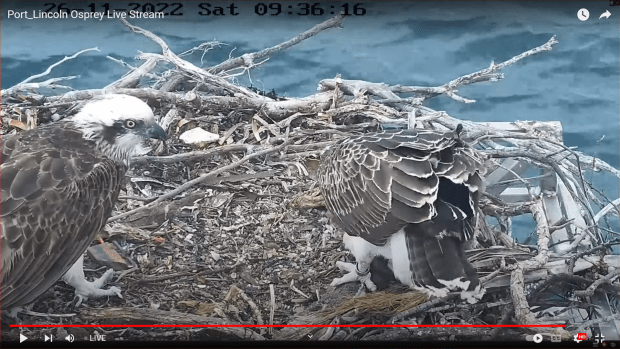
Yesterday it was a bit of a feast at the Port Lincoln Osprey nest and this morning an extremely large flat fish (a flounder? they do have them in PL) appeared on the nest. Mum flew in when Dad arrived but Zoe took charge. Now, that fish was big enough to feed three but, it didn’t. Zoe ate every last bit of it. She worked on that fish for more than two hours!!!!!!!!! Mum gave up and went off to get her own. I can only imagine the number of fish Zoe’s mate is going to have to produce when she has a nest of osplets. Just think about it. I am not certain I have ever seen an osplet eat as much fish as our Zoe.

Mum waited for over an hour hoping to get some breakfast but, the fact is, Zoe does not share.

At one time there were gulls overhead and both Mum and Zoe were alarming.

No 16. The Red List. The White-fronted Goose

Greater White-fronted Goose” by Rick Leche is licensed under CC BY-NC-ND 2.0.

Oh, goodness. Isn’t that a beautiful goose? White-fronted geese are medium sized. The white face is set off by that taupe of the head and back, the splotched chest, and that orange bill of the Greenland geese with legs to match. On occasion, the bill can be pinkish – that of the Siberian birds. There is a fluffy white bottom under those grey-brown back and wing feathers. What is amazing is the ombre – going from the solid taupe head, to the lighter neck, then lighter still on the breast. Just imagine if someone took this into their hair salon and asked for the stylist to copy it! It would be quite stunning, actually. Females and males are similar while the juveniles lack the white face, the black barring, and their taupe colour is not as deep as that of the adults.

Greater White-fronted Goose (Anser albifrons) DSC_0139” by NDomer73 is licensed under CC BY-NC-ND 2.0.

They breed in the cold of the Arctic tundra areas in the spring and summer. Greenland is one of the sites. In his entry, Gill Lewis writes, “This Greenland summer has seen her new brood hatch and grow. Her proud gaggle follow her, tail-waggling and beak-nibbling on the arctic tundra. A family, feeding and fattening.” In his entry, David Stroud said, “…she hatched six goslings and, with her mate, led them three kilometres up the steep valley sides and onto the lake-studded plateau used for brood-rearing and moulting.” Can you imagine, those wee ones following behind their Mum and walking upwards for 3 kilometres? It would be an incredible sight. They eat grasses, clover, grain, winter wheat and potatoes, according to the RSPB.

These lovely geese then fly and spend their winters in Ireland, the Orkneys, and Britain.

Why are these lovely waterfowl on such rapid decline? It is interesting and can be remedied. But, first. In 1982 shooting of White-fronted Geese in the UK was outlawed. Even so, their numbers have been falling rapidly. There are simply not enough youngsters to replace the adults and the cause is well known. The warming of the North Atlantic is the primary cause with its climatic changes and heavy snow falls. Those snows are arriving earlier and earlier at a time when the geese need feed before laying their eggs. So little food. One other cause, the one that can be remedied and is being done so for some species is wetlands. Instead of draining land so that humans can take over more and more vast tracks of it, we need to stop and rebuild the wetlands that are required for all our waterfowl. Whether or not anyone will find a way to halt or even slow the warming of our planet with its land and oceans is another story – a particularly grim one. So sad, these geese have been flying back and forth from the Arctic to the UK for 2 million years – just think about it. And, oh, how quickly we have ruined the entire landscape for them – in a blink of that time.

So when rewilding and news of the creation of wetlands comes to your ears, stand up in support of it – and remember the White-fronted Goose when you do.

Greater White-fronted Goose (Anser albifrons) DSC_0132” by NDomer73 is licensed under CC BY-NC-ND 2.0.

In the News:

Long-Billed Curlews” by FotoGrazio is licensed under CC BY-NC-ND 2.0.

The Curlew. These amazing shorebirds with their extremely long curved beaks are also in rapid decline. Oh, how I love reading these short Country Diary Posts. I hope you do, too.

https://www.theguardian.com/environment/2022/nov/25/country-diary-a-cloud-of-curlews-carries-me-away


Thank you so much for being with me this morning. Let us all collectively send our warmest and most positive wishes to Orange so that Rubus might be found safely and be cared for as he needs. Take care all. See you soon.

Thank you to the following for the posts and streaming cams that make up my screen captures: Port Lincoln Osprey, Port Lincoln Osprey FB, Orange Australia Falcon FB, Charles Sturt Falcon Cam and Cilla Kinross, Openverse, and The Guardian.