Middle takes the Fish Tail…and more news in Bird World

26 October 2022

Hi Everyone,

I hope that you had a really lovely afternoon.

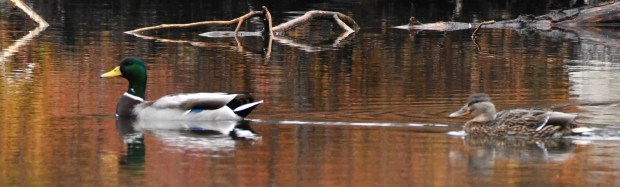
It was not a particularly beautiful mid-afternoon on the Canadian Prairie. The forecast is for the temperatures to climb tomorrow and last for 3 or 4 days. Good days to go out and see the local wildlife. Still, today was not a disappointment. While waiting for three Canada Geese to cross a road, in front of them, down about 5 metres were three fauns crossing over, too. What a beautiful sight and, how nice it was that everyone slowed down to let them move at their own pace! At the local pond, there were about 200 Canada Geese on the soccer pitch with only a few in the water along with a lone male Wood Duck and a pair of Mallards.
Nearer to home, more than 35 Crows gathered in a nearby tree. It was only 1500, too early to be having a communal roost. Was there any Owl in the neighborhood that was bothering them?

This is a small corner of the tree. There were so many that flew in. Normally this time of year the Great Horned Owl comes by and all the Crows gather to usher it out of their territory.

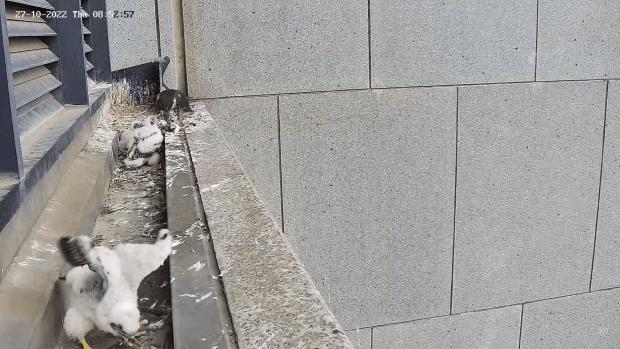
The first of the Australian raptor families to have breakfast this morning appears to be the scrape box on the water tower at Charles Sturt University. Xavier came in with a nice bit of prey at 0726. The eyases were sound asleep until his arrival. Indigo ate first with Rubus joining in. Indigo then moved to the corner and Rubus continued eating. Where does he put it all? Then Diamond arrives. Xavier moves and eats some prey on the ledge. Diamond searches for leftovers. Meanwhile, Indigo is on the Cilla Stones wondering what in the world is going on?

It is a wet morning in Port Lincoln. Middle and Big are waiting for their breakfast fish to arrive.

A nice fish arrived and if you were watching that feeding, you might have been wishing that Big would get a few more bites! Now isn’t that a switch? Middle dominated the feeding from the onset to the ending. At one time, Middle turned away – possibly thinking Big would get grumpy if she didn’t get any fish! Then after Big got a couple of bites, Middle leaned back in and ate some more! Goodness. There was no beaking although I noticed Middle eyeing Big and wondering and one time Middle raised its neck up and looked directly at Big as if to dare her but…nothing happened. Big is docile. Meanwhile, Middle still does a lot of snatch and grab even if the feeding is directed at him. Still a little nervous. That is a good thing. It will bode him well for his future.

I love how Middle opens his beak wide letting Mum know he is ready!

Middle just keeps getting bites of fish and more fish and all the while he is sitting right next to Big. Cautious but never as fearful anymore.

Big gets the lion’s share of that fish. Big doesn’t seem to care.

Want to know what really showed how much this nest has changed? Big got the tail and was playing with it. Everyone thought it would keep Big busy for a bit but, no. Mum had other ideas. She took the tail, gave a bite of the fish flesh to Middle and then Middle took and horked the tail — right in front of Big. Oh, hos this nest has changed!!!!!!!!!!!!!!!!!!

Here is Big playing with the fish tail. Look. Middle is actually leaning down wanting to take it.

Mum took it from Big. She is pulling out the last of the fish flakes from it.

Middle has just gotten this fish tail and is beginning to hork it down. Ironically, Big didn’t even attempt to do that. Quite interesting.

Oh, how this nest is turned around. My money is on Middle. A true survivor. Maybe both Big and Middle will each get a sat-pak since Turnby Island will have no chicks. I think it would be very interesting to compare these two after they leave the nest.

At 0822 a freshly caught pigeon is brought to the 367 Collins Street scrape. What a chore Dad has trying to pluck with those four ravenous eyases waiting in line for food. I sure wouldn’t want that job. Does anyone remember how in 2020 little Dad was almost pushed off the ledge trying to feed those three big girls?!

Some eyases would rather run up and down and flap their wings than eat!

Oh, gosh. It sure was a good start to the day at all of the Australian nests. I am especially delighted because Middle is really coming into his own. What a joy to see that osplet hork down that fish tail today. Just little tears of happiness. The trauma is over on that nest. Please join us now and watch these two grow and fledge!

Thank you so much for being with me to check on the breakfast meals in Australia. Take care. See you soon!

Thank you to Port Lincoln Ospreys, 367 Collins Street by Mirvac, and Charles Sturt Falcon Cam and Cilla Kinross for their streaming cams where I took my screen capture.

Gorgeous day for birding

It is a gorgeous day today. 24 degrees C. We still, for at least today, have summer weather. This meant seeing new and old friends today at the park. There were at least 12 male Wood Ducks, as many females, a host of female and a few male Mallards, and, of course, Canada Geese.

This adult male Wood Duck with its distinctive red eye and green helmet thought that I might have some seed for him to eat. He did not seem to want to take ‘sorry’ as a proper answer.

The duck below is all wet from diving around in the park stream.

Their plumage is absolutely outrageously gorgeous.

There were a few adult female Wood Ducks but not nearly as many as the males at Kildonan Park today. Because there are issues with identification between the juveniles and those in eclipse, I have come upon a bit of a foolproof method for me. The duck below is an adult female Wood Duck. She lacks the red iris and eye ring of the adult male; she does have a yellow eye ring and a distinctive white eye patch. Her bill is dark. I do not want the iridescent green on the top of the head to fool me. This bird is lacking in the 2 pale lines from the throat extending around the neck and onto the cheek. To see those, look at the images of the adult male.

There were a number of Mallards, both male and female.

All of the animals were having a wonderful morning around the duck pond. There were many who brought specialty bird seed just for them. Others, like this little Red Squirrel, were finding acorns and seeds in the grass.

As I was sorting through these images to show to you, there were several knocks on the front door. Several times I went out and no one was there. There are times that sounds carry but, then the knocking got louder and louder. This time I caught the visitor! My house is covered with cedar shakes. It looks more like a cottage in a forest but there is someone who loves those cedar shakes. When I opened the door he flew to the apple tree.

Unfortunately the automatic focus set its mind on the leaves and not on the woodpecker! And she was not certain that he wanted his picture taken or not.

I say ‘she’ because that gorgeous read crest would extended all the way down to the bak if this were the male. But, it is not, it is a female.

You can see that its body is mostly covered in black feathers with a flaming red crest. There is a white throat and its beak is a long dagger shape sadly hidden by the leaves. This particular Pileated Woodpecker lives around my garden year round (and the neighbour hood). She will make her nest in the cavity of a dead or dying tree lining it with wood chips. When she is knocking on my cedar shakes she is looking for ants, wood-boring beetles, and insect larvae. She also likes berries and nuts and I have seen her on the large suet cylinder as well as the telephone pole drilling away. The woodpeckers particularly like the bug and nut suet if you are trying to attract them.

I am particularly concerned for both this Pileated Woodpecker and the male and female Downy that live around my garden. My city has sprayed orange dots on two of the 119 year old Maple Trees in front of my house on the boulevard. If they are to cut them down, is one or both the home and nest of the woodpeckers?

The Grey Slated Juncos are still here today along with a few White Throated Sparrows and Song Sparrows.

It is easy to tell the White-throated Sparrow because of that distinctive white patch under the beak forming the throat – hence, the name. There are also two black bands and three white on the crown along with two very distinctive yellow patches above the eye. The White-throated Sparrows come to Manitoba to breed during the summer. By the end of the month, all of them will be gone to their winter homes.

The Song Sparrow comes to Manitoba also for summer breeding. Soon they will also be away on their journey south. For now, a few are in the garden scratching around the grass and leaves for insects and bug larvae. They are beautiful with that plumage of rust and grey with streaks of white.

It has been a lovely day. I have it on good authority that all of the nestling falcons are fine as are the osplets at Port Lincoln. Yesterday, they once again had 7 feedings! Speaking of feedings, the list of what Mum and Dad have brought in for the Collins Four is anything other than 99% pigeon. This year they have averaged 7.4 prey items per day with 3 being the lowest number of deliveries and 11 being the highest. They have had pigeon, New Holland Honeyeater, Rainbow Lorikeets, Quail, Silver-eyed Gulls, Sparrows, Spotted Pardalotes, Starlings, Wattlebirds, and a White plumed honeyeater. This is quite the surprise. Normally the urban falcons exist primarily on pigeon. I wonder if the people in Melbourne are no longer feeding the pigeons so that the falcons have to look to other species? In Orange, the diet is varied with lots of parrots and Starlings.

A late delivery yesterday was a green parrot. I do not specifically recognize the ‘type’ but will try to find out.

The only streaming cam I have not checked on today is the one for the White-bellied Sea Eagles. Indeed, WBSE 27 was jumping all over the tree and it or both might have fledged. I will alert you if this is the case.

Thank you for joining me. I hope you enjoyed the ducks! Take care. See you soon.

Thank you to the Collins Street Falcon Cam by Mirvac where I took my screen shot of the delivery of the green parrot.

Late Saturday in Bird World

I want to thank the person who wrote and thanked me for keeping everyone abreast of what is happening with the Port Lincoln Osplets. It is truly my pleasure. The situation of siblicide last year with Tapps really touched our or tore out our hearts. People can say that nature is not like Disneyland – and it surely isn’t – but, it is still hard. How many times did we want to scoop up little Tapps and feed him? I almost quit watching Ospreys entirely because of Tapps. I do understand – completely.

I began to wonder about these third hatches. The Osprey nests had such a hard time last year that there were few with three hatches that survived. The first was Tiny Tot at Achieva. Aka Tumbles. What an amazing bird. I will not bore you with all of the intricate details but, in the first two six weeks of her life, Tiny Tot had 12 days – 12 whole days – without food. At least twice, she went for 72 hours. That bird wanted to live. She was clever! And, yes, she got angry and lashed out at the older ones twice. I believe it was the last instance when Diane, the female, took notice. She began bringing in food to the nest. Those big catfish saved Tiny Tot’s life. And then Tiny Little at Foulshaw Moss. Neither of the Tinys should have survived but they did and were stronger birds for it. My interest in third hatches was cemented with the two Tinys. I want to see if their survival rate is higher than the big siblings. The problem is that so few of them are ringed or have satellite trackers. Someone in France just photographed Blue 494 from the Dyfi Nest. Maybe they will see Blue 463, Tiny Little, too. Oh, I hope so.

What I can tell you is that the PLO are doing fine. Little Bob has a good appetite. He can’t eat as many bites as Big Bob but at the most recent feeding, Little Bob ate enough to go into food coma! Mom seems particularly focused on making sure that each gets bites. She is doing really well this year and so is Dad with bringing in the fish. It is 11 degrees C in Port Lincoln and the winds are still blowing strong at 24 kmh. That is 14.91 miles an hour. It might not sound like a lot but it can certainly disrupt fishing.

Here is a close up. Little Bob is the one that is being fed. You can see that he already has the makings of a very good crop.

This is Little Bob getting some nice bites. The one that looks asleep is actually Big Bob. She has eaten and is taking a ‘breather’. Meanwhile Little and Middle Bob are enjoying the morning breakfast.

There is Big Bob back up at the table! Doesn’t take long. She can eat bigger pieces and more of them now. But there is no problem with Little or Middle Bobs eating. Everyone is doing well.

Every once in awhile their eyes lock on one another and my body goes rigid but, so far, nothing. Mom goes around making sure everyone has bites. It is that kind of security that keeps things tranquil.*

These are really well behaved youngsters. Food is plentiful and they line up with mouths open letting out little peeps. Middle Bob is getting some bites now while Little and Big wait their turns.

As I said, Little Bob has a very good appetite and he won’t leave the table until he falls over in food coma or mom calls it quits. Remember, she does not want them to catch cold. Right now the feedings are lasting about nine minutes.

Little Bob is full and in a food coma. The crops are filling on the older two. Oh, what a delight this nest is to watch this year. Of course, it can all change. Just continue to send the warmest of wishes to this family. We want three survivors! Three.

Closer to home. I was heading out to check on the Wood Ducks at the park. The last time I was there the male Wood Ducks – save for one – were in the equinox. They were moulting and getting their fall plumage. They were certainly not their brilliant beautiful selves.

As soon as I was out the door I could hear the familiar pecking of the male Downy Woodpecker in the garden. He comes several times a day. Rumour has it that he lives inside the 123 year-old Maple tree in front of my house.

In the winter I rub peanut butter suet on the bark and I often see him eating away. This summer he brought his baby to find the suet. The strange thing is – we have never seen the female. It is so odd.

Little Woodpecker is such a sweetie. One day when Sharpie, the Sharp-shinned Hawk, was in the garden, the little woodpecker was on the suet like he is today. For 45 minutes, he held on tight, not moving, just blinking his eyes rapidly. He was so afraid he was going to be Sharpie’s lunch. I felt so sorry for him. Sharpie was sitting on a branch under him pretending to be. feeder! Needless to say Sharpie wasn’t successful that day.

It is a beautiful fall day and the park was full of Canada geese and people having picnics and playing cricket.

Over in the pond, the male Wood Ducks really stand out. They have finished their moult. Just look at the range of colour in those feathers. Even the golden beige ones are gorgeous.

Here is a different one. The shape of the head is slightly different on this one.

The female Wood Ducks have really grown, too. My goodness. What a change in a a week. They were so tiny when I left but they seem to be growing by leaps and bounds.

There were definitely more females than males.

The Mallards were particularly annoying today. We noticed that the female Wood Ducks tended to stay close to one another.

Isn’t she beautiful?

The male Mallards are in the middle of moulting. Soon they will have those beautiful emerald green heads that are so characteristic. For now, they look a little bit like peeling duck decoys instead of living breathing water fowl.

There were lots of female Mallards in the pond today.

Two Canada Geese came flying in creating a bit of a ruckus.

Then they slithered along the surface of the pond. They looked rather strange and everyone stopped to try and figure out what they were doing.

We presumed that they were sipping water.

Speaking of water. The pond is pretty clean this year. There are two fountains and everyone is abiding by the signs and not feeding the ducks. If they do it is wild bird seed. What a huge difference from the algae infested muck of last year.

It is early morning in Australia. There will be more meals for the youngsters. All of the birds in our park are safe and sound tonight. We have had no frost. In decades past there was always a freeze in August. I wonder if this might impact migration dates?

Thank you so much for joining me. Have a lovely rest of the weekend. Tomorrow I am going to try and break my unlucky streak and catch that juvenile Green Heron that is hanging about our City. Take care all. Stay safe.

Thank you to the Port Lincoln Osprey Project for their streaming cam where I took my screen shots.

Friday Night with the Birds

Do all the successful birders get up before 5am and head out to find that rare bird that landed near to where they live? Even if I were an Osprey and had Rutland’s Blue 33 delivering me breakfast, I would surely be out of sorts. That is precisely why that Juvenile Green Heron that has been near Winnipeg will never grace my eyes! Still, we gave it another try. Perhaps the heron would be back at its fishing spot a few hours before sunset?

I wish you could hear my big sigh. We arrived and right before our eyes was the largest group of kayakers I have ever seen! Even so, there was a man sitting in the rocks in the middle of the river with his long lens focused on the shore on the other side. Was it the heron? After examining the shore, the trees, the water, nothing. Maybe he was hoping that the heron would fly in and he would have the ideal position for the best shot?

Or was he watching this pair of Hairy Woodpeckers? They were chasing one another around a tree. (Or are these a pair of Downy Woodpeckers?) They looked quite large compared to the little Downy that comes to our suet.

One of the most interesting events came at our third stop. This was one of the many ponds located in a residential area – the same one where the Cormorants were yesterday. We sat down and observed nothing short of ‘Canada Goose Airlines’ taking off. Let me explain.

When we arrived there were approximately 300 Canada Geese on the water or foraging around the shore.

This scene looks pretty chaotic, right?

Then in a blink a flock gets orderly. They group together and swim to the shore seemingly ignoring everything around them.

The geese then follow one another up the incline. Then very quickly they turn and face the water.

In a split second they are off! Heading South on their way to the Southern US for winter.

This was repeated until the water was almost emptied of Canada Geese.

As they get organized in the sky, the Canada Geese will get into their standard ‘V’ formation. Did you know that the leader is actually the lowest in the sky? It is. Moving from front to back, the geese get higher. The front goose is the one really flapping its wings. All of the others benefit from its wing power and the swirling air. Aerodynamic engineers have studied this method and have determined that flying in a ‘V’ formation with the front goose doing most of the work adds 71% more distance than if a goose travels alone.

But who gets to be the leader? Do they have an election? The geese actually take turns. When the front goose gets tired it drops back for some rest. Working together like this, Canada Geese can travel up to 2414 kilometres or 1500 miles in a single day! Wow.

Geese like to fly at night for various reasons. One is the turbulence. Geese do not soar like eagles, hawks, and falcons. Those raptors rely on thermals to help them. Because they do not soar, geese do not need the thermals during the daytime. In fact, those thermals can actually disturb the wind turbulence that the geese need to fly. Secondly, it is cooler flying at night especially for birds that travel by flapping. This means the geese do not overheat like they might do on a hot sunny day. Because raptors sleep during the night, it is so much safer to fly then. Raptors often attack by hitting their prey in the air. Peregrine falcons are masters at this and yes, they can take out a goose. But the falcons are diurnal hunter meaning they hunt during the day and sleep at night! The geese are safe from them when they travel at night.

One thing our beloved Canada Geese are threatened by at night are cities where the buildings have their lights on. They fly toward them and die. This is why there are ongoing campaigns to have cities ‘brown out’ during spring and fall migration. Does your city have a policy of shutting out the lights for all the birds – not just our geese? Find out. Those skyscrapers with their all glass windows are a tragedy in the making. You might want to get together with your local bird group and approach the Mayor’s office. It certainly doesn’t hurt to inform them of the issue and ask for their cooperation.

I will leave you with some shots from our second stop. Oh, the little Wood Ducks are growing and the adults in moult are getting all their feathers back. It won’t be long until they are flying South also.

Oh, isn’t he gorgeous? He has finished his moult and now has all of those amazing coloured feathers back. For several weeks this fella looked like he had mange. I felt so sorry for him.

Male Wood Duck

Some of the female Wood Ducks are so tiny. They are very shy especially around the geese.

This is an American Black Duck. I poured over my guide books to make sure. The question remains: is the bill a dull yellow or is it olive? If it is dull yellow then it is a male but if it is olive, it is a female.

American Black Ducks are fairly rare in Manitoba. They are not even mentioned in the Manitoba Birds book. We are in the centre of Canada and American Black Ducks mostly locate in eastern Canada for their spring and summer breeding grounds. This is because they like remote wooded swamps – areas that one of their biggest threats doesn’t like, the Mallard. The birds are highly protected in Canada and there are hunting restrictions to help with those protections.

Another tiny little female Wood Duck. She looked like she was lost around the Mallards and the American Black Duck. She kept looking around like she was looking for her family. Am I anthropomorphizing too much?

It has been fantastic to go exploring in my own neighbourhood this summer. What a delight to see how organized Canada Geese really are. Those organized flights were nothing short of amazing.

If you are having a problem with empty Osprey nests, the female on the eggs at Port Lincoln looks increasingly uncomfortable today. We are in the pip and hatch zone. So check it out:

Thank you so much for joining me today. Take care all. See you soon.

Thanks to Port Lincoln Osprey Project for their streaming cam where I took my screen capture.

Everything is just ‘ducky’

It was another beautiful day on the Canadian prairies yesterday. Tomorrow many of the migration events as birds move through out province from north to south. The Sandhill Cranes have covered the farmer’s fields in the south already and a friend noted that the nuthatches and chickadees were all over her feeders yesterday.

There are birds coming and going at one of the local parks but the Wood Ducks remain, waiting for the juveniles to be ready. The Canada Geese were there, too, and a few people were feeding the ducks and geese grain and corn. I will say it again – all the signs put up to say no bread or salted popcorn, etc. have worked. The pond is much cleaner and while the birds might be acting like they are starving they are healthier for the effort.

Female Wood Duck. 31 August 2021

This little female Wood Duck was such a sweetie.

I am a big softie for our Canada Geese. There were about 200 of them around the pond and several hundred more on the playing fields eating grass.

These male Wood Ducks are in various phases of molt. Some, like this one, are almost finished while others remain in the eclipse phase, halfway finished. By the time they fly the males will be there colourful selves!

Those red eyes are a certain way to know it is a male Wood Duck.

Did you know that Wood Ducks are a type of perching duck. They like to stand in trees and will, if there is a box available, make their nests high off the ground.

Some of the wood Ducks joined the Mallards and the Northern Shovelers for some wild birdseed a couple were tossing on the ground.

There were about 50 of the little female Wood Ducks out and about trying to get seed.

Ah, they are so sweet. The white teardrop around the eye lets you know this is a Wood Duck.

Isn’t she gorgeous? She looks like she has white goggles on. But that beautiful grey and rusty mottled chest is stunning.

My bird book says this is a female Northern Shoveler. They will dabble on the surface of the water for food but we watched them use their wings and feet to stir up the water to get food from the bottom to rise. This one has decided to try out the wild bird seed the couple are spreading on the ground.

This cute little female Mallard kept looking at me. I wonder if she thought she should charge to have her picture taken? Perhaps a handful of seed?

Mallards are dabbling ducks. They tip themselves so they can feed feed, rooting through shallow water and mud in search of plants and insects. She will also nibble along the surface and yes, she loves it when you feed her seed on land.

This juvenile male Wood Duck was having a great time with an acorn. At first I thought he was going to choke but no, he was playing a game.

He would pick up the acorn and then he would let it roll chasing it down the embankment and then picking it up again.

This little Mallard started imitating the Wood Duck. It was quite hilarious.

There were about 50 ducks coming up to find seed. Can you spot the female Wood Ducks? and the female Mallards?

It was lovely in the park. It was so good to see people feeding the ducks the right food. Those signs really worked. One man came over to talk to me – everyone is always curious when you are out with a camera and a long lens. He thought I had found something super special! He entertained me with Knock-Knock jokes. Then he offered me some advice, ‘You can get bags of wild bird seed at the Dollar Store. I bring two bags every evening.’ What a great guy. ‘Be sure not to throw the seed in the water!’ as he walked to his car. He is absolutely right. Only toss the seed up on the ground away from the shore.

In other bird news: Maya and Blue 33 have migrated from Rutland. Maya on the 30th and Blue 33 on the 31st according to Rutland’s announcement. Everyone has now left the Dyfi Nest with Idris the last to fly out on the 30th. Aran remains at the Glaslyn Nest waiting til the last either because of his wing injury or he is still protecting the nest or both. I have not heard if Z2 (Aeron) at the Pont Croesar nest has left or not. The WBSE continue to do well so everything is alright with them. They are stretching their long necks to see what they will do. There is no news about Iris having left the Hellgate Canyon area of Missoula for her migration. Someone believed they took a snap of her on her favourite tree down on the river this morning. There was still one egg on the Orange Peregrine Falcon nest but there could be another later today.

Take care everyone. I hope to find some pelicans today – are they hiding? And if not, I will go back and feed the ducks at the local park. Thank you for joining me this morning. Stay safe!