It’s Love…Saturday in Bird World

Good Morning Everyone! It’s Saturday. We hope that each of you had a good week. For those going back to school, it must have been a bit of a shock after the holiday break. Have a good weekend. Get outside if you can – even if it is only for a few minutes. Makes all the difference in the world smelling the fresh air, feeling the sun on your cheeks, and I hope seeing a bird!

The kittens have a new ‘enrichment’ activity toy.

They have had so much fun and have spent so much time figuring out things. Lewis can now use both paws. It is past midnight and Missey is working on her technique. Cute.

My top story is yet another death by lead. As long time readers will recognise, I am a big fan of all the work that the Ventana Wildlife Society and the LA Zoo do for the California Condors. So, today, when I received the link to this Twitter feed from Geemeff, I was once again saddened beyond belief. Lead in hunting and fishing equipment needs to be banned from being manufactured and used. Pull it off the shelves. There are alternatives – copper and stainless steel. Yes, at the moment because their production numbers are not as high as lead, they are a bit more expensive. About $1.50 US a box of cartridges for shooting I was told (not sure the size). So, the use of lead is not necessary. It is also not necessary by the military. Ban lead! Just do it.

First feathered friend for the 2023 Memorial Wall. So sad. It is so unnecessary that I just want to stand in the middle of the street and scream but that won’t help. So today I am going to write my Member of Parliament, the Honourable Web Kinew. He is Indigenous and has a good chance of being our next Premier in Manitoba. He might just care enough to do something when he has the power and the people. Clearly our current government in Manitoba will do nothing. But it needs to be a federal law here, in the US, everywhere-!!!!!!! So make a resolution to write to your Department of Natural Resources and the Department of the Interior in the US, your Congress member, and your Senator. Their e-mail addresses will be published. Then why not write your President.

BTW. The Ventana Wildlife Society is hiring a lead specialist for outreach to ranchers in the area of Big Sur and Pinnacles. Know anyone that fits the description? Please forward.

I always wonder if the DNR puts up a few bird cams to make us feel soft and fuzzy towards them. They derive huge income from selling hunting licenses. The specific amount is published. Check it out and then get mad. But don’t donate to their cameras until they take a stand against lead. A serious one. For those of you living in other parts of the world, check out the use of lead in your country and let me know what you find out. It would be appreciated.

While you are at it, how do you think about selling licenses to drill for oil and natural gas in pristine waters that could easily impact wildlife? aren’t we, as an international society, telling those folks in power that it is time to invest in renewables? not fossil fuels?

Have a look at this 1:39 minute video on the birds and the land in Alaska – and imagine an oil spill. Please help them by writing to your politicians pressing them to stop licensing for oil and natural gas – anywhere.

Hello Everyone! You cannot have my prey!!!!!!!!! Got that, Mum. I am telling everyone so they know – you cannot have it!

Elain’s great video for 6 January shows us the many visits of Indigo and the interactions in the scrape box at Orange on Charles Sturt University’s water tower! And, of course, it begins with Indigo arriving with prey screaming his head off!!!!!!

Well, it’s love. No other pictures of the sweetie pie E21 and Harriet needed. Just look at the love in a mother’s eye to her recently hatched wee one. Precious. Who says eagles do not have feelings?

Meanwhile, it is after 1700 on Friday and E22 is working away with its tooth visible trying to get out of that shell. Soon!

Oh, goodness. If you were watching, Harriet went to roll the egg and E21 got stuck on her talon and went out of the nest cup. The little ones cannot move to get back under Mum and they cannot regulate their temperature. Thankfully Harriet saw what had happened and within 10 minutes had E21 back under her by rolling it with her beak!!!!!!!!! It was a little tense watching it as Harriet had to stop a couple of times but she managed to get the job done. E21 had its first adventure!

Welcome E22! I saw you for the first time at 07:06.

A little later. You are more dried off and E21 is no worse for his adventure.

At 09:36:03, V3 flies in and meets Gabby on the nest. She sees him coming before he lands and begins calling.

The couple begin working on the nest. — I think that it is time to recognise that V3 is the ‘main man’ now. Whether or not this new pairing will produce eggs and eaglets this year is unknown. Will V3 be around next year if they do not have eaglets now? Who knows. For now, it is time to enjoy the two of them together and be happy for Gabby.

The couple get an entire five minutes together before V3 is off protecting the realm. I am thinking about getting him a Superman suit.

Both appeared back together on camera at 13:47. Give V3 a big hand of applause. He is keeping everyone else away from the natal nest. Bravo.

They are both constantly vigilant. Each one watching from different sides for intruders that could attack the nest. It has to be very stressful.

Gabby flew in with a huge crop and V3 flew in after her with a large crop, too. They dined together it seems.

They are a couple. They are together in the morning, during the day, and at night. No doubt about it. And who says they aren’t mating at their ‘special’ spot off camera??? Or maybe they aren’t. Who knows???

Superbeaks. Pearl is 28 days old today and Tico is 27 days. Let us examine the pair more closely through a few images. That is Pearl closest to the rails and little Tico at the back by Mum.

What do you notice about these two eaglets immediately? There could be several things.

Let’s work on some terms and the one I want is not in the image below!!!!!!!! Their rictus or smile is now yellow. This happens during week 4. Their eyes are the best 90% chocolate you can purchase! When they get older their eyes will lighten to that celadon colour that can be white, lightest of watery blue, or very light grey-green. Their cere is still black. Their Maxilla is black. These will change to chrome-yellow as they age. Now look. Dandelions on the top of the head with thick grey down. Those dandelions will begin to look like ‘Mohawks’ very soon. The blood feathers are growing in. This thick down will remain under them to help the eagles regulate their temperature. Now it covers all of their body.

Pearl is getting much more stable on her legs and was seen flapping her wings.

I thought I had a screen capture. One of the eaglets, Pearl, was flapping her wings building up some muscles. They are both developing just fine. There is so much food! Some chatters noticed a bit of bonking by Pearl to Tico and that Pearl had eaten most of one meal but, they are both fine. The last time I checked Tico was being fed.

Now just imagine. In 28 days time, Little E21 is going to look like the eaglet in the image above. Hard to get around that, isn’t it? They grow so fast.

Jackie and Shadow have been on and off their snowy nest all day.

Thunder and Akecheta were perched on Tor together today. Time 16:02.

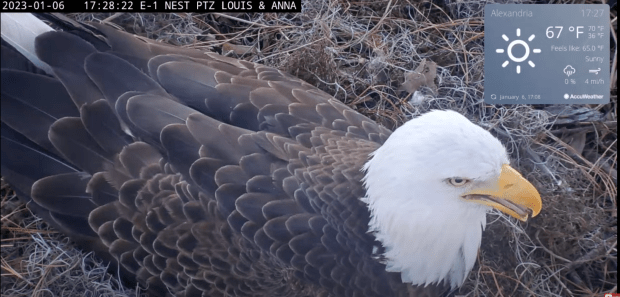
Anna and Louis are not giving us any hints. For the past two years, this Louisiana Bald Eagle couple whose natal nest is E1 at the Kisatchie National Forest have had only one hatch. Will it be the same this year? Egg 1 is 38 days old today and egg 2 is 34 days old. The average hatch time in Louisiana is 35-39 days. So things are going to happen shortly. Wish them luck! This is their third breeding year together and both are nicely equipped to raise two healthy eaglets. Louis will just pile more fish on the nest. Can you imagine? He was so excited the first year, 18 fish (Anna brought in some to equal 20) on the nest at once!
The wee ones at the E3 nest of Alex and Andria are ‘lanky teenagers’ now. Not round little cuddly eaglets. They are growing their feathers and getting bigger and bigger. E3-01 was out of the nest cup the other day and E3-02 made that leap today.

Oh, precious. Notice. They do not yet have yellow smiles!!!!! But they do have black specks and those black specks indicate grey wooly down and feathers!!!!!!

Both eagles were at Decorah today. When you look at that image, I want to give a shout out to the Raptor Resource Project and Explore. They have done an amazing job – with the quality of the images – and their ability for close ups and pans. Just beautiful.

The juvenile was back at Decorah North.

Good news for Achieva Osprey fans. Barbara Snyder reports on FB that there was a successful mating attempt today. Diane’s leg must be getting better. Cannot think of more joyful news. Thanks Barbara!
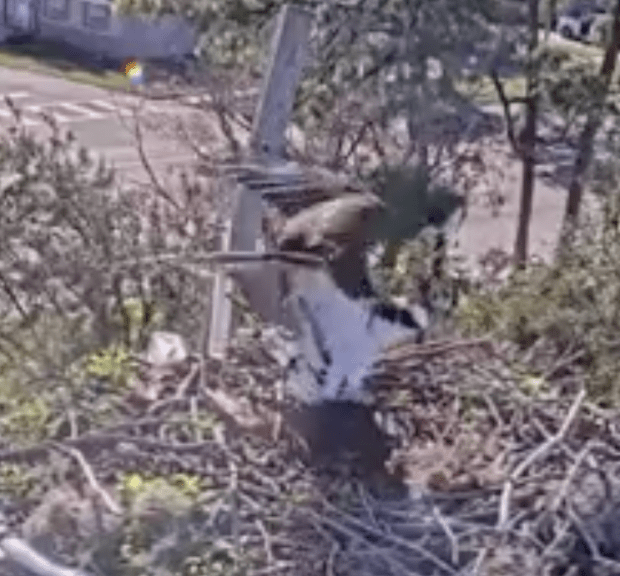
Bird sightings in Dulwich. I could hug the author…they even like to see Sparrows. I wish so much that people who dislike sparrows would stop to think that not only do they need to eat but they are in rapid decline in certain locations. I love my sparrows. Each has a different face and some you come to recognise as they reappear daily.

https://www.theguardian.com/environment/2023/jan/06/country-diary-a-flock-of-seagulls-and-a-lesson-in-resolve?CMP=share_btn_link

Everyone reading my blog knows that habitat loss, climate change and the sheer impact of the human population is killing both wildlife and our planet. An article in The New York Times discusses the impact on various species. Save it and read it when you have time. But read it so that you can talk about this with others. Thank you.

My blog is mostly about raptors. But, I love all birds (and other wildlife) and I am absolutely entranced by Loons. As many of you know, I have wanted to get a good look at them and have travelled throughout my province trying to do so. I did finally see ‘two at a great distance’ in 2022. There is a new book out about loons. Stay tuned!!!!!!!! It has received rave reviews. I hope to have it read in a couple of weeks.

Thank you so much for joining me. I expect we will wake up to E22 with all of us holding our breath and hoping that E21 is a ‘darling’ of a big sib. Tomorrow one story I will be following is the loss of wildlife due to outdated farming and farmland practices in the UK. Don’t ever think it is just the UK. All I have to do is drive to the nature centre for my walk to see all the farmland given over to large housing developments. No birds there. Hardly a tree! There is more bad weather with more record breaking rainfall coming to California from the 9-14th. Jackie and Shadow could see lots of snow while our falcons and eagles in the Channel Islands will have rain. If you live in an area that has the potential for flooding and mudslides, please do take extra precautions. Everyone take care. Winter weather can be very hazardous. See you soon!

Thank you to the following for their notes, their Twitter feeds, their announcements, postings, videos, and streaming cams that make up my screen captures: Geemeff, Ventana Wildlife Society, GoGreen, Cornell Bird Lab, Charles Sturt Falcon Cam and Cilla Kinross, Elain and Charles Sturt Falcon Cam and Cilla Kinross, SWFlorida Eagles and D Pritchett, Birdie Cam, NEFL-AEF, Superbeaks, FOBBV, IWS and Explore.org, KNF-E1, KNF-E3, Raptor Resource Project and Explore.org, Barbara Snyder and Achieva, Achieva Credit Union Osprey Cam, The Guardian and Amazon.ca

Victor, Kisatchie E3, and more in Bird World

31 December 2022

Good Morning Everyone. Wishing each of you a wonderful end to 2022.

Today’s blog is brought to you by Dyson! Not only can Dyson ‘suck up’ birdseed quicker than any other squirrel I have ever met but, today, she figured out how to get the feeder off the hook, drop the seed cylinder onto the ground, and just sit there gobbling up all those fine black oil seeds, millet, peanuts, and cranberries. So clever. It would be impossible to get mad at her – she is curious, intelligent, and a hard worker! She is a survivor in an urban environment that is not always friendly.

Isn’t she adorable?

From Dyson and all her friends in the garden, we wish each of you some tasty treats, good health, and love in the new year!


Now, let us deal with the sadness first. A juvenile Bald Eagle landed on the Delta 2 nest in British Columbia. Immediately it was noticed that the juvie had lost a leg or a foot. The older eagles brought it some food. Sadly, yesterday, the bird was found dead at the foot of the nest in very emaciated condition.

Then on to the good news. Recognise this beautiful juvenile? Hint: Hatched in the Channel Islands. Sister: Lillibet. Was taken into care due to extreme zinc toxicity. It’s handsome, strong, and resilient Victor!!!!!!!

There is even more good news.

Kingpin and Redwood Queen’s offspring, California Condor 1030 Iniko, was caught in her nest during the Dolan Fire of August 2020 in Big Sur. The nest tree burned and so did the streaming cam and no one knew if Iniko survived. But, miracles do happen, and Iniko survived and Redwood Queen came back and took care of her little one. Kingpin is presumed to have died in the fire. Then a male condor came and there was a fight and Iniko fledged too early and was injured. Taken to the Los Angeles Zoo, Iniko was released into the wild a year ago along with two other condors, Rachel Carlson and Dian Fossy at San Simeon. Today photographs of Iniko in the wild were released. Doing well!

Please, always keep in mind that there are so few California Condors. Their lives are precarious and they often die because of lead poisoning from the carrion they eat and are now susceptible to Avian Flu (eating dead diseased birds). Always grateful to the Ventana Wildlife Society for the work they do to protect and rehabilitate these birds and make the wilder safe for them.

Both eagles E3-01 and E3-02 at the Kistachie National Forest nest of Alex and Andria are doing well. That little one (02) got some good bites today and there is so much food on that nest! Still the parents love to eat, too, and the little ones got full, Mum ate, and they wanted some more. They didn’t get any but, it won’t be long before another feeding. Andria is doing fantastic.

Pine has been brought in to help with the flies. I wonder if it works as a deodoriser, too??

Look at those precious little wings. 02 has already learned to balance using its wings! Incredible.

Highlights of the feedings at E3:

The cam operator at Superbeaks did some nice close ups of the nest on Friday afternoon. There are two eaglets. Squint in the image to see the two. Just look at the crop on that one that we can see clearly. Goodness gracious. You can also imagine how big they are compared to the wee ones at Kisatchie.

Gabby and V3 are working on the nest. They fly in and out and he brings prey. Life seems to have settled down at The Hamlet near Jacksonville, Florida for our beautiful girl.

Jackie and Shadow have been working on their nest at Big Bear almost daily and today they had a little help from Fiona.

Elain’s highlights from the scrape of Diamond, Xavier, and Indigo for 30 December. Some bonding and then comes screaming Indigo. You can sure tell that Indigo is related to Izzi!!!!!!!!!!

Before 0700, one of the adults, it looked like Dad’s legs, delivered a breakfast fish to Zoe in the nest. It was a really nice fish and it looks like Zoe still has a crop at 1100 hrs.

At 1415, Mum brought in another portion of a fish, a decent size, to Zoe. There were times in-between these two prey drops to Zoe that she was picking up sticks on the nest, resting, and was off the nest. She did appear to have a crop at noon. Was there another fish? Perhaps. I could not see it in the rewind but that does not mean she did not eat off camera.

Cooper’s Hawk. A female often comes around the garden and in 2019, I was fortunate to be sitting on a bench in The English Garden, a part of our Assiniboine Park, when a pair of fledgling Cooper’s Hawks were hunting for insects.

I have been picking at that book, Slow Birding and came across some interesting facts about Cooper’s Hawks today. I would like to share one of those with you because it will shed some light on the efforts by all the bird parents to feed their young.

Heinz Meng studied the diets of Cooper’s Hawks in Ithaca, New York (Cornell) from 1948 to 1958 before their numbers were decimated by DDT. He discovered that it took 66 birds or mammals to raise a single Cooper’s Hawk chick to fledgling at 6 weeks. As the nestlings grew the number of prey items increased. “On a daily basis, this is four meals a day in the first week, five a day during the second week, then varying between seven and nine prey a day during the remaining weeks.” That is a lot of food for each chick – and this does not count the mother while she is incubating the eggs. Now imagine much larger birds, on the nest for a longer period, like eagles and ospreys. Those males work darn hard!

Did you ever think about a bird’s beak or bill? Next time you are looking at different birds, pay particular attention to the part that makes certain that they can consume their food whether it be seeds, insects, or prey items. In the instance of the Common Crossbill, their beak – look at it – means that they have to live in pine forests. They would starve to death otherwise!

https://www.theguardian.com/environment/2022/dec/30/country-diary-these-stocky-finches-serve-a-life-sentence-confined-to-coniferous-forests?CMP=share_btn_link

Last a call for rodents and frozen fish for Clay the Eagle from my childhood home state of Oklahoma. Smart eagle to go back to where it was rescued the first time! Poor thing. Do you know anyone there who can help?

As we leave 2022 behind, it is natural for most of us to make a list of ways that we would like to change our lives – our New Year’s resolutions. I do not know if we can slow our planet down from climate crisis demise but, I do know that I want to find more ways to be useful. One of the things that Slow Birding taught me is that we should start in our own homes and gardens. Do the best we can with what we have. Remember – the wildlife rehabilitation centres near you need clean old towels just as much as they need donations of money. Know someone who has lost a pet and has lots of food left? Wildlife rehabilitation centres take pet food, too. Clean gently used sheets. Check their websites for they will often have a wish list.

Also remember to be gentle to yourself in 2022. Remember – if you can – that a walk outside. It removes all the pressures of the day. Just 5 minutes can change a bad day into a good one!

Happy New Year Everyone!

Thank you to the following for their posts, their videos, and their streaming cams that make up my screen captures today: Terry Carman and Bald Eagles Live nest Cams and News, Stephanie Ross and the Channel Islands Eagle Lovers, Tim Huntington and Webnectar Photograph, KNF-E3, Superbeaks, NEFL-AEF, FOBBV, Elain and Charles Sturt Falcon Cam and Cilla Kinross, Port Lincoln Ospreys, and The Guardian.

Fish feast for Zoe…and other news in Bird World

25 November 2022

Good Morning Everyone,

I hope those of you that celebrated Thanksgiving had a lovely celebration. It was another warm day in the garden. Today it will be 6 degrees C. The sky is a beautiful blue and the sun is bright. There should be a lot of activity in the garden. I am quite enjoying watching the Starlings and the Sparrows flit about their lives enjoying the Butter Bark and the soft suet. It is hard to imagine that they are both vulnerable and in decline and on The Red List in the UK but, as I am told by many, their lives are so precarious and the Avian Flu last year could rear its ugly face again this year.

I just think that the Starling below is quite stunning. The so called ‘white’ spots on their bodies during the non-breeding season actually look silver in the sunlight. That coupled with those magnificent rust and rust tipped ebony wing feathers make them stand out and yet, if you don’t know they are there, they blend in quite nicely with the bark on the branches of the Lilacs.

Dyson has been coming for peanuts for several days but, instead of running about storing them, she has stopped and taken the time to eat several before scurrying about. She is really adorable. I notice that her colouring is also changing. Some of the youngsters have great tufts coming out of their ears now. I will see if they will sit still long enough for me to get a photo for you soon.

Junior was about today along with a least one of the three fledglings but Mr Crow and his family were not about. I wonder where they found food. It always scares me if I see road kill as I know they will chance it to get some food. I wish everyone would stop and if they see road kill get out and move it to the side of the road, way off the shoulder, if it is safe for them to do so.

The Australian Nests:

I cannot possibly tell you how quiet it has gone in Bird World now that all of the Australian birds have fledged. You might already guess that Xavier and Diamond are taking good care of Rubus and Indigo and that Zoe is screaming her head off for a fish. Dad went out and came back with nesting material. What in the world is up with the fishing in Port Lincoln?

Cilla posted a prey transfer for Indigo that took place yesterday in Orange.

Dad brought in a fish for Zoe at 09:56. She ate the entire thing. The fish tail went down at 10:21:08. Dad ‘appeared’ to have a crop. Mum was sitting on the ropes as she is above. Will Mum get anything to eat?

With Dad appearing to have a crop and Zoe getting a fish, what is there for Mum? Has Dad decided now that the chick has fledged, his duty is only to feed it and him and Mum can fend for herself? It is certainly common at other nests.

Mum did not sit around. She has proven herself today. She brought in a nice fish for her and Zoe at 13:30:31 and another one at 14:39:40. Indeed, Mum was on the nest with Zoe and flew off quickly as if the fish had skimmed the water near the barge. Isn’t this just excellent! Everyone will have had a good feed today.

Indeed, Mum was just finished feeding Zoe the 1330 fish when she spotted the next one. We will have to start calling her ‘Eagle-eyed Mum’.

Off she goes!

Zoe and Mum are having feasts today while Dad sits on the perch. Good for Mum. She is going to make sure that her and her daughter are well fed.

In his book, After They’re Gone. Extinctions, Past, Present, and Future, author Peter Marren says of the Ospreys, “To survive the Sixth Extinction, it may help to be useful- useful to humankind, that is” (164). Marren continues on the following page, “In Britain, nesting ospreys and sea eagles attract tourists and hence income to places that need it” (165). Every place that has wildlife should heed Marren’s words. They should consider the environment and rush to bring it back to life because those beautiful animals and birds and the landscape that is cared for and respected will help with the economy in the future. Indeed, my granddaughter is looking for a place for a holiday to see birds and animals. It would be truly sad if I had to tell her to go to a zoo!

Making News:

a little change from plants- hen harrier looking for dinner.” by island deborah- New Book ‘Song of the Sparrow’ vig is licensed under CC BY-SA 2.0.

Well, to tackle this entire issue of the vulnerability and extinction of the Hen Harrier, Hen Harriers will be bred in captivity and released in England on the Salisbury Plain. Twelve birds, six males and six females, have been brought from France and Span to establish the breeding pairs. This is a project between Natural England and the International Centre for Birds of Prey. Their goal is to release 100 birds over the next 5 or 6 years.

Fantastic. You can read more about this intervention to increase biodiversity here:

https://www.theguardian.com/environment/2022/nov/23/hen-harriers-to-be-bred-in-captivity-and-released-on-to-salisbury-plain?CMP=share_btn_link

I have become increasingly aware of these magnificent birds over the past year and have devoured as many new books on them that I could. There are a couple that I have quite enjoyed and will mention if you or someone you know is interested in the life and the plight of these magnificent birds of prey. They are Bowland Beth. The Life of an English Hen Harrier by David Cobham, The Hen Harrier’s Year by Ian Carter & Dan Powell

Hen Harrier male (Circus cyaneus) illustrated by the von Wright brothers. Digitally enhanced from our own 1929 folio version of Svenska Fåglar Efter Naturen Och Pa Sten Ritade.” by Free Public Domain Illustrations by rawpixel is licensed under CC BY 2.0.

The problem is the illegal killing and the destruction of the land that supports these beautiful birds. So when will the courts begin to crack down on those who persecute the raptors?

A nauseating story is coming out of County Down, Northern Ireland of a lovely Buzzard found with a plastic bag around its neck hanging on a tree. Unbelievable. Just look at that face and that gorgeous plumage.

Inquisitive Buzzard” by John C Williams is licensed under CC BY-ND 2.0.

Here is that Story.

Dead buzzard found hanging from a tree in County Down – Raptor Persecution UK

Each year the Raptor Persecution UK puts out a report on the killing of raptors and, sadly, this year – 2022 – has been the second highest record in history. What a tragedy and why is this happening?

RSPB’s 2021 Birdcrime report reveals second-highest figure on record – Raptor Persecution UK

Fieldfare on a cherry tree” by hedera.baltica is licensed under CC BY-SA 2.0.

No 15. The Red List. The Fieldfare

FF 031 ~ Fieldfare~” by Mike Hazzledine — British Biodiversity is licensed under CC BY-NC-ND 2.0.

Fieldfares are a large member of the thrush family. The name Fieldfare comes from the Anglo-Saxon meaning ‘traveller of fields’. Look at the image above. They have the most beautiful light steel-blue-gray heads and wings. Their back, which you can see in the image below, is the colour of a beautiful Horse Chestnut. Their tails are black. Their ivory breast is spotted with a deep espresso tinged with chestnut. A peach wash makes a gorgeous collar. Their back end is a grey and they have black legs with touches of black around the eye. The female looks very similar to the male but has slightly more chestnut than the blue-grey and some consider the colouring more ‘dull’ on the female. There is an image of a female feeding her nestlings below. Make up your own mind if she is dull!

The decline of the Fieldfare from a handful of breeding pairs to now only one or two brings much sadness to many British birders. The author of the entry in Red Sixty Seven, Nick Acheson, writes about Joe Harkness another author whose book, Bird Therapy, speaks to the joy that birds bring to all of us. In writing about the Fieldfare, Harkness says that he is elated when two Fieldfares visit his garden during the winter’s snow and ice. Acheson says that Harness’s joy comes “not from the beauty of the birds, though beautiful they certainly are, not from their rarity, for per se they are not rare at all (globally). His joy comes from their shining witness, perceived – this once – in a place of domesticity.” Indeed, Fieldfares are not found in fields despite their name and do not frequent gardens but are mostly seen on the wet hawthorn hedgehops, Buckthorn bushes in the sand dunes along the sea.

Fieldfare” by Linton Snapper is licensed under CC BY 2.0.

The Fieldfare is not a thrush but it can be found spending time with flocks of thrushes during its migration from Northern Europe to spend time in Britain in winter. In the Scandinavian countries, they are known as Birch Thrushes or Bjorktrast. There they feed on berries until they arrive in Britain in mid-September where they roam the country side, the fields, the hedgerows and the gardens looking for food. In particular, they will search for berries from the Rowan, Hawthorn, and Holly. In farmlands, they feed on invertebrates and earthworms.

Fieldfare on a cherry tree” by hedera.baltica is licensed under CC BY-SA 2.0.

The decline of the Fieldfare is due directly to the steep decline in insects. Studies in Europe have shown that the biomass of insects in Germany has declined by 75%. The decline is serious in other countries and this is due directly to the use of pesticides. Climate change is also playing havoc with these lovely little birds. Milder temperatures in the northern countries and then quick freezes have cost the lives of nestlings. Many Fieldfare have also chosen not to migrate which is one reason there is the decline in numbers in the UK. Of course, the Northern European countries are not the only ones that are using pesticides. In the UK, there are similar issues and declines in birds that depend on insects for their food source.

Oh, thank you so much for being with me today. Take care all. See you soon!

Thank you to the following for their posts and streaming cams where I took my screen captures: Charles Sturt Falcon Cam and Cilla Kinross, Port Lincoln Ospreys, Openverse, The Guardian, RSPB, and Raptor Persecution UK.