17 August 2024
Good Morning Everyone,
Friday was the last full day of our time in Nova Scotia, and it turned out to be a blockbuster day. We arrived at Evangeline Beach in time for the Semipalmated Sandpiper murmurations! After arriving from Hudson Bay and the Arctic region, thousands of shorebirds feed on the mollusc. They will fill their bellies and get the much-needed fat on their bones in Nova Scotia before heading off for their flight to South America. It was one of the most magical moments I can remember.
I will post images from the long lens camera – thankfully I took the 600 mm. This is a poor video from my iPhone.
Turning left out of the beach road, a lone eagle was waiting for someone to toss out a dead chicken from one of the barns at a local farm.

There were eagles all along the road, sitting on hydro poles near the corn fields waiting for prey! I have images of them on my other camera and will post those for Monday. The day turned out to be really nice in terms of bird sightings.
The Eastern Kingbirds and Northern Mockingbirds have been around the animal sanctuary. The Mockingbirds particularly like the raspberries! The animals are positively charming. We respect what Jen and Will are trying to do here, taking in unwanted or abused farm animals – including a couple of feral cats. It is a lot of hard work, from dawn to dusk. I appreciate the cost of feeding and the vet care necessary for the animals, not to mention the upkeep of fencing! They sure don’t do it for the donations – it is sheer love.
This is Jen with Cece. A woman phoned at Christmas, wanting to know what to do with her newly born pot-bellied pigs. Could Jen help? At the end of it all, the baby piglets died all but one, and it was very tiny and sick when Jen finally was able to rescue it. Cece fit in the palm of Jen’s hand and had to be fed by a syringe. Cece lived to the surprise of many and thrived. Just look at her now! She is trained to live in a house but is learning to live with the other animals running free on the five-acre property.

There are too many wanting pot-bellied pigs for pets. They do grow, they need to be spayed or neutered and they need exercise. Many people do not understand how intelligent they are and are not equipped to take proper care of them. Jen now has eleven!
These two are below the apple tree. They love the apples and rolling in the mud in the little stream next to the tree.

The sheep are lovely. Not as trusting as some of the other animals. These two, mother and daughter, were quite abused and again, not expected to live. It is a testament to the knowledge and dedication — and love – that Jen gives to them. They are thriving like the donkey and the pony that are now nearly 30 years old.

The owner of the rooster had to move and could not keep him. They loved the rooster so much that they offered to help with its upkeep for as long as it lived. The rooster is thriving.

This turkey missed being someone’s dinner on Thanksgiving! It loves nothing more than a good dirt bath.

The sanctuary began with five goats that were not expected to survive. They did, and here they are now—adorable. They love people and want nothing more than to be petted.

Staying at the sanctuary enriched our holiday. I learned so much and am appalled at how harmful humans can be. It is unbelievable what we do to other living souls. It was a real joy to be in a place where life is respected.
Other adventures. included the wonderful surprises awaiting in the small town. Two decades ago, Canning was a small village that appeared destined to fold. Today, with the help of the local distilleries, wineries, tourists, and a group of young entrepreneurs, the town has taken on a new life.


The coffee was fantastic, too! The baking was delicious and is in high demand so you have to arrive early in the day to have good choices. Everything is gone around 1400 and the little shop closes at 1500. They seem to be doing well. They also sell some of the local coffee roasters beans along with pottery and art work including that of Will, one of the owners where we are staying.


The relaxed way of life, the charm of the small villages, and the friendliness of the people helped us enjoy every minute of the time we were visiting the Annapolis Valley. I look forward to returning!
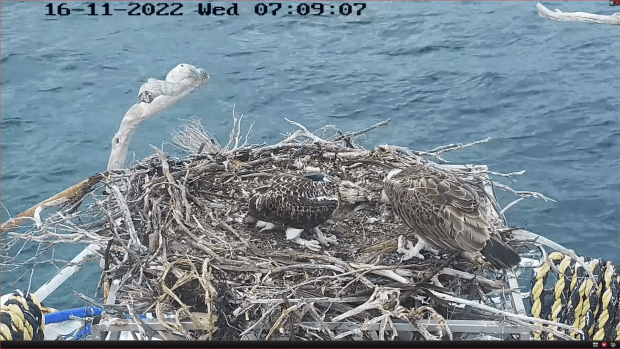
Turning back to Bird World – Dr Green has found Antali. Everyone was quite worried. Antali is spending time with Dad, Finnegan, down river and is being fed well. Maybe Iris and Finnegan are dividing up the responsibilities for the two with Iris providing for Sum-eh???

‘PB’ sent me an image of Finnegan’s latest catch. My goodness. Him and Antali will be having a feast!

After spending so much time around tourists, beaches, and shorebirds, I completely understand the need to protect their nests!
The issue of the industrial fishing of the Menhaden is also harming the Striped Bass. It is the food chain. The commercial fishing needs to stop, not only in the Bay but also far enough away from the its mouth so that there might be some hope for the fish to recover in terms of populations, but this will not happen unless there is an immediate moratorium.

Geemeff’s summary for Loch Arkaig and The Woodland Trust:
Daily summary Friday 16th August 2024
Garry LV0 and Affric 152 spent hours on the nest again today. Although Affric gave Garry much vocal encouragement, he only brought moss to the nest, no fish. Fundación Migres provided more photos of the Scottish cohort including our chick 1JW, we’re not sure which photo he’s in but all the birds look in magnificent shape as they prepare for migration. Photos and tweets cobbled together into a video for those who don’t get on with TwiX. Weather-wise it was wet and windy as forecast, and more of the same tonight but with a possibility of dry spells tomorrow.
Night cam switches on (day cam): Nest One 21.56.53 (05.06.56); Nest Two 21.47.01 (05.13.30)
Today’s videos:
https://youtu.be/RnY54XNtci8 Spain: more photos and tweets of 1JW and the other ten translocatees
https://youtu.be/rQYUcsjAKB0 N1 Affric joins Garry but he brings sticks not fish 10.51.20
https://youtu.be/lD-oLI2NjpA N1 Garry and Affric return later but there’s still no fish 16.20.59
Bonus photo – our ringer Lewis Pate makes The Week In Wildlife (thanks Moira)
https://bit.ly/WeekInWildlifeLewisringingaSeaEaglechick
Watch the Loch Arkaig Osprey livestream 24/7 and join in the conversation here:
https://www.woodlandtrust.org.uk/trees-woods-and-wildlife/osprey-cam
‘A’ comments about the Royal Albatross:
“At Taiaroa Head, TF chick is doing well, according to his latest weighing. He has been fed regularly by his parents over the past two weeks. The chicks are all starting to flap and hop, stretching their wings to feel the wind. It is so sad to think that when they go, they are leaving for up to five years, heading for South America (off the coast of Chile) and not returning to Taiaroa Head for four to five years, when they will return to their natal nesting area to find a mate. We have a long time to become deeply attached to these chicks, born in January and leaving us in September. That’s many months to fall in love with them, watch them, wait for their parents, and hope for their wellbeing. It is such a bittersweet moment, and I will never forget the look of sheer bliss on Lilibet’s face as she fledged into the storm. It was an amazing thing to watch live. I felt very privileged indeed.”

“Lady is doing a great job of feeding the eaglet, really stretching to reach it and giving it just the right sized pieces, and the chick in turn is a great little feeder. SE34 is hungry and is eager to reach out for the bites. I did notice a size difference between the chicks yesterday or the day before, but they are still relatively closely matched. Once or twice, when Lady goes to clean bits of fish off SE34’s face, the eaglet shrinks as if intimidated and on one occasion ducks and tucks, but in general, it seems confident when eating.
Just before 15:53, after SE34 really reaches to grab a big bite, Lady drags the fish closer to the chicks. Shortly before 15:54, SE33 wakes up. SE34 continues to accept the bites Lady offers. SE33 is sitting up and watching the feeding. It has a PS, but does not interfere as SE34 continues to eat, not appearing to be intimidated at all by its sibling.
The two eaglets were left alone on the nest for a lot of time today – it was a sunny spring day and I doubt they were cold, and I also presume there was a parent within eyeshot somewhere, though I didn’t see either.
At 15:55 SE34 is being very careful not to look SE33 directly in the eye, but is not scared to accept yet another bite of fish. SE33 does another (small) PS. Lady continues feeding SE34, who continues taking mouthfuls without hesitation. SE33 sits beside SE34 at the table but is not being offered food, so competes for a bite. Lady looks slightly startled.
At 15:56 Lady gives a bite to SE33. At 15:56:35 the next bite goes to SE34 and SE33 decides to take exception, beaking its sibling in the head. It grabs a beakful of head feathers and twists at the back of SE34’s head. No damage is being done but SE33 is definitely frustrated and continues its attack for a full 20 seconds before looking up at mum. SE34 stays down.
Lady offers SE33 a bite, then proceeds to clean up the table, have a few bites herself, and generally not feed SE33. She offers a bite around 15:58 but there is no interest. She offers another and SE33 accepts it. Lady gives SE33 a second bite, then a third, and SE34 lifts its head. Lady continues feeding SE33 (who has the remains of an earlier crop). SE34 is getting squashed by its sibling. 16:02 and the feeding of SE33 continues. SE34 watches but is not offered any bites, nor does it compete for any. On the other hand, SE34 is pretty full by now, with a very respectable crop, and is certainly not intimidated, with its head up. At 16:02:45 Lady offers a bite to SE34, who accepts it without hesitation. There is no reaction from SE33. So it appears the bonking that is occurring on this nest is not causing problems with SE34’s feeding. SE34 is not intimidated out of eating and Lady is keeping an eye on your younger hatch. So far, so good. But as we know, these nests are very volatile and the dynamics can change rapidly and dramatically. Talons crossed that Lady and Dad do their usual sterling job. “

Thank you so much for being with us today. There will not be a posting on Sunday as we arrive home late Saturday. I will look forward to sharing some of the images of the shorebirds and more eagles on Monday. In the meantime, take care of yourself. See you soon!
Thank you to the following for the posts, notes, comments, videos, articles, and streaming cams that helped me to write my post today: ‘A, BAH, Geemeff, H, PB’, Jen Lussing and Will Cooper and the animals at the LAILO Farm Sanctuary, Aspinall Pottery, The Village Coffee Shop, Montana Osprey Cam FB, Montana Osprey Project, BirdGuides, Menhaden- Little Fish, Big Deal, Maryland DNR, Geemeff and the Woodland Trust, NZ-DOC and Cornell Bird Lab, and Olympic Park Eagles.