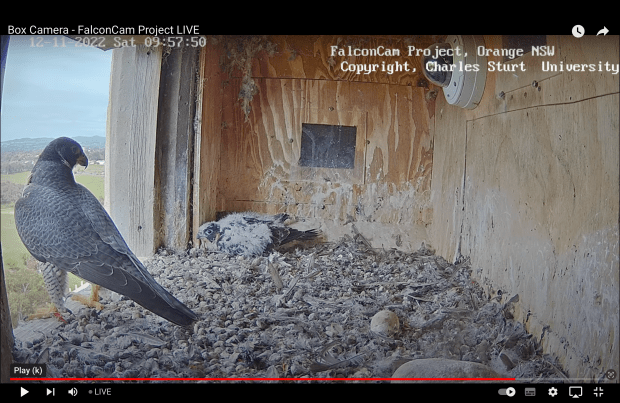
Ervie, Indigo…and more news in Bird World on Sunday

13 November 2022

Good Morning Everyone.

Saturday was one of those quiet stay-at-home days. It gave me a chance to think of the ways that those of us who live in wintery climates cope with the weather. As it is, the sow is dancing down right now. The European Starlings are eating suet and Butter Bark and Mr Crow cawed so much that I gave him high protein kitten kibble. Oops. The Starlings have found the kibble!

Inside the house, the candle holders have been cleaned and given new candles. An apple crisp is in the oven. So, instead of starting out birds today, we will begin with something simple to make your house cosy on a crisp day. Put 1 sliced orange and 1 sliced lemon in a 2 litre (qt) pot. Leave the peel on – that is where the lovely oils are. Add a few bay leaves, 2 or 3 cinnamon sticks, a good tablespoon of cloves, and cover the whole with water. Bring to a boil then lower the heat and let it simmer. You can add water as needed. I used to add tea bags to the brew. It is a lovely spiced tea but needs some straining. The other thing you can do is to take the peels of your oranges and lemons and use them. I always have bags in the freezer! It is part of a strategy to have zero waste.

Making News:

Our darling Ernie. Poster child of handsome beginning to do some moulting.

For the very first time successful fledges at Maine’s Hog Island Boathouse Osprey platform. Dory and Skiff are making the news! Congratulations to this Osprey couple who successfully fledged three osplets from the Hog Island Osprey platform this year. What an amazing family this was to watch.

Oh, so very grateful to Cilla Kinross for finding Indigo and showing us how this handsome lad is doing after fledging. Isn’t he a stunner?

Tweed Valley fledged three ospreys this year. Two of them have perished. The other, Glen, found himself on a couple of container ships before finally making it to Spain! Here is the latest on this youngster.

https://www.bbc.com/news/uk-scotland-south-scotland-63584969?fbclid=IwAR1vsE2ErGcB71e711Z9k01Xt4GWUC4PDPCn03KH3yCzRLdl3MECQnPSDz8

In the Mailbox:

‘EJ’ sent me some grand news. It is amazing what we can do when we get together to help benefit the environment and wildlife. A community joined together and raised 2.2 Million GPB to purchase a tract of land to enlarge a nature reserve. Just think – this could be a way of halting development in areas that are needed by the wildlife. Is there land where you live that is adjacent to a nature reserve that could benefit from such an endeavour? Keep this positive action in mind if ever you get a chance to work with your community.

File:The Ewes Water Valley – geograph.org.uk – 1538379.jpg” by James T M Towill is licensed under CC BY-SA 2.0.

You can read about this successful project here:

https://www.scotsman.com/heritage-and-retro/heritage/langholm-moor-ps22-million-raised-to-complete-community-buyout-3793764

Australian Nests:

All eyes are on Port Lincoln. Ian Falkenberg was up at midnight finishing up the permit forms – that myriad of red tape that Port Lincoln has to do in order to ring the osplets on the nests. Fran and Bazza said that he was up again at 0600 getting ready. So, today, Big, whether you like it or not you will be weighed, measured, hopefully a sample of your blood is taken for DNA, and you will be given a sat pak. Big, we all know that you are one big cranky girl that won’t let any bird get in your way. You are now the only hope of Port Lincoln for 2022 – you carry a heavy responsibility. Please do not ever land on a hydro pole no matter how much you might want to.

Ian Falkenberg has made the call to postpone putting the tracker and ringing until later today or tomorrow. This cannot be done in wet weather. In addition, it really is now or never. In the UK, birds are not banded after 45 days because of the great fear of scaring them off the platforms and fledging early.

Mum and her ‘Big’ Girl crying out to Dad.

Dad brought a fish in around 0815. Big kind of rushed Mum once she had the fish. Mum got the catch anchored to her talon and flew around the nest arriving on the other side where she had control of the fish. It was headless so Dad has his share, too. Mum and Big had a nice chunk.

A small headless fish arrived around 1515.

The rain began. Mum and Dad had been perched together. Mum flew over to the nest to Big and Dad joined them at 19:44.

It appears that three of the Melbourne Four have now fledged. One remains at night and some of the others show up on the ledge for prey deliveries.

At Orange, Rubus is shedding many of the dandelions and is watching for Xavier and Diamond to deliver prey. They do not disappoint. Here was yesterdays recap from the moderators: RECAP 10 41 15 D w/ prey, Rubus takes; 11 25 12 X w/prey, D arrives/feeds: 13:31:22 X w/juv star, feeds, X takes: 16:30:10 X w/prey, feeds 18 53 31 Xw/prey, Rubus takes, D arrives , tug o war, D feeds.

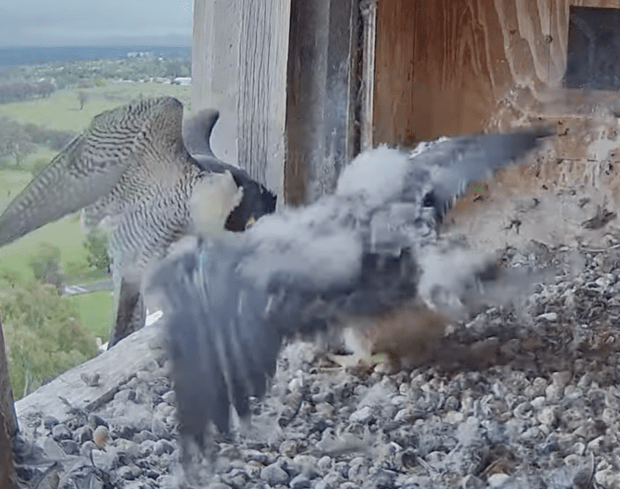
There was a tug o war and lots of excitement. Just look at how much of the baby fluff is now gone.

Other Bird News:

One of the things that changes for me – during the winter – is that I do not travel on the roads as much nor do I go to the nature centre 5 days a week for a walk. Saturdays become very quiet and one of the joys is having Ferris Akel in the background doing his live stream around Wildlife Drive, Montezuma, Sapsucker Woods, and Ithaca, New York. We have a few ducks still in the City and a few geese were flying overhead this evening. Someone even has a Baltimore Oriole in their garden today – with the snow! I am, however, having duck withdrawal and Ferris does seem to find them this time of year! I really recommend Ferris Akel’s tours on Saturdays beginning about noon Eastern time. Ferris is humble always saying he doesn’t know this or that but, he does. I have learned so much for him. In fact his tour is often on in the background to whatever else I am doing. You can also check out some of the archived tours of Ferris by going to YouTube and entering Ferris Akel Live.

‘A’ said that she had learned to embrace ‘brown’ never realising that there are so many shades and hues. Fantastic! That brings me great joy. Most of the female birds are considered dull compared to the flamboyant colours of some of the male species. Here is a female Ruddy Duck. Just look at all those wonderful browns and tans, there is a touch of caramel and espresso, and that lovely sort of grey-brown.

All of the birds are at a great distance from where Ferris is streaming. The images are then quite soft. Nonetheless, I hope that you enjoy the few that I am including.

Just a slightly different angle.

A female Shoveler. You can never mistake a Shoveler for a Mallard. Just look at that bill. It is massive in comparison to the size of the head.

There were American Coots and I know that none of us will ever make the mistake of saying a Coot is a duck. It isn’t.

Oh, how I love Sandhill Cranes. They glean the farmer’s fields just after the seed crops have been harvested. There are many in Southern Manitoba in October doing this exact same thing. Gorgeous.

I don’t blame the Canada Geese getting out of Canada. Gosh, golly, it looks like much more fun in the pond at Sapsucker Woods than it is walking around in the snow in Canada and not finding any food.

What shocked me is precisely how much smaller the geese are when compared to the swans.

Just look at that. It makes the Canada Geese look like miniature ducks. Seriously. And I have always thought of them as large.

There was a juvenile Bald Eagle lurking about at Sapsucker Woods also.

Looking for some lunch?

No 6 The Red List: The Hawfinch

Ah, this is another one to pull out those shades and hues of brown. With its head the colour of rust or Corten Steel, its black bib and black eye surround, and heavy beak, this beautiful little bird, the Hawfinch, has a jaw and beak so strong that it can exert pressure of more than 50 kilograms on a seed! The strong triangular beak is black in the winter changing to a blue-black in the summer. Notice the rusty head in comparison to the grey-brown back and that intensive brick-brown eye. Both males and females are similar in appearance.

Hawfinch bill

Hawfinches like to live in woodland where they will feed off various hard seeds. Some, if you are lucky, can be found around gardens eating cherries. The male builds the nest out of dry twigs and grasses lining it with lichen. The female will take over in roughly a fortnight.

Today there are less than 1000 breeding pairs of Hawfinch in the UK. There are a number of causes. Nest predation by Jays and Grey Squirrels is one of these. In Wales, the culprit has been trichomonosis. Trichomonosis is an infectious disease caused by the parasite Trichomonas gallinae. The parasite attacks the upper digestive tract, mainly the crop and esophagus making it difficult for the bird to eat. It can also impact the liver, lungs, and air sacs. The fourth hatch at Melbourne last year died of trichomonosis as did the Mum at the Janakkalan Osprey nest in Finland this past summer.

That’s it for today. I hope that each of you have a wonderful weekend. It looks like it could be dry at Port Lincoln so maybe, at the age of 57 days, Big will be ringed and get that sat pak. We wait to see.

Thank you for being with me. See you soon!

Thank you to the following for their posts and streaming cams which make up my screen captures: Friends of Osprey, Audubon, Cilla Kinross and the Orange, Australia Peregrine Falcon FB, BBC, Tweed Valley Ospreys, Port Lincoln Ospreys, 367 Collins Street by Mirvac, Charles Sturt Falcon Cam and Cilla Kinross, and Ferris Akel Tours.

Sex hats for Birds?…and other stories from Bird World

12 November 2022

Good Morning!

I hope that everyone has had a wonderful start to their Saturday. It is -8 degrees in Winnipeg, heavily overcast with some flakes of snow drifting down. The Blue Jays have been scurrying back and forth for peanuts since dawn.

The following quote is from an article that ‘K’ sent me and I wanted to share it with you. I do so treasure these feathered friends of ours. They have brought me so much love and joy. I cannot imagine – for a single instant – life without them. When I park my car on the street and walk to my house, I can hear them. Singing. What happiness that brings!

“All is an Ocean. All flows and connects so powerfully that if, in this life, you manage to become more gracious by even a drop, it is better for every bird, child, and animal your life touches than you will ever know.” (Dostoyevsky’s, The Brothers Karamazov)

The pictures are from the day before the snow. Mr Crow is here, Junior and one of the three siblings, a White-breasted Nuthatch came to visit, too.

This is Junior. He is the Dad of the three fledglings this year. Junior normally stays all winter. How do I know it is Junior? His feathers are a little duller but it is the thin eye line that extends further back. You can compare them. Junior is sitting on the edge of the bird bath while one of the fledglings is down getting a peanut.

Black isn’t just Black but depending on the light it is a green black or an iridescent purple blue with green as in the second image. Mr Crow is beautiful. My heart warms every day that he comes as it does for all the others.

It was the first time ever I have seen a White-breasted Nuthatch at the feeders in a long time. The last was on the 13th of October in 2019. A little over three years. According to the recent bird surveys, the Nuthatch population is on the rise in Canada and the rest of North America. We normally recognise the Nuthatch because it moves along the tree branches with its head facing downwards.

The squirrels have all been here, too. They have not cooperated for photos! Most of the time they are trying to get as many nuts off the solid seed cylinders as they can!

Making News:

Oh, we all love those shy flightless parrots who are more than vulnerable. There is new research that might help in caring for these marvellous characters. Adorable. Simply adorable.

Halfway around the world, a much anticipated California Condor release took place a week ago. The Condor is as vulnerable as the Kakapo is. These releases are always great moments, full of emotion and excitement. I missed this event and am so grateful that the release of these four birds back into the wild has been archived so that we can see it at our leisure.

In the Mailbox:

‘N’ writes: Today this was posted by one of the moderators at one of the streaming cams: “We’ve been trying to discourage anthropomorphic stuff for years, I’m afraid. It’s a losing battle. people project human emotions on the birds all the time.” You have mentioned this subject several times. Is it possible for you to repeat what you have said?

I would be happy to, ‘N’. First I would like to introduce Dr Marc Bekoff who is the international authority on animal emotions. He is Professor Emeritus of Ecology and Evolutionary Biology at the University of Colorado in Boulder. I am extremely impressed with the work that Dr Bekoff and other Cognitive Ethologists are conducting. Cognitive Ethology is the comparative, evolutionary, and ecological study of animal minds. This includes their emotions, their beliefs, their reasoning and processing, their consciousness, and self-expression. The keen interest, ‘N’ in animal cognition is not new and it is extremely important for animal welfare and protection. Bekoff sees the field as all encompassing in terms of understanding the subjective, emotional, empathic, and moral lives of animals.

In his research, Dr Bekoff has consistently said that as humans the only language we have is our own and it is the only thing we have to describe animal emotions. If we do not look at them and use the words joyful, grieving, then what words would we use to describe what we are seeing? We have nothing more than what we have. Dr Bekoff continues in his book, The Emotional Lives of Animals, by saying that he knows no researcher who, when working with their animals, “DOES NOT FREELY ANTHROPOMORPHIZE. THIS ANTHROPOMORPHIZING IS NOTHING TO BE ASHAMED OF, BY THE WAY; AS ALEXANDRA HOROWITZ AND I HAVE ARGUED…THESE SCIENTISTS ARE SIMPLY DOING WHAT COMES NATURALLY. ANTHROPOMORPHIZING IS AN EVOLVED PERCEPTUAL STRATEGY…IT IS NOW LARGELY ACCEPTED AS FACT, THAT ANIMALS, SHARE THE PRIMARY EMOTIONS, THOSE INSTINCTUAL REACATIONS TO THE WORLD WE CALL FEAR, SURPRISE, SADNESS, DISGUST, AND JOY.” (10). The capital bold letters are mine.

I could continue on for pages ‘N’ but, it is upsetting when someone makes the statement that you have written. I am sorry but they are not informed by the current science. There are many who believe that animals do not feel pain or fear. It makes it easier to kill them! We know animals feel pain. I have seen eagles and other raptors grieving along with the Corvids in my own neighbourhood. I have seen Grackles celebrate the fledge of one of the chicks in my garden (they invite the extended family) and we have all heard and some have been blessed to witness the rituals associated with Crows when one of their group dies. I hope this answers your question and provides you with a beginning from someone expert in the field, Dr Bekoff, to rebuff those statements. I also urge everyone who is interested in this topic to get a copy of this amazing book. It is paperback and can be ordered through library loan as well. It will provide you with a clear foundation on this subject backed up by clear examples, not anecdotes.

In other mail, ‘K’ sent me a wonderful letter and an article, “Cherish This Ecstasy” by David James Duncan from The Sun written in July 2008. I want to share the topic of that article with you – bringing back the Peregrine Falcons from extinction. It seems so appropriate as we just watched Indigo and 2 or is it now 3 of the Melbourne Four fly and await Rubus’s triumphal departure.

Now do you know what the invention was that brought the Peregrine Falcons back from sure extinction? It was the Peregrine Mating Hat invented by one of Cornell’s Ornithologists. The ornithologist would put on the hat. He would sing Chee-up! while, at the same time, bowing Buddhist style. You have seen our falcons do this in their bonding rituals. The male falcon copulates with the hat. The scientists remove the sperm and inject it in the few females they had at the time. The hatchlings were raised in a DDT free environment – and that is how we now have Peregrine Falcons living almost everywhere.

Here is an example of the hat and the process. Turn your sound down a wee bit.

While we are talking and thinking about everything falcon, it is a good time to mention some of the really good books that are out there. They are in no particular order but each is loved and well worn and I pull them off the bookshelf often.

Falcon by Helen MacDonald. I love MacDonald’s books. That is not a secret. This little paperback volume is the social history of falcons from the gods of the Ancient Near East and Egypt to the hunting falcons of Europe and the Middle East. Everything you wanted to know about falcons and more including their use in the military. It really is a good read particularly if you want to known more about falcons than just scientific data – their entire cultural history of falcons in a wonderful narrative. My first pick always for a book on the subject of falcons (not just peregrines) other than a guidebook.

On the Wing. To the Edge of the Earth with the Peregrine Falcon by Alan Tennant. Ever wanted to fly? to understand how falcons migrate? This is the view from Tennant’s flying and tracking of the falcons as they migrate. Tennant narrates the voyages tracking the birds with the tiny little transmitters on their tails. I like it because the science is woven in with the narrative.

Queen of the Sky by Jackie Morris is a beautiful little book. It not only includes the stunning watercolours of Morris and gorgeous photographs of Hiss and her friend, Ffion Rees, who rescued this dying falcon from the sea and nurtured it back to health. This is a profoundly personal and moving book. There is a deep connection between Ffion Rees and Hiss that develops over time but which began the minute Rees looked into the eyes of that raptor. They looked into the souls of one another. Highly recommended for the art work alone but the story will certainly move you.

The Peregrine by JA Baker. Baker tracks a pair of peregrine falcons during their daily lives. He is transfixed by them. You get to know their habits – everything about them – through the eyes of Baker. Many consider this a ‘must have book’ for the shelf.

There are more but these would get you started – but, as I said, out of all the MacDonald is first. Since I love the paintings of Morris and the positive story of a falcon rescue and release the Morris is second.

And one last falcon bit. Dr Cilla Kinross (the researcher at Orange) went out looking for Indigo today. Xavier and Diamond saw her. I imagine they did not want her to get too close to their beautiful fledgling. The video will not win any awards but it does give you a fantastic idea of the sounds the adults can make if they are anxious about someone being near their offspring.

Before we check on any of the other nests, let’s see how Rubus is doing in the scrape alone. It would appear that some of those dandelions are shedding but there are lots to go. Rubus also appears to be only interested in the visits by parents if they have prey! My goodness Rubus is ferocious when there is prey about. Diamond has been flying up and checking on Rubus quite a bit this morning.

The beautiful golden glow of dawn falls over our dear little one, Rubus, who now looks out to the wide world of Indigo and the parents. Rubus, you will fly too but…it is going to be awhile. You need to get rid of most of that fluffy down. Flap those wings and shake, shake, shake.

Dare I say that Rubus is missing Indigo?

Rubus would love another prey delivery.

Diamond goes over to check on Rubus.

At 367 Collins Street, it is anyone’s guess as to how many of the eases are now fledglings. We know from a video clip from ‘Bathroom Guy’ that at least one has fledged. It is now believed that there are two. This morning very early there were three erases on the ledge waiting for a prey delivery – or at least hoping for a prey delivery! Did one return for breakfast? We know that the eyases can easily reach this height.

Here is a group of photos of the erases on camera this morning. Looking, listening, eating, and loafing.

Loafing has spread around the world…starting with Alden at UC-Berkeley. What an influencer he is!

It seems as if two have fledged and two remain to fledge – but, in truth, we have no idea! That is the nice thing about the scrape at Orange. You can be absolutely certain when the eyas flies for the first time!

The streaming cam remains off at Port Lincoln. This morning when it was back on there was a note that Big had two fish meals both of them brought in by Mum. Thank goodness Big is older and Mum is a good fisher. It is difficult to determine what is going on with Dad but, whatever it is could be linked to his two seizures seen on camera during the early incubation stage.

5 Red Listed Bird: The Mistle Thrush

Mistle Thrush (Turdus viscivorus) captured at Borit, Gojal, Gilgit-Baltistan, Pakistan with Canon EOS 7D Mark II

I first saw an image of this lovely bird after the ospreys had started their migration to Africa. For the life of me I cannot remember if it was the Glaslyn or the Dyfi nest in Wales but, on one of them was this stunning little bird, the Missile Thrush. The scientific name Turdus viscivorus means ‘devourer of Mistletoe’. It is a large songbird with a grey-brown head, back, and wings. Its breast is spotted with the same grey-brown on ivory. Piercing deep espresso eyes with an ever so slight eye ring. The pop of colour comes in the pinky-peach legs. One can only imagine that this combination in haute couture would land it on the Paris runways. In its behaviour, this Thrush is powerful and aggressive. It eats insects, invertebrates, and loves berries. They do love mistletoe but will also eat hawthorn or holly berries. The largest of the warblers in the UK, their son is loud and is carried for a distance from their perch high in trees. Actually, it isn’t a song but a rattle.

These lovely birds are globally threatened. Their numbers have declined dramatically, as much or more than 50%. The cause is a lack of habitat. Hedgerows where the find food and wet ditches because of the drainage of farmland has led to a lack of earthworms and other invertebrate that the Missile Thrush relies on for its food. Cow pastures and woodland have also been lost or degraded.

Research conducted by the RSPB suggests that ‘Farming measures likely to help song thrushes include sympathetic hedgerow management (with tall, thick hedges), planting new woodlands on farmland, and planting wild bird seed mixtures including leafy cover.’ In addition, the RSPB found that preventing the soil from drying out during the summer would be of great benefit to the thrushes. Hotter summers have brought more rain so perhaps, there is some hope here.

Migration News:

Bonus remains in close proximity to the area he has been in Turkey for the last little while. Waba is still in the Sudan feeding at the Nile but has moved slightly south.

It is so wonderful to have you with us. Thank you so much for being part of this marvellous international family of bird lovers. Take care of yourselves. See you soon!

Special thanks go to the following for their posts, videos, and streaming cams that make up my screen captures: Kakapo Recovery, Ventana Wildlife Society, Charles Sturt Falcon Cam and Cilla Kinross, and 367 Collins Street by Mirvac.