It is ‘the golden’ time in the garden. The sun is setting and there is a peachy-apricot- with a touch of lilac glow that kisses all of the western branches of the trees and the shrubs in the garden. Mr Crow is cawing. There are gulls, hundreds of them, flying overhead. They have found insects! The feeders are now quiet. Toby is beside me on the bench and like ant toddler, he wants my attention. No more computer!
I cannot wait to take him to the beach next Saturday. I think a lifejacket needs to be purchased, just in case he is not the great swimmer I think he is. Don is going to sit and watch his grandson, Carter, fishing. It is set to be the perfect end of the summer – ospreys included. The family and their chicks are still at their nest! So excited.
Today I am baking a peach kuchen. Every summer I make at least one, usually a plum one, in memory of one of my dearest friends, Rosemarie. We lived in Southern Manitoba, and our children were friends in the 1970s. She was remarkable. Her parents had sent her over the Berlin Wall to freedom – and that is how she came to be in Canada. I treasure all the recipes she taught me and the time we spent together. They moved to BC, where her husband had a position with the CBC. I left for the UK, and we lost touch. Thank goodness for memories!
Prayers for the people and wildlife in the zone of the hurricane.
The Guardian shows how rewilding can help against drought – and that is something many need to consider.
Geemeff’s Woodland Trust daily summary for Loch Arkaig Friday 21st August 2026 No sight of Amber 8P6 again today so it looks like she might have headed south, very young, but then she always was very determined and ahead of her older sister. Juniper 8P7 is very much still here, on and off the nest throughout the day and always announcing her arrival, occupation, and departure. She’s had to contend with several Hoodie invasions today and shows no hesitation lunging at them to drive them off, defending her fish and using a crow voice just like her mum Dorcha did. At one stage she flew off the nest clutching a fish, circled round, landed with it then took off again, possibly to find a place to eat without attendant Hoodies. Louis brought her two new fish, taking the Nest Two tally to four hundred and fifty, and his personal tally to four hundred and forty five, however there was also plenty of leftover fish from yesterday, and the Hoodies managed to get some while Juniper was away. No activity at Nest One bar a couple of songbirds. The weather was settled today and will continue dry but
chilly overnight with a low of 7°C, continuing dry and bright tomorrow with sunny intervals and a high of 15°C. Today’s videos:https://youtu.be/t5D_e4cLKwI N2 Louis brings fish one but several of yesterday’s are still there 06.07.15https://youtu.be/ZawjOTbmSDA N2 Juniper tries to protect her fish from a marauding Hoodie 11.09.48https://youtu.be/HDLYdQM9HkM N2 Fish number two arrives and so does a Hoodie 11.53.37https://youtu.be/tX2bGpkf4FkN2 Juniper flies with fish and aHoodie enjoys the leftovers 16.40.47
Bonus webinar – next Thursday 27th, with analysis by @SteveQuinn of Louis’ fishing performance and other nest activity this season, and an update from @WTScotland on the restoration of Arkaig Community Forest, with a Q&A afterwards:
The birds are on the move. What can you do to help? Turn out your lights! Ask your town and City to turn off their lights. Leave out water and if you can, put out food!
We now have at least 300 birds eating in the evening. My daughter gave me two triple-tube feeders…we are going through seed as the songbirds make their way south to their winter homes. I am so glad I can help them, along with the ones who live here all winter.
An article about a Snowy Owl – and just to note, the first Snowy Owl, has been photographed in Manitoba this season. Some interesting research – have a short read!
A satellite-tracked female snowy owl in the eastern Canadian Arctic spent 186 days on sea ice, hunting ducks at open water cracks in the pack ice hundreds of miles from land in total winter darkness. The biologists who tagged her expected her to fly south for the winter. She flew north onto the frozen ocean. The finding flabbergasted them. Inuit seal hunters had known about it for centuries.
Jean-François Therrien, a doctoral student at Université Laval working with professor Gilles Gauthier, tagged 12 adult female snowy owls on Bylot Island in Nunavut as part of an International Polar Year research project studying key indicator species of northern ecosystems. When winter came, the tracking data showed something nobody in the academic world had documented with technology. Eight of the 12 owls spent more than 95 percent of their winter locations over sea ice or along the coast. Six adult females spent most of the winter far out on the Arctic sea ice. One stayed there for 186 consecutive days. She was not lost. She was not drifting. She was hunting.
The ocean freezes across the Canadian Arctic every winter but it does not freeze solid. Leads and polynyas, cracks and pools of open water, persist throughout the ice sheet. Sea ducks, particularly eiders, and seabirds concentrate at these openings because the open water is where the food is. The owls found the ducks by finding the water. Gauthier described the hypothesis directly: bird researchers at coastal field sites have observed snowy owls attacking eiders in winter. If the satellite positions of the owls matched the locations of open water leads recorded by other satellite systems, the connection would be confirmed.
The owls were not behaving like the animal most people picture when they hear the words snowy owl. Most people imagine a white bird sitting on a fence post in a farm field somewhere in Minnesota or upstate New York, hunting mice in the snow. That version of the snowy owl is real. It is the owl that shows up on Christmas Bird Counts and birding websites and nature documentaries filmed in places where camera crews can reach. The other version, the one the Inuit have always known, is an owl that flies north when winter starts, lands on sea ice in the Arctic dark, finds a crack in the frozen ocean, and sits beside it killing ducks at temperatures that drop below minus 50 degrees Fahrenheit.
The isotope data confirmed the diet shift. Stable isotope analysis of feathers showed that marine prey made up a substantial portion of the winter diet for owls that chose the sea ice. A snowy owl that breeds on lemmings in the summer and switches to sea ducks in the winter is not a rodent specialist. It is a predator that changes its entire hunting strategy, its prey base, and its habitat seasonally, moving from tundra grassland to frozen ocean the way a seasonal worker changes job sites.
Project SNOWstorm, a US-based tracking initiative that has followed more than 115 snowy owls with GPS transmitters since 2013, found the same behavior at a smaller scale on the Great Lakes. Snowy owls wintering in the northern United States moved out onto frozen Lake Michigan and Lake Erie for weeks at a time, hunting ducks at the cracks that opened and closed between wind-driven ice sheets. The researchers described the Great Lakes behavior as practice for the full Arctic version: owls learning or maintaining the ice-hunting skills that adult females use on the Arctic Ocean in the years when they stay north.
Source: Therrien et al., Université Laval / Gauthier, Université Laval / ScienceDaily / Project SNOWstorm / Birds of the World, Cornell / Old Farmer’s Almanac / COSEWIC (2025).
Bonding sessions are taking place at the Peregrine Falcon scrape of Gimbir and Diamond on Charles Sturt University in Orange, Australia.
Great news. Aurora from Loch Arkaig nest 1 has been photographed in Poole Harbour fishing! Fantastic.
Viki sends us her latest:
“I am pretty certain Junior brought a live fish back to the north copse overlooking his nest – I haven’t seen either parent all morning!!!!
I AM AS PROUD AS A PARENT !!!!! He’s gonna make it !!!”
“Well, he clearly still needs plenty of fish as do his parents, apparently. And that little snit will NOT dive for a frozen bait fish I throw – but Dad (and I think Mom) will …. But they took 2 or 3 fish before Dad carried one out to Junior – who, btw, whether he stole that live fish out of another’s nest or not, dropped at least half of it —- TEENAGERS !!!
But aside from all that, I am so proud of that crazy, crafty #2 chick and his dad!!!!
Back out to throw some more fish. Dad is hanging around so maybe Junior will get some and SHUT UP!!! LOL”
“Junior had been practicing dragging his feet in the water. When he saw me coming down the deck with the fish bag he returned to nest but flew off his nest when I tossed the fish and must have been thinking about going for it, but flew off the wrong direction and Dad got it and brought it to their other “veranda” -nest. So I threw another. Junior just looked and kept calling. Dad brought the fish he’d had to Junior and then did four or five more dives for the other fish TO SHOW JUNIOR HOW TO DO IT RIGHT BEFORE MY VERY EYES !!!
Amazing. And now that I’ve picked my second tick off for that effort I’ll hit the shower. Sheesh.”
Viki is my heroine. She has kept this single osprey family alive on Indian Creek, Maryland, where there should have been 5- 60 chicks; one survived because of her. My heart beats softer and happier because good people like Viki exist in the world.
I love this family and I am so afraid that Iris will not return next spring. We want them to live forever, don’t we?
Clark has a fish. No one comes. In flies Wensi…Clark returns with the fish!
Ospreys at Charlo at night but during the day it seems they are over at Roger’s Place.
No one is home at Coeur d’Alene, Idaho.
Mum continues to provide fish at Santiam. I am not clear what is happening at Blackbush.
One of my favourites, Blue 33, checking the nest at Rutland. The gulls are moving in – known as the clean-up crews – when they think a nest is just about at the end of the season. Blue 33 will be the last to leave after all the youngsters and Maya.
At Tweed Valley:
Kielder’s Kirknewton was the intruder at Dylan and Seren’s nest at Llyn Clywedog. How grand.
Teifi and Elen fledged their entire clutch of three. Beautiful osplets!
It is a wonderful day. Viki added a note that I will put here: “Your stamina as a caregiver is extraordinary. I can’t imagine how you get anything else done. Your husband is very fortunate for having been so unfortunate.
Thinking of you – and so you’ll smile –” . And, yes, I did smile at the incredible feat she undertook to keep that osprey family alive. Bravo. In a world when too many ‘count’ the dead, it is a relief that someone dares to feed.
It is exhausting being a caregiver. I am not sure I have any stamina at all. I am busy reading several books, including one that our reader and friend, ‘R ‘, recommended. My goal is to enrich Don’s life as much as possible, try to understand when he has trouble communicating, and recognise that he is also frustrated living in a body where he is not the person he was. Still, we try to make every day a little special. It could be a friend’s visit, a trip to the park, a walk with Toby – it doesn’t need to be much. The trips to the farm are excellent, and we are definitely looking forward to going to the beach next week!
Take care everyone. We will see you soon.
Thank you to all the contributors today – to Geemeff, to the owners of the streaming cams, to those that post information and images on FB – we thank you so very much!
It warmed up! Mike finished the railings and will begin the small deck extension shortly. Toby and I planted beans, tomatoes, red peppers, chives, various lettuces, and rosemary. We even managed to almost finish painting a wicker plant stand for one of the lovely chartreuse ferns. It was 17 C. Ann and Don went to the zoo, where to their delight, the peacocks were really putting on quite the show. It was what I call a ‘cracker’ of a day.
‘PB’ just sent a note about Achieva. Jill went out and caught a small fish for Big to eat alone. Then she went out again and came in with a big catfish for both her and Little. She is a brilliant dedicated Mum!
I love the fact that these two osprey are so bonded that they remain together despite having no eggs but protecting their territory and nest for next year! It’s called ‘hope’ and we all could use a good dose of it right now!
Sadly, Flora’s Harry has not been seen at the Alyth Substation osprey platform since Saturday. Flora had to go and find food, and when she left their eggs, the Corvids came and ate them. It is a blessing. There are no chicks to starve, and Flora can have a summer building up her strength. Harry was very special and is a huge loss.
Blue KL5 has not returned to the Loch Garten nest for many days. He is also presumed to be lost like Harry. It has been a rough year in the UK osprey world, much different than in previous years when couples were secure and chicks hatched and fledged in a normal calm manner.
Heidi reports on the saddness coming out of Mispillion Harbour osprey platform.
There is cuteness at the nest of Dylan and Seren – and what a bright spot these little osplets are that are hatching!
So cute – turn around you silly!!!!!!!! Manton Bay with Blue 33 and Maya.
Iris had a little visitor from one of the nests inside her nest!
Have you been wonderfing about the female at the Glen-Hayes nest?
We have a fledge/fludge at Johnson City ETSU.
Have you noticed that Monty and Hartley raise the most energetic chicks?!!!!!!!! Always getting into mischief. SK Hideaways gives us some of their latest antics in this video: https://youtu.be/GhKpFR5-4Ao?
Lady and Dad have been regularly coming to the nest tree in the Sydney Olympic Park.
Hatch watch for Richmond and Wendy.
Gracie Shepherd shows us the latest on the fires on Santa Rosa Island where there are eagle nests with babies!
What a cutie that hatched for Dylan and Seren yesterday with another nice pip in the second egg!
Prey becomes comfy pillows at Big Red and Arthur’s nest in New York.
Aerating the eggs at Pitkin County in Colorado.
Ann loves peacocks and this article just popped up in The Guardian!
It’s raining. The sky is grey and it is cooling off. Hoping for warm weather tomorrow! Take care everyone. We will see you again soon.
Thank you to everyone for their contributions – videos, informative posts and messages with images, authors of FB posts and the owners of the streaming cams that allow us these screen captures and a view into the life of these families.
Saturday was one of those quiet stay-at-home days. It gave me a chance to think of the ways that those of us who live in wintery climates cope with the weather. As it is, the sow is dancing down right now. The European Starlings are eating suet and Butter Bark and Mr Crow cawed so much that I gave him high protein kitten kibble. Oops. The Starlings have found the kibble!
Inside the house, the candle holders have been cleaned and given new candles. An apple crisp is in the oven. So, instead of starting out birds today, we will begin with something simple to make your house cosy on a crisp day. Put 1 sliced orange and 1 sliced lemon in a 2 litre (qt) pot. Leave the peel on – that is where the lovely oils are. Add a few bay leaves, 2 or 3 cinnamon sticks, a good tablespoon of cloves, and cover the whole with water. Bring to a boil then lower the heat and let it simmer. You can add water as needed. I used to add tea bags to the brew. It is a lovely spiced tea but needs some straining. The other thing you can do is to take the peels of your oranges and lemons and use them. I always have bags in the freezer! It is part of a strategy to have zero waste.
Making News:
Our darling Ernie. Poster child of handsome beginning to do some moulting.
For the very first time successful fledges at Maine’s Hog Island Boathouse Osprey platform. Dory and Skiff are making the news! Congratulations to this Osprey couple who successfully fledged three osplets from the Hog Island Osprey platform this year. What an amazing family this was to watch.
Oh, so very grateful to Cilla Kinross for finding Indigo and showing us how this handsome lad is doing after fledging. Isn’t he a stunner?
Tweed Valley fledged three ospreys this year. Two of them have perished. The other, Glen, found himself on a couple of container ships before finally making it to Spain! Here is the latest on this youngster.
‘EJ’ sent me some grand news. It is amazing what we can do when we get together to help benefit the environment and wildlife. A community joined together and raised 2.2 Million GPB to purchase a tract of land to enlarge a nature reserve. Just think – this could be a way of halting development in areas that are needed by the wildlife. Is there land where you live that is adjacent to a nature reserve that could benefit from such an endeavour? Keep this positive action in mind if ever you get a chance to work with your community.
All eyes are on Port Lincoln. Ian Falkenberg was up at midnight finishing up the permit forms – that myriad of red tape that Port Lincoln has to do in order to ring the osplets on the nests. Fran and Bazza said that he was up again at 0600 getting ready. So, today, Big, whether you like it or not you will be weighed, measured, hopefully a sample of your blood is taken for DNA, and you will be given a sat pak. Big, we all know that you are one big cranky girl that won’t let any bird get in your way. You are now the only hope of Port Lincoln for 2022 – you carry a heavy responsibility. Please do not ever land on a hydro pole no matter how much you might want to.
Ian Falkenberg has made the call to postpone putting the tracker and ringing until later today or tomorrow. This cannot be done in wet weather. In addition, it really is now or never. In the UK, birds are not banded after 45 days because of the great fear of scaring them off the platforms and fledging early.
Mum and her ‘Big’ Girl crying out to Dad.
Dad brought a fish in around 0815. Big kind of rushed Mum once she had the fish. Mum got the catch anchored to her talon and flew around the nest arriving on the other side where she had control of the fish. It was headless so Dad has his share, too. Mum and Big had a nice chunk.
A small headless fish arrived around 1515.
The rain began. Mum and Dad had been perched together. Mum flew over to the nest to Big and Dad joined them at 19:44.
It appears that three of the Melbourne Four have now fledged. One remains at night and some of the others show up on the ledge for prey deliveries.
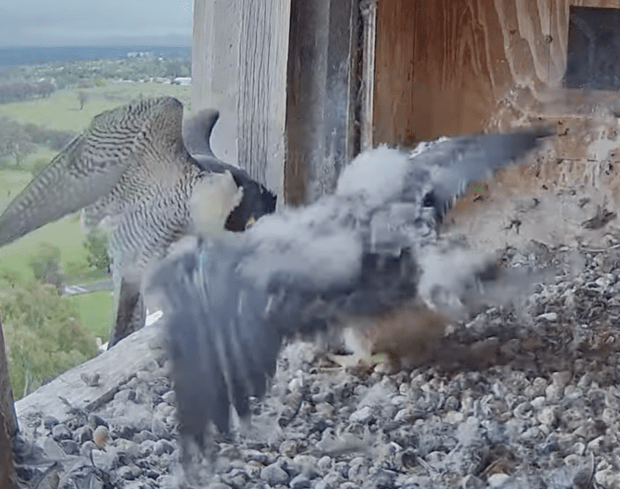
At Orange, Rubus is shedding many of the dandelions and is watching for Xavier and Diamond to deliver prey. They do not disappoint. Here was yesterdays recap from the moderators: RECAP 10 41 15 D w/ prey, Rubus takes; 11 25 12 X w/prey, D arrives/feeds: 13:31:22 X w/juv star, feeds, X takes: 16:30:10 X w/prey, feeds 18 53 31 Xw/prey, Rubus takes, D arrives , tug o war, D feeds.
There was a tug o war and lots of excitement. Just look at how much of the baby fluff is now gone.
Other Bird News:
One of the things that changes for me – during the winter – is that I do not travel on the roads as much nor do I go to the nature centre 5 days a week for a walk. Saturdays become very quiet and one of the joys is having Ferris Akel in the background doing his live stream around Wildlife Drive, Montezuma, Sapsucker Woods, and Ithaca, New York. We have a few ducks still in the City and a few geese were flying overhead this evening. Someone even has a Baltimore Oriole in their garden today – with the snow! I am, however, having duck withdrawal and Ferris does seem to find them this time of year! I really recommend Ferris Akel’s tours on Saturdays beginning about noon Eastern time. Ferris is humble always saying he doesn’t know this or that but, he does. I have learned so much for him. In fact his tour is often on in the background to whatever else I am doing. You can also check out some of the archived tours of Ferris by going to YouTube and entering Ferris Akel Live.
‘A’ said that she had learned to embrace ‘brown’ never realising that there are so many shades and hues. Fantastic! That brings me great joy. Most of the female birds are considered dull compared to the flamboyant colours of some of the male species. Here is a female Ruddy Duck. Just look at all those wonderful browns and tans, there is a touch of caramel and espresso, and that lovely sort of grey-brown.
All of the birds are at a great distance from where Ferris is streaming. The images are then quite soft. Nonetheless, I hope that you enjoy the few that I am including.
Just a slightly different angle.
A female Shoveler. You can never mistake a Shoveler for a Mallard. Just look at that bill. It is massive in comparison to the size of the head.
There were American Coots and I know that none of us will ever make the mistake of saying a Coot is a duck. It isn’t.
Oh, how I love Sandhill Cranes. They glean the farmer’s fields just after the seed crops have been harvested. There are many in Southern Manitoba in October doing this exact same thing. Gorgeous.
I don’t blame the Canada Geese getting out of Canada. Gosh, golly, it looks like much more fun in the pond at Sapsucker Woods than it is walking around in the snow in Canada and not finding any food.
What shocked me is precisely how much smaller the geese are when compared to the swans.
Just look at that. It makes the Canada Geese look like miniature ducks. Seriously. And I have always thought of them as large.
There was a juvenile Bald Eagle lurking about at Sapsucker Woods also.
Looking for some lunch?
No 6 The Red List: The Hawfinch
Ah, this is another one to pull out those shades and hues of brown. With its head the colour of rust or Corten Steel, its black bib and black eye surround, and heavy beak, this beautiful little bird, the Hawfinch, has a jaw and beak so strong that it can exert pressure of more than 50 kilograms on a seed! The strong triangular beak is black in the winter changing to a blue-black in the summer. Notice the rusty head in comparison to the grey-brown back and that intensive brick-brown eye. Both males and females are similar in appearance.
Hawfinches like to live in woodland where they will feed off various hard seeds. Some, if you are lucky, can be found around gardens eating cherries. The male builds the nest out of dry twigs and grasses lining it with lichen. The female will take over in roughly a fortnight.
Today there are less than 1000 breeding pairs of Hawfinch in the UK. There are a number of causes. Nest predation by Jays and Grey Squirrels is one of these. In Wales, the culprit has been trichomonosis. Trichomonosis is an infectious disease caused by the parasite Trichomonas gallinae. The parasite attacks the upper digestive tract, mainly the crop and esophagus making it difficult for the bird to eat. It can also impact the liver, lungs, and air sacs. The fourth hatch at Melbourne last year died of trichomonosis as did the Mum at the Janakkalan Osprey nest in Finland this past summer.
That’s it for today. I hope that each of you have a wonderful weekend. It looks like it could be dry at Port Lincoln so maybe, at the age of 57 days, Big will be ringed and get that sat pak. We wait to see.
Thank you for being with me. See you soon!
Thank you to the following for their posts and streaming cams which make up my screen captures: Friends of Osprey, Audubon, Cilla Kinross and the Orange, Australia Peregrine Falcon FB, BBC, Tweed Valley Ospreys, Port Lincoln Ospreys, 367 Collins Street by Mirvac, Charles Sturt Falcon Cam and Cilla Kinross, and Ferris Akel Tours.
It is going to be 21 degrees C on the Canadian Prairies. Just a fabulous autumn day to be outside checking on the geese and the ducks and other birds that are migrating through the area. That is where I am headed shortly. It is so rare to get this kind of weather in October that it has to be enjoyed.
I want to thank everyone, before I forget, for all their letters and comments. Much appreciated!
In the Mailbox:
I have had word that it will be a long time before anything can be confirmed about the eagles and ospreys on Captiva/Sanibel. Individuals have seen both eagles and ospreys flying in some of the news broadcasts from the area. The area was more or less completely destroyed I was told. So sad for everyone’s property but thrilled that the raptors appear to be around.
Several have written in to ask if there is something wrong with Mum’s eye at the Port Lincoln Osprey barge? Thank you, ‘M’ for the image of Mum!
What you are seeing is the nictitating membrane or third eye lid. This thin membrane helps the Ospreys to see under water and instead of lowering this third eye lid, it raises up from the bottom. You will often see the birds pull up the nictitating membrane when they are resting. Some people call them a windshield/windscreen. Their function is to hold in the lubricating fluids of the eye. — So there is absolutely nothing wrong with Mum’s eyes!
Making News:
A recent poll in the UK reveals that the majority of individuals believes that nature is in need of protection! While I do not have a crystal ball, it seems that this might be the sentiment in most countries in the world. So why is there not being more done to protect the land and the wildlife – not just words – but action?
Mr Kes at the Robert Fuller nests in the UK has a new mate!
Nest News:
If you are a fan of Big Red and Arthur, the Red-tail Hawks on the Cornell Campus, then you will be thrilled to hear that L4 was caught on Karel Sedlacek’s streaming cam catching a squirrel yesterday. This is the longest that any of this popular couple’s fledglings has ever been seen on campus. It is fantastic.
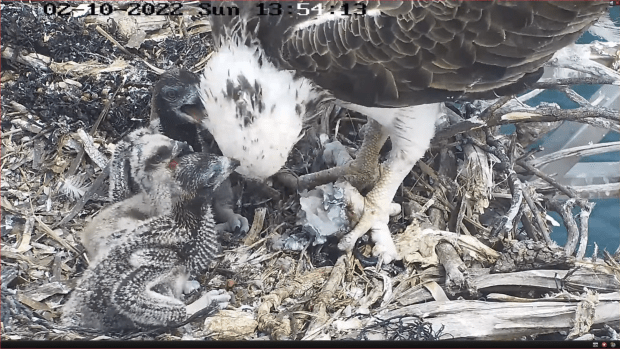
The osplets at the Port Lincoln Osprey barge just seem to be ravenous. Big Bob is 2 weeks old and they are entering their big growth spurt and consuming more and more fish will help that. Dad brought a small-medium fish in at 1334 and it was completely gone by 1400. At first Big Bob was right up there followed by Little Bob. Little Bob got a couple of good bites and then Middle joined the line. Middle had the advantage in terms of position with Middle and Little seemingly getting all the bites. I wondered when Big would tear into them but s/he didn’t and all left the table with crops. I wondered about the heat – it is 19 degrees C in Port Lincoln and they are in the direct sun. They had a nice meal and that is all that counts. What was interesting was that both Big and Middle made attempts to pick at the fish themselves! Keep the fish coming in, Dad!
The three had another fish and finished it off around 1900. Look closely. Little Bob is losing his soft light grey downy coat. Oh, he will be a reptile soon!
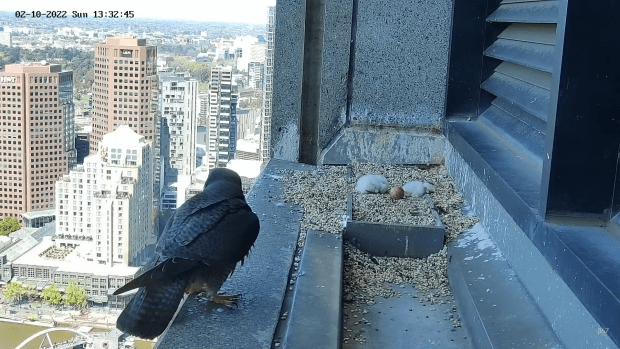
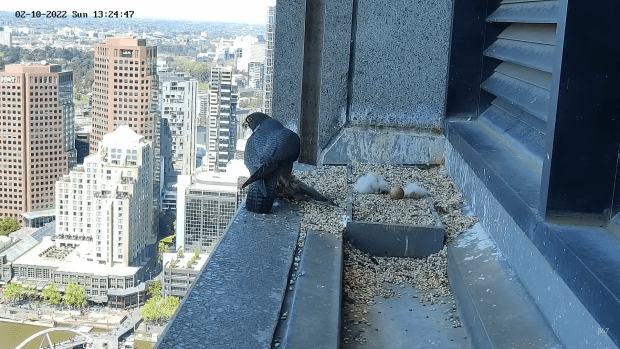
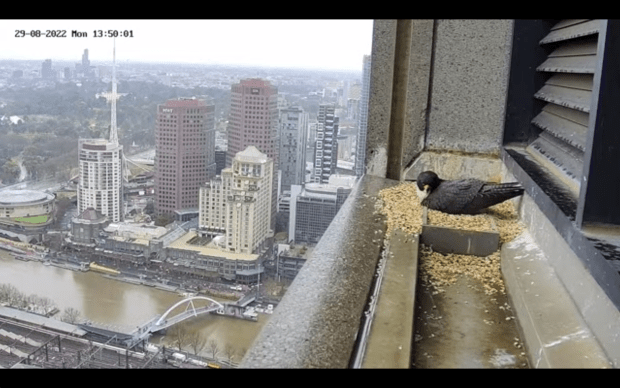
It was really hot up in the scrape box at 367 Collins Street. Mum was just panting and it appears that both Mum and Male2 provided the eyases with some much needed shade until the sun was no longer on the scrape.
Yesterday I said something that confused one reader and I presume more, so my apologies. The couple at the Melbourne 367 Collins scrape are both new parents. I had been watching the old couple for about 5 years -.
What I ascertained from the 13:13 feeding is that it is possible the male has now served as a umbrella to shade the chicks, is bringing in prey for the female and the chicks, and has fed them. I admit to being completely confused by these two unless they are side by side and I can see the line of black in the white at the neck of the male. Both have extremely dark heads. The be all end all of this is that we should not be worrying. These first time parents are working this out and it seems that male2 will be another ‘saviour’ like Xavier.
They are soooooo cute!
Everyone is wondering whether or not Xavier and Diamond will have a second hatch at the scrape box on the water tower in Orange. Big Bob (or Only) is only a day old. Yes, many times falcon eggs hatch within 24 hours of one another but, that not happening in Orange does not mean it can’t. The last two years Xavier and Diamond have had only one hatch out of three eggs – Izzi in 2020 and Yurruga in 2021. It is common for not all of the eggs to hatch – there is one egg still in the 367 Collins Street scrape that hopefully will not hatch!
Mum and Dad have done wonders with SE29 and 30 this year. Big beautiful eaglets ready to fly.
I love this image of SE29 up on the parent branch with Lady. SE29 has ‘officially’ been declared as branching at 1445 on Saturday. Thanks, ‘J’.
Thank you for being with me this morning as we check on all the action that happened late Sunday in Australia. Please take care. See you soon!
Thank you to the following for their streaming cams and posts that make up my screen captures: Cornell Bird Lab, Robert E Fuller, Port Lincoln Ospreys, 367 Collins Street by Mirvac, Charles Sturt Falcon Cam, and Sea Eagles@Birdlife Australia Discovery Centre Sydney Olympic Park.
What happened to August? It seems as if we blinked and it flew by. Despite the heat there is a look about the leaves on the trees and the wilting of the tomato plants despite their being well watered that is alerting us to the end of summer, not just the calendar. There is another 9 or 10 days before the teachers and students are back to their classrooms in Manitoba. It is a reminder that it is time to get a small delivery of firewood. There is something so cosy about a wood fire on a crisp autumn morning and if August is any indication, autumn will be here in two blinks.
The colour of the light and the water of the pond seemed to be taking on the hues of autumn.
The rain started in the early morning hours of Monday and everything has turned green in the garden again…it is raining so hard! And for once, I am so glad to see it! Monday will be a good day for reading the small pile of books accumulating on my desk.
In the Mailbox:
‘N’ writes: “Do all falcons incubate the eggs the same no matter where they live? Do all ospreys?” Oh, what an interesting question! I am not a specialist on incubation, the term used for the behaviour whereby adult birds keep the eggs warm until they hatch. My experience watching the nests of different species is that birds are very individualistic and even within a single species, the attention that they give to their incubation duties varies. I found a paper that actually discusses the different approaches to this important task. It is not a recent one but it is quite interesting. The author covers some birds that are unknown to me but, I believe the findings and the data can enlighten us as to the full answer to your question, ‘N’.
RSPB created an extremely short video about Avian Flu killing the White-tail Eagle chicks on the island of Mull. What is so intriguing is the landscape of the island and the beautiful chicks so alive in the nest. It is clearly not the be all- end all informative presentation but it was nice to see where these eagles live.
Just a couple of months before Avian Flu began killing the White-tailed Eagles on Mull, this beautiful 7 minute video was made showing them on their island setting. Have a watch:
The attempt to rid Gough Island of its House Mouse problem has hit a wall. The eradication of the mice that were biting and killing Tristan Albatross chicks and adults is now being viewed as a failure. Everyone had such high hopes that the island would be rid of these invasive mice but an unknown problem presented itself – the slug. Have a read:
In his newsletter, David Hancock of Hancock Wildlife just posted the following information about the Delta 2 nest in British Columbia, Canada: “Firstly, both Ma and DM have gone on their migration. Ma was last seen at the Delta 2 nest/territory on July 25th. DM (taking his new role as Ma’s mate very seriously) hung around for another week keeping an eye on things. He was last seen there on August 1st. Thanks to all who donated to the GoFundMe campaign, as well we received a a few private donations which are greatly appreciated. These donations are going to cover the costs associated with the installation of a sturdy new nest pole and two (2) new cameras at Delta 2.”
Nest News:
It is egg 4 for the Melbourne Peregrine Falcon couple on the ledge of 367 Collins Street! Oh, my goodness. Dad you are going to so hope that the pigeon population of the city is very plentiful!
Here is a video of that last egg being laid:
It was a prey drop and a chance for Dad to get himself acquainted with how you have to wiggle around to get 4 big falcon eggs under so they can stay warm.
It is a lot easier for Mum to get those four eggs tucked in tight. Do you think there will be a 5th?
We have a ways to go before hatch for Melbourne and Diamond might not be finished laying eggs. Incubation is a time for the females to rest. It is going to be very hectic if all the hatch at Melbourne! And exciting.
The Sydney Sea Eagles are developing right to schedule. Their plumage continues to come in and they are picking up sticks in the nest and preening. SE29 is standing and walking better each step. They really are gorgeous. The Monday morning feeding saw both 29 and 30 with nice crops full of fish. I have seen no concerning aggressive behaviour on the part of 29 to 30 that would cause me to worry.
We are about 3 weeks away from hatch watch at Port Lincoln. Mum and Dad continue to take turns incubating. That said, Mum will always have night duty and Dad will provide Mum with her meals.
You would think that Mum would be very stiff incubating the eggs all night. Dad has arrived and is nudging her off so he can have a turn. Mum goes away for her breakfast and a break, returning in about half an hour.
You are doin’ good, Dad.
There has been an unknown male visit Annie in the tower.
There is a notable change in the behaviour of the female Ospreys in the UK this year. Normally they would depart the nest about 10-14 days prior to the fledglings leaving on their migration. This year it appears the majority are choosing to remain on the nest while some or all of the fledglings depart. While we will not know the specific reason, I wonder if it is, in part, due to the raising of these large female chicks and the Mums needing more time to get in top shape. Or could it be that prey is plentiful, the weather is nice in the UK, and they just want to be home for a little longer?
Idris, Telyn, Padarn and Paith are still at the Dyfi Osprey nest in Wales as of Sunday the 28th. Idris has stayed on the perch all night. Pedran was last seen on the 11th of August at 0905.
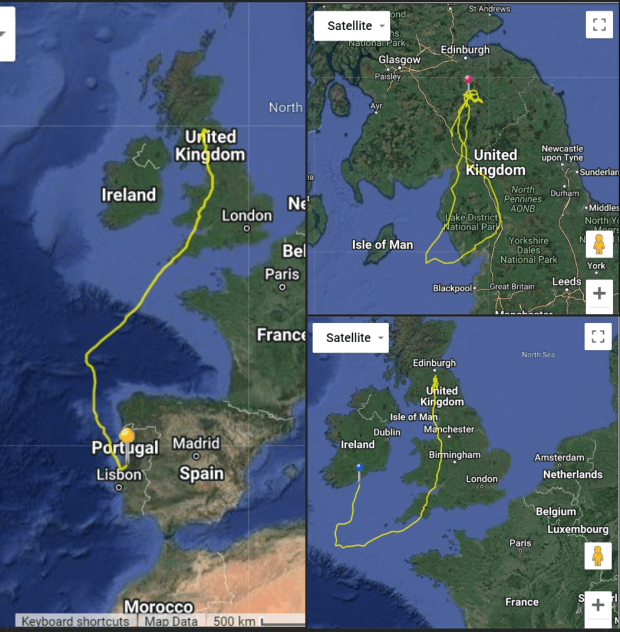
If you follow Tweed Valley, the three fledglings are going in very diverse directions including Glen who remains on the nest. Kirk is in Ireland having flown south and turning back to the land. Tweed is nearing land in Portugal.
Ruthland is updating us on their second hatch at Manton Bay, 1H2:
Tiger Mozone says that the fledglings need good DNA and luck. 1H2 certainly has great DNA. Let us all hope she has some awfully good luck, too.
1H2’s parents, Blue 33 and Maya, along with older sibling 1H1 were all still at the Manton Bay Nest at Rutland on the 27th and there is no news of either 1H1 or Maya departing since.
Seren was on the Llyn Clywedog nest early this morning and Dylan even popped in for a few minutes to join her later.
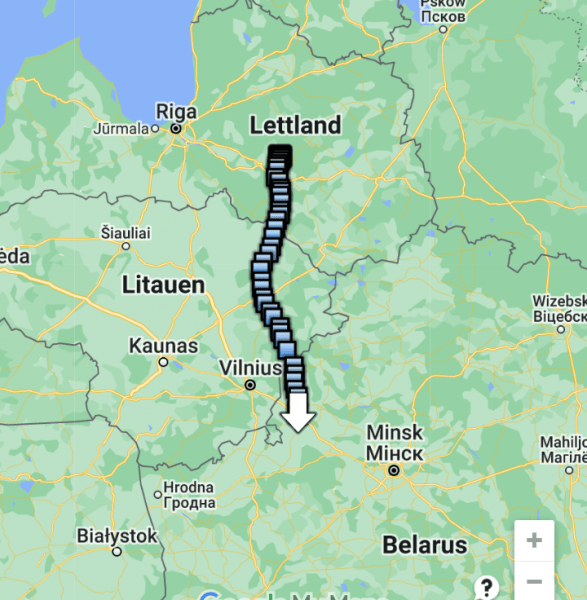
It is just incredible. Bonus continues to prove that he is a very special Black Stork! He flew from the nest in Estonia and spent the night in Latvia on the 27th. He has now flown through Lithuania and is in Belarus near Minsk. That was a total of 279 km.
Kaia, Bonus’s foster mother, remains in Belarus in the Prypjat Wetlands near Shestovicy.
So what intrigues me is this. If Kaia remains where she has been for the last several days since she flew north out of the Ukraine, is it possible that Bonus might also wind up in the same wetlands? Or will Bonus fly into the Ukraine? and remain there? or turn back north like Kaia? We should have our answer in a day or two.
Here is the distance shown by Google Maps:
Waba has begun the journey also and the tracker shows that he crossed into Latvia from Estonia on 28 August. He then flew a short distance.
I have received word that Karl II has left the nesting area in the Karula National Forest and has begun his migration. More on that to come tomorrow.
Victor has done so well since Dr Sharpe travelled to the Two Harbours nest on the Channel Islands to take him to be treated for zinc toxicity at the Ojai Raptor Centre. He has now been moved out to the big flight area! It just doesn’t get too much better than this until he is released. Wow. Victor. Way to go!
Looking forward to Lena and Andy at Captiva next year? or Connie and her mate? Window to Wildlife posted a 7 minute video about updates changes to the cameras, etc with some lovely pictures of Lena feeding the wee nestlings last year.
Thank you so much for joining me today. Please take care of yourselves. See you soon.
Thank you so much to the following for their streaming cams, their videos, and their posts that make up my screen captures: RSPB, 367 Collins Street Falcons and Mirvac, Charles Sturt Orange Falcon Cam, Sea Eagles@Birdlife Discovery Centre Sydney Olympic Park, Port Lincoln Ospreys, Cal Falcons, Dyfi Osprey Project, Tweed Valley Ospreys, Rutland Osprey Project, LWRT, CarnyxWild, Looduskalender, CIEL, and Window on Wildlife.