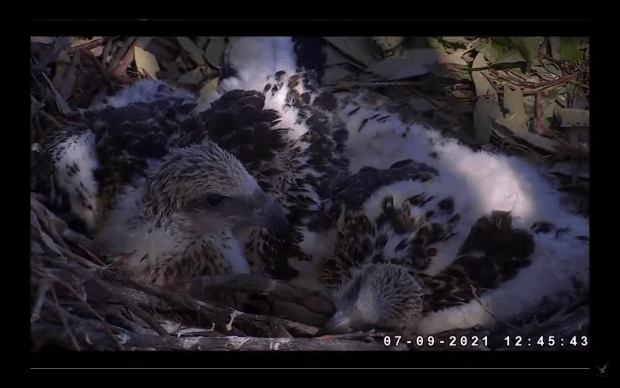
A whale of a fish for the PLO kids

In the middle of the night, the osplets were restless. Mom needed to stretch her legs and they all stood up, beaks wide open thinking it was time for yet – another – meal. They were so well fed during the day it is hard to imagine them being hungry at 02:45 but they thought they were.
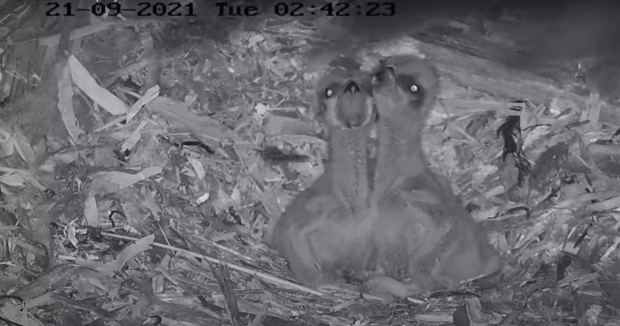
Mum worked hard and finally corralled Big and Middle back under her wings and chest! But not before they peeked out again and had another try for a feeding! Just look at how wide they can open their mouths. Goodness.

Mum went sound asleep and was looking really comfy when this image was taken at 05:10.

Mom needed another stretch before the sun rose. Oh, goodness. It was mayhem.

Big and Middle started pecking one another and Little Bob ducked! All I could think was get a fish on this nest quick.

Mom was having none of it. She sat on the chicks and stopped all the nonsense in its tracks. I thought she looked rather pleased with herself.

A couple of minutes later, Dad was on the ropes with a whale of a fish. He ate part of the head and got rid of the sharp teeth before transferring it over to the family.

That fish is big enough to last them all day! What a great catch.

They all got themselves lined up nicely in order of age – Big Bob on the outside, Middle Bob, and then, of course, that character Little Bob eating first! Yes, his crop does get full and yes, he does pass out in a food coma. This kiddo isn’t afraid of anything. It was almost slapstick comedy watching him duck when Big and Middle thought they would have a go at one another. Smart kiddo.

Nice crops!

Feeding is over. Dad returns to pick up the fish.

Dad returns the fish. It was so sweet. He waited a bit watching her feed their three healthy little ones.

I don’t know. These two are like a well oiled machine this year, synchronized. I want to knock on some wood. It is like they went to parenting classes or something – a sea change from last year. I want this so much to stay throughout the season to fledging.

Mum decides that feeding is over. Just stop for a minute and look at the size of that fish on the nest. I am still amazed. Everyone is full and the chicks are falling asleep.

Dad returns to the nest. The adults have a chat and they decide that Dad will leave the fish on the nest as Mum will need to feed the little ones again soon.

I sound like a broken record but this year we have seen fish delivered to nests that were described as ‘big’. I am referring to a few that went to the Collins Marsh Osprey nest. This fish is ‘big’. Look at its circumference and length. There is lots of flesh for this family on this one catch. It is not a twiddler.

Isn’t Mum cute? She is hungry and has figured out a way to brood the babes and eat in peace! Enjoy it Mum. You have earned it!

Dad has returned and has removed the fish after Mum had some good bites. He will bring it back, no fear. Look at those two little heads poking out. How cute.

No doubt there will be a lot more feedings throughout the day. This Osprey nest is in excellent shape. Dad has proved that he can fish in high winds and Mom can keep the peace with the youngsters and make them line up and eat properly. I am so impressed.

If you missed it, Lyn Brenig’s proposed all terrain World War II vehicle tours around the nature centre has been scrapped after public protest. If you think your voice doesn’t matter, it does!

This news is not about Ospreys but, we might discover that our beloved fish eagles will also be breeding farther north. Birdguides.com is reporting the successful breeding of the Audouins Gull on France’s Atlantic coast – farther north than has ever happened. Have a read:

https://www.birdguides.com/news/audouins-gull-successfully-breeds-on-french-atlantic-coast/?fbclid=IwAR2I1fHwgsu9gmObxB9AE1HxbzcHZeWFBKSw5ldICoPX_K0HvYgmKi7xVQk

Last, but not least, another mention of the documentary on the Ospreys that has been in production for several years. Everyone will have to check their local PBS stations to see when it will be available in their country. I did write them and a DVD will be sold later. Here is that great trailer to get us all excited:

Keep sending your warm wishes to the Port Lincoln Ospreys. Life is good there. We want it to stay that way!

Thank you so much for joining me this evening. Take care everyone. See you soon.

Thank you to the Port Lincoln Osprey Project for their streaming cam where I took my screen shots.

Blustery winds in Port Lincoln

The blustery winds and water blowing onto the nest have made for a rough morning at Port Lincoln. Still, hats off to Dad. He managed to land one hefty fish that he brought to the nest at 6:49:35. Did he catch another? or return that big fish at 7:59:26? It was a bit chaotic. Right now the nest is rocking and the winds are blowing steady at 34 kmh.

Fish were coming and going and feedings and attempted feedings with the wind and the mist off the water.

The weather really turned and Mom hunkered down on top of those babies. She cannot afford for them to get wet or even damp. It is only 9 degrees C.

Notice that Mom has kept that big fish on the nest.

As soon as there was a break in the weather, she fed the kids!

Even then Little and Middle Bob were cold and tucked under Big Bob after they had some bites.

The bad weather is still holding on in Port Lincoln. Mom is doing her best to keep those babies dry and warm.

I really want to say how impressed I am with this Osprey family. Both Mom and Dad are there for these three and at every opportunity they are trying to get some morsels in them – maybe not a lot but some – because they really cannot afford to have them get damp. Send your warm wishes for the winds to calm, please.

It did get up to 29 C on the Canadian prairies and everyone who had a kayak was out on the river. Yes, that meant that the Green Heron was no where in sight! I will try again this week. The fish are still jumping and there will be no let up in our nice weather so the heron should still be here. Wish I could send some of this off to Port Lincoln.

Mr Squirrel and Mr Blue Jay did make an appearance at the bowls at precisely the same time. One wanted nuts and the other wanted a bath.

It is always wonderful when they arrive about an hour before sunset. Nice to know that they are safe and sound.

Mr Blue Jay was not pleased with the amount of water in ‘his’ bowl. He refuses to use the bird bath. Only this ceramic bowl. Notice the square chipped out. That is from his talons! Every year I have to drag this bowl out. He refuses to go to any other even if they are full.

Notice that the Vermillionaires are still blooming. The hummers love them and there was a sighting in our City today of a hummer so they have not all migrated.

I love how he has his crest up. Look at this image from the front and then the next one from the side.

Mr Blue Jay is quite adorable.

Let us all hope the weather calms completely down at Port Lincoln. That said, Mom and Dad are doing everything they can to feed and keep those babies warm and as full as they can. Everything in the other nests is fine. We will be on hatch watch at the Collins Street falcons in about 6 or 7 days. After that it will be Xavier and Diamond’s hatch. The sea eagles continue to grow and are vigorously flapping their wings. The Bald Eagles are working on their nests in the US. Meanwhile, us Osprey lovers are waiting for news of our favourite birds being sighted on the way to Africa (or Spain).

And did you say an Osprey Plushie? Seriously, I did. When the Dyfi on line shop opens in October they will be for sale. I have never seen one. What a brilliant fundraiser! If you are outraged that they will have all terrain vehicles roaming around Lyn Brenig, get on to their website and tell them so. First the filming crew, then the nest being cut down, and now this. What is the purpose of a nature centre? and if it is funds that need to be raised then why isn’t the government understanding how valuable our wildlife and wild areas are to getting this planet a little more normalized.

Thanks so much for stopping in. Take care!

Thank you to the Port Lincoln Osprey Project for their streaming cam where I took my screen shots.

Little Bob loves his fish

I find myself continually checking on the Port Lincoln Osprey nest. In part it is because of the death of the third hatch, Tapps, last year. It is also because this nest has a history of siblicide. With the hatching of the three osplets so close together this year, everyone is hopeful that each will thrive and survive. If they do, there is a satellite tracker waiting for them so we can follow their lives like we do Solly’s.

Dad was on the ropes of the barge moored at Port Lincoln, Australia, eating some of the fish that he had just caught. This was his second catch of the morning. It wasn’t long til he shifted it over to Mom on the nest for the family breakfast.

The weather report has removed the forecast for rain but the winds are picking up. They are blowing at 34 km/h in the early afternoon. That is 21.1 mph.

It is hard to tell -when the camera was pulled out- who ate.

Turn around Little Bob! Or did Little Bob eat and we didn’t see it?

This feeding is over. You can see the fish left and another tail of a fish in the upper right. There is no shortage of food on the nest. That makes for happy osplets!

At 13:30 Dad brought in a big sized fish. This is so good. That fish, if left on the nest, will feed these wee ones for the rest of the day.

You could hear the wind blowing on the camera. It is very strong and the bobble heads are even more of a challenge for Mum to get tiny morsels into everyone’s mouth. Here she is trying to feed the little one in the middle and its head won’t stay still.

Aren’t those little wings darling?

I have not seen any targeted aggression with any of the three osplets.

Little Bob and Middle Bob have their mouths wide open.

Little Bob decides he is just going to take a bite out of that fish! How cute.

The feeding continues. All three have crops – not huge – but it is a cool wind. I wonder how long mom will feed them? will she stop before they get a chill?

Little Bob even went for the steal on this bite.

It is too funny. Mom is going to cover them up but Little Bob still wants to take a bite out of that fish! Priceless. (You can see his little crop). Oh, Little Bob, you are quite the character already. You are going to be a handful for your mother later!

Oh, my goodness. It is only 14:16 and so far this is today’s tally at the Port Lincoln Osprey nest. Looking at this everyone should be completely relieved. Mom is doing what is best – little frequent feedings. Additionally, she is getting them back under and warm so they do not catch a chill. This nest is really doing well this year. I am much more optimistic.

Fish deliveries: 6:11, 8:16, 13:30

Feedings: 6:11, 8:16, 9:12, 9:25, and 13:30

Please continue to send all of your positive warm wishes to this family so that all three fledge.

Thanks for stopping by for this quick check on the Osplets at Port Lincoln. Take care everyone.

Thank you to the Port Lincoln Osprey Project for their streaming cam where I took my screen shots.

Friday in Bird World

Someone has a sense of humour over at the Dyfi Osprey Project. Have a look at their season highlights (oh, I had forgotten what a horrid spring these birds had!). There are some great images in this video compilation.

There was a really short feed at the Port Lincoln Osprey Nest before the sun came up.

The golden rays of the morning are falling on mom has she has those three little osplets under her keeping warm. It is 11 degrees C – coolish and the winds are blowing at 23 km/h. Brisk. I hope Dad has a good day fishing. The forecast is for rain on Saturday and Sunday.

Glaslyn has officially announced that Aran is now on his migration. He has not been seen since Tuesday.

Closer to home. The Great Blue Heron wins the award for patience. He stood positively still and because of that, he was very successful in his fishing today in a river south of Winnipeg. I wish I could find the words to describe how quiet it was on the river and what a privilege it was to see this really beautiful bird catch its dinner.

This Great Blue has been keeping the juvenile Green Heron company but if the latter was around, he is still alluding me.

There was not a sign of a Wood Duck or a Cormorant but the Mallards and the Canada Geese were the usual suspects at the urban pond today.

For some reason today, the grass seemed greener to the geese on the other side of a major paved thoroughfare. We ushered them back but not without a lot of hissing and honking. The grass was definitely not greener and the cars were not being respectful. If you see geese, please slow down.

How many of you are Big Red and Arthur fans? The Red-tail Hawk couple at Cornell University? If so, the folks at the Cornell Bird Lab have put together a compilation video like the one for the Dyfi Osprey Nest. Here it is:

It is that time of year. First, I remind everyone to please not rake your yard. There are insects growing there. Just leave the leaves. Someone’s ears will thank you for not using the blower as well. And, finally, this is the time of year that the eagles, the condors, and many other bird species show up in the wildlife clinics because of lead. Please tell everyone you know that fishes and hunts to use lead free kit. Thanks!

The Bald Eagle is not, of course, the symbol of Canada but many breed here during the summer and we want all of the birds safe.

I hope that each and everyone of you have a wonderful weekend. Maybe the weather is sunny and dry – go for a walk, say hi to your favourite birds. Check out the little ones at the PLO nest or WBSE 27 and 28 at the Sea Eagles nest in Sydney. Hatch watch for the falcons is still a ways away.

Thank you to the Port Lincoln Osprey Cam where I took my screen shots.

Very Impressive

I find myself continually checking on the PLO nest. Do you?

It is a sunny 18 degree C day in Port Lincoln, Australia. The problem is the speed of the winds. The rate is 42 kmh or 26 mph. The water is choppy. The barge is moving a bit. Add that together with three ‘Bobbling’ Bobs and well – could you feed these three hungry Osplets moving about every which way? I am certain that I could not! Dad has even delivered the fish despite the waves and wind. I really am finding myself being totally impressed by these two adults.

After the osplets hatch, the Mom tends to stay on the nest most of the time. That said she does take breaks and, at this nest, Dad can be seen relieving her so she can have a stretch and a relaxation break. Still, his primary role is food delivery – ‘Daddy Door Dash’. Alan Poole reminds us that the number of fish deliveries doubles and triples in the first 20 days after hatch. This is the rapid growth period. It is during these first weeks that we do not want to have cold rainy weather either – it seems to both impact the fishing as well as the health of the wee babes.

Ospreys are semi-precocial. This means that they are not as developed as ducks or chickens who, after 24 hours, can walk, are covered with feathers, and feed themselves. Ducks and chickens are precocial. Songbirds, on the other hand, are born altricial –naked and require complete care. Osplets are in between. They are born with down but still need the parent to keep them warm and feed them. They cannot regulate their own temperature until they are 2 to 3 weeks old.

In terms of growth, osplets should “triple their body weight in the first 8 days after hatch and then double that again in the next 4 days” according to Poole. By the time they are a month old, if all has gone well, they will be 70-80% of their adult size.

Mom has the task of trying to make sure that each open beak gets some fish. She is ever so gentle. The pieces of fish are so tiny. It is difficult to image those small morsels in that large beak of hers meeting up with the tiny, tiny beak of a wee babe. But she does it! Instead of still pictures I thought a couple of videos would help illustrate how impressive this female Osprey is at feeding.

I have to admit that I always worry about the third hatch. In the first video both Big Bob and Medium Bob had some bites. Little Bob had his beak wide open but I didn’t see any fish go in.

In the next video, Mom makes a point of feeding Little Bob. Look at how she stretches over Big Bob to reach Little Bob’s beak. What a relief!

These Bobs are doing so well. They still have their egg tooth that they used to get out of those hard shells. And, of course, we can see that bold dark eye stripe so characteristic of these fish eagles.

One day they will resemble their parents but there is a lot of growth and development that has to take place before then. Right now they have a coat of soft light grey down. This will be replaced by a darker wool and then the osplets will enter the reptilian phase where they look more like their dinosaur relatives than birds. The rusty-gold and coppery red of the pin feathers is gorgeous.

The three osplets in the nest below – not the PLO nest but another just for illustrative purposes show a bit of the range of plumage development. There is the lighter grey down, then the emergence of the charcoal and the one on the left is entering the reptile phase.

“7-10 day old Osprey young” by Conserve Wildlife Foundation of NJ is licensed under CC BY-NC 2.0

Their flight feathers will emerge last.

There are certainly exciting days to come but, for now, I want to focus on the magic as they seemingly grow right before our eyes. The stated range of fledging dates is 55-60 days in Australia. Those days will pass very quickly. Let’s enjoy them while we can!

I do hope you enjoyed the short videos of the three Bobs at the PLO nest having a feeding today. I do find myself continually commenting on how cute they are — and they are ever so precious.

Thank you for joining me. Send your warm wishes to this nest so that Dad’s fishing ventures are successful and that all three grow healthy and fledge. That would be remarkable. I am so hopeful this year.

Thank you to the PLO Project and their streaming cam where I took my screen shots and video clips.

Wednesday in Ospreyland and elsewhere

The water on the lake is very smooth today. Strangely there were no gulls, only one Cormorant fishing, and a lone duck. The bison were not in their enclosure but the sky was the most beautiful blue and the Aspen trees are nothing short of gorgeous. It was a good day. I also learned a lot by plunking myself down and talking to the chap that runs the Nature Centre. So first with the terrible photos. The blame is on my ‘finger’. The setting on the camera was definitely not where it should have been.

This cormorant was rather amazing. He dove into the water and came up about 15 metres from where he went under – but not for several minutes. Incredible. I hope he found a fish for his efforts.

Feel free to help me identify this duck. I have three bird books in front of me and none of the descriptions fit this one. Ideas? I was told that there is a duck that should not be here but should be in British Columbia. I wonder if this is it?

The fawn was not going to cooperate! And why should it? But I do wish it would have turned and smiled.

Driving through the hills and gravel roads is such a change from the urban asphalt. These colours were stunning and changed from area to area in the park.

The national parks in Western Canada from 1915-1946 were built in part by some ten thousand foreigners, the unemployed, the homeless, conscientious objectors, and people deemed to be enemies of the state. I understand that they were not criminals but were perceived, at the time – during the Depression and the wars – to be persons who might cause civil unrest.

Four hundred and forty German POWs worked at Riding Mountain National Park. They were originally in detainment camps in Alberta that were crowded. They volunteered to come to Manitoba and work in the forests cutting wood. Each man’s quota was 3/4 of a cord of wood a day. Their camp was at Clearwater Lake. There were no fences and no barricades. In conversations with staff at the park, it was known that the men would often sneak out of camp and go to dances in some of the small towns. No one seemed to mind. They would be back in the POW camp in the morning for the roll call.

The men worked eight hour days. There was not a lot to keep them busy. They began wood carving. Many made dug out canoes from the large spruce trees in the forest. They raised pigs and grew vegetables in their gardens. They also caught a bear and tamed it and it became the camp mascot.

A number of the men returned to visit Riding Mountain on the 50th anniversary of the end of WWII. It is totally fascinating – a part of the history of my province that I did not know.

Times have certainly changed. Look at the old canvas tent and the chairs. I love the moose calves. Not sure the rangers would like to see this happen today! I can’t wait to learn more about this beautiful area where I live.

This is a short video about the POWs and their role at the park.

Now to turn our minds back to the birds for a moment. The sun is just rising over the water at Port Lincoln, Australia. It is kissing the back of our Osprey mum with its golden rays.

Six or seven hours after the third Osplet hatched, it was holding its head high wanting some fish.

I am not quite sure where it is during this feeding! It will be a scramble but hatching out of that egg took a lot of energy and many do not even eat the first 24 hours. I have a feeling that this little one is strong. Let us all hope so and send good wishes down to them and their parents. I want to see this nest fledge three this year!

What a beautiful place for an Osprey nest. I hope there are a lot of fish for Dad to bring to the nest. Fingers crossed.

Looks like everything is going well at Port Lincoln. Here is another image of its first feed, less than six hours after hatch. Fantastic.

The researchers and administrators at the Port Lincoln Osprey Project have posted a number of videos on the Port Lincoln FB page. You do not have to be a member of their group to watch them. Check it out!

Thank you for stopping by. I hope to do a full check on all the nests – including returning Bald Eagles – tomorrow night. Take care everyone. Stay safe!

Thank you to the PLO for their streaming cam where I took my screen shots.

And then there were 3

Port Lincoln Ospreys welcomed the third hatch at 00:57:50.

This was one of the best images. Mum moved that eggshell later. Congratulations PLO. Let us hope that since the hatches are so close together, the rivalry will be minimal and all three will get to wear an antennae!

There is other good news. Laddie, LM12 and Blue NC0’s 2021 hatch, LR2 was photographed in Trebujena, Spain by Richard Page-Jones. Fantastic. Not sure if he will stay there or continue on to Africa. Well done Loch of the Lowes!

Three other interesting tidbits this morning. A study in Canada has revealed that if you put colourful collars on cats, it helps protect the songbirds in your garden. I might just buy these for the neighbour’s cats that come around my feeders!!!!!!!!

https://www.cbc.ca/news/canada/british-columbia/cat-collars-bird-deaths-research-university-northern-bc-1.6168493?fbclid=IwAR0ivf3W0erFnpo5TwYIOag2pxKP1yXuhYwmyddPthi-jpeQpBITJrB1Etk

There is another positive story coming out of my province, Manitoba. The Burrowing Owl Recovery Project has discovered the only known nest – a first for so many years – with two adults and six owlets. Well done.

This morning’s newsletter is short but it is packed with positives. Head over to the Port Lincoln Osprey streaming cam later today to check on that new hatch if you have time. Here is the link:

I am cautiously optimistic about the PLO this year since the hatch times are so close together.

Thank you for checking in. Have a great day.

Thanks to the PLO Project for their streaming cam where I took my screen shots.

Double Cute – the two Little Bobs

Ospreys quite similar to the ones we know today were well established in much of their current breeding range at about the same time our earliest ape-like ancestors left forests and began to walk upright across the plains of Africa.

Alan Poole quoted in D. Gessner, Return of the Osprey, 158.

I could not wait to wake up this morning to check and see how the little Osplets are doing at the Port Lincoln Barge. Yesterday I wondered how you say cute in Osplet – but how do you say double cute? These kids are healthy and strong and by 18:00 necks were held high. No teaching these two what to do when mom gets up and dad delivers a fish, 50 million years of genetics have seen to that!

These images are in reverse order. They go from what I believe is the last feeding in the evening to when the little one was figuring out how to turn around to get some fish. Sorry about that. My mind must be operating in reverse!!! As you go back in time you will notice that the chicks have, in six hours, figured out how to line up for mom so they get some fish. It is nice they are almost the same size. Mom is so patient with these two.

I have left the time stamps on the the top ones, the most recent. Enjoy.

Mom trying to get some rest.

That is a nice fish that dad has brought in.

There were two close feedings together towards the end of the day.

Born with their mouths open like little tiny song birds.

Waiting for Dad.

A much needed rest. Mom will have to sleep as much as she can when those little Bobs are quiet.

This is the 11:54 feeding.

The ‘little’ one got himself straightened up and got some fish but, initially, his head went the opposite direction.

Oh, little one, you need to turn around!

More cuteness. I had so forgotten how incredibly quick these Bobs learn. In a week we will not recognize them from the size and the way they look today with their seemingly black face goggles.

It is now 01:04 in Australia and Mom is having a sleep. Can’t wait to check in on how the two are doing in about six hours. Thank you for joining me. Stay safe everyone.

Thank you to the PLO Project for their streaming cam where I took my screen shots.

The Birds ‘Down Under’

As people in North America wait for the Bald Eagles to begin preparing their nest and breeding, much of the ‘bird’ action is in Australia. I pulled up a map so that we can locate the nests that are on streaming cams in Australia – fondly known as ‘Down Under’ here in Canada.

I made the map a little larger just so it is easier to see. Or is it just me that is having trouble reading all that small print?!

The White-Bellied Sea Eagle Nest is in Sydney. On the map it is in bold letters on the lower right hand side. The Peregrine Falcon Nest of Xavier and Diamond is in Orange. Orange is just outside of Sydney. Trace your finger to 10 o’clock from Sydney and you should see Orange in grey letters. The 367 Collins Street Falcons are in Melbourne. It is at the very bottom in black letters. The Port Lincoln Osprey Barge is in Port Lincoln. This is a small place. Locate Adelaide which is up the coast from Melbourne on the left. Take your finger and move it over in a straight line to the left from Adelaide to the bottom of the second peninsula. There is Port Lincoln. I am also going to include Solly’s Location so you can see where she is relative to where she hatched and fledged at Port Lincoln. Solly is currently staying the majority of the time at Eba Anchorage. Solly is 311 km from the place she fledged. Prior to Solly, the general understanding was that Eastern Ospreys stayed much closer to their natal nest. The evidence from the satellite tracking is changing the understanding of how far these fledglings might travel upon fledging.

Time flies. It was only a blink and Pippa Atawhai, the 2020 Royal Cam chick, had fledged — BUT, that was a year ago. Now we are waiting for Tiaki to fledge soon. It seemed like the month of August just melted. It was on the 3rd, the 6th, and the 9th that Mum at the Port Lincoln Osprey Barge laid her eggs for the 2021 season. At this very moment, the PLO FB Page is taking guesses on when the eggs will hatch. Yes, we will be moving into hatch watch within a week. Baby Ospreys are coming. Oh, those lovely little reptiles!

Dad continues to bring in materials for the nest. They are all over the place – big strips of bark and moss – even some more rope. He is a bit of a pack rat. Thank goodness he hasn’t been bringing in toys like Richmond and Jack in the US. It would be awfully crowded if that were to happen.

Watching this nest is not for the faint of heart. Siblicide is a regular occurrence.

The dominant hatch of 2021 was Solly. She is 352 days old on 7 August, Australian time. Solly was considered, out of the two surviving chicks, to be the one that would succeed. We have no news of DEW and unlike Solly, DEW was not equipped with a satellite transmitter. Solly has, however, demonstrated that she can survive and today she flew rom her normal home tree in Eba Anchorage to Perlubie to check out the fish. This is the graph from the satellite transmission.

The Port Lincoln Osprey Project is taking guesses as to the date of the first hatch on their FB page. You don’t need to be a member to pick a day – go and have some fun!

The White Bellied Sea Eaglets are doing fine. They are well fed and protected and they are growing so fast. Those beautiful juvenile feathers are coming in changing their appearance almost daily. They had a good fish feast the morning of the 6th and the wee ones slept and then woke up and began picking up sticks and leaves on the nest moving them about with their beak. They are not yet steady on their feet but they are standing more and 27 was attempting to walk today.

Both still had big crops after the fish breakfast. 28 got the majority.

Just look at those beautiful colours coming in. 27 is on the left and 28 is on the right.

Here 27 is standing watching 28 play with some sticks with its beak and talons. The sea eaglets are developing at a normal pace. It is all good.

The golden glow of morning fills the scrape box of the Peregrine Falcons, Xavier and Diamond, in Orange.

Each parent takes turns incubating the eggs so that the other can have a break. Diamond will do the overnight incubation and Xavier will be the security guard.

Here is a short video of the hand over of incubating duties from Diamond to Xavier:

Remember that the males are about 30% smaller than the females. Xavier works with his feet and wings to get those three large eggs under him so they can all be warm.

It is even harder for the tiny male at the 367 Collins Street nest who has four eggs to warm!

Mom arrives for her turn.

She is working her wings too to get those four eggs under her.

Looked at how poofed out all those feathers are. Wow.

Here is Dad. His feathers are all poofed, too. He is so tiny compared to mom. My goodness – he really does have to work to get all four under him properly.

After wiggling about he gets everything settled. We will be looking for hatch towards the end of September.

Thank you so much for joining me. All of the birds in Australia seem to be doing just fine. We will watch the sea eagles change colour before our eyes and anticipate the arrival of the Ospreys. It’s a few weeks before falcons start hatching. Take care everyone.

Thank you to the following for their streaming cams where I took my screen shots and video clips: The 367 Collins Street Falcons, The Falcon Cam at Charles Sturt University and Cilla Kinross, Sea Eagle Cam @ Birdlife Australia Discovery Centre, and the Port Lincoln Osprey Project and FB Page.

PLEASE NOTE: I am taking my computer in for servicing. I hope to have it returned to me sometimes on Thursday so I will be back with another newsletter Thursday or Friday.

A look at 3 feedings at the WBSE Nest

All of the other nests are relatively quiet. While I do love to see the adults sharing incubation duties, watching a bird incubate eggs can sometimes feel like watching paint dry. So I decided to go and see what was happening with the little sea eaglets. They were just finishing a meal when I started watching them. I turned away for a second and a second gull was brought to the nest by Dad at 12:47. Good gracious. Had Dad won the Silver Gull Lottery?

This is an image from the feeding when I first started watching the sea eaglets. Thank goodness for rewind. This was the first prey delivery of the day and it arrived at 12:19:01.

Both eaglets are sharing the prey and behaving themselves in this feeding. WBSE 27 is on the left and 28 is on the right. The picture shows Lady giving 28 a morsel of meat. She alternates between them. There is absolutely not a hint of rivalry.

Here they are standing up. It is a wonder they aren’t falling over from being top heavy.

They hear Dad approaching the nest.

Dad arrives at the nest with another gull. Both of them sit on their little bottoms in shock. Look at their faces seeing that prey. Also notice that 28, in the front, has a large crop, too.

The time for the second delivery is 12:47:20 as shown on the time stamp.

Remember, both have literally just eaten. Both chicks have crops. Neither one of them is ‘starving’. Indeed, there is no shortage of food on the nest. The behaviour in this second feeding demonstrates that rivalry is not always because there is less food being delivered. It is strictly about dominance on the nest.

In the image below, 27 is up by Lady getting ready to be fed. 28 is moving up from the back to go to the left of 28. I wonder why 28 did not go to the right. That is its usual spot – and it is a good place to catch the eye of Lady.

27 first gives 28 ‘the look’. Was it because 28 had to balance itself by extending its wing out and it touched 27’s back?

Whatever it was, 27 pecks 28 making sure that 28 realizes who is boss.

28 immediately goes into submission and stays that way for approximately 12 minutes while 27 eats the gull. These are the hardest things to watch on these large raptor nests between the chicks. We always want them to be nice to one another.

By the time that 28 straightens himself and gets up to the feeding place, the gull is almost gone. 27 got 98% of that gull while 28 got a few bites.

The behaviour of 27 shows that despite there being plenty of food, she will insist on dominance. She will eat first. Anyone watching large raptor nests will know that there is always a dominant bird. Often the one dominated gets very clever. They listen, watch, and learn to read ‘the clues’ so as not to be attacked. 28 has a little more learning to do. It would be interesting to see if 28 is only pecked when it is on the left.

So the time is 13:07:18 – and guess what?! A third gull arrives on the nest at 13:15:13. Yes, I am serious. Dad must have found a nest of gulls. If I remember correctly there is an old barge and the Silver Gulls make their nests there. It is not far away. Someone told me once that the pigeons are for falcons and gulls are for eagles. It certainly seems true at some of the Australian nests!

Here is the next prey item arriving on the nest.

Both chicks get up to the feeding area. 27 is on the left and 28 has its usual spot on the right. It is important to note that the eagles do not see straight in front of them; they must tilt their head a bit.

Just look at how full these two are! I do hope that Lady gets a chance to eat.

This time 28 got lots of food. Lady alternated between them. In the end, 27 was too full to eat anymore and 28 finished off that gull.

Both are in food comas.

There is no moral to this story. There is a lot of prey coming on the WBSE nest. This is the first time I have seen three prey items delivered and eaten in this short of time. WBSE 27 still feels that it needs to, sometimes, throw about her position on the nest. At this last feeding there was no rivalry. Both ate and they had big enough crops to last them til evening!

As they grow, each will need more and more food. The gull chicks are not that big. The food that is delivered is also meant for Lady. Let us hope that she gets a good meal today. The female’s lose vital nutrients making the eggs they lay and it is said that they lose approximately 30% of their body weight during the nesting phase. Hopefully Dad will bring on a nice big fish or eel for later.

The Silver Gull that Dad brings to the nest are the most common gull in Australia.

“Silver Gull” by 0ystercatcher is licensed under CC BY-NC-SA 2.0

They are found everywhere. While the adults are 40-45 cm or 15.7 to 18 inches and have a wing span of 94 cm or 3 ft, the chicks would be much smaller. Last year Dad was always raiding the nests of the gulls in addition to fish, eels, and at least one turtle. I recall that one eagle expert said that the ‘red meat’ of some prey tends to make the eaglets more aggressive than the fish. That could be what happened today or maybe 27 was just annoyed at 28 for touching her.

Both sea eaglets are eating as you can see. It is a bit unnerving to see the eldest whip the little one into shape especially since they had been doing so well. Still, this is a worthwhile nest to watch because the behaviour is so fascinating. I am going to have to watch this nest more closely. I am curious as to whether the pecking only occurs when WBSE 28 is on the left of 27. Perhaps it doesn’t matter.

The link to the WBSE camera is here:

One of the things I find most fascinating are learning the birds connected with their vocalizations in the Sydney Olympic Forest.

Thanks so much for joining me today. Stay well, stay safe. See you soon.

Thank you to the Sea Eagle Cam @ Birdlife Australia Discovery Centre where I took my screen shots.