Sydney White-Bellied Sea Eaglets

There was concern that siblicide was occurring on the White-Bellied Sea Eagle nest in Sydney’s Olympic Park. It is time to put those fears aside. Prey delivery has become regularized and the two are fed regularly, growing, and are becoming curious about what is happening outside the nest.

The White-Bellied Sea Eagles are Australia’s second largest bird of prey. They have a wing span of 1.8-2.2 metres or 6-7 feet. They weigh up to 4.2 kg or 9 lbs. The female is larger and weighs more than the male. This is known as reverse sex size dimorphism. The adults on the Sydney Olympic Park Ironbark Tree are Lady and Dad. There have been a succession of breeding couples using this tree nest for decades.

In 2021, WBSE 27 hatched on 29 July at 4:57 and WBSE 28 hatched 31 July at 5:48 pm. Just to remind you how tiny they were here are two images in those first few days.

In the first image WBSE 27 was not quite 24 hours old.

In this one, WBSE is not quite 24 hours old and WBSE 27 is almost 48 hours old. You can clearly see the egg tooth, the white piece on the tip of the beak that helps them break through the hard egg shell.

Now look at the two of them. WBSE 27 is on the right with WBSE 28 on the left. You can see how 48 hours difference in age impacts the growth of the juvenile feathers.

In terms of the development, we are entering weeks 5 and 6. By week 5, the chicks will still have their white down. Pin feathers will appear on the shoulders, the back and the wing tips. If you look at the image above you can see these dark feathers coming in on each of the chicks. They should be standing on both feet, checking out the nest, and trying to pick up food. They may start to flap their wings. As we get to week 6, more and more of the dark feathers will begin to show all over the chick’s body. They will preen a considerable amount of time per day. They will now do more wing flapping and standing on both of their feet without the aid of the wings. They will continue efforts at self-feeding (if allowed, Lady does love to feed them!).

Looking forward to developments during week 7, the chicks will do a lot more preening as the dark brown juvenile feathers will continue to grow over their entire bodies. It has to be really itchy – those feathers coming in. Their tail will become noticeable. When they sit they may spread their wings. You may see them begin mantling. They will become more steady on their feet. One notable change is the chick’s interest in grapsing twigs and food with their feet. They should continue to work on self-feeding but this, of course, depends on whether or not prey is left on the nest for them to practice.

WBSE 27 is standing nicely on his feet. WBSE 28 still has a crop from an earlier feeding. You can really see how many wing feathers are coming in. Just look at that little tail developing.

It looks like 28 has a bit of a food coma. 27 is busy looking at what is happening outside the nest.

WBSE continues to work on its balance. Notice how it is holding out its wings for balance. Often the birds will use the tip of the win to keep them steady on their feet. By the end of the 6th week, they should be standing without using the wings. WBSE 28 is working hard to do this.

WBSE is also curious as to what the adult is doing up on the branch. Notice how 28 is sitting with its wings loose to the sides. Sometimes I find that the chicks on the nest are actually ahead of the development scales for that week.

Lady has come a long way in her parenting skills. Both chicks wait their turn to be fed. She will give 28 a few bites and then 27 and then back to 28. This method has given the chicks food security and reduced the pecking of 28 by 27.

Lady always looks like she is smiling to me.

Here is the link to the Sydney Sea Eagle Cam.

Thank you so much for joining me. I know that there are so many people who love these little eagles and I wanted to reassure all that the nest is very calm and peaceful and the chicks are developing normally. Take care everyone. Stay safe.

Thank you to the Sea Eagle Cam@ Birdlife Australia Discovery Centre for their streaming cam where I took my screen shots.

Checking in on Australia

It is raining in parts of Australia. Orange got 50 mm and there are floods about while there was 37 mm out at the Campus where the scrape box of Peregrine Falcon couple, Xavier and Diamond, have their scrape box.

Diamond has spent time on the ledge and going back to the scrape box looking like she is concentrating on that first egg. What do you think? Maybe today?

Sadly, the poor weather might be impacting Dad’s ability to bring in prey to the two babies in the Ironbark Tree. Until now, there has been little to no demonstrations of dominance but yesterday the prey diminished and WBSE 27 started telling the little one who is boss. It is unclear if WBSE 28 had any of the morning fish. WBSE 27 is 26 days old today and WBSE 28 is 24 days old. Oh, I hope this stops. There is enough for everyone! Most people say that the parents will not step in. And, as you know, if I hear survival of the fittest one more time I might scream loud enough for someone to hear me in Australia! All you have to do is to think about Tiny Tot on the Achieva Nest or Tiny Little — those tortured little ones turned out to be a force to be reckoned with. I wish Tiny Tot had a tag and a satellite transmitter. I sure would like to see what she is doing in a couple of years. If there are two Ospreys that will survive it is those two. And they started out like WBSE 28. Of course, only worse for Tiny Tot.

Mom was looking particularly beautiful over in the Port Lincoln Osprey Nest. The colour of the water contrasted with the nest lining — well, it is gorgeous.

The female at Collins Street in Melbourne certainly looks like she is going to lay her second egg today. She is getting full in the bottom just like Diamond. She is certainly plunked down in that scrape box with that stern look she can give. It must be quite uncomfortable laying eggs!

I don’t do a lot of reporting on the Albatross despite the fact that not only am I fond of them but I really want our oceans to be cleaned up and the fish stocks renewed so that all of the sea birds are promised some kind of a decent life. Sharon Dunne does a great job running the FB group as well as keeping us abreast of everything ‘Tiaki’, the Royal cam chick of the 2021 year.

Ms Pippa Atawhai was just the cutest little albatross chick and her parents were incredible. She was the 2020 Royal Cam Chick. Her nest was close to the visitor’s centre. Tiaki’s nest is down close to other nests. Some are less than 3 metres away. This has led to a lot of ‘drama’ between the chicks! Seriously. I thought it was only the juveniles that caused mischief. Oh, no. These gals can seriously get with the squabbling.

The Cornell Bird Lab caught that on camera today. Have a look:

It reminds me of my garden. Before I seriously started watching birds and their behaviour, it seemed they all got along and lived in some kind of sing song happy land. Oh, geez. There is even a hierarchy in our garden! Incredible. Have you noticed this behaviour at your feeders? Is this why we say ‘Pecking Order’?

This was a quick check in. I am restless – not knowing for sure if Malin is alive or dead or nothing can be determined. But I want to leave you with an uplifting story and a lesson. Yesterday I reported on the Osprey that had been hanging upside down in a tree for two days because of being entangled in fishing line. The beautiful bird had pulled all of its muscles from being upside down. The bird, at 45 feet, was ten feet more than the climber could reach so he used an extension net and a pole saw to cut the line and catch the bird in one swoop. On the ground the bird was detangled from the line. A stainless steel treble hook – for catching 3 fish at once – had gone through the talons of this baby. Today, this young one is healing. The lesson is ——- clean up after you go fishing. Join in groups to clear the shores of rivers and lakes of fishing debris that gets caught in them. Help our water birds!

I took these screen shots from A Place Called Hope’s FB page. They have a wonderful video on their site of this rescue and I urge you to search FB, find their home page, and watch it. It is very moving. What wonderful people these people are – there is not a situation too challenging and if a bird can be saved, A Place Called Hope will give it that chance.

Thank you for joining me today. I am certain that Collins Street will have another egg tomorrow and well, Diamond might have one as well. Take care everyone. Stay safe.

Thank you to the following for their streaming cams: Sea Eagle Cam, Birdlife Australia and the Discovery Centre, 367 Collins Street by Mirvac, Cornell Bird Lab, The Falcon Project with Cilla Kinross and Charles Sturt University, the Port Lincoln Osprey Project, and A Place Called Hope FB page.

Friday in Bird World – the happy and the sad

There were a few people who did not sleep well last night – concerned as we were over the safety of Malin. At the same time, there are great people going out to check on our little warrior. I want to give a shout out to Susan Theys, the wildlife rehabber for the area. Susan searched last night for Malin to make sure that he was OK and is returning sometime today, when she gets a chance, to search again. In addition, I want to thank Jake Koebernik, the Osprey and Eagle DNR staff for area 3, Steve Easterly, the DNR Biologist, and Patricia Fisher, Wildlife Rehabber. Malin had been flapping its wings vigorously yesterday and for a few days. Still, the video footage shows a chick that left because there was an intruder.

Two other really good things happened. The rain has been pouring down for hours on the Canadian Prairies. The ditches are full and it is marvellous. I hope that it rains for a week – putting out all the fires and filling up the water reserves. Instead of being grumpy, people are so happy. This rain might also be falling in Missoula, Montana – in the Clark Fork River tomorrow. Fingers crossed!

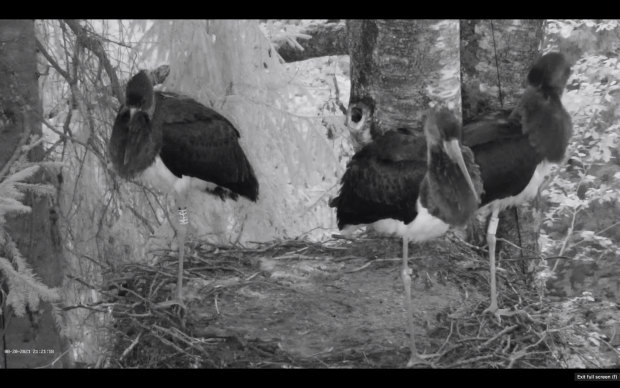
The second miracle happened in Latvia on the Black Stork nest of Grafs and Grafiene near Sigulda. For those who do not know, the male, Grafs was having a difficult time feeding the storklings by himself since Grafiene left for her migration. A feeder area was fixed in the ditch and stocked with fish along with a decoy of Grafiene. Grafs had not found this and the concerns grew. Fish could not be delivered directly to the nest because of the condition of it. On 20 August, Grafs made one fish delivery. BUT the miracle happened at 8:39:34. The youngest storkling, at 66 days, fledged. My source tells me that two fledged but I need to confirm the second. Now the storkling/s can find the feeder and supplement any food from Grafs. What a relief! I hope that all of them leave the nest. The oldest is 69 days and the middle is 67 days old. This is the best solution.

Here is the flight sequence of the youngest:

Wheeeee.

In Estonia, in Jan and Janika’s Black Stork nest in Jegova County, the trio have eaten every bit of the fish that Urmas has brought to the nest – for the banding and then the pail of fish the other night. You can see that they are gone in the image below.

Jan fed the storklings at least once today. These birds, like those of Grafs, are almost ready to fledge. They will, hopefully, find the feeder area set up for them too!

It is essential that we all stay hopeful – for the six storklings and for Malin. Send strong positive thoughts to all these birds.

I took this at the tea time meal. Tiny Little did not have the fish, Big Brother 464 did but, she is waiting and hoping and so far White YW has been a great ‘Door Dash’ delivery.

Oh, this bird has brought us such joy. She is tenacious. I adore her.

Dad wouldn’t leave Tiny Little hungry and screaming her head off! It is three hours later, the last fish of the day probably, and here is Tiny Little filling her crop in the image. Oh, you are going to sleep well Tiny Little!

There have been rumours that some of the female Osprey in the UK – the ones on the streaking cams – have fledged. Today, Telyn, who was believed to have left since she had not been seen since Wednesday, turned up with a fish on the Dyfi Nest. So Telyn is still with us!

Mrs G is still on the Glasyn Valley nest. Oh, she is so stern looking! You can almost tell an Osprey female from the intensity of their gaze.

Disturbing news coming out of Maryland in the US today concerns two workers who needed to replace a light in a Southern Maryland Park. Actually it is outrageous. To do that, they removed two Osprey chicks from their nest and euthanized them. I know how to spell both words ‘disturbed’ and ‘angry’. The incident occurred at Cove Point Park. “County officials said they had a “cooperative services agreement” with the U.S. Agriculture Department’s Animal and Plant Health Inspection Service (APHIS) to have the ospreys and their nest removed. The commissioners said they were “not consulted or informed as to why or how the decision was made to euthanize the juveniles in the nest rather than relocate.” That last word is very significant – relocate. Relocate is not euthanize.

The Washington Post article is here. I hope you can open it. If not, Google the subject. There will be other news agencies picking up this story.

https://www.washingtonpost.com/dc-md-va/2021/08/20/two-young-osprey-were-removed-their-nest-euthanized-so-workers-could-replace-light-southern-maryland-park/?fbclid=IwAR2FK-kl_ATvumaLbvuTcOXd27F7GIywXTafm6Hh2MKm4FwaadqqW_O83PE

When the laws and agreements do not work, who advocates for the birds? The Audubon Society acted as advocates for Pale Male’s nest on Fifth Avenue. Maybe Audubon will go to work for these two?

If you find this as disturbing as I do, take a few minutes and fill out the form telling the Commissioners of Calvert County, Maryland what you think. Here is the link to the form:

https://www.calvertcountymd.gov/FormCenter/Contact-Us-Main-Homepage-8/Contact-Us-49

Always good for a smile or three are the two sea eaglets, WBSE 27 and 28. My goodness these two are so close in size and the bonking was at a minimal this year. They are well fed and healthy….and those pin feathers are coming in and they are both preening up a storm!

I have not been able to spend as much time with this family in the Sydney Olympic forest but I hope that might change. These two are growing slightly ahead of schedule it seems – their big clown feet match those crops. Just stop and look at those crops. They are so full they sag. Crazy. Dad and Lady are doing a fantastic job. So pleased.

The day is just beginning in the forest. Just look how big that sea eaglet is next to Lady! Wow.

I know that many have not watched this nest because of past things that have happened. I encourage you to check in this year. Lady is a more experienced mom and both of the eagles are healthy. There is no one getting the advantage over another. They are delightful.

That is what I want to leave you with this magnificent rainy day – a smile. Those sea eagles are adorable. Why not stop in and check on them? Here is the link:

Thank you to everyone for joining me. Please continue to send your positive energy to the Black Storks in Latvia and Estonia, to those storks and Ospreys migrating, and to little Malin. Malin really needs it. To my knowledge he has not returned and it is worrisome because the parents have been on the nest with fish today trying to lure Malin back. Malin is approximately 2 months and 2 days old.

Thank you to the following for their streaming cams where I took my screen shots: Collins Marsh Nature Centre, Byrwd Gwyllt Glaslyn, Dyfi Osprey Project, The Latvian Fund for Nature, The Eagle Club of Estonia, Sea Eagle Cam, Birdlife Australia, and The Discovery Centre, and The Cumbrian Wildlife Trust and the Foulshaw Moss Osprey Cam.

Late Wednesday and early Thursday nest check in

Kindness, the Bald Eagle nestling in the Glacier Gardens Bald Eagle Nest in Juneau, Alaska is 70 days old today (5 August). Bald Eagles are considered fully grown at 12 weeks. The average age of fledging on the Glacier Gardens nest is 89 days while the rest of Alaska is 80 days. Kindness had a quiet Thursday. It was misting rain. Mid-afternoon Dad brought Kindness a small live fish. She ate it all!

Kindness is very good at mantling.

Kindness was fascinated by the flopping of the tail of the live fish.

She is growing into such a beautiful juvenile.

Kindness is such a sweet little Eaglet.

You can watch her here:

The little osprey nestling, Malin, on the Collins Marsh Nature Cam, had at least five feedings on Wednesday. A big shout out to ‘S’ in Hawaii for counting those feedings! Malin’s tail and wing features are looking so much better.

It was nice to see Malin with a bit of a crop early Wednesday afternoon. Those feathers are really developing and that girl loves to use her eye liner. Can’t wait to see what Malin looks like when she has all of her juvenile plumage.

Malin’s crop got bigger. So happy to see this. When Tiny Tot on the Achieva Nest needed food to really grow and begin to catch up, it arrived. Everyone’s warm wishes must be working for Malin! I do hope she grows feathers back over that shiny crop. I don’t think I have ever seen that in an Osprey chick, have you?

Malin is becoming quite the character. She is so happy when mom is on the nest. I wish I could sit in that yoga position like Malin does!

The Collins Marsh Osprey Cam is here:

At the White Bellied Sea Eagle nest in Sydney, it is all about the feedings. Unlike Kindness who eats more and requires less feedings, these little nestlings require lots of feedings with fewer bites. Lady and Dad have both been taking turns feeding and brooding. Lady does do all of the night time brooding. 27 and 28 can melt your heart. I have been told the bonking is minimal.

27 is 7 days old and 28 is 5 days old. These two are really sweet.

Lady just adores these little ones. She is so happy to be a mom again.

You can catch all of the action at the WBSE Nest in the Sydney Olympic Park here:

Hob Osterlund reports that Amazonia, the last of the Laysan Albatross Colony to hatch, fledged sometime between Monday and Tuesday off Kauai. For me, there are always a few tears when the birds fledge but no more so than for the Albatross who spend 4-6 years at sea before ever returning to land. What a leap of faith that first flight brings and how astounding it must be to fly. Take care H958. We hope to see you in Kauai in a few years with your sea legs on.

@ Hob Osterlund

There is troubling brewing down in Orange, Australia. Xavier and Diamond have been preparing the scrape box for the 2021 season. Izzi was officially 10 months old yesterday. There was a confrontation in the scrape box with Xavier. Neither bird was injured but it was Xavier that left the box. Most people feel that Xavier and Diamond will now have to treat Izzi like any other intruder – unless, of course, he wants to join in raising his siblings. It has happened – actually worked well – in the UK. We wait and watch.

Cilla Kinross posted a very short video of the unfortunate encounter:

It is a new day in the scrape box. Xavier arrives with a male Red-rumped Parrot as a food gift for Diamond around 11:20. He calls Diamond and she quickly arrives accepting the gift and fleeing the scrape box. Xavier waits and leaves after. This is good. I did not see anything of Izzi!

Diamond must have been so happy that Xavier brought a parrot than a Starling!

She grabs it quickly and goes out to enjoy her meal.

Here is the link to the camera for the Falcon Cam at Charles Sturt University:

The female at the Port Lincoln Osprey Barge laid her first egg of the 2021 season two days ago. Today should be egg#2. It wasn’t there at 12:32 on August 5 (nest time) but Mum looked restless and uncomfortable.

Still only one egg. Old timers tell me that there can be 4 days between eggs.

The 2018 hatch, Calypso, has been seen hunting just north of the barge. She was the first Osprey banded for a long, long time in Australia. She stays within 10 km of the barge – a real difference from Solly who remains up near Eba Anchorage, more than 200 km away.

Those beautiful Black Stork nestlings are doing very well. Everyone worries because these lovely nestlings hatched so very late. It is hoped their parents will stay with them and not leave for migrate before they can fly.

My friend in Latvia, ‘S’, also included a video that was made showing how the nest looked after last year’s season was ending. Wow, that nest is really narrow at the base. Have a peek!

The light in the forest changes throughout the day. There has been lovely misty rain in the early mornings with the sun bursting through later in the day. I must rewind the streaming cam today to find the parents returning to this nest to feed this trio.

There is still plenty of time before these beauties fledge. You can watch this rare Black Stork nest in Latvia of Grafs And Grafiene here:

Thank you so much for checking in with our birds today. It looks like everyone is doing fine except for Xavier and Izzi. We hope that is sorted and Izzi, the little cutie pie that no one wants to leave, is on his way to start his journey and find a mate! Take care all. See you soon.

Thank you to the following for their streaming cam where I took my screen shots: The Latvian Fund for Nature, the Glacier Gardens Bald Eagle Cam, Collins Marsh Nature Centre, Sea Eagles, Birdlife Australia and the Sydney Discovery Centre, Port Lincoln Osprey Project, Falcon Cam Project at Charles Sturt University in Orange, and to Hob Osterlund for the photo of Amazonia on her FB page.