Iniko #1031 dies of lead poisoning

26 June 2026

Hello Everyone,

There are some posts, like Gessner’s article on the pending extinction of the osprey in The Bay area, that deserve their own blog. Today there is also another one – and I am posting it separately.

I adored Iniko and followed her story from the time she was just a dot in a shell, the hope of Redwood Queen and Kingpin, the leader of the California Condor condo. She was incredible and I remember that December day when she was finally released into the wild with so much hope resting on her after spending nearly two years rehabilitating in the Los Angeles Zoo. May her soul soar in the skies over California.

Iniko’s bio on the Ventana Wildlife Society website:

2020 was a year of trials and tribulations and many of us identified with Iniko (1031), the condor chick that delighted viewers on our Condor Cam, powered by explore.org. Iniko means “born during troubled times” and was suggested by camera viewers after they saw all that she went through that year. It started off fine for Iniko (1031), snug in her redwood cavity under the care of the most prominent pair in the population. But the good times would not last.

The Dolan Fire swept through Big Sur on the night of August 21, 2020 taking the life of her father, Kingpin (167), and nine other free-flying condors. The flames were hot for Iniko (1031) as well, but she managed to survive in her cavernous nest. As her mother Redwood Queen (190) rose to the task of being a single parent, a new challenge emerged. An unmated male condor, Ninja (729), entered the nest, possibly seeing an opportunity to claim a vacant territory left open by the passing of Kingpin (167). Redwood Queen (190) rushed-in to defend her chick, and Iniko (1031) was force-fledged from the nest; falling to the ground during the scuffle. The entire story was told in our first documentary, Giants of Big Sur, Part Three, Born During Troubled Times.

Redwood Queen (190) chased off the intruder, but Iniko (1031)’s prospects seemed dim huddled there on the ground with only one parent. Our concern grew as time passed and the chick remained vulnerable, even showing a slight limp. The field crew moved in on October 19th and rescued Iniko (1031), hiking her carefully out of the canyon and transporting her to Los Angeles Zoo for treatment and care. Luckily, she sustained no long-term injuries, and Iniko (1031) was re-released back into the wild with two other female condors on December 4, 2021. Iniko (1031)’s story serves as a reminder that we, too, can make it through troubled times.

Since her return to the wild, Iniko (1031) has flourished. She seems to have bonded closely with the other female condors in her release cohort and spends most of her time foraging and flying with them over the scenic landscape of Pinnacles National Park.

Our Star, Iniko (1031) also appeared in our second film, Condor Canyon released in 2024. ​Now she’s of breeding age, with her head and neck (and eyes) are becoming the orange and pink hues of an adult! She is thriving and forming new connections with condors who could soon become her mate. One of these condors is Apollo (718), who Iniko (1031) has consistently been observed with in the early part of this year. We are excited to see where Iniko (1031) continues to journey as she reaches this new stage of life!

Iniko #1031 is an iconic California Condor. Some facts:

Iniko (California Condor #1031), whose name translates to “born during troubled times,” is a famous wild-hatched condor whose survival through multiple crises in Big Sur, California, captured global attention.  One of the most famous was when she was a chick and survived in the natal Redwood tree while the fire took out the forest. Her mother Redwood Queen returned to rescue her daughter but Iniko was injured by a rival male and taken to the Los Angeles zoo.

Her life story is a dramatic timeline of resilience and conservation:

  • April 2020: Hatched in a massive, ancient redwood tree in the Big Sur wilderness to parents Redwood Queen (#190) and Kingpin (#167).
  • August 2020: Survived the devastating Dolan Fire, which burned through the condor sanctuary. While her nest tree survived and protected her, her father Kingpin went missing and is presumed dead. 
  • October 2020: Force-fledged after an aggressive, unmated male condor (Ninja) attacked the nest. Iniko fell to the forest floor and sustained a leg injury . 
  • October 2020: Rescued by field crews from the Ventana Wildlife Society and transported to the Los Angeles Zoo for veterinary care . 
  • December 4, 2021: Re-released back into the wild at San Simeon alongside two other female condors, Dian Fossey (#1011) and Rachel Carson (#1042), by the Ventana Wildlife Society
  • Present: After thriving and foraging in the wild, frequently spotted near Pinnacles National Park and the Central California coast, Iniko’s mortality monitor went off. She is presumed to have died from lead poisoning. Searches for her body are ongoing but the area is remote and rugged.

A video of Iniko’s rescue by Cali Condor: https://youtu.be/VzgVrPpaiwE?

A great film about the life of Iniko, “Surviving against all Odds”: https://youtu.be/0TDawpr5KPE?si=61C8o8qlmiUCVH_x

The June 25th Condor Chat reveals the death of Iniko and what can be done about lead poisoning. https://www.youtube.com/live/akoVgSzZ1x0?

They are working hard about issues related to hunting and fishing in California to change the use of lead. Ventana Wildlife even makes lead free ammuntion available at a reduced cost or free.

There is already a ban in California against the use of using lead. If you listen to the Condor Chat live, you will find out why there is still lead in the environment. The market is not supporting the switch to non-lead in all calibres.

This is a tragic loss that did not have to happen.

I want to thank the Ventana Wildlife Society for all they do to try and protect these most endangered birds that are crucial to our environment. Thank you to Cali Condor for the videos and the Ventana Wildlife Society for the videos and images.

Victor made the news!

13 July 2022

It was really fantastic to hear from ‘B’ that there are super donations going into Ojai Raptor Centre for Victor from the Fraser Point Nest on Catalina Island and for Little Bit ND17 who is in care at Humane Indiana Wildlife. They are much loved not-so-little eagles. Forever grateful to those that work in the wildlife rehabilitation clinics donating their time and volunteering so that the wildlife get the very best care they can have. They do it with love, not for money.

Victor made the newspapers today! California loves its raptors and it is always encouraging to see stories about the Big Bear Valley Eagles – the antics of Spirit and her parents, Jackie and Shadow and those ever adorable Cal Falcons – Annie, Alden, Grinnell Jr and Lindsay.

Here is that link:

https://www.vcstar.com/story/news/2022/07/13/bald-eaglet-rescued-ojai-raptor-center-rehabilition-facility-after-fall-channel-islands-nest/10040561002/?fbclid=IwAR2OL-4wsCC13Z5tl4bOcm3enLhMe6tCPwwDX0vW2kA_16k2RcwCjrQIs2c

Again, some of those amazing eagles and ospreys get forgotten when there is a crisis. Takoda is one gorgeous fledgling. Mr President continues to supply him with wonderful fish. Looks like an early morning catfish.

Wonder if Dad will bring in a dinner fish?

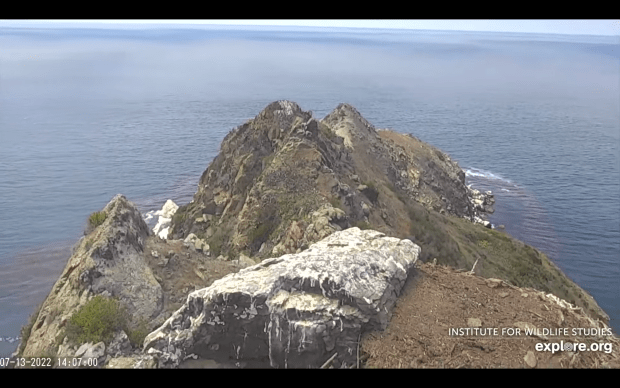
Lancer is on the rocks by the Two Harbours nest late this afternoon.

It doesn’t look like there is anyone home at the West End Bald Eagle nest of Thunder and Akecheta.

If you love California Condors, the Condor Cam is up and running and there are Condors in the trees around the site. They are often there feeding on carcasses provided for them by the Ventana Wildlife Society.

Here is the link to the camera in Big Sur:

This is a very quick look at a few nests this afternoon. I have spent the day creating a flight path for the garden birds – and there is a huge mess to clear up. I hope that everyone is well. Check in on your favourite birds. Many are about and still coming to the nests for food. Take care. See you soon!

Thank you to the following for their streaming cams and/or FB pages where I took my screen captures: Explore.org and the Institute for Wildlife Studies, Ventana Wildlife Society, and the NADC-AEF.

Late late Sunday in Bird World

Is there a better way to spend a snowy Sunday than to watch little eaglets being fed in their nests?

Gabby and Samson’s NE26 hatched at 03:04 on the 23rd of January. It was caught in an image that Pascale Ragon posted on FB. What an adorable little eaglet! It is also very strong, holding its head up high and not bobbing along so much!

The image of this sweetie below shows clearly the very sharp egg-tooth that was used to break out of that shell. It looks like 26 has already caught on to the latest in eye liner styles!

This ‘new born’ is also eating large flakes of fish. I could not believe it. Oh, what a sweet little tongue.

Gabby and 26 have this all worked out. Mom tilts her big beak 90 degrees and baby brings its beak straight up the middle. Bingo! I cannot tell you how impressed I was with what was going on at this nest today — but mind you, Samson and Gabby are always at the top of my list for Baldie parents.

Look at this sweet one looking up to Mum. That is simply adorable.

Hi there.

I feel like a new grandparent showing off pictures — I could seriously have cut and pasted so many you would be bored to tears. It is hard to take your eyes off a 12 hour eaglet!

The eaglet at the Kisatchie National Forest Bald Eagle nest had 10 feedings today, again. They began at 06:47 and ended at 17:40. I compares the times from one day to another. So, on Friday, the first feeding was at 06:52 and the last one at 17:41. There was a similar pattern for Saturday. Does Anna have an app that tings at the same time each day? Or are the feedings linked to dusk and dawn? Bald Eagles are diurnal. They hunt and eat during the daylight hours. The little eaglets are trained and treated as such from the time they hatch.

You can see that this eaglet -who is 11 days old today- is beginning to change. The light grey fluffy down is giving way to the darker thermal down. This will mean that once that thermal down is all in, Anna will not have to brood the eaglet so much.

Today, Anna let the eaglet have quite a bit of warm, not hot, sunshine. Both her and Louis were close but they let the little one have some air!

In the image below, the ‘baby face’ is also disappearing. The beak is growing longer and the egg tooth is almost totally gone. If you look at the wings you can see little black lines. Can you believe feathers are coming??

I have had the Big Sur condors on my mind and was very thankful when Ventana Wildlife Society posted this message on their FB page today. What a relief! Little Iniko 1031 was only released back into the wild six weeks ago, on 4 December 2021, after being caught in the Dolan Fire and having a long rehabilitation.

The Kakapo Recovery are also very happy. This is the ‘white board score board’ for the eggs. It looks like it could be a really super year if they all hatch and the chicks survive.

Each time I went to check on Ervie, the nest was either empty or there were pigeons doing clean up.

Then, all of a sudden, at 13:00:51 Ervie comes flying in. He was sure putting on the breaks. Just look at those magnificent wings. Oh, Ervie, you are so special.

Ervie must have a motion detector for when Dad is coming to the nest with a fish! It was 13:01:09. Ervie arrived 15 seconds before Dad!

That timing is not a coincidence. So where did Ervie see Dad with the fish? Was Ervie on the old barge while Dad was fishing?

It was a really nice fish and Ervie will enjoy every morsel!

Ervie spends several minutes mantling and alarming before he digs into his lunch.

Ah, thank you Port Lincoln! Ervie is a beautiful bird.

Two hours later and Ervie is screaming for more fish!!!!!!!!! I bet they could hear him across the bay!!!!!! No wonder Mum and Dad don’t stay on the barge when Ervie is about.

R1 and R2 were well fed today. This is the coldest day Miami has experienced this season. It is currently 16 C – which on the Canadian Prairies would be considered a nice summer day! But, if you live in Miami, everyone would be cold.

Rita was making sure that everyone was eating.

Both eaglets had nice crops before Rita informed them it was bedtime!

Rita tucked both eaglets in as best she could to keep them warm from the wind and what would be to her, the cold temperatures.

There has been a bit of concern by the watchers of the Berry College Bald Eagle Cam. Missy stepped on the left wing of the eaglet. Something startled Missy about 20:12 and she got up abruptly. Is it hurt? I do not know. We will have to wait and see how it is doing tomorrow.

The eaglet was moving its wings fine at the time of the image below.

All is quiet now and then something startles Missy.

She gets up, looks to her right and stumbles around the baby.

Send warm wishes to this little one that everything is alright. They are so fragile at this stage and B15 is doing so well. Something startled Missy about an hour later, too. Everyone is tucked in now and we wait to see how the baby is doing tomorrow.

I will leave you with a nice shot of Ervie with his crop. What a handsome osprey you are, Ervie.

Thank you so very much for joining me today. With the exception of the worry at Berry College, Bird World is looking good. Take care everyone. See you soon!

Thank you to the following for their streaming cams or FB pages where I took my screen shots: The Kakapo Recovery, Ventana Wildlife Society, Port Lincoln Osprey Project, Berry College Bald Eagle Cam, NEFlorida Bald Eagles and the AEF, KNF Bald Eagle Cam, and the WRDC Bald Eagle Cam.