Bird World Happenings. 27 July 2021

Oh, so many of us are having Empty Nest Syndrome. It is that time of year. You go and check to see if there are any Osprey fledglings on the nest – and no. Poof. Gone. It suddenly sets in that those precious little fluff balls have grown up. They have fledged and are gaining their flying skills for migration. Osprey breeding season is almost over. There are a chicks few trailing behind – Collins Marsh and Chesapeake Bay to name a couple in North America. There are still chicks on the nest in Manitoba but there are no streaming cameras. The Port Lincoln couple on the barge are only ‘thinking’ about eggs. Those will come mid-August most likely. So what does one do?

One of the first things is to treasure the moments we got to spend with these bird families. It is a privilege to see them living their daily lives. There is a saying in Japanese – Ichigo ichie. It was coined by the great tea master, Sen-no Rikyu. His meaning focused on the sharing of the tea ceremony and the realization that you can repeat the ritual but you can never re-create that moment with the same person ever again. You must live it to the fullest with the deepest respect. In terms of our birds, I would like to think that we must treasure every moment that we can share with them and give them our attention. It truly is a once in a life time encounter. Tiny Little will never again receive a huge fish and fend off its sibling with that same sibling later getting a little tiddler from dad. Those were two precious moments that will never again be repeated. Indeed, I wonder if we will ever see Tiny Little again before her migration. That nest has been awfully empty today.

Some of us began to focus on the few nests that do have chicks. My attention has been on the Collins Marsh Osprey Nest in Wisconsin. It is easy to notice the very odd behaviour of the bonded pair at the Collins Marsh Osprey Nest. It truly is strange. The female disappears for 21 hours! That was when ‘S’ and I began to find other strange tidbits about this nest. The female returns on Sunday morning and Dad spends the day bringing in several fish deliveries. Then on Monday the male brings in the first fish and we don’t see him anymore. It is the female catching the fish and bringing them to the nest. So is there a pattern here? or are we just losing our minds? The female brought in two fish today in the afternoon. One was cream coloured with gold scales but the last one was pink inside and out with gold scales. Any help on IDing these would be much appreciated.

In the image below, it looks like a salmon-red colour. Needless to say the chick went to bed quite full. Every time it started chirping mum was offering fish. She has been very devoted since she returned.

Thanks S for this great screen capture.

A couple of hours earlier Mum brought in this fish. I could not readily identify it either. Regardless of the species, the chick is delighted with the arrival! The faces this chick makes are incredible. Very animated.

This is the approach to the nature centre that is near the Collins Marsh Reservoir and the Mud River in Wisconsin. Look at the left and you will see the ‘retired’ fire tower which is now home to the Osprey nest on the very top of the glass enclosed space that appears above the ‘red’ in the image. Snowy Owls inhabit the nest in the winter. The tower is 33.5 metres or 110 feet tall. The staff of the Osprey centre access the camera within the glass enclosed area. At one time it was thought that there was a portal from the glassed area to the nesting platform but it turns out that is not correct. There is no ‘easy’ access to the Osprey nest. Getting to the nest physically to do a wellness check on the chick, right now, would mean finding a person with particular skills and then being certain that it was safe for them.

courtesy of Wikimedia Commons

You can see that the nest is slightly off centre and is situated on a sort of cone hat with the camera on the pole at the corner.

Looking at this got me to thinking about access. It is quite true that there are raptor nests that can never be accessed. Eagles and Ospreys love to make their nests in extremely high places away from us! That said I have known or witnessed ‘tree climbers’ in Germany whose skill set is such that no tree defies them unless the tree itself is unsafe. This is an interesting situation at Collins Marsh. The Wisconsin DNR Biologist and the Wildlife Rehabilitator continue to monitor the chick in terms of feather growth, etc. That is great news. The question then arises: if the chick displays in another week or ten days problematic feather growth, what can be done? With the access so difficult, it would seem nothing. So let’s keep our fingers and toes crossed that nothing is wrong with the feathers! It would, however, seem prudent to explore the possibility of a portal access to the nest once the Ospreys have migrated and before the Snowy Owls take over. I hope that it is never needed but, if it were, it would be a win-win for everyone. All of that said, it would require the services of a structural engineer to figure out the best way to do this. Maybe there is someone who is qualified and loves the raptors that might, at least, consider if this was possible and do it as a donation of time to the centre. That would be grand.

Tuesday morning at Collins Marsh Osprey Nest: The day began with rain and then wind.

Mum left later and returned with a small fish/ a twiddler.

Mum leaves the nest three times after this. Very different behaviour than Monday. Dad does come to the nest and delivers a piece of fish. The chick winds up with a bit of a crop.

At the moment, the chick is on the nest alone. It is windy and the temperature is currently 24 degrees C going up to a scorching 30 degrees.

Mum returns and the chick joins her in fish calling to Dad. Oh, I hope the fish arrives and mum stays to shade the baby today.

The Cornell University Red tail hawks are still putting smiles on everyone’s faces. Suzanne Horning was out yesterday evening checking on them. I remain ever so grateful that she lets me share her images with you.

K3 and those beautiful celadon eyes just strikes right at my heart. This little one has, according to the boots on the ground, turned into a magnificent flyer.

K3 sees Arthur and immediately starts calling for food. You will notice that when the chicks do not see an adult they generally do not food call but when they do see someone who might bring ‘a food delivery’ you can hear them crying several blocks away!

K1 had a nice spot on top of one of the light stands. These stands have been, in past years, great places for the chicks to eat their prey. They are nice and flat on top.

If you cannot see their tails it takes a few moments to sit and figure out which K you are looking at. In this instance, the belly band has more red than the chick in the image above.

This is such a beautiful close up of K1. Look carefully at that beak – that very sharp point for tearing the food – and then look at how clean it is. You will see the chicks cleaning their beaks on all manner of things – sticks, tree bark, grass. At the same time they are also sharpening them. Like their feathers they need this ‘tool’ of theirs clean and sharp.

Here is a great little article that goes into more depth on the reason you see birds rubbing their beaks. It is short and very informative!

https://www.audubon.org/news/heres-why-birds-rub-their-beaks-stuff

Big Red is doing a kind of hawk walk while she is looking for prey. She is our gorgeous matriarch and every second seeing her reminds us how precious she is.

The Hornings did see Arthur but I don’t have an image for him. Both adults are moulting now and look a little scruffy.

Some of you have been asking about Arnold. Well, look at that picture of Arnold with his mate, Amelia. His wounds have healed enough that he now has a waterproof bootie and can spend some outdoor time with Amelia. If Arnold continues to improve – and why wouldn’t he with Amelia there cheering him on? – he could be released in a couple of weeks. That is wonderful!

@ Cape Wildlife Center

A few nest checks for the UK Ospreys and wow, lucky was with me.

There is one very loud food crying fledgling on the Loch of the Lowes nest. Looks like it is LR2. He wants his breakfast ‘now’!

Telyn is on the perch of the Dyfi Nest in Wales and Ystywth is eating her breakfast. How lucky she is. LR2 is so unhappy. I wonder if his big sister, LR1, took the first fish?

Ystwyth eating a fish on the Dyfi Osprey Nest in Wales. Telyn is o the perch.

One of the reasons for the big smile on my face is that when I checked the Glaslyn Nest of Aran and Mrs G someone was on the perch! And it is Mrs G. The timing could not have been better.

There she sits – the oldest Osprey in all of the United Kingdom – looking out over the territory that she shares with Aran.

Mrs G on the perch at Glaslyn.

Perhaps if I took one more peek at the Foulshaw Moss nest someone might be there having breakfast. Let’s see!

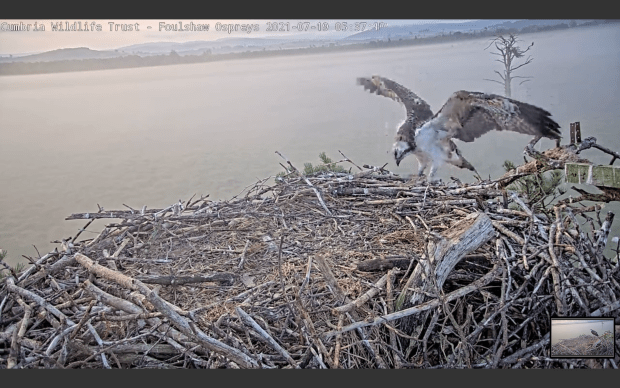
Well, not only is there no one on the nest but there is not an Osprey to be seen on the parent’s tree in the distance. I wonder if White YW and Blue 35 have taken everyone to the reservoir to try some fishing?

It is now 17:00 on the Foulshaw Moss nest and there are two fledglings hunkered down because of an intruder. “Hello, Tiny Little!”

Ah, maybe there isn’t much of an intruder. Wonder what Blue 464 is hiding? It is a big fish! No wonder Tiny Little is there. I will try and check back later to see if he gets some of it. The fish looks large enough for both as long as 464 doesn’t fly away with it. You can see its tail extending out to the left of the log. Hopefully 462 won’t come around!

Oh, Tiny Little is wanting that fish! She is up to her old tricks. It is a huge fish. Blue 464 will get tired of working at the mouth and walk away if Tiny Little can be patient.

Tiny Little has stepped back. She caused Blue 464 to move the fish a bit and she might be remembering that he did fly away with part of a fish the other day. Just wait, Tiny Little. There will be fish left!

But life throws birds wrenches and today, Blue 464 flew away with that huge fish! Tiny Little is yelling at White YW to go and get another one. Poor Tiny Little!

This is a good overview of what is going on at the nests today. So happy to catch Tiny Little. These moments are very precious.

Thank you so much for joining me today. It is so nice to be with fellow bird lovers. Just a reminder. If you live in a place where it is hot please, if you can, leave out bowls of water for the birds. Old ceramic serving bowls work great. The clay does not get as hot as metal containers. If you leave water for the hummers, make your own. It is 4 cups of water to 1 cup of sugar. Make sure the sugar is dissolved. You can heat it and allow it to cool before putting in the container. Do not use the red commercial hummer food. It actually kills the birds! How sad is that? A company allowed to make a product that actually kills the thing it is supposed to help! OK. It happens with humans, too. Terrible.

Thank you to Suzanne Arnold Horning for allowing me to use her images of Big Red and her family in my blog. Thank you to the following for their streaming cams where I get my screen captures: Cumbrian Wildlife Trust and the Foulshaw Moss Osprey nest, Scottish Wildlife Trust and Friends of the Loch of the Lowes, Bywyd Gwyllt Glaslyn, Carnyx Wild and Llyn Clywedog Osprey Nest, and Collins Marsh Nature Centre. A big shout out to the Cape Wildlife Centre who is caring for Arnold. You are fantastic!

Monday in Bird World 26 July 2021

There have been dark clouds over our City since the morning. I think everyone I know was hoping for some heavy rain – gutter gushers are what I think they call it in some places in the southern United States. But, no. Enough to water the flowers for the hummingbirds and then stop. No more than four minutes of rain. So what do you do? Well, you go and check on Tiny Little at the Foulshaw Nest. No one was there this morning and guess what? No one is there tonight!

It is the time of year when we have to loosen the apron strings and begin to say farewell to all these beautiful bobbleheads that have grown into amazing birds. Their journey is just beginning as the cameras are shut down. There is at least a 4000 mile trip to Africa or Central America, or Brazil depending on where the birds begin their long, arduous flight. We wish them all well and hope to see Tiny Little in two years flying around, causing mischief.

Earlier, both of the chicks on the Loch of the Lowes Nest were home waiting for a fish drop from either Laddie or NC0 or both.

Feeling lucky after catching these two and watching them in that gorgeous setting, I decided to check on some of the other nests. Some luck at the Llyn Clywedog Nest, where Seren 5F had delivered a Mullet to Blue 496. That is one big baby. He has already been seen carrying a good size piece of fish on his talons to the trees.

No one visited Poole Harbour when I checked, but all of the chatter says that sky dancing continues to take place between CJ7 and the two-year-old fledgling Blue 022.

Blue 096 on the Rutland Manton Bay nest has been missing from sight since last Thursday. He turned up on the nest today for a few minutes, and his sister, Blue 095, sent him packing. He has a crop, so he is getting fish somewhere else. No worries with that chick! Alive and well.

And now for something completely different. Remember the small white storks that the people of Mlade Buky saved from starvation along with Father Stork?

The female has fledged, and I suspect the males have too (but I have not seen this information). They still return to the nest to be fed by Father Stork. Their animation and the sounds they make are incredible. Have a look, and a listen:

The little chick on the Collins Marsh Nest has had three feedings today. Mom flew in not that long ago with what looks like a Small Mouth Bass (feel free to correct me) for the wee one. That chick was excited to see that fish land on the nest. It remains warm up on that tower, 110 feet off the ground!

Look at the chick’s expression.

It is so exciting when food lands for everyone! Indeed, the parents simply become Door Dash – or other food delivery services. There are a lot of people looking out for this little one – at the Wisconsin DNR (Stephen), at the Collins Marsh Nature Center (James) and at the local wildlife rehabilitation clinic (Patricia). Their attention to the mother missing and the feather issues with the chick are so appreciated.

The nests are slowing down and I will also be slowing down with my postings. You can expect one posting a day in the late afternoon or early evening. Thank you so much for joining me. Take care. See you soon.

Thank you to the following for their streaming cams where I took my screen shots or my video clips: Mlade Buky White Stork Nest, Collins Marsh Osprey Nest, Poole Harbour Osprey Project, Scottish Wildlife Trust and Friends of Loch of the Lowes, Carnyx Wild and Llyn Clywedog Osprey Nest, and Cumbrian Wildlife Trust and Foulshaw Moss Osprey Nest.

Good Morning Ospreyland

I have a friend who lives in the Northeastern United States. She has a beautiful garden and loves her songbirds. She also adores Big Red, Arthur, and their chicks. Wicky and I often get really down in the dumps over the direction that environmental policies are going. Then we see something and begin to believe that there is hope that all this heat, drought, flooding, birds falling from the sky, etc will pass. We need one another – for on the day I am down, she is up and vice versa!

Today Wicky sent me a quote from Jane Goodall that I would like to share with you. I am including the interview in the New York Times that she sent as well. I hope you can open it.

“Traveling the world I’d see so many projects of restoration, people tackling what seemed impossible and not giving up.”

I am always impressed with how New Zealand develops positive policies for their wildlife. Another area that is doing that is Scotland. Here is a short early morning BBC programme on the restoring of the landscape at the Cairngorms National Park. I am including some images of the park for you so that you get a glimpse of the type of landscape being restored.

“Cairngorms” by wwarby is licensed under CC BY 2.0
“Cairngorms” by chuckrock123 is licensed under CC BY-ND 2.0

Of course, my interest is the Ospreys and this is the home to the Loch Garten Ospreys. It was the first place that the Ospreys returned to in the UK in the 1950s. It was the home of the Lady of the Loch, that female, often called the Norwegian by Tiger Mozone whose DNA, according to Tiger, is in every UK Osprey except for CJ7. Lady was the foundation stone.

The image below is of that historic Osprey nest that is still used.

Sadly this year there were no Ospreys breeding at the nest. I might be remembering this wrong but it seems to me that two birds arrived at the nest and people in a canoe or kayak got too close trying to take photographs and the birds left not to return. (I hope that I am not remembering another nest – I could be so feel free to correct me, please!). Fingers crossed for next year! Here are some images of the loch. It is freshwater and is full of trout. We know that Ospreys love their trout. Dylan flew 13 km to get trout for the Clywedog Nest with Seren and Only Bob a week or so ago.

What an incredible sunset.

“Sunset at Loch Garten” by chuckrock123 is licensed under CC BY-ND 2.0
“Loch Garten” by Cairngorms National Park is licensed under CC BY 2.0

This is that short programme with Ade Adepitan, MBE on the restoration of the natural environment in the Cairngorms:

It is now approaching 11pm on the Canadian Prairies. The Osprey nests in the United Kingdom are just waking up.

Good Morning Tiny Little! I wonder if you dreamed about flying?

Totally serene image of Loch of the Lowes. No one sleeping on the nest. On occasion NC0 or one of the fledglings will appear on the nest but for the most part the camera remains fantastic because sometimes you can see the Ospreys fishing in the loch.

Aila did not return from her migration. Louis waited and waited refurbishing their nest. When he could wait no longer he paired with a new female. They raised two chicks on another nest off camera. The new Mrs Louis is Dorcha. When the two chicks were ringed on 15 July it was believed that they were 4-5 weeks old and are both are believed to be male.

Beautiful Manton Bay Nest of Blue 33 and Maya. The camera will be shut off soon and we will have to wait til the Ospreys return in March. Normally Blue 33 and Maya arrive within an hour of one another. Just think – they travel 4000 miles and arrive in that close of time. It is unclear if they winter together in the same place.

The beautiful morning turned into a day of defending their nest for Blue 33 and Maya. Poor birds.

What a beautiful morning – just look at that pink sky and the green of the landscape – at the Dyfi Nest of Idris and Telyn. I can’t see a fledgling but it sounds like one of them is scratching on the microphone of the camera!

The cameras have not come on at the nest of Dylan and Seren but, wow. I found an 11 minute video shot by a photographer of Llyn Clywedog. We can get a really good look at the loch where their nest is located. It is like you are going for a walk around the water. Very restful.

It is now a sunny afternoon at Llyn Clywedog and no one is home! It is quite understandable why the owners of these streaming cams will be turning them off in the future!

Tiny Little made a short flight from one side of the nest to the other. She spends a lot of time looking down over the edge. Did someone tell me that birds are afraid of heights? Yes, they did. It was someone at the Cornell Bird Lab years ago. It is one of the reasons the little ones don’t often fall off the edge of the ledge nests.

Tiny has spent a lot of time sitting on the edge of the nest looking down.

It’s tea time at the Foulshaw Moss Nest. 463 has joined Tiny Little who is food begging. His crop is pretty flat. Good luck Tiny!

At 16:32 Dylan flew in with a live fish which 464 promptly mantled. Let’s hope mom is around to feed some of that fish to Tiny Little!

White YW is out of there as 462 flies in for the fish. This is going to get interesting. It is still alive! Good lessons.

Oh, we had a little rain and a thunderstorm during the night. It is still really cloudy and, despite the 27 degree heat, one can imagine it is cooler!

Thank you so much for joining me. It seems that everything is going along as it should with the UK Ospreys – save for our little darling Tiny Little who needs some confidence. It will come. They are all individuals. Have a wonderful start to your week. Take care. See you soon.

Thank you to the following for their streaming cams where I took my screen shots: Cumbrian Wildlife Trust and the Foulshaw Moss Osprey Nest, Scottish Wildlife Trust and Friends of Loch of the Lowes, Scottish Woodland Trust, LRWT, Rutland Water and the Manton Bay Osprey Nest, Carnyx Wild and Llyn Clywedog Osprey Nest, the Dyfi Osprey Project, and Bywyd Gwyllt Glaslyn. A big shout out to Wicky for sending me the Jane Goodall interview!

Nest Hopping News for 1 July

Juvenile Osprey Blue 096 has fledged from the Rutland Manton Bay Nest of Maya and Blue 33 (11). It happened at 12:12:27 pm.

He looks up.

Wings begin flapping. Blue 095 goes, “oh, not this again! This nest is getting too small for flapping. I wish you would just go away!”

He’s on tippy toes and grabs the wind and…

Blue 096, male chick of Maya and Blue 33 (11) fledges on 1 July 2021.

Jack delivers a breakfish to Tiny Tot this morning. Oh, thank goodness! It is 28 degrees C and the weather service says there is a 40% of a thunderstorm around 5pm in St Petersburg, Florida. Thanks, Jack!

By 9:29 Tiny Tot will have that fish out of dad’s talons and she will be saying ‘Yum’.

There were, to my knowledge no fish deliveries to Tiny last evening. She was really waiting and watching for dad. Turns out it is a small headless fish, a bit of a teaser for our gal who chowed down on that whopper the other day, this morning.

Look at those magnificent wings. Tiny, you are such a gorgeous bird!

Well, one of those nests that I suggested you watch when others get stressful just turned up the noise. Lady Hawk posted a video of the Royal Cam chick going to visit her neighbor SSTrig and the neighbour gets into a big territorial dispute. Taiki is very social and meant no harm but we now know there won’t be any afternoon tea parties with these two. Here is that video:

There is great news coming out of New Zealand. Remember I love this country for the way in which it takes care of its wildlife. Well, today, New Zealand announced that it is putting surveillance cameras on all of its fishing boats to make sure that they comply with safe fishing so that no seabirds are caught as bycatch. Way to go New Zealand!

The landscape at the Glaslyn Nest of Mrs G and Aran in Wales is stunningly beautiful. I admit to dreaming of trees and places where you can look out and see birds and not the concrete of the city. Of sitting and smelling the wet grass and hay and not the petrol fumes of cars. Of disappearing into the wilderness.

Aran and Mrs G are spending more and more time together. Aran is able to fish after his injury in early June but he is still healing. There will be no more chicks this year but the couple was seen bonding. That is fantastic!

Aran brought in a big fish earlier that he was eating. I wonder if he shared it with Mrs G who now has a nice chunk and the tail in her talons. He has provided at least one fish to her that was caught on camera which is a great indication of Aran’s continuing progress in healing.

The two Bobs at the Dyfi Osprey Nest in Wales are enjoying a lovely fish that Idris delivered. Telyn is a fantastic mom but that nest is getting a little crowded. She may have to stand on the rails to feed her babies soon. These two are growing like crazy! You might remember that Dysynni, the male, is the largest male Osprey born on this nest ever. Idris has really brought in some of the large fish. It has been determined that many of those fish actually weigh more than Idris – breaking another myth that Ospreys can only carry a % of their actual weight.

It also demonstrates how much food and the quantity of it matter to the health and well being of the chicks. This is the nest of a super dad – as are many of those in Wales and other parts of the UK.

Meanwhile, over in Scotland, the two Bobs on the Loch of the Lowes nest are waiting for NC0 or Laddie to bring them in a tea time fish. Gosh these Bobs are beautiful. The time has flown by and they will soon be hovering and fledging but, in those very first days, I really wondered if Bob 2 would survive the bonking from Bob 1.

And goodness, I woke up this morning and had to look twice to figure out which of the chicks on the Foulshaw Moss Nest of White YW and Blue 35 was Tiny Little Bob! Which one do you think is Tiny Little?

If you said the one closest to the right looking out, you would be right. She or he is watching for one of the parents to arrive with a fish! As noted from the people who ringed the chicks, they could not determine the gender of Tiny Little from the measurements because of its small size at the time. Rumours had gone around that Tiny Little is, in fact, a female.

Today, the Cumbrian Wildlife Trust put out their announcement about the ringing of these three Ospreys. Part of the celebration is that Tiny Little was the 100th osprey chick to be banded in Cumbria since 2001. That is amazing. Here is part of the text that was posted:

“I’m incredibly pleased that we have ringed another three osprey chicks at Foulshaw Moss Nature Reserve this year. For a time we we’re unsure if the smallest chick was going to make it. It was rapidly being outgrown by its bigger siblings but it carried on fighting for its share of the food from mum and dad. Now there’s not much difference in weight – and it was the smallest one that was the 100th osprey chick to be ringed in Cumbria since 2001! Osprey chicks are weighed by the licenced bird ringer and each chick is given a coloured leg ring. This year we have Blue 462, a female weighing 1.6kg, Blue 463 weighing 1.5kg – gender unknown, and Blue 464, a male weighing 1.6kg”.

Paul Waterhouse, Cumbria Wildlife Trust

I wanted to check in on the little Golden Eaglet in Bucovina, Romania. He has changed so much in just a few days. Most of the white feathers are gone and are now replaced with the beautiful dark black kind of espresso coloured ones for the juveniles.

The female has come to the nest to feed the eaglet. There were lots of bones and scraps of meat left on them. It is unclear to me whether or not the mother has brought in new prey or is using what is in the pantry.

You can look and see the remote mountain area where this nest is located. I continue to hope that the parents are able to find enough prey for this little one to thrive and fledge.

Thank you so much for joining me today. I regret I have no images of the Ks for you – maybe later today. They are off exploring the trees and some of the buildings with Big Red and Arthur. Everyone is fine; they are just not around the nest!

Thank you to the following for their streaming cams where I obtained my screen shots: Bywyd Gwyllt Glaslyn, Cumbria Wildlife Trust and Foulshaw Moss Osprey Nest, Scottish Wildlife Trust and Friends of Loch of the Lowes, Achieva Credit Union, Asociatia Wild Bucovina, LRWT and Manton Bay Osprey Nest, Cornell Bird Cam Royal Albatross and NZ DOC, and Dyfi Osprey Projec. I would also like to thank Lady Hawk for her video clip of the territorial dispute between Taiki and SSTrig.