18 March 2022
Over the past couple of days there was a lot of focus on the word ‘survival’. ‘Survival of the Fittest’ is most often the term used. On the Dale Hollow Bald Eagle nest belong to River and Obey, there were three eaglets struggling to survive. On the 15th of March, Big Bob’s instinct that something had shifted in the amount of prey delivery or feedings kicked in. Big Bob wanted to survive. Because of her size and weight, it is easy to intimidate the younger siblings. Some leave it at that. Others switch to some beaking but, that normally stops as the chicks get older. Others get in a killing frenzy like Big did. Middle Bob’s tactic to try and not get the wrath of Big Bob in order for it to survive was to get out of the way and literally keep its head and neck down. That brings me to Little Bob or Tater Tot.
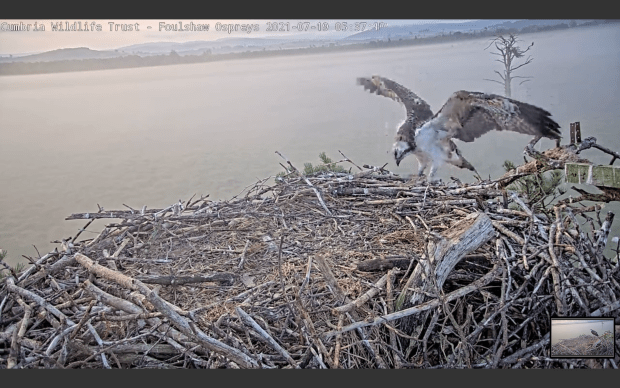
I have watched many third hatches. That is what I do – study the long term survival of the third hatches. They are remarkable if given a chance. They are creative, quick at getting food or finding dried up food in the nest and eating it. The easiest way to say it is, “They get street smart”. I look back at Tiny Tot Tumbles on the Achieva Osprey Nest in 2021. On more than five occasions, watchers thought that today was the day that Tiny Tot would die. Tiny Tot survived because its mother started bringing catfish to the nest in addition to the fish that Jack, the Dad brought in. Tiny Tot was also clever and would eat anything. It learned to run around the rim of the nest and get behind the mother feeding. It learned snatch and grab. All of those techniques to survive worked. Every one thought that Tiny Little, Blue 463, of the Foulshaw Moss Osprey nest would only last a day or two. Its two older siblings were enormous.
There is Tiny Little or Blue 463 in the image below. You will immediately recognize him. You can quickly see the size and age difference. The parents were White YW and Blue 25. I watched one day when the Mum was feeding the old siblings. They were obviously full. So she stopped feeding them. Tiny Little had not eaten. White YW flew off the nest with the fish. She waited and returned to the nest and fed Tiny Little the rest of the fish once the two big sibs had gone into food coma. Tiny Little got incredibly good at the snatch and grab and the parents made sure it ate.
Both Tiny Tot and Tiny Little lived to become the dominant birds on their respective nests. They became the ‘boss’. Tiny Tot even helped her parents fight off intruders. She took charge of the nest. So what happened this early evening on the Dale Hollow nest did not have to happen the way it did.

Little Bit or Tater Tot had an enormous will to live. It had not had any food since the morning of the 15th. My calendar and the timing shows that to be at least 79 hours. Little Bit also had a strong survival instinct and I will never forget it.
In India, the yogis slow their breathing down. To conserve its energy, Little Bit appears to have also slowed its breathing and, at the same time, understood if it stayed perfectly still (something very hard to do), it might, just might, not get the wrath of Big. It was simply incredible to watch. I marvelled at this wee babe tricking many of us – including myself – twice. I was for certain Little Bit had not survived the brutality. So, I want to say that I really admire the tremendous effort this chick made to live. I really wish it had of survived because it had a formidable spirit.
I am glad that Little Bit fooled me and made me look silly twice. I wish it had been a third time. Little Bit endured an incredible mauling by Big but the last attacks on its head killed it. Little Bit was injured so badly that it moved its leg and eye for the last time about 19:11:46. River had come to the nest without any food. Middle moved up hitting its beak on River’s bak trying to get some saliva. There was no food brought to the nest. River dug a piece of fish bone out but there was nothing for the two to eat. Big did beak Middle several times. River looked as if she was going to brood them and then she flew off. Obey came on the nest and noticed Little Bit was dead. He had no food either. So neither Big nor Middle had any food tonight. Tomorrow, Middle will have had one small meal Thursday night since Wednesday morning. Sad. Very sad.
I want to remember Little Bit the way he was on the 14th of March when all were up at the table and it had a little crop. It was such a sweet wee babe. You can see that while the oldest sibling is quite large, the difference in size compared to the Foulshaw Moss chick, is not that acute.

I am glad that Little Bit’s suffering is over. He wanted to live so much that he endured some of the worst treatment that I have ever seen in a third hatch. Of the nests that I monitor – in terms of third hatches – there have been two siblicides. The first was Tapps on the Port Lincoln Osprey nest (2021 at 18 days) and the second is our Little Bit (at 17 days).
For those who might be new at watching Bald Eagles, the Dale Hollow Nest is an anomaly in my huge binder of nests. So what am I saying? In general, a small chick like Little Bit needs to eat less food much more frequently to thrive. After 3 weeks, the feedings change – they become longer and more frequent because their crops will hold more food. There appeared to be a pattern whereby a fish would come in around 07:09 and almost 12 hours later another would appear at around 17:09. These were not huge fish. On occasion, a fish would come in after the breakfast fish but this was inconsistent. To keep nest stability, it appears that feedings need to be regular and frequent in the first few weeks. An adult needs to be on the nest to shade the young nestlings from the heat of the sun. Even Big was losing hydration this afternoon panting away. Little Bit had its fur pulled off and had bare skin showing in parts. It could not stand the heat. It was stressful on each of the three chicks. It is impossible to tell without having the chicks weigh in but one might assume that they became dehydrated. All I had to do was look at some of the other nests to see if the adult was shading the chicks. Akecheta and Thunder were, Lena at Captiva was, etc. Typically the parents will shade or be umbrellas even when their chicks have juvenile plumage. I did see River cover the eaglets when it was raining Thursday evening but I did not see her shading them in the heat of the afternoon this week. Please correct me if I am wrong.
There will be some people who will be angry with me. On the research documents that I fill in on the nests there is a category for siblicide but there is also a category for parental neglect. Those categories appear in much of the literature on the topic. Not every human child has an attentive parent. We would like that to be the case but, it is not always true. There are degrees of human parenting that range from neglect to excellent. Likewise, the quality of care of eagle parents seems to also vary. The adults are not robots who promptly feed their chicks every hour although most do when they hatch up to about two and a half to three weeks — 8 or 10 times a day. Watch the counts for feedings at the Big Bear Valley nest of Jackie and Shadow. Eating once a day will cause an eaglet to not thrive. So it would appear that it was not just Big trying to survive but also the quality of parental care on the nest or lack thereof that combined with a lack of food.
I hope that both Big and Middle Bob survive to fledge. It is hard to lose a little one or any one of the chicks on the nest. It breaks your heart. But let us hope that Middle will survive. We need to send it our most positive wishes.

Thank you so much for joining me, for all your letters and comments, and for allowing me to be fooled by Little Bit twice. Sadly, this time Little Bit has crossed over. It was a difficult day and because of that I think I also said that ‘S’ that gave me the information on Milda’s new mate was from Lithuania. My sincerest apologies. S is from Latvia. There will be more grammatical errors and some spelling issues, probably. It was a difficult day – I said that twice. Tomorrow is a new day and let us all send positive wishes to all of the nests. Take care everyone.
Do not worry. My newsletter will come later Saturday afternoon. We all just need to take a wee break. It has been traumatic.
Thank you to the Dale Hollow Eagle streaming cam where I took my screen captures.