The Daisy Chronicles, Day 11 continued

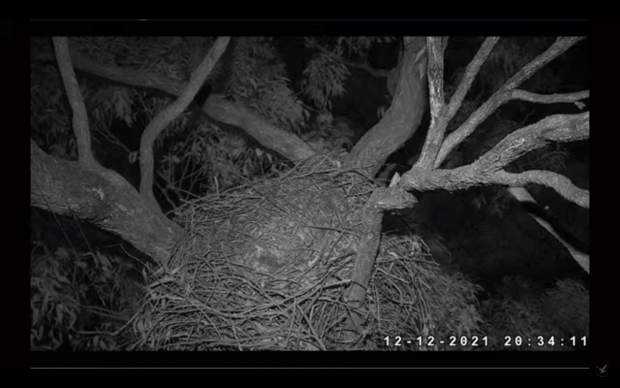
It is 13:14 in Sydney Australia’s Olympic Park Forest. Daisy, the Pacific Black Duck, has 8 eggs she is incubating in the White-Bellied Sea Eagles nest. So far today she has had a visit by three Ring-tail possums in the night and two Ravens. The possums did not bother Daisy’s eggs and the Ravens sitting and cawing in the upper branches of the tree did not cause any issues for Daisy. She seemed to ignore them completey – she kept her cool. They might well come back today and the sea eagles might show up but for now, our little duck is resting. She took 5 hours off -divided into two time periods – to go and forage. She has taken the opportunity to sleep while incubating.

Daisy seems to be developing a strategy to thwart both the Ravens and the sea eagles. She stays on the nest leaving right at sunset and then leaving again 2 or 3 hours before sunrise. That way she can eat while the others are sleeping and be on her eggs to protect them if the Ravens visit. Last year she played tag with Dad. So far they have not encountered one another. Dad did come one evening but Daisy was foraging.

Daisy is such a beautiful duck. I love how the down looks like it has little twinkle stars in it.

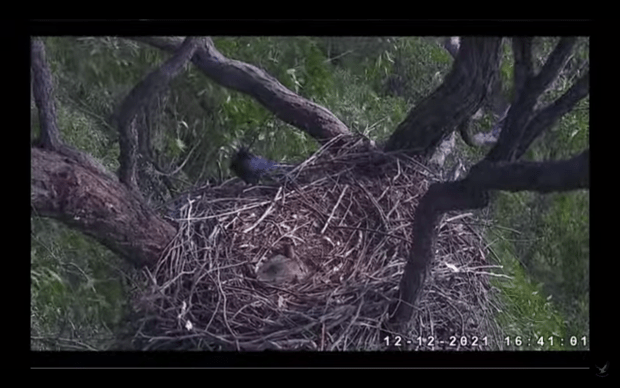
At 13:46 a visitor came to the nest – a quiet visitor. Out of the corner of my eye I saw a bird fly from the right to the left across the nest and land. My heart sank. I thought the Ravens had gone into stealth mode. But, no. It was a Pied Currwaong. You might recall that it is the Currawongs that chase the Sea Eagle fledglings out of the forest. Or you might recall that a group of them pecked at the head of WBSE 27 causing it to have to go into care (it was also hungry and dehydrated). They can be mean. Daisy kept her head down but keeping her eye on every movement the bird made.

In the top image, the Currawong is flying between the two branches on the left.

The Currawong has landed on the branch directly in front of Daisy. Daisy is watching with one eye and keeping still.

You can see it better in this image. It continues to fly around the tree. I can see its shadow. Perhaps it is more curious. It is unclear to me if the Currawongs are a threat to Daisy. I must check.

The first half of the day has not been totally uneventful. Ravens did land on the tree but did not go to the nest and Daisy ignored them. Now the Currawong. She seems nonplused so I am going to presume she is not taking the bird as a threat. Whew. Anxious for a moment there. In fact, I am certain that all of us are anxious and would like to grab Daisy and give her a safe nest box. Sometimes watching but not being able to do anything is extremely frustrating. I suspect you feel the same. I wonder how many of you are eating more cookies or candies watching Daisy to help with the stress???? I certainly am! The holiday baking is not going to last long at this rate.

Other Bird World News. The State of Illinois has passed a Bird Safe Buildings Act to eliminate the death of millions of migrating birds. Dallas has been turning off the lights to help during migration but Illinois is taking this to the actual construction of the building. This is a good thing!

I have found a new Bald Eagle Streaming Cam for you. There is a huge interest in birds where I grew up – Oklahoma. There are so many hawks and eagles. Bartlesville has set up a streaming cam for their Bald Eagle couple. I do not know anything about this nest but it has been recommended to me. Here is the link:

If you like images of beautiful birds, here are some amazing captures in super 8k resolution. Thanks ‘S’ for sending me this link. Some of these are simply stunning.

Speaking of beautiful bird images. Every year we travel to Toronto where the Royal Ontario Museum puts the winners of the international bird and wildlife photography contests – from youngsters to seniors, amateur to professional – on display. The results of one of the many photographic contests have been posted on the Internet. There were 22,000 entries for Bird Photographer of the Year. The prize went to an amazing image – you will have to go to the link to see it – I do not want to spoil the surprise. There are categories for young and old. You will not be disappointed and if you love them, there is a book with the 300 winning entries in all categories. Here is the link to this year’s winners:

https://www.birdpoty.com/2021-winners?fbclid=IwAR0GP7AE4gxcS3iREKgIYPmJViqp07iDOvsU9dUnFZGG_odSMvCarCIboLs

I will be monitoring Daisy throughout the rest of the day. Other than the Noisy Miners and horrific sounding Sulphur-Crested Cockatoos, I hope to hear absolutely nothing more than the hum of the streaming cam. My next report on Daisy will be tomorrow (Monday the 13th) around 13:00. All of the other nests are doing just fine. I am hoping to see an egg on the nest of Gabby and Samson tomorrow or the next day. Fingers crossed. And mark your calendars because in less than two weeks – 12 days to be exact – we could have a hatch on Harriet and M15s nest in Fort Myers. Honestly, I can’t wait – it is called ‘Bobble head Withdrawal.’ The couple spent some time bonding today before they get busy with little ones. And YRK has flown in to relieve OGK after 8 days of incubating duties at the Royal Albatross Colony on Taiaroa Head, NZ.

Thank you so much for joining me and caring so much for Daisy. I believe that thousands of people sending love and positive wishes to Daisy and her precious eggs is nothing short of wonderful. If only she knew. Wow. I am blown away just thinking about it.

Take care everyone. Stay safe.

Thank you to the Sea Eagles@Birdlife Australia Discovery Centre for their streaming cam where I took my screen shots and to ‘S’ for sending me the link to those amazing bird images.

The Daisy Chronicles, Day 11

Daisy opted to take 2 breaks. One right after sunset on Day 10, returning about two and a half hours later. She then incubated until 03:08 when she left for a morning break and foraging.

While Day was away, the little Ring-tail Possum was climbing around the branches of the tree gathering leaves for its nest and showing some curiosity about Daisy’s spot. I was so glad that it did not get too close to that fluffy down covering the eggs. It might like some of that softness for its own nest!

Oh, but look. Isn’t it cute? It will not hurt Daisy or her eggs (unless it does take the down because that is what is covering the eggs!).

Daisy returned at 05:38:10. Literally 10 seconds after sunrise. Amazing inner clock this little duck uses.

The camera operator caught WBSE flying around the River but they did not come to the nest in the old Ironbark Tree in Sydney’s Olympic forest.

That is the Parramatta River and that white streak over the trees in the foreground is a WBSE. There are other WBSE nests around the area so it might not have even been Lady or Dad.

The two Ravens came to the tree cawing trying to scare Daisy at 07:40:37. They were in the branches up above (you could not see them when the cam operator pulled back). Daisy took no notice of them – she had no reaction and they left within 30 or 40 seconds. I find this behaviour very interesting. This little duck is really getting smart.

It is currently around 09:45 on the nest and so far it has been a relative peaceful morning. Here are some images of Daisy on the nest.

Daisy looks so peaceful sleeping in the middle of all that fluffy down.

All I can hear in the forest are the Noisy Miners and some Sulphur Crested Cockatoos. Hopefully our beautiful little Pacific Black Duck – Daisy – will have another peaceful day incubating her eggs. Fingers crossed.

Thank you for joining me to check in on Daisy. I will continue to monitor the nest from now (16:49 until the wee hours of tomorrow morning) and I will post a very late night notice. Take care everyone. Send all your positive wishes to Daisy – they are working!

Thank you to the Sea Eagles@Birdlife Australia Discovery Centre for their streaming cam where I took my screen captures.

The Daisy Chronicles, Day 10 -11

Daisy has spent the day peacefully sleeping, pulling some down, and rolling eggs most of the day.

A Raven arrived on the nest at 16:40, cawed, and left by 16:41:43. Daisy did not seem agitated by its presence.

It is now 5 minutes since the Raven was at the nest, I heard it briefly further into the forest. Daisy continues to rest. She has been incubating the eggs since 21:55:42 last evening without a break. It is assumed that her strategy is to leave right after sunset, go to the river and forage. Last evening she covered her eggs well with the down but she needs more leaves. My eagle friend told me that the Ring-tail Possums were up in the tree getting leaves for their nest which is below Daisy’s. She wished they would drop some of their leaf load for Daisy. Wouldn’t that be splendid?!

Daisy took her first break at 20:01:33. Six minutes earlier than the day prior. She returns at 22:32:40.

Daisy decided to take another break in the middle of the night. She flew off at 03:08. Great idea. She is currently still away but she will return before dawn! What an intelligent young duck. She’s pretty much got it. By going foraging right after sunset and right before sunrise not having to leave during the day but having had two feedings herself, she just might do this!

It is such a privilege and a blessing to be able to watch this amazing and brave little duck try to have ‘a family.’ She is working so hard – so many of you have written wanting a miracle for our darling Daisy. It would seem that everyone is both excited and frightened at the prospects. So for now, let us just revel in the fact that so far today, on Day 10, that all is well. It has been relatively quiet. The Raven came once but Daisy didn’t even flinch. So far Dad and Lady have not shown up so that Daisy has to scramble off her eggs. There is much to be thankful for today.

It is 03:36:45. I am expecting Daisy to return in about an hour. My next report will come late today. There were few close ups of Daisy yesterday. I included the 2 during the time the cam operator zoomed in on Daisy at the end of the evening. Isn’t she just beautiful?

Thank you so much for stopping by and checking in on our favourite duck. It is now Day 11. Take care everyone. See you soon.

Thank you to the Sea Eagles@Birdlife Australia Discovery Centre for their streaming cam where I took my screen captures.

Catching up with Ervie

I have spent so much time watching Daisy, recording the happenings on the nest, and sleeping at odd hours that many of the other nests have been neglected. One of those is the Port Lincoln Osprey nest in Australia. I stopped in today to check on Ervie’s movements by the Sat-Pak and there were some gorgeous images of this juvenile male Osprey by Take 2 Photography, Fran Solly.

Ervie has been all over the place. Many are expecting him to leave the area of the barge. I wonder how far Ervie will go?

These were Ervie’s movements yesterday. Oh, he does love to fly.

Fran Solly went out and took these images of Ervie flying around the coast. Isn’t he just such a handsome bird?! My goodness, Ervie. You are doing Mum and Dad proud.

Male Ospreys tend to return to where they hatched to make their nests. I wonder if all three lads will show up at the same time? And I learned a new word today ‘Dust Up.’ Do you know this word? Remember when Ervie and Bazza were knocking one another about the nest – or off it – that is apparently a ‘Dust Up.’ Love it. Sounds so much better than saying Bazza just knocked Ervie off the edge of the nest! or Vice Versa.

Other Bird News: Gabby and Samson continue to have a sub-adult intruder coming around. No eggs on that nest yet. Aren’t they gorgeous?

Samson on the left and Gabby on the right.

We could be less than 2 weeks away from the first hatch at the Southwest Florida nest of Harriet and M15.

I have seen no weather warnings for Florida – like the disturbances going through the Midwest and the winds up in the Finger Lakes area of upstate New York.

Harriet is alerting. There is a predator around. Is it the Great Horned Owl (GHOW)?

Anna is incubating two eggs at the Kistachie National Forest Bald Eagle Nest in Central Louisiana. Louis continues to be so exciting. He is great for bringing in the fish but he is also softening up that nest with tonnes of Spanish Moss.

Connie is incubating two eggs over at Captiva, too. Her new mate is Clive. Hopefully this nest will have some luck. That said, local pelicans are being brought into care for red algae.

All of the Bald Eagle nests outside of the tornado and storm areas in the US are fine. More Ospreys are being spotted on the Iberian Peninsula and in Africa which is a grand sign. Ferris Akel was thrilled to see three Snowy Owls today on his tour. One even flew for him. I should invite him to Manitoba for the winter. One of our birders spotted 25 Snowy Owls in a short drive around the agricultural fields. — And a reminder. The owls in the Central US have been found to be thin and dehydrated. They are blaming this on photographers trying to get images and scaring away their prey. As you know I am a raptor lover – they often do not eat for several days so when you see one hunting or eating – leave it alone, please. Stay way, way back. Invest in a long lens!

It is very quiet morning at Daisy’s nest. A couple of times I have heard the cawing of the Ravens but Daisy has been peaceful, unfluttered would be a good word. There will be a late night catch up on her nesting activities.

This is not a Raptor Time: Watch this Titmouse modify its nest, bring in nesting materials, and hatch and fledge 11 chicks in Japan. Seriously it will put a smile on your face. I wish I could transport Daisy and her eggs into a box like this! Oh, she even wiggles her little bottom like Daisy. Here is the link:

Happy Saturday everyone. Take care. Thank you so much for joining me.

Thank you to the following for their streaming cams, their photos, or their FB Pages where I took my screen captures: Port Lincoln Osprey, Port Lincoln Osprey FB Page, Fran Solly, SWFlorida Eagle Cam and D Pritchett Family, NEFlorida Eagle Cam and the AEF, KNF Bald Eagle Cam, Captiva Bald Eagle Cam.

The Daisy Chronicles, Day 10

The little Pacific Black Duck leasing the big White-Bellied Sea Eagle nest is incubating 8 eggs. This is potentially day 3 of hard incubation.

Daisy left last night right after sunset. She covered up her eggs well with the down and was off the nest at 20:07:48. No one bothered the eggs while she was away. She returned at 21:55:42.

Daisy returned to her intact nest cup at 21:55:42.

Oh, this beautiful little duck. I think she must have been taking some advice from her elders on when to leave and return to thwart the WBSE and the Ravens. Let us hope it continues to work.

As I write this it is coming on to 07:45. Everything is fine in the forest. I can hear the Noisy Miners and some Sulphur-Crested Cockatoos but nothing from either the Sea Eagles or the Ravens.

Daisy was very smart leaving after dusk and returning. I hope that she had enough to eat to keep her strength so that she does not have to leave again until night time. Send all your positive energy. So far in the scheme of things in the forest, Daisy is doing great! She is so brave. The Ravens normally come in the morning and if they do, they will be in my evening report. Fingers crossed they are taking the day off.

Thank you so much for joining me. I will bring an update on Daisy later this evening. Until then, take care!

Thank you to the SeaEagle @Birdlife Australia Discovery Centre for their streaming cam where I took my screen captures.

The Daisy Chronicles, Day 9 continued

The Ravens came around 09:37. They were in the branches of the Ironbark Tree where Daisy has her nest. They made loud noises, stayed for a couple of minutes and left. They never went down to the nest. The day was relatively uneventful until the Ravens returned at 15:52. Daisy froze. They made loud ‘caws.’ They sounded frightening. From the camera position I could not tell where on the tree the Corvids were. Daisy turned around once as if they had moved behind her and then, they were gone. Throughout the day Daisy has been plucking more down off her breast and sides.

It has been reported that the White-Bellied Sea Eagle couple, Dad and Lady, that ‘own’ the nest Daisy has her eggs in have left Goat Island. The cam operator looked over at River Roost and they were there.

Hard to see but 2 white dots on tree middle ground 1/4 in from left edge – those are the WBSE

Meanwhile, Daisy is snoozing. She has spent a lot of time today sleeping which is really good since she had less than 3 hours to forage. It doesn’t take a lot of her energy to incubate. Hopefully she won’t have to use what she has to escape from the WBSE if they show up or if the Ravens return before dark.

No predators came. Daisy spent much time putting down between the eggs before she flew off the nest for her break at 20:07:47. So she left just a minute or so after sunset. The nest looks nicely covered. Well done, Daisy!

Thank you so much for joining me. Tomorrow is Day 10 for this brave little duck. Take care.

Thank you to the Sea Eagles@Birdlife Australia Discovery Centre for its streaming cam where I took my screen captures.

The Daisy Chronicles Day 9

If you read my earlier blog but not the updated version, then there are a couple of corrections. Daisy left her nest at 01:40:55 after the possum settled down. She landed back on the nest after a break and foraging at 04:59. That was very short! The Ring-tail possum will be an annoyance to Daisy but, unlike the Bushtail Possum, the Ring-tail will not eat the eggs. Last night the Ring-tail and Daisy scared one another leaving Daisy to reveal all of her eggs.

It is now 09:17. Daisy did not lay another egg this morning. So the total of eggs is eight. In the image above you can see that Daisy is getting more down off. It is going between and around the eggs. Daisy is now in ‘hard’ incubation. Normally she would leave the nest often for short bits. Because of the Ravens, she might leave at night to forage. She will probably not be off the eggs for more than 3-4 hours at a time. The eggs will take 26-30 days to hatch. So if we count yesterday as hard incubation day 1, we are looking at 5-9 of January for the ducklings – should the eggs survive to hatch – to arrive. The following day they would leap off the old Ironbark Tree nest to the forest of the floor and follow their brave Mum down to the river where they can begin relative independent lives. They are fully capable of regulating their temperature and feeding themselves, plus walking and swimming when they hatch.

Some images of our favourite brave little duck – the little duck who might, against all odds, hatch some ducklings!

Daisy continues to remove more down, mixing it with the eggs or tucking it in each side.

One of the things I realized today is just how important sound is to Daisy. She has to be able to differentiate the sound of the Ravens from all the other noises including airplanes. She also has to be able to detect when the Ravens – or Sea Eagles – are coming due to the vocalizations in the forest.

Daisy has been on the nest now for almost five hours and no predators. Putting myself in her place – knowing that around where I was trying to keep my children save – were predators that would harm them but I have no idea when they will try to break in the house to take them. I can imagine that this little duck is under a lot of stress. She cannot let her guard down for a second. She is doing her very best!

Daisy has removed more down and some of it has decorated the back of her neck.

At 09:55:17, the pair of Ravens came to the Ironbark Tree. They did not land on the nest but in the upper branches and made a lot of noise and then flew away.

Daisy immediately tucks her head in but she is very vigilant – ready to strike if they get on the nest.

The concept of ‘the sitting duck’ is too appropriate. But, so far, the little duck has held.

It is now 10:15 and the Ravens cannot be heard in the forest. They will return. Just when is a guess but they will be back.

For a comparison of their size, the Pacific Black Duck ranges in length from 54-31 cm with the males being larger. The wingspan is 90 cm and they weight 1000-1100 grams. Australian Raves are 46-53 cm in length and weigh 650 grams. They have a wingspan of 100 cm. Daisy could be a little smaller in terms of length and wingspan but she outweighs the Ravens by at least 350 grams or about 3/4 of a pound.

Daisy is really pulling off the down. More is clinging to the back of her neck. I hope it doesn’t blow off and be wasted. Hopefully when Daisy has to take a break she will be able to cover up the eggs really well with more down to help her. I wonder if that would deter the Ravens?

It is nearing 10:30 in the morning for Daisy. I have the sound turned up so I can hear if the Ravens return and will be monitoring what Daisy is doing from now to dark. All I can hear in the forest right now are a lot of Noisy Miners. I will do a posting at dusk (2am CDT in Canada) of a round up of the rest of the day’s events.

Thank you for coming to check on Daisy, the brave Pacific Black Duck who is on day 2 (?) of her hard incubation. Take care everyone. Stay safe.

Thank you to the Sea Eagles@Birdlife Australia Discovery Centre for their streaming cam where I took my screen shots.

The Daisy Chronicles, Day 9 – updated

It is actually still Day 8 for Daisy as I write this. The clock on the streaming cam says that it is 19:28. It is 02:28 on the Canadian Prairies. Daisy remains on her eggs.

Does she know that the two Ravens are on the branches above the nest? She must. They are right above her. One on one side and one on the other.

Every once in awhile they make a noise. They know that sooner or later Daisy is going to have to leave the nest. When she does, they will take her eggs. I am hoping that Daisy can sleep a bit and conserve all of her energy. She has not left the nest for at least 14.5 hours. Unlike raptors that have true crops to store food, ducks have an enlarged esophagus that is capable of handling large amounts of food before it moves into the a thin-walled area of the stomach called the proventriculus.

The White-Bellied Sea Eagles, Lady and Dad, are not at their River Roost.

Daisy has been very vigilant about the Ravens but she had another intruder. That was the Ring-tailed Possum who has its own nest in that big nest. This possum will not harm Daisy’s eggs. It might scare her – which it did but it is the Bushtail Possum that likes the eggs. That possum wanders around at night. Daisy remained on the nest until the possum quieted down. Poor thing they will wear her out by not letting her eat! I wish there was some type of sci-fi invisible protective dome we could place around Daisy and her eggs.

Daisy flew off the nest at 1:40:55. She waited for the Ravens to leave and then had to wait for the possum. By leaving in the middle of the night she outwitted the Ravens. She will have a few hours to forage before she has to return to her eggs. I hope our little duck got lots to eat. She must be tired fighting off all these intruders who want her eggs!

It is now 03:50 in the Sydney Olympic Park Forest. Daisy should be returning to her eggs within an hour. It appears that the on line camera continues to go on and offline. I cannot access live after 01:59 – so, for now, this is my Daisy report. So many of you have dropped all your other bird watching to cheer Daisy on. Continue to send your good wishes to her. She needs all she can get. Will the little duck outwit all of them? We wait. It appears we have 8 eggs – hopefully no more. Daisy did a bit better covering. Fingers crossed.

Daisy returned to her nest at 04:59 ahead of the Ravens. Our little girl is smart!

Our girl looks good and the down coming around the nest will make it easier for her to cover. Cloudy today but no rain forecasted for Daisy.

Thank you so much for joining me. Take care everyone. Be safe out there.

Thank you to SeaEagles@Birdlife Australia Discovery Centre for their streaming cam where I took my screen shots.

The Daisy Chronicles, Day 8 The Ravens Return

The Sea Eagles@Birdlife Australia Discovery Centre’s streaming cam was off line. It came back on line at 07:49 on 10 December, Day 8 for Daisy.

Daisy is on the nest and has been removing more down for the nest cup. I am going to have to presume that she arrived as she would any typical day, before sunrise which was at 05:38 today. She would have laid egg 8 and it would have dried. She is now incubating the eggs as she has for the past couple of days.

The wind is starting to pick up. It is 08:49 and the forecast is for an 80% chance of rain beginning at 09:00 changing to 100% chance of rain for the rest of the day. Certainly the rain will not bother Daisy and as long as she is on her eggs they are warm and dry. The rain might help keep the predators away – I am not sure. As you know I have been wondering about the amount of down that Daisy has and I was reminded this morning by a good friend that Daisy is actually laying these eggs one month earlier than the last time she attempted to hatch eggs here the beginning of January 2021.

You can see the big duck eggs in the egg cup. Daisy is removing down.

She tucks it in around the edge of the eggs.

Once Daisy finishes tucking, she rolls around on the eggs.

Except for the visit by the two Ravens and Lady and Dad arriving one evening when Daisy was gone, it has been relatively quiet for our little duck. Last time she played tag with Dad. He was determined to find out who was using his nest. They would only miss one another by seconds. I ‘think’ that might be more difficult this clutch because of the lack of nest material to cover the eggs. It makes it very worrisome. Once Daisy finishes laying all of the eggs – oh, geez, I really hope she is done – she will have another long month of incubation.

Daisy was not more than comfortable and the Ravens came to the nest. Here is a video. You need to hear the distant sound, see Daisy hunker down, and see her protect her eggs.

Oh, Daisy is such a brave and determined little duck! As long as there is only one or two Ravens, she just might be able to hold her own. And as long as she is on those eggs I do not think they can get them – unless, of course, they come with 5 or 6 friends. Whew. That was nerve wrecking. I cannot even imagine how Daisy felt when she heard those Ravens coming and had that one right on the nest. My goodness.

Keep sending your positive wishes to Daisy. As long as everything stays OK on the nest with Daisy, you will not hear from me until tomorrow morning. Fingers crossed.

Thank you so much for joining me. Stay safe.

Thank you to the SeaEagles@BirdLife Australia Discovery Centre for their streaming cam where I took my screen captures and video clips.

Thursday in Bird World

The camera for Daisy’s nest is offline. This is the last image and it was raining at the time. Daisy will come to the nest just as she has done for the first 7 days to lay egg 8 today. It will become increasingly difficult for Daisy to cover the eggs as the number increases unless there is a miracle on the nest and a bunch of leaves fall for her to gather. As I pointed out in an earlier blog, Daisy had much more down last year and this was helpful but – it is not helpful in the rain as it shrinks and is for naught. We can only hope that Daisy’s luck continues but we must be prepared that it is a long slog for our little duck until these eggs hatch. Anything and everything can happen.

I will bring a brief update on Daisy later this evening if the camera starts streaming. Just wish our little duck all the luck you can.

There are wonderful reports coming from Jean-Marie Dupart in Senegal. The Osprey count is more than he would have imagined and he is having to report early. Dupart believes, by the end of the month, that he might have counted 1000 individual Ospreys!

At the Kalissaye Reserve, there were 127 for the entire month of November. Already in December for one week, the count is 160. Saloum Park had 64 birds for all of November and now already there are 90. Dupart is overjoyed.

The Kalissaye Reserve is a small nature centre or reserve near the Casamance River. The Casamance Region is know as ‘The Green Garden of Senegal’.

Wet lands and the Casamance River in the background. This is the area of the Ospreys. Wikimedia Commons.

This is Saloum Park or Delta in Sengegal. These look like perfect places for our Osprey to over winter.

Wikimedia Commons
Wikimedia Commons

The Port Lincoln Lads had plenty of fish yesterday. Ervie had the first two fish at 06:19 and 08:39. Bazza had the next four deliveries! At 14:22, 15:58, 17:33, and 20:40. Falky did steal one of Bazza’s fish so he did get something to eat yesterday. Mum delivered the 14:22 fish to Bazza – she even looked like she might have even fed her big boy! I think Bazza is indeed Mum’s ‘baby’ despite the fact that he was the first hatch.

The Captiva Osprey Pair, Andy and Lena, arrived back at their nest early.

I will give you this link to watch this nest but there is a word of caution. Andy and Lena have had many successful hatchlings but have never fledged any Osprey. The reason is that the Crows come and eat the chicks. That is so sad. Maybe this year Andy and Lena will have good luck like Port Lincoln.

The Kakapo Recovery has announced that 2021 adoptions are closing today – that is the 10th of December in New Zealand. If you are a supporter of the Kakapo Recovery, you might wish to adopt one of the non-flying parrots as a holiday gift to all your family.

There are two eggs at the Captiva Bald Eagle nest with Connie and Clive and two eggs with Anna and Louis at the KNF nest in central Louisiana.

Connie’s new mate, Clive, looks at the two eggs.

You can watch Connie and Clive here:

Louis is just a great dad down at the KNF Bald Eagle nest. Last year he was so excited when Kisatchie hatched that there were 18 fish on the nest for the eaglet and Mum. There was no way they could eat all of them. This year he is really helping to build up a really cosy nest!

This is Anna and Louis’s second breeding attempt. Last year they fledged Kisatchie. They are in a very old nest in the Kisatchie National Forest. It had belonged to another Bald Eagle couple who had fledglings up to 2013. Kisatchie, last spring, was the first eaglet to fledge from the nest in 8 years. It was a wonderful event.

Here is the link to Anna and Louis’s nest. I promise they are a fun couple.

Thank you for joining me today. It is so nice to have you stopping in to check on the birds. Isn’t that a great count of Ospreys in Senegal? Wow. I am hoping that Blue 463 might be spotted — our very own Tiny Little Bob from the Foulshaw Moss nest in Cumbria. Take care everyone.

Thank you to the following for their streaming cams or their FB Pages where I took my screen shots: the Kakapo Recovery, the KNF Bald Eagle Cam, the Captiva Bald Eagle Cam, Port Lincoln Osprey Project, Sea Eagles @Birdlife Australia Discovery Centre, Wikimedia Commons, Captiva Osprey Cam, and Jean-Marie Dupart for his report on the Ospreys in Senegal.