The Daisy Chronicles, Day 4

Going back to Day 3, Daisy duly stayed on the three eggs for a bit. The third egg was laid at 06:55:06. Daisy began preparing to depart, moving leaves and twigs over the eggs at 08:17. Within two minutes, she was gone — after checking that no one was around watching.

Oh, she is such a beautiful brave little duck!

This programme seems to have put the images backwards! The top row and one on the second shows Daisy covering up her precious eggs.

Day 4: 6 December 2021

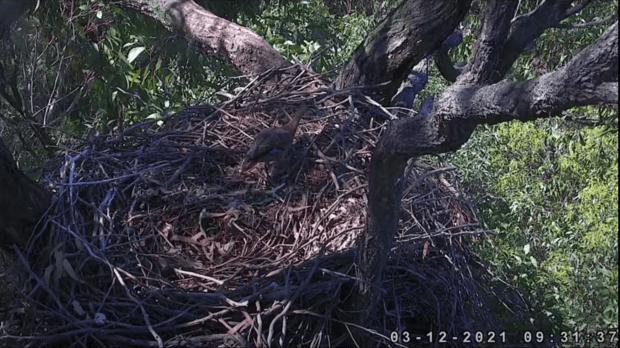
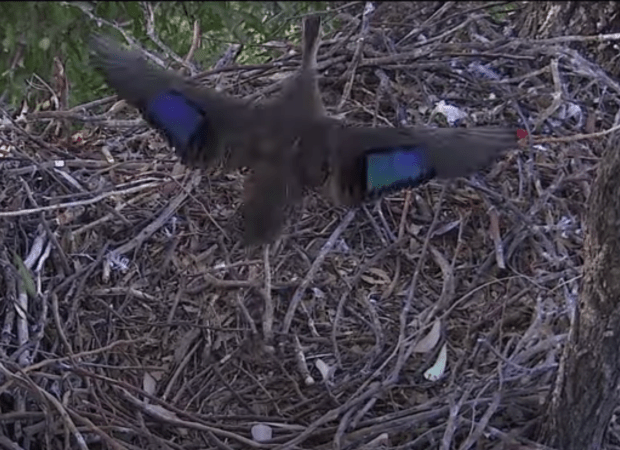
Everyone’s favourite duck, the Pacific Black Duck, Daisy, flew into the nest at 05:21:51. You might be able to see her fluttering and flying up in the image below. She is the blurry mark above ‘2021’.

Daisy landed on the nest a second later.

Daisy seemed a tad more nervous this morning. She is extremely cautious taking almost two minutes before she waddles over to the egg cup.

I wonder what sounds from the forest Daisy is hearing that are making are nervous? Are Lady and Dad back from Goat Island? Has Daisy seen them?

Daisy was still nervous after she settled. She did not remove the leaves. She laid down on them and used her paddle feet to stir them around and the eggs.

At precisely 06:19:36, Daisy laid her first egg – about half an hour earlier than the day prior.

There it is. You can see that it is wet and shiny. It will need to harden and Daisy will hope that predators stay away so that she can cover up her clutch of four eggs completely today.

Daisy is allowing the air to harden the egg as she stands over her clutch. If she follows the same routine of previous days, she will remain on the nest for not quite two hours.

So far Daisy’s luck has held. We hope that the Sea Eagles remain on Goat Island. And Daisy may resist putting down with the eggs until there is hard incubation so as not to attract the Ring-tailed Possums who have made a nest also in the sea eagles’s tree.

Good Luck today, Daisy! Cover the eggs really well. You have hundreds of people watching you and sending you much love and luck!!!!!!

Thank you for joining me today. I will bring updates for other nests later today that will include a final check in on Daisy. Take care all.

Thank you to the Sea Eagle@Birdlife Australia Discovery Centre for their streaming cam where I took my screen captures.

Watch Iniko live – and other Bird World news

For those of you excited about the release of California Condor #1031 Iniko, you can watch her and all the other condors up by the sanctuary live! Remember that Iniko and those released with her wear an Orange tag with black numbers!

The camera moves around the sanctuary. Here are a couple of screen captures of the site for you.

For those who love the Royal Albatross, OGK arrived home at 18:40:19 to relieve YRK so she could go and feed. There was a lot of allopreening (preening of another not yourself), sky calling, and cuddling. YRK let OGK on to incubate but stayed close to the nest for awhile. What a lovely couple.

Ranger Sharyn checks OGK’s egg and gives the thumbs up.
OGK admiring his egg and talking to it. So sweet!
OGK allopreening YRK on arrival.

Sharon Dunne posted a video of the exchange. Enjoy!

Last year was a very sad year for many bird nests. I recall the great sadness when both Peace and Hope died on the Captiva Island Bald Eagle nest. Those were two very unnecessary deaths. Someone near Lori’s property where the nest is located used rodenticide! Just crazy. The two beautiful chicks died. The parents, Joe and Connie, were overcome with grief. Indeed, it was that grief that Joe suffered that – well, caused him to leave or not defend his area well. It reminds me so much of Samson’s father Romeo’s grief. Connie is now with another male, Clive. Connie laid her first egg sat 05:55:37 this morning. We wish them well – and I certainly wish that people would remember and recommend RATS: Raptors are the Solution!

Good luck this year, Captiva!

Here is the link so that you can watch Connie and Clive. There is also a side camera. I just prefer the overhead to see all the action.

It has been a really busy day. Daisy did, as she has done the past two days. She stayed with her three eggs now until the newly laid one was dry and hard. She stretched to try and find leaves. This seems to be an issue – fewer leaves on the nest this year. One of my friends told me that there is also something different this year than last – a pair of Ring-tailed Possums has a nest in that same tree. That could be the reason that Daisy has not pulled out any down yet. Lady and Dad, the White-Bellied Sea Eagles that are unwittingly leasing their nest to Daisy were at Goat Island. It is hoped that they will remain there for the full month! My friend also noticed that the egg cup is very small this year. She hopes Daisy does not lay very many eggs so they can be covered properly allowing us the hope and Daisy that we will see ducklings jump. Anyone have any ideas on how to dump several huge baskets of leaves on that nest? The Port Lincoln lads continue to do well.

Thank you for joining me today. Take care all. See you tomorrow for Day 4 of the Daisy Chronicles.

Thank you to the following for their streaming cams where I took my screen shots: Sea Eagles @ Birdlife Australia Discovery Center, Captiva Bald Eagles, Ventana Wildlife and Explore.org, Cornell Bird Lab and the NZ DOC.

The Daisy Chronicles, day 3

Daisy appears to have established a routine coming to and from the nest. I will check this today once it approaches dawn in Sydney.

Yesterday she arrived before dawn and checked on the one egg. She cautiously returned later and laid her 2nd egg. Once it was hard and she had warmed it for a short while, she began bringing leaves from all around the nest – stretching her little neck to its fullest. If she heard a predator, she would stop everything. Slink down into the nest cup as best she could and wait. Then she would begin gathering leaves again. Then she departed.

The images below are from the time Daisy arrived til she left on day 2.

Today is Day 3! Oh, our brave little duck. She arrived before dawn. Egg 3 was laid at 6:55:07. You can see that moment in the images below. Oh, this little duck from last year learned so much in a year. Many of you have written to me remembering that last year we felt that if Daisy had arrived a month earlier the eggs might have all hatched. Well, this smart duck did that this year. This would be her first clutch of the season. She can lay eggs twice. Last year Lady and Dad spent the month of December at Goat Island for the most part rarely checking on the nest. We will never know if Lady hadn’t tossed the down all over the place if those eggs could have remained hidden from the Ravens. But, if Dad and Lady are away from the nest ———— well, Daisy, we are all sending you the best energy that we can.

You could hear the Sulphur-Crested Cockatoos and the other birds in the forest. Daisy is extremely cautious – as she should be.

It looks like there are a few sprinkles on Daisy’s feathers. Our beautiful little duck is standing above thee eggs so the third will dry and the shell harden.

Daisy will do what she has done the other two days. Allow the shell to harden. She may stay on the three eggs a bit before covering all three and leaving the nest. She appears to not have removed any down from her breast yet for the eggs.

The egg is now dry enough to Daisy to lay down on all of the eggs.

I wish Daisy knew how many well wishes she has from around the world including her good friend ‘I’ from Poland.

Thank you so much for being here for Daisy today. Stop in tomorrow for Day 4 of The Daisy Chronicles. Stay safe!

I will continue to monitor the situation — and, of course, you can, too. Here is the link to the streaming cam!

Thank you to the Sea Eagles @Birdlife Australia Discovery Centre for their streaming cam where I took my screen captures.

The Daisy Chronicles, day 2

We are going to start off with a check on what is happening in San Francisco – before moving on to Daisy.

An absolutely adorable 4 min 16 sec radio discussion on The Love Story in the Sky at The Campanile.

Did you know that Peregrine Falcons were virtually wiped out in California? In the late 1970 there were only two nesting pairs? This was the result of DDT. There is lots of literature but reading Rachel Carsons, Silent Spring, is a very good start.

DDT might have been banned after the revelations of Rachel Carson and others but it remains in the soil in various places. One of those is Big Bear California where DDT was sprayed on Big Bear Lake to kill the mosquitoes. It is still a contributing factor in thin egg shells which may be part of the problem with Jackie and Shadow, the Bald Eagles that have their nest at Big Bear.

Daisy the Duck did not spend the night on the White-Bellied Sea Eagle nest.

She arrived before sunrise to check on the nest. No one else was there. Daisy will be very cautious. She does not want to draw attention to the egg cup where her first egg was laid.

She goes over to where her egg is and checks. It is still there. Safe.

We can see where Daisy’s egg is because we know it is there but it is nicely covered with leaves and nest material so the predators cannot find it.

Daisy leaves right as the sun is rising and the forest is waking up.

Daisy carefully waits on a branch when she returns an hour and a half later. Can you see her?

She is checking and rolling her egg.

Daisy is very still. When she is in labour, her tail will move up and down.

There are now two eggs! Look you can see them both. Daisy is holding herself up so as not to break the second egg. When the eggs are laid they are soft. The air will dry off the surface and make them hard.

Daisy has settled on the eggs nicely. She is having a rest. Daisy will not do hard incubation until all of the eggs are laid. That is so they will hatch at the same time.

This last image of Daisy was taken a few minutes ago. It is nearly 08:30 in Sydney, Australia.

So far Daisy has been lucky. Lady and Dad did visit the nest tree a week ago and then on the day that WBSE 27 was released from care, they were not at the River Roost. They will often go to Goat Island if there are no eaglets to look after. Still, we know that they do come to check the nest.

Someone asked me why Daisy does not stay on the eggs now all the time. If she did they would not all hatch on the same day. Secondly, she is a very smart little duck. Her presence on the nest makes all of the other forest animals and birds curious. Last January they had never seen a duck on the big sea eagle nest — and neither had anyone else! I think Daisy will try and protect her eggs really well this year from the Ravens. She is almost a year older and she is ‘wiser’ now. Her breeding and the laying of eggs normally coincides with plenty of food and water. Her mate, who came to inspect the nest last year, only takes part in the mating ritual. The rest is up to Daisy. That is why she is so vulnerable. Only 20% of Pacific Black Ducks live to be 2 years old. Indeed, the average life span is only about two years. Oh, I so hope that she is successful this year! There are so many people hoping for Daisy!

You can join in and become a real Daisy fan. She needs all the love and positive energy we can all send her. Soon the name of the streaming cam will be changed from Sea-Eagle to Duck Cam! Here is the link to the streaming cam. Daisy arrives about 13:15 CDT or around 05:15 Australian Time. I am not expecting her to stay all day but she might surprise me.

Once Daisy lays all of her eggs (there could be 11), she will begin her hard incubation. Incubation will last for 29 days after the laying of the last egg. This is the difficult time. Daisy still has to eat and have some relaxing time. Last year she even went out during the night. It is then that the eggs are vulnerable. As long as she is incubating them, the Ravens seem not to bother. Our fears of the sea eagles proved to be nothing. They could behave differently this year but they were not a threat last save for the fact that scattering the down nesting material allowed the eggs to be seen. Fingers crossed.

Thanks for joining me. Take care everyone. See you soon!

Thank you to the Sydney Sea Eagle @ Birdlife Australia Discovery Centre for their streaming cam where I took my screen captures.

Daisy is back!

Daisy is a Pacific Black Duck. This past January Daisy laid her second clutch of eggs in the old Ironbark Tree used by the White-Bellied Sea Eagles for their nest. She has now returned to lay her first clutch for the 2021-22 season. She laid her first egg today!

Last year we held our breath watching Daisy pick the nest with her mate, lay her eggs, be frightened off by Dad and Lady only to find out their were curious – not harmful. WBSE do not like duck down! It sticks to their bills and must feel ‘fuzzy’. The Rainbow Lorikeets came to visit Daisy every morning. The culprits were the Ravens.

The female Black Pacific Duck normally lays their nest on the ground. Daisy might believe or know for certain that is unsafe. So she tried this high tree deep in the forest. I wrote blog after blog about this brave little Duck that outwitted the big sea eagles. Sadly, the WBSE scattered the down lining the nest cup that had come from Daisy’s chest. She was able to replace it once but then it rained. When she got up off the nest to get food for herself (her mate does not help her at all), the Ravens saw the eggs and ate them. They were within a couple of days of hatching. It appears that Daisy wants to take her chances again using the nest of Dad and Lady. My goodness. Welcome back, Daisy!

Can you see her?

There it is!

You will notice that Daisy has not lined the egg cup with the down from her breast. She will. It seems she was in a hurry to get into this big nest and lay that egg. I wonder if she laid eggs elsewhere and was frightened away? Isn’t she beautiful?

This is so exciting. Daisy renewed my love for ducks last year. The camera operator at the Sea Eagle nest is very good at getting close ups of the beautiful nest cup she will make. The image below is from day 13 of incubation. Daisy was half way to hatch. She is listening for the sea eagles. You can see the mess that Lady made with the duck down – that precious lining and covering, scattered.

Daisy’s beautiful lined nest in early 2021

Daisy was always very cautious when she returned to the nest. She would listen and look around for a long time. She did not want anyone to see where her clutch of precious eggs was.

Satisfied that no one is around, Daisy sits on her eggs.
A friendly Rainbow Lorikeet curious about the little duck in the big sea eagle nest.

This morning I wrote that there wasn’t much happening in the Australian nests and wow – Daisy, you just changed all of that. So everyone even if you think you do not like ducks you will want to watch The Chronicles of Daisy – the little duck that thwarted the great big sea eagles! Here is the link to the camera. Oh, I am so excited I can hardly sit still. Seriously, this is better than ice cream or your favourite mystery thriller.

Just a note. Daisy will not do hard incubation until all of the eggs are laid. There will be between 7-12 normally. The ducklings will all hatch at once and jump off the nest when they are 24 hours old. They will then follow Daisy quickly to the Parramatta River where she lives and where they will immediately forage for food.

Thank you to the Sea Eagles @ Bird Life Australia Discovery Centre for their streaming cam where I took these screen shots.

Everyone’s favourite duck is back!

Lady and Dad had no more than finished eating the fish that was brought to the nest yesterday – in case one of the eaglets showed up – than our very own Daisy flies in! Yes, you read that correct!

Daisy is a Pacific Black Duck. Last year her and her mate visited the White-Bellied Sea Eagles’s nest in the Sydney Olympic Forest in December. They decided that it was the perfect place for Daisy to make her nest and raise her ducklings. The pair worked very hard making a nest cup lining it with leaves and the soft down that Daisy pulled off her breast. It was a work of art!

There were seven eggs in the nest. In total, however, Daisy laid nine eggs. Dad ate one and it is presumed that Daisy laid one egg elsewhere on a day when Dad decided to stay all day at the nest trying to catch her. Daisy is a very intelligent duck!

Here she is laying her last egg.

No one knew how but Daisy managed to thwart efforts of eviction. Lady and Dad were very curious and would come to the nest and mess it up but they were curious only. Dad had tried to eat a second egg and couldn’t and seemed to not like the taste of them anyway! Daisy would wait for the sea eagles to leave and return quietly to incubate her eggs. They were close to hatch when, at a time she was off the nest, the Ravens came and found them. Hundreds of people cheered the little duck on. No one thought that her or her eggs would last longer than a week but, she almost made it. Maybe this year she will.

This morning Daisy came to visit the nest again. Look closely. Her camouflage really works well. Can you see her?

There she is right in the middle of the nest.

What a relief to see that our darling little Daisy survived another year. She looks really nice and fit except for her paddle feet which look a little worse for wear since last year.

I could not see if her mate was with her or not. He certainly didn’t come into the nest but he might have been on one of the branches. Last year, he was very active in helping Daisy select the nesting site. Sadly, he was not active in protecting Daisy and the eggs.

Normally Black Pacific Ducks would make their nests on the ground near water. In this case it would be somewhere along the Parramatta River. There are, as we well know, predators ready to steal the eggs or eat the ducklings the minute that they are laid or hatch. Perhaps Daisy still thinks it is worth the risk of the ravens to try for a clutch here. Black Pacific Ducks lay two clutches of eggs a year. This is earlier than last year so, perhaps, this would be the first of two clutches this breeding season.

Oh, those beautiful wings. I cannot tell you how excited I am to see Daisy and to think of the possibility of seeing ducklings jump off this old nest in the Ironbark Tree. That would be really amazing.

I will keep you posted of developments or you can tune into the Sea Eagles cam to see if Daisy returns tomorrow morning. Here is the link to Cam 4 without the chat:

If there are any updates on WBSE 27 I will bring them to you tomorrow. There was some clarification about what happened. 27 had been standing on the road or sidewalk. When it flew up it was attached by a group of Currawong who kept hitting its head and it fell to the pavement. Thankfully a ranger was close by and 27 was alert in the transport van. So far no news is good news. I am really hopeful that 27 will get great care and if there was nothing broken or no internal injuries, it will make a full recovery and be returned to the wild. Indeed, this could all be a blessing in that 27 will be strong and well fed and able to fly before it is released. This might be just the chance it needs to survive.

Thank you so much for joining me. Take care everyone. See you soon!

Thank you to the SeaEagle Cam@ Birdlife Australia for their streaming cam where I took my screen captures.