Early Monday in Bird World

6 June 2022

Liz has posted a video of Urmas and his team removing the Black Storklets from Janika’s nest in Jegova County, Estonia on 5 June. I reported earlier that a glove like a Black Stork shape had been used to place the storklets in the basket. That information is incorrect and my apologies. Bare hands were used. One storklet, sadly, died in the nest over night before the intervention. They need temperatures of 22-28 degrees C. They cannot thermoregulate their temperatures yet. In addition, it rained and well – I hope the remaining chicks survive and thrive. It will be a first for the Veterinary College to raise Black Storklets to fledging. Good luck to Urmas and his team!

Here is the video that Liz posted:

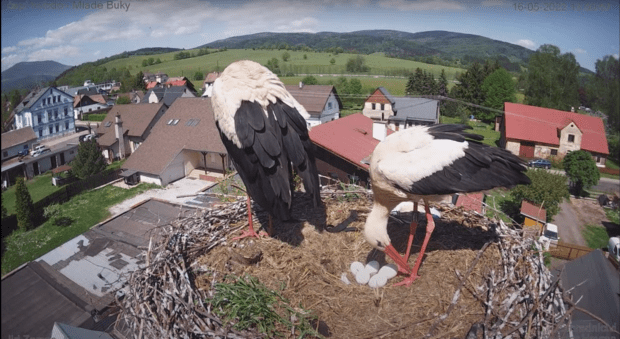
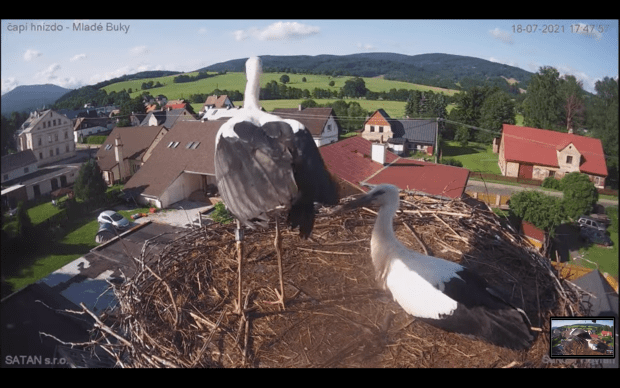
The White Storks Bukachek and Betty still have five storklets in their nest in Mlade Buky, The Czech Republic. You can see the difference in size from the oldest to the youngest known as ‘Little Finger’ by the chatters.

Bukachek (male) is making sure that the wee storklet gets food in the image below.

It has been raining on and off. The rich Red Iron in the clay makes all of the Storks look dirty. Maybe when it is not so rainy more straw will be brought to the nest! That would help.

Awhile ago I mentioned the Lesser Spotted Eagles. Andris and Anna, at their nest in Zemgale, Latvia. The camera was down for awhile but it is now back and running. In the meantime, a beautiful little Lesser Spotted eaglet has hatched!

It is so cute and fluffy! There was only one egg so this is the only chick. Had there been two eggs, the first hatch most always predates the second. So having only one is a good thing! The parents can focus on bringing food to this cutie pie.

Voldis came to the White-tailed Eagle nest that he shares with Milda near Durbe, Latvia. He arrived at 05:30 and stayed for well over an hour.

Milda has had a terrible time since her long time mate, Raimis disappeared two years ago. I hope that Milda and her mate if it is to be Voldis have a very successful next breeding season. This year the eggs were predated.

Margit hatched on 25 April and is growing by leaps and bounds with the tender care of the parents, Kalju and Helju. This Golden Eaglet’s nest is in Soomaa National Park in the southwest of Estonia.

Oh, such a beautiful eaglet. Margit is waking up. The black dot behind the eye is the ear. It will be covered over with feathers before the eaglet fledges.

Helju just brought breakfast for Margit. Liz caught it in a video:

This is the streaming cam for this nest:

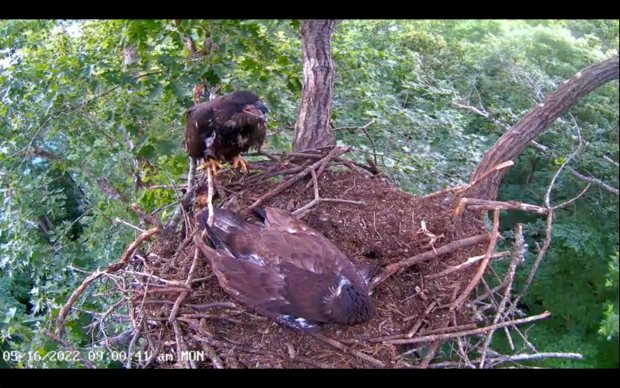
What is happening with Ahote? Ahote, the youngest of the three eaglets at the West End nest of Thunder and Akecheta, fledged on June 2. He has spent the time since then on Transmission Rock and is getting hungry unless food was delivered. Working his way back to the nest, he got some wind on his wings and got to the nest but was blown off course. No doubt he will get there! Very determined.

In the image below you can see him directly below and slightly to the right of Kana’kini and Sky.

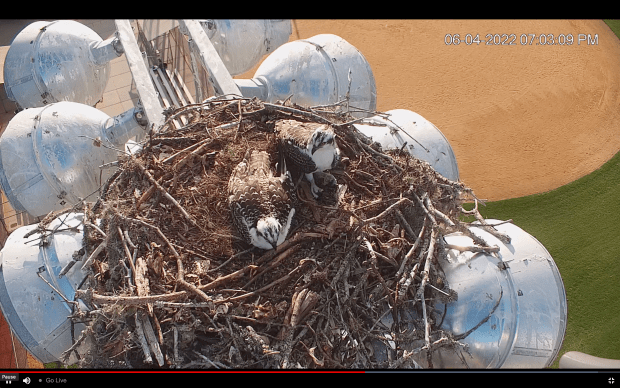
Checking on Osprey nests in the UK, the third chick hatched at Llyn Brenig but did not survive.

Aeron Z2 and Blue 014 have had their first hatch at the Pont Cresor nest in the Glaslyn Valley.

Laddie LM12 delivered nine – yes, 9 – to the nest for Blue NC0 to feed their three Bobs at the Loch of the Lowes.

All three Bobs seem to be doing fine at the Glaslyn nest of Aran and Mrs G. Just look at how dark Mrs G’s plumage is and that necklace.

Aran has been busy delivering fish. Little Bob is not always in the most perfect position!

I do have to admit that Idris and Telyn are my favourite Ospreys in the UK along with Blue 33 and Maya.

Telyn is feeding the two older Bobs while Bobbie Bach is asleep.

Food coma!

Oh, could that be comfortable?

There is Bobbi Bach ready for his meal while the others sleep. Poor Telyn. They are surely keeping her busy.

It looks like it is starting to dry out for Dylan and Seren at the Llyn Clywedog nest. Gosh, Seren was just so wet and hunkered down keeping the three Bobs warm and dry. Let us hope the sun comes out, too, to warm them up.

Both of the Ospreys were on the UFlorida-Gainesville nest sleeping during the night.

Both are back on the nest waiting for a breakfast delivery!

Good Morning Little Bit 17! Everyone is waiting for prey deliveries at the ND-LEEF nest. I hope that the adults will feed Little Bit like they did yesterday. That would be grand.

The scrape box at Manchester NH is getting to be quite the mess! A good wind will help clear it out. It is hard to believe but this scrape will be on fledge watch beginning on the 10th or 11th of June – this coming weekend!

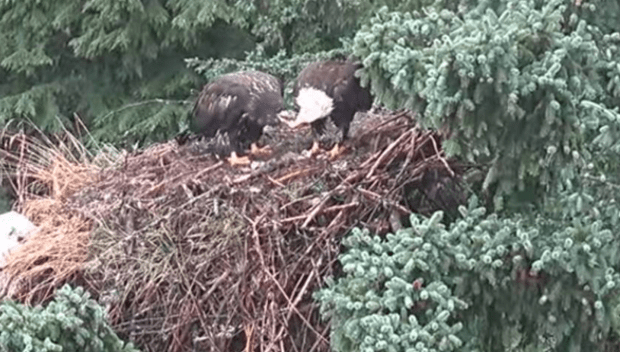
Nancy is on the nest at 08:40 feeding E1. It looks like they will have a beautiful day at that Bald Eagle nest in Minnesota. Wonder when E1 is going to take to the skies? Nancy has done wonders taking care of E1 and fending off intruders.

Fledge watch is on for the three at the Pittsburgh-Hayes Bald Eagle nest. It looks like only two but 17 is up higher in the tree.

There are still two eaglets – Sentry and Star – on the Redding nest of Liberty and Guardian. We are on fledge watch for these two also! It could be a very busy week!!!!!!

We are definitely on fledge watch for the eyases on the nest of Big Red and Arthur on the Cornell campus. The chicks are restless and L1 is definitely ready!

Oh, the excitement of a nest of four hawks – each itching to fly including the youngest, L4. Wonder if L1 will be the first of the oldest to go? Stay tuned.

Thank you so much for joining me this morning. Take care. See you soon!

Thank you to the following for their streaming cams where I took my screen captures: the Eagle Club of Estonia, Mlade Buky White Storks, Latvian Fund for Nature, IWS and Explore.org, Friends of LOTL and the Scottish Wildlife Trust, Bywyd Gwyllt Glaslyn, Dyfi Osprey Project, CarnyXWild, UFlorida-Gainesville Ospreys, ND-LEEF, Peregrine Networks, MN-DNR, Pix Cams, Friends of Redding Eagles, and Cornell Bird Lab RTH.

Late Saturday in Bird World

4 June 2022

It was a fantastic day on the Canadian prairies. Clear blue sky. Sun shining bright and everyone happy – even smiling and saying ‘hi’ on the trails. Sadly, the birds thought it was beautiful too and they must have all gone sight-seeing! There were some American White Pelicans – 7 to be exact – hanging out with 9 Double-Breasted Cormorant. A female Hooded Merganser. A family of Canada Geese! And many Red-wing Blackbirds protecting territories where there were obvious nests. It was still nice to be outside with the sun beating down even if there had been not a single bird in sight.

There were two females on nests and these three goslings with their parents. This place should be crawling with goslings – everywhere. The flood really did a lot of harm.

The Redwing Blackbirds appear to have sentinels that stand watch or follow humans trying to lure us to one spot or another away from the nests.

There has not been a lot of time to check on all the nests. I wanted to see if Little Bit 17 had any food. He had an entire fish to himself yesterday but he needs food every day! It won’t always get it, sadly. Not on this nest. At 19:02:47 a Bluegill at 19:02:47. Everyone sort of looked at Dad and the fish. Then at 19:04:57 Little Bit stole it! I cannot tell you if he got any fish to eat but he worked on it until 16 – the one who beaks him – stole it from him. Then 15 took it and Little Bit moved over by the porch and did the snatch and grab and got some fish. There could be another delivery later.

It is not a huge fish.

Little Bit was quick! And he took advantage of a good situation. It is too bad that Dad didn’t just block the other two!

16 has the fish and 15 is going to get it away. Little Bit is at the top left watching and listening. Little Bit knows if 15 gets the fish he will get some food.

There is a scab forming over the bad peck that 16 gave Little Bit the other day.

Little Bit is by the tree snatching and grabbing bites from 15 as 16 watches.

At 17:37 Little Bit gets the fish head and moves with it to the top railing where he feeds off it until 17:50! Well done Little Bit 17! You will clean that head of every bit of fish flake like no one else. So happy.

Janika has been regularly feeding the storklets. The last feeding was at 22:54:10. The four have eaten well today. I thought maybe she would stay with them during the night but she is off hunting for food. Urmas has not removed any of the chicks. Perhaps Janika can make this work! I hope so. I wish she would find the fish basket provided for her.

The last two eggs hatched for White Storks Bukacek and Betty at their Mlade Buky nest in The Czech Republic. I cannot help but think that the two smallest will become brood eliminations but, maybe not. That is a lot of mouths to feed.

At the Cal Falcons scrape, Annie and Alden have done the most amazing job raising these two eyases. They are huge – full of energy and life and absolutely healthy. We will be forever grateful that the Avian Flu did not manifest itself in the West so that these two can take flight. Their names could not be more perfect – Lindsay and Grinnell Jr.

Meals happen outside of the scrape now and the chicks run up and down flapping their huge wings. Seriously – look at that wing!

These two have great fun playing with one another. Have a look:

There is something so stunning about the plumage of juvenile Ospreys – the patterning, the beautiful black and white. I do think they are much more gorgeous than the adults. Don’t tell them! Middle has been working his wings since Big fledged.

These two have eaten well. Mum and Dad really filled them up yesterday after getting Big back on the nest for breakfast. And it is nice that the heavy rains forecast for Gainesville as part of the Tropical Storm did not materialize.

The five falcons at the Manchester NH scrape have almost lost all of their baby down. It is really something when food comes to the scrape. All are fed but oh, my what mayhem!

Aran and Mrs G are doing fine with the osplets. It is a wonderful streaming cam because you can hear rural Wales – the sheep bleating and the cows mooing. It is quite lovely if you live in a city like I do.

Despite the strong winds at the Dyfi nest, Idris and Telyn are keeping the osplets nicely fed and hunkered down. Bobbi Bach has really eaten well. He hatched on the 28th of May and is a week old today. Happy Week Birthday!

Poor Telyn. The wind has done a mess of her feathers.

When the third egg hatched at the Loch of the Lowes, I held my breath. It took Blue NC0 a few days to get it together to feed three. Now just look at them. Unbelievable. Lots of fish and this is what happens – fluffy little Osprey chicks with their soft grey down turn into Reptiles. Little Bob is not having any trouble. There he is in the middle of the pack at Mum’s beak.

All over England they are celebrating the Queen’s Platinum Jubilee but in Poole Harbour everyone continues to be delighted in the first three – yes, the third hatched – ospreys to hatch in Poole Harbour in more than 200 years!

In fact, of the birds translocated from Scotland to Poole Harbour over the course of a couple of years, three are now breeding. It has been an enormous success and a shout out should go to Roy Dennis Wildlife for his steadfast belief that you could re-introduce birds to a location by using hatches from another area (Scotland in this case).

You can read all about CJ7 and Blue 022 on Roy Dennis’s website here:

https://www.roydennis.org/category/latest-news/

Roy Dennis writes extensively about this project in his book, Restoring the Wild.

Big Red took a break from parenting to sit on the lights in the sun today. It is quite crowded on that nest now!

The light was not so good to see the eyases but it was good to show the dark bands on the chick in front of the light box. There are five clear dark bands on that chick. From the length of that tail in comparison to the bird to its right, it has to be L1. I would suspect that there are actually 6 clear bands. She is ready to fledge!

What a year it has been for Big Red and Arthur with four eyases on the nest! Even at 19 Big Red continues to surprise us and keep us in awe. She is an incredible hawk and hawk Mum!

Thank you for joining me for this quick look at a few nests today. Take care. See you soon.

NOTE: My Sunday report will come in the late evening.

Thank you to the following for their streaming cams where I took my screen captures: Bywyd Gwyllt Glaslyn, Dyfi Osprey Project, Friends of Loch of the Lowes and the Woodland Trust, Cornell Bird Lab and RTH, ND-LEEF, UFlorida-Gainesville Ospreys, Poole Harbour Ospreys, Cal Falcons, Peregrine Networks, Mlade Buky Stork Cam, and the Eagle Club of Estonia.

Monday Morning in Bird World

16 May 2022

The sun is trying desperately to brighten the sky. The leaf buds are half way open and there is a tinge of green on all the trees in the neighbourhood. So nice after the long grey white brown winter which seemed to go on forever. The flood waters in my province are finally receding but the cost to the wildlife is unknown. I do hope to see some goslings but how many nests were destroyed by the rising waters will always only be a guess.

I want to thank everyone who sends me news items that demonstrate that we have a long way to go in our fight to make our planet safe for our dearly loved feathered friends (and others). News has come to me this morning from ‘S’ about the toll that wind turbines are taking on the eagles – both Bald and Golden. What an avoidable tragedy!

The ESI Energy Company, Inc. has pleaded guilty to violating the Migratory Bird Act in its killing of at least 150 Bald and Golden Eagles.

https://www.smithsonianmag.com/smart-news/wind-energy-company-pleads-guilty-to-killing-eagles-180979898/

The story was carried by all the major US news agencies. Thank you ‘S’ for bringing this to my attention.

https://www.usatoday.com/story/news/2022/04/06/150-eagles-killed-wind-turbines/9492311002/

The simple solution is to paint one blade black. “An eagle eye has two focal points (called “fovea” [singular] or “foveae” [plural]) one of which looks forward and the other to the side at about a 45 degree angle. These two foveae allow eagles to see straight ahead and to the side simultaneously.” A study by Jesper Kyed Larsen, Environmental Expert at Vattenfall (Netherlands Energy Company) says, “Painting one blade of a wind turbine rotor black resulted in 70 percent fewer collision bird victims. That has to do with the way birds perceive the moving rotor of a wind turbine.”

https://group.vattenfall.com/press-and-media/newsroom/2022/black-turbine-blades-reduce-bird-collisions#:~:text=That%20study%20showed%20that%20painting,Larsen%2C%20Environmental%20Expert%20at%20Vattenfall

So why is this easy solution not being undertaken? Why is this taking so long?

Some US States have outlawed balloons because of the damage that they do to the waterfowl. ‘L’ writes about a story that broke in Florida after 90 balloons were popped and tossed into the water? How many waterfowl will wind up in the care of the local wildlife rehabilitation clinics? This is precisely what happened on a yacht in Biscayne Bay. Will fines and public shaming help to stop the problem of the balloons? And do we really need to have balloons to have fun? or to mark the site of a celebration?

https://www.timesunion.com/news/article/2nd-arrest-after-viral-video-shows-popped-17171599.php

The two osplets on the nest at the practice field at the University of Florida in Gainesville are waiting for their breakfast.

As I write this, it is now past 11:00 and the two chicks are still waiting for a fish to appear.

As all of you know, ‘R’ and I have been trying to solve the mystery of the lack of fish coming to this – a fact that saw the third hatch become a victim of siblicide. Every possibility had been examined with no conclusions other than multiple factors might be causing issues including the amount of algae in one close lake and the encroachment of dormitories and parking lots taking up part of Alice Lake. This morning ‘R’ caught the camera panning around the campus. There had been a question about whether or not Dad had another nest.

So who is on this nest? Is this a second nest of Dad’s?

The mystery continues.

Still tracking what is happening at the nest of Richmond and Rosie on the old Whirley Crane in San Francisco.

Everyone was expecting the first egg to pip or even hatch by the 15th of May.

Rosie was rolling eggs and the camera is zooming in to see if there is a pip.

That looks like old fishing nets on the nest. Makes me nervous just like fishing line and baling twine.

Is anything happening? It is very hard to tell.

Everything is fine at the platform of Blue 33 (11) and Maya at Rutland today.

Iris. Iris has, perhaps, had a suitor landing on the nest. One day she called for a fish and he did not bring her one. The next day she fought him off. Yesterday she did let him land but she isn’t friendly. Oddly, Louis doesn’t seem to be around. If only this new male would bring Iris a fish!

There is a chunk of fish on the MN-DNR nest of Nancy and E1, Harriet. We can assume that all is well so far there today.

Beautiful close ups of DC9 at the National Arboretum nest of Mr President and Lotus.

The two eaglets on the Dale Hollow nest are restless this morning. We are within the early part of a fledge window at this nest.

So many of us are really going to miss the triplets at the West End nest of Thunder and Akecheta. What a joy Kana’kini and her two brothers have given us this year. But hates off to Akecheta. He sure stepped into the role of Dad in a big, big way!

The wee eyases at the Cal Falcons nest cuddled up with one another. They are waiting for their breakfast.

Cal Falcons reports that the eyases have reached a milestone in their development:

Oh, those five eyases at the Manchester, New Hampshire scrape are growing. Unbelievable!

The falcons on top of the tower in Oudenaarde in Belgium have an amazing view! In the image below you can see that while the chicks are seemingly alone, there is an adult close by. This would be the same with all the other falcon scrapes that we watch.

Big Red was up early – just as the sun was beginning to shine over Cornell’s campus at Ithaca – feeding the Ls. Notice how the eyases’ gorgeous contour and wing feathers are starting to grow.

Gosh, I continue to enjoy watching the Goshawk, Alla with her chicks. Here is a short video clip of a feeding this morning.

Bukachek and Betty have been taking turns incubating their eggs in the Mlade Buky nest in The Czech Republic. Some of the interference with the nest has stopped. Looking for pip watch in about a week.

That’s a wrap for this morning. The truck has arrived to start taking apart a very old garage/shed that has been the ‘penthouse’ for Little Red. By mid-June, if all goes well, there should be a greenhouse/conservatory taking its place. Can’t wait. The birds are not happy with the workmen being here – indeed, the birds are not happy if I am outside other than to fill their feeders!

Thank you for joining me today. Take care all. See you soon.

Thank you to the following for their streaming cams an/or FB pages where I took my screen captures: Cornell RTH, Cal Falcons, MN-DNR, LRWT, UFlorida-Gainesville Ospreys, DHEC, NADC-AEF, Mlade Buky White Stork Nest, Peregrine Networks, Montana Osprey Project, Explore.org, SF Bay Ospreys and Golden Gate Audubon.

Feedings and fires…Storks fall from the sky over Athens

Today is a gorgeous day on the Canadian prairies. The rains helped to contain or put out many of the wild fires in our province and this morning, for a second day, we woke up to blue skies and white clouds! All of the plants are a vibrant green and the birds continue to sing. There was not enough to fill the dry creeks but the downpours we did get are a reminder of how much all life depends on water. The nestlings and fledglings would add ‘food’ to that list!

There is a constant worry that some of the late hatches are seeing dwindling food deliveries and that the parents might leave for their migration with young still on the nest. My friend, ‘S’ is concerned, as are many others, for the nestlings on two Black Stork nests – one in Latvia and the other in Estonia. Some others worry about the little osprey on the Collins Marsh Nature Centre nest that we have been calling ‘Malin’. (The official contest is underway for the official name).

Malin self-feeds from small Bullhead. 11 August 2021

Malin was receiving 5 feedings on occasion. Those were good days. The chick has not been fed well by the standards of other nests. This past Sunday, 8 August, Malin had no food. Yesterday, 10 August, he had two feedings. Today, there have already been 2 – one at 9:35 and the other around 11:42. Always these are small whole fish or pieces of fish. I have not seen a whopper on this nest.

Malin is hungry and several of us are trying to ascertain if the fish are ‘fished out’ or if the Dad has another nest – it really is unclear. A report by the Wisconsin DNR on the number of Bald Eagle and Osprey nests in the state indicate a drop of Ospreys in area 3, where the Collins Marsh nest is located, by -25.2%. While every other area saw an increase in Ospreys, Collins Marsh was only one of two that showed a decline. Does all of this reflect a growth in Bald Eagle Nests in the area? If you would like to read the report from 2019 (I have not found one for 2020), I am attaching a copy. A big shout out to ‘S’ who found this and sent it to me. Thank you.

The feedings for the nestlings of Grafs and Grafiene at the Sigulda Nest show a similar up and down pattern to that at Collins Marsh. However, there has not been a day without food to my knowledge at Sigulda.

‘S’ reports that on 9 August, the storklings had four feedings – which is considered low – but yesterday, they had only two. Today, there have been 2 deliveries by the female, Grafiene, and one by the male, Grafs. Grafiene is also like the female at the Collins Marsh nest, Marsha, who leaves for periods up to 24 hours at a time. The behaviour of these two females is very curious.

It is hoped that there is time for both the Black Storklings and the Osprey to fledge. ‘S’ advises that the minimum is ten days for the storklings. The Ospreys tend to migrate at the end of August or beginning of September in Wisconsin.

Malin is not ready to fledge. It is very worrisome for many reasons. I look at the development and growth of the Osprey fledglings in the UK and then compare this with Malin. Those in the UK have fully developed feathering and have really perfected their flying skills. They are self-feed with ease. Most have been fledged for a month. Will Malin have a month to further develop his body and skills? Will the storklings? The nest that is on the branch of the pine tree in the forest near Sigulda is so very narrow and has collapsed in the past. Will the hopping and flapping cause the little ones to fall?

The storklings are so excited when a parent arrives with fish that it does make you wonder if the could make the branch nest collapse. Grafiene covered the nest with little fish around 17:20. There was lots of food for each of the nestlings.

The storklings were eating and eating and had large crops. I wonder if a parent will bring another delivery before night?

I am including the link to the Black Stork Nest in Sigulda County, Latvia. If you wish to find the chat room or forum (with lots of information) please check the information under the streaming cam.

In Alaska, Kindness is not short of food. She has gone some days with few deliveries and other days, Dad not only leaves her food for self-feeding but today, he fed his baby girl. Dad just can’t help himself. He has an enormous soft spot for Kindness. The image below of Dad feeding Kindness is right after he had delivered prey 20 minutes earlier! Oh, Kindness, how lucky you are.

Did you know that Bald Eagles have a polarizing lens that helps them see fish in muddy waters? (Just like those who fish often wear Polarizing sunglasses.) That said Bald Eagles normally only feed in the top 15 cm or 6 inches. Their bare legs are designed to only go into the water 15 cm or 6 inches. Like the Ospreys and Sea Eagles, if they had feathered legs, they would get water logged.

You can watch Kindness here. The moderator on the camera chat is reminding everyone today that Kindness is 76 days old today. She is already flapping and jumping. The average act for fledge on this nest – not the whole of Alaska – is 89 days. (The whole of Alaska is 80 days). If she behaves like the other eaglets on this nest, you should be able to watch her until mid-September. Here is the link to that camera:

The White-Bellied Sea Eagle, Lady is feeding 27 and 28. Those little ones continue to look like white fluff balls but if you look carefully, their necks and wings are getting longer and there is a hint of ‘dark plumage’ underneath that natal down. The WBSE nest had a fright a few days ago. Dad showed up on the nest with a laceration on his leg and a cut near his throat that was bleeding. That seems to have subsided and Dad is busy catching fish for the family. (I am wondering about the small amount of salt water in the Parramatta River and its healing effects on Dad’s foot.)

27 and 28 do bonk but not much anymore. Some of the time it is instigated by the ‘little one’! They really are a good match for one another and unlike past years, viewers are remarking that they are really enjoying seeing the nest this year.

The egg tooth is disappearing as their beaks grow longer.

If you wish to watch then, here is the link to the cam:

There is some troubling news coming out in Bird World. ‘S’ informs me that the storks crossing over Greece where the wildfires are raging are being injured in large numbers as they migrate to Africa on the eastern routing. Various news agencies are reporting that people in Athens have been picking up dead storks off their lawns. This is more than sad. Here is a short news report by Reuters. I hope you can open it.

Here is a news article on the plight of these poor birds.

https://www.aljazeera.com/news/2021/8/9/disoriented-by-wildfires-migrating-storks-die-crossing-greece

A second is the number of raptors going into care. In the United States, there is an all out assault on plant life. Various levels of government are asking for and receiving permission to undertake ‘aquatic treatments’ using either Tribune or Harpoon. These are chemical herbicides and they poison birds!!!! At the moment, A Place Called Hope, has raptors in its care because of these treatments.

In Jacksonville, crews have been up doing maintenance on the NE Florida Bald Eagle cam. The presence of humans on ‘his’ nest brought Samson out from the trees and onto the nest yesterday. Wow. What a wonderful treat. Samson remains in the area and does not migrate while Gabby leaves early to travel north to cooler weather. Ironically – and sadly – this year it has been as hot in Ithaca, New York as it has been in Florida.

All three of the fledglings at the Foulshaw Moss Osprey nest were present yesterday. Poor White YW. Tiny Little Bob almost ripped his leg off trying to get at a fish delivery. Tiny Little! To steady himself, White YW had to put his talon on Tiny Little’s head. Gracious. It ended OK – no bird was injured.

For some reason all of the fledglings have been coming to the nest for fish. One will get the fish from dad, one will stalk that sibling, then they will get it and then White YW will arrive with another fish and confuse the entire situation. It is really quite hilarious. The fledglings are as big (or bigger) than Dad! You can watch them here:

https://www.cumbriawildlifetrust.org.uk/wildlife/cams/osprey-cam

Oh, wow. Tiny Little just snagged a fish from sibling 462. Fantastic.

Tiny Little is a ‘scrapper’ just like Tiny Tot. They both learned ‘street smarts’ to survive. Well done, Tiny Little! It was not that long ago that Tiny Little was shy. Her aggression will help keep her alive in the future.

News Flash. The female companion of Bucacek on the Mlade Buky White Stork nest in Czechoslovakia has been named Marketa.

Everyone reading my newsletter loves birds and animals or you wouldn’t be here. I was sent a delightful story – a view of rewilding through the eyes of a deer. Since we have so many deer in our city that have been displaced for ever more condominiums and roads, it really struck home to me. Perhaps you would enjoy reading it, too. Here is the link to ‘Rewilding is a Two Way Street. A letter from your neighborhood deer’.

https://www.hcn.org/articles/essay-wildlife-rewilding-is-a-two-way-street/print_view

Whew. That was a long newsletter. Sorry. Thank you so much for joining me. Send warm wishes to all the birds – for food and for the storks to survive as they travel from northern Europe to Africa. Take care everyone.

Thank you to the following for their streaming cams where I took my screen shots: Collins Marsh Nature Reserve, Glacier Gardens Park in Juneau, Latvian Fund for Nature, WBSE Sea Eagle Nest, Birdlife Australia, and the Discovery Centre, Cumbrian Wildlife Trust and the Foulshaw Moss Osprey Nest.

Pair Bonding

The term ‘Pair bonding’ was first used in the 1940s. In terms of birds, it refers to a long-lasting relationship that results in breeding, care of one another, the nestlings and fledglings.

Pair bonding is “reinforced by ritual behaviour.” That is a very simple definition. A good example of on going pair bonding, is the ‘Morning Duet’ of Lady and Dad on the White Bellied Sea Eagle nest in Sydney, Australia. In fact, the rituals associated with pair bonding often occur at various intervals as a means of reinforcing the relationship not just before breeding.

This is Lady and Dad doing their duet together.

Pair bonding rituals also take place as many ‘bird couples’ prepare to begin their long migration. Working on nests is also happening, preening one another is on the rise. It reminds me of certain war movies where the couples seal their relationship as the male heads off to the field of battle – that sealing often consisting of an engagement ring or a promise to wait for the other. It is precisely the same with our birds. In this instance, both will migrate and each will hope that the other returns to the nest in the spring to renew their bond.

Aran has undertaken any number of sky dances with fish deliveries for Mrs G this week at their nest in the Glaslyn Valley.

Blue 022 and CJ7 continue to work on a nest in the midst of sky diving, fish deliveries, and mating. Sadly, they have chosen one of the Poole Harbour nests that doesn’t have a camera! Still, it is wonderful that they have remained together since spring and that brings promise to everyone that osprey chicks will hatch in Poole Harbour once again.

This evening, my friend, ‘R’ sent me the links to the two short videos below. It seems that Bukacek, the single father White Stork, in Mlade Buky and his new love, are sealing ‘the deal’. You can see some of the community coming out to watch – what a happy ending to such a tragic season for Bukacek.

Xavier and Diamond, the resident bonded pair of Peregrine Falcons whose scrape box is on top of the water tower of Charles Sturt University, are not migrating. Indeed, they are just beginning their breeding season. They continue to pair bond in the scrape. Here is a short video clip I made today so you can see this ritual:

According to the Falcon Cam Project of Dr Cilla Kinross, the average date for the first egg is 27 August. Here is the historical information for Diamond:

  • 2015 with Bula. 31 August, 2 September, 6 September
  • 2016 with Bula. 31 August, 2 September, 6 September
  • 2017 with Xavier. 26 August, 28 August, 31 August
  • 2018 with Xavier. 20 August, 22 August, 24 August
  • 2019 with Xavier. 28 August, 31 August, 2 September
  • 2020 with Xavier. 27 August, 29 August, 1 September

It is going to be so exciting when the little white balls of fur hatch. Can’t wait!

Other Nest News:

Some of us watching Malin on the Collins Marsh Osprey Cam are simply left shaking our heads. The female has been absent from the nest the last three Saturday nights in a row. There is no perch to the nest (they seriously need one). In addition, fish delivery just goes ‘off’ at the weekend. Malin slept alone through a thunder storm with lighting and rain last night and did not receive a single fish today – Sunday. Oh, I can hear you thinking that Ospreys do not need to eat every day and you are absolutely right. In fact, Tiny Tot on the Achieva Nest had 12 full 24-hour days that she did not get food. Often the parents teach the chicks that food does not always come every day. Still, the weekend pattern with this pair of adults mystifies me. Both came to the nest for short spurts without fish today. Malin was food calling (finally) late in the day. She is such a sweet little Osprey – and everyone is delighted that her droopy wing and feathers seem to be filling in and correcting themselves. So, once again, let’s put the optimist’s hat on and hope that there will be 5 fish deliveries tomorrow for Malin! Come on Mom and Dad prove me wrong and bring 6 big ones.

Malin’s beautiful feathers quickly dried out.

At one point, Malin was so excited when Mom arrived that she began to flap her wings and so some little hops. It is reassuring to see those feathers improve every day. We are all hoping for some big fish for your tomorrow, Malin!

A few of us have been calling the Collins Marsh chick, Malin which means ‘mighty little warrior’. That is because it had neither a number or a name. The Neustadter Nature Center at Collins Marsh is having an official naming contest. My friend ‘S’ just told me about this. I am so sorry it is such short notice but please go to their FB site and enter a name in the comments. Put in your favourite name – it doesn’t have to be Malin! I want the Nature Centre to see that there are many people, from around the world, interested in these Ospreys! But be fast. The names must be in by closing time tomorrow, Monday, 10 August. Here is the link where you can go and simply add a name in the thread:

https://www.facebook.com/Neustadter-Nature-Center-at-Collins-Marsh-140052786074932

After Monday, the names will be short listed. Please go back to this FB site and vote for your favourite. Thank you!

There are now three eggs in the Port Lincoln Osprey Nest. They were laid on 3, 6, and 9 August. That means that there is already six days between the first and the last. This nest always makes me nervous because of its history of siblicide. But, I am going to strike an optimistic note this year and take a wait and see attitude.

The White Rock Fire that was threatening Dr Christian Sasse’s property where he live streams his programmes on Ospreys and Bald Eagles is no longer out of control. Rain and the gallant efforts of the firefighter’s seem to have stifled this wildfire. This is great news for all the people and the wildlife. Let us hope that rain pours down on all the wildfires.

Thank you for joining me. It is so nice to have you here. Please go on line and put in a name for the little chick. Take care. See you soon.

Thank you to the following for their streaming cams where I took my screen shots and video clips: Port Lincoln Osprey Project, Collins Marsh Nature Centre, Bywyd Gwyllt Glaslyn, Sea Eagles, Birdlife Australia and the Discovery Centre, Falcon Cam Project at Charles Sturt University and Dr C Kinross.

Early Monday in Bird World, 2 August 2021

Many who read my newsletter have a love for all birds and a particular fondness for one or two species and a number of nests. My personal journey began with an encounter in my own garden – literally, getting up close and personal with a female Sharp-shinned hawk in the dead of winter who, I believed at the time, was eating the garden rabbit, Hedwig. She wasn’t. Our eyes locked to one another’s, ‘something’ happened. I cannot describe it but those minutes changed my life. I know that many of you have had a similar experience as well as others who have gone on to write books about their journeys.

Philip Brown’s, The Scottish Ospreys from extinction to survival, written in 1979, is just such a book. My used copy arrived in the post a couple of days ago from the UK. The only time that I have had to read has been late at night. The book is so well written that I was often hesitant to stop reading. His enthusiasm and love for these fish-eating birds animates the drive in Scotland to reintroduce the Osprey after years of extinction. Brown gives a good solid history but it is his personal stories of spending time with others at the eyries of Loch Garten guarding the nests that draws the reader into sympathy with the birds. Brown worries about the trees that are partially dead but have nests, about the poachers that are killing the birds, and how to halt the illegal practice of egg collecting. Those are woven in with the growing understanding of osprey behaviour and the efforts to grow public interest in the birds. If Ospreys tug at your heart then this is a book that you should read. When I was looking for a copy I discovered that the book could be ordered from the UK with standard post for a very reasonable price. It is a hardback book and used copies are available for less than 5 GBP.

I want to re-mention another book, available only in paperback. Lady of the Loch. The Incredible Story of Britain’s Oldest Osprey is by Helen Armitage. There are a couple of ways it is different than the Brown volume. It is newer, written in 2011. The book covers the reintroduction of the Osprey to Scotland also but does it by focusing on a single bird, Lady, at the Loch of the Lowes. Lady raised 48 chicks migrating to Africa and back 20 times. That is simply astounding. Armitage’s book is different in another way. The lens is female, a welcome change when the majority of books on Osprey are written by men. She includes details not found in other volumes including one that I found particularly interesting. In trying to protect the Osprey, “In September 1899, Queen Victoria confirmed that certain regiments would stop wearing osprey plumes…” She also notes that it was women who continued the fight to stop the use of bird plumes including the Duchess of Portland who became the head of the Society for the Protection of Birds. It is time to think of fall reading and these are two really excellent books to curl up with.

In nest news, it appears that Bukacek or Father Stork is the only member of his family sleeping on the nest at Mlade Buky.

It is possible that both Pankrac, the female, and Servac, the male are with other fledglings preparing for their migration?

The normal practice with raptors is the female leaves for migration first. The male remains feeding the fledglings and bulking up himself. Once the fledglings depart, the male begin his long journey. Is this also the same ritual for storks?

I had a beautiful letter from a reader, ‘S’. She confirms the special status of storks in her country, Latvia. The people of Latvia have a special name for the White Storks, svētelis. She says the term speaks to the “embodiment of something holy and brings peace and protection from bad things.” This belief explains so much about the great love the people of Latvia have for their storks and that same understanding of storks being special must extend to surrounding countries where people go to great lengths to care for these amazing birds.

In regards to the migration of the storks, ‘S’ says that every year the storks gather on the trees, the roofs of all the houses and buildings, as well as on the electricity poles close to where she lives. When they are all ready to leave they begin clacking their bill together similar to what they do when the storklings are wanting food. Close your eyes and try to imagine how wonderful it would be to see this enormous gather of storks, each being called by the winds to begin their journey. The only equivalent we have in Manitoba are the Canada Geese. Every year they gather on the large ponds near to our nature centre, Fort Whyte. They arrive as the sun is setting calling one another. It is extremely moving. I can only imagine if it were storks!

There are several videos on YouTube about Klepetan and Malena, the famous Croatian white storks and the man, Sljepan Vokic, who has cared for Malena for more than 22 years. Sometimes, it is nice to see one of those videos just to remind ourselves that the world is full of kind caring people.

Skipping down to Australia, the two little sea eaglets, 27 and 28, are doing really well. It is mystifying watching Lady feed them the tiniest morsels of fish from her large beak.

Just look at the size of fish flake Lady is feeding to 28. She is so gentle.

There is plenty of fish in the nest and, so far, I have not seen any signs of food competition. Both of the little ones have nice tiny crops after their feedings. So far, so good. Fingers crossed it keeps up. Indeed, the only cheekiness I have seen is 28 trying to take a bite of 27’s head!

I love the look in Lady’s face as she stares at those two precious little fluffy bobbles. In many ways Lady reminds me of NC0 on the Loch of the Lowes nest in that she has grown into being an excellent – and loving – mother.

There is a gentleness about her movements with the two chicks this year that is striking. These moments of both of them tenderly tucked under mom will pass so quickly – they grow so fast!

A quick early Monday morning check on the UK Osprey nests reveals that Aran and Mrs G have been on the nest together since approximately 4 am.

Amidst the bleating of the sheep and the cows mooing, Aran brought in a fish for Mrs G and did a survey of their nest.

It is reported that Aran’s wing is much improved. He is flying more and fishing for himself as well as delivering fish to Mrs G. This is all good news since it was unknown at the time of his wing injury in late May whether or not he would be healed in time for migration.

One of Laddie and NC0’s chicks is on the Loch of the Lowes nest hoping for a food drop. Of course, that band is in hiding so it is anyone’s guess which chick is calling for fish!

The scene at the Dyfi Nest of Idris and Telyn and their two fledglings is simply pastoral. That said, no one is home!

The nest of Tiny Little is equally beautiful. I love the gentle yellows of the sun kissing the Dyfi Nest as it moves above the horizon and the gentle golden pink colouring the landscape of the Foulshaw Moss nest below.

A little later the Foulshaw Moss is magical. No Tiny Little though.

I cannot think of a better way to start a Monday morning than collapsing into the serenity of one of these landscapes. You can feel the stillness while, at the same time, soaking in the freshness of the smell of dew on grass.

Thank you for joining me. I will get the synopsis of what is happening with the Gough Island Recovery project this week. Once I started reading Brown’s book on Ospreys many other things went to the wayside. I hope that you have a great start to the week. Take care all.

Thank you to the following for their streaming cams where I took my screen shots: The Scottish Wildlife Trust and Friends of the Loch of the Lowes, Dyfi Osprey Project, Sea Eagle Cam, Birdlife Australia and the Discovery Centre, Mlade Buky White Stork Cam, Bywyd Gwyllt Glaslyn, and The Cumbrian Wildlife Trust and the Foulshaw Moss Osprey Nest.

Oh, Tiny Little!

Oh, what a relief to go to the Foulshaw Moss Osprey Nest and see all three of White YW and Blue 35’s fledglings on the nest. Big Sibling 462 had the fish.

Of course, Tiny Little had her back of tricks open to try and get that fish and sibling 462 knows that Tiny Little is getting much better at stealing fish.

So, 462 decides that the best approach is to take off with the fish in talon! Meanwhile, 464 is at the back of the nest, only partly paying attention.

Tiny Little reminds me so much of Tiny Tot from the Achieva Osprey Nest. No matter what, Tiny Tot would dig around in the nest and find food. That is precisely what Tiny Little is doing right now. The first thing she eyes is a nice fishtail.

She eats all of the fish and horks down that tail like the pro at self-feeding she now is.

Then after digging around a little more, look what she finds. Wow. A great big piece of fish. Way to go, Tiny Little.

When she finished those treasures, Tiny Little began to move sticks around. Was this to pass the time? Or was it in search of more hidden treasure?

Both Tiny Little and 464 ‘think’ that a fish drop is imminent. They have seen an adult, and they are both food calling.

Each has tried to find the perfect position to get in close and take the fish from dad, White YW.

And now both have flown off the nest! That fish drop must have been made somewhere else, off-camera. It was so good to see all of them but, particularly, Tiny Little. She is looking really well.

News has come in from the Roy Dennis Wildlife Foundation that this year’s chicks, eight of them taken from nests in Scotland, were successfully translocated to Poole Harbour. They were placed in cardboard boxes filled with moss and closed – kept in a temperature-controlled van. The party stopped in Staffordshire for the night. The chicks were fed then and fed again in the morning. They have all been at Poole Harbour for about a fortnight and will be released the first week in August. Let us hope that the birds that have been translocated return and help build up the population of Ospreys at Poole Harbour in the future.

Roy Dennis’s website is full of information. You should check it out when you have time. Roy Dennis is one of the main individuals responsible for bringing back the Ospreys and other large raptors to the UK. Here is the link:

There should be another hatch – WBSE 28 – today. Indeed, maybe Lady isn’t given up secrets, and we already have two soft little chicks. Meanwhile, WBSE 27 could not get any cuter. It is hard to imagine that this little soft ball of down will be a big sea eagle by October!

I did check on the Collins Marsh chick before things got hectic. By 13:13, the wee babe had at least three feedings. Oh, that was really wonderful to see. This is not a popular Osprey nest. When I look down and see ‘3 people watching’, I know precisely who those three are! This is an image of the last fish delivery around 13:00.

Despite two earlier feedings, our wee babe is happy to tuck in. So three feedings in one morning. That is sometimes better than what happens in an eight hour period on this nest. Yeah, dad! Keep it up. This wee one needs to really grow and begin to put on some fat, too.

Ferris Akel has been out finding that beautiful Roseate Spoonbill, and he has made another video of it fishing. In past images or videos, this gorgeous bird has been in the trees. Here that is for your pleasure:

The White Storks at Mlade Buky are doing fantastic. They come to the nest for food, but it also appears that they are now spending time off the nest doing their own fishing. Here are some images from the late afternoon.

There were always only two storks on the nest. The other one must be catching enough fish to try and be on the nest when Father Stork returns to feed.

They did a lot of preening.

They also did a lot of looking for Father Stork, but he did not show up.

One flies off to the left. That bird will fly over the rooftops and fly beyond the highway on the other side of the tree line about 3/4 from the bottom of the image.

Then the other one departs. What beautiful wings.

Tomorrow I will bring you some more news from the Gough Island Recovery Project to eradicate the mice and rats killing the Sooty and Tristan albatross chicks and adults.

The only news in my garden included the ‘usual gang’ was a Golden-Crowned Sparrow this morning. Not very exotic for sure, but since the heatwave came through, there are fewer ‘visitors’ to the garden despite plenty of water and food.

“Golden-crowned sparrow” by jimculp@live.com is licensed under CC BY-NC-ND 2.0

Thank you so much for joining me today. We will hope that Tiny Little landed another fish before the fishing stops for the day. Regardless she looks really great – and that necklace of hers is more prominent along with her stout legs. I hope you are all doing well. I will look forward to bringing you updates and news about the Gough Island Recovery tomorrow. Take care! Stay well.

Thank you to the following for their streaming cams where I took my screenshots: Cumbrian Wildlife Trust and the Foulshaw Moss Osprey Nest, Sea Eagle Cam, Birdlife Australia, and the Sydney Discovery Centre, Collins Marsh Nature Centre Osprey Nest, and the Mlade Buky White Stork Cam.

Fledge at Mlade Buky and other news in Bird World

We have a fledge at the White Stork nest in Mlade Buky!

Oh, this is just so wonderful. The people of this community can be so proud as these three beautiful birds leave their nest. It was their help that made it possible for these three to be alive today. Bravo.

Here is the video so you can watch it.

The heat wave has taken more tolls on birds in the Pacific Northwest not just the Osprey chicks that literally roasted in the nests. Cooper’s Hawks have been jumping off the edge of the nests so they do not get cooked by the hot sun. This is a real tragedy in the making. Even the number of birds at my feeders is down. They spend the day in the myriad of vines in the shade of the house and the lilac bushes only coming out to drink and return to shade. The outside temperature near the water bowls reads 34 C. That is hotter than it is in the West Indies! So please put out water for the birds! Find old dishes and provide them with something. Thank you!

I hope that you are able to open this. If not you could Google ‘hawks jumping out of nests to avoid heat’. This is just so sad.

The streaming cams for many of the nests are being turned off as the season ends. Glaslyn will turn off the feed to Aran and Mrs G’s nest shortly as will Rutland Water on the Manton Bay Nest of Blue 33 and Maya. We will look forward to another season with them in the future. Blue 33 and Maya are a super Osprey couple – celebrities if you will allow me to call them that. They have been together since 2015 and have fledged 17 chicks. They raised a nest of four in 2019. That is almost unheard of and really takes a strong male to feed that many. I am impressed. I told someone if I came back as an Osprey in another life I wanted Blue 33 for my mate. He is incredible. They will return to the Rutland Manton nest in late March – usually within an hour of one another.

I expect many others will follow as it is costly to run the cameras. If you go to the camera and it is not functioning check the nest’s FB page. They have probably turned off the camera til the next season. But please remember that the breeding season is only beginning in Australia with the Peregrine Falcons, Port Lincoln Ospreys, and the WBSE.

NC0 up at the Loch of the Lowes nest is out fishing for her chicks. She is incredible. She spots the fish from the nest and dives down and gets it. Here is a very rough cut of a video of the two Loch of the Lowes chicks enjoying themselves.

I never thought I would say that a Golden Eagle nestling was cute but Zenit certainly is.

Zenit is really working on his wing flaps and from his crop it appears that he has had a feeding. That is good. I am just thinking how lucky Zenit is to be in a tree nest with shade.

Kindness is one of the cutest Bald Eagle nestlings I have ever seen! Here she is again trying to nibble around mom.

Oh, how beautiful. Kindness sitting next to Mom. Everyone thinks Kindness is a female because her Dad loves to feed her!

You are getting to be a big girl, Kindness. You are 52 days old today! More than halfway to fledge which will be around 89 days – the average for the Glacier Gardens nest. (The average in Alaska is 80 days).

Tiny Little has been in the nest every time I checked on her. A fish came in and 462 ate and ate. Then 464 came and couldn’t get the fish tail down. Tiny Little was playing with it when White YW brought in another fish. Tiny Little ignored it and dad left with the fish! Silly Tiny! Some dads will feed their chicks but White YW doesn’t seem to do this very often preferring that Blue 35 take on those duties almost exclusively. Tiny Little has yet to get confident in opening up a fish with a head.

White YW returned to the nest at 17:39 and Blue 35 flew in to feed Tiny Little. Tiny did not ignore that fish this time!!!!!!!

Oh, she just loves being fed by mum. Tiny Little eats for about forty minutes.

This kiddo should be stuffed.

At 21:00, Tiny Little and big sib 462 were cuddled up duckling style read to sleep.

It is not clear to me if Tiny Little ever did a second flight today. She was flapping those wings really hard and walking around the nest looking down for a long, long time. Often I had to leave only to return to find Tiny on the nest. Maybe someone saw her fly again?

Tiny tried everything but getting over on the middle left side of the nest and just going for it like she did when she fledged was something she did not do. There were a few good hovers. Fingers crossed for tomorrow. Need to get those wings strong and self-feeding down for migration.

The couple who saved the little osprey chick that fell into the river at the Putuxent Osprey Nest 2 were surprised that so many people from around the world watch their birds! I mentioned to them the need for an emergency number on the streaming cam. Fingers crossed! Thank you to everyone that sent them a thank you note. The chick is doing well.

Thank you for joining me for a quick look at a few nests on a Sunday evening. Take care. It is very hot in so many places or there are torrential rains and flooding. So where ever you are be careful.

Thank you to the following for their streaming cams where I took my screen shots: Glacier Gardens Park, Cumbrian Wildlife Trust and the Foulshaw Moss Osprey Nest, Mlade Buky White Stork Cam, Patuxent Park Osprey Cam 2, and Asociatia Wild Bucovino.

Adventures in Ospreyland and other bird tales 16 July 2021

Imagine that you have one child. Everyone is happy – it is easy to provide for the one. Then imagine one day you blink and think you are seeing double. But you aren’t. There are two children. Now imagine that you are away from home and return to find three. Osprey families have the same difficulties in providing for multiple children just like humans. The adults at the Patuxent River Park in Upper Marlboro, Maryland, Osprey nest number 2 now have that challenge! The pair had only one chick of their own and are now fostering two chicks about the same age as theirs.

Cathy Cohen of the Jug Bay Natural Area posted the following image on the park’s FB page today of the mom and the three chicks. The first foster chick was placed on the nest on 30 June. Nest 2 was chosen because the foster chicks are about the same age as the one hatched on the nest. There they are. It is incredible. They look like a perfect match. How wonderful to give those two lucky ones another chance. Intervention can be a good thing.

The foster Mom was said to have welcomed the chick who had fallen from a barn silo with open wings yesterday! Here she is looking over the babies while they are sleeping (or supposed to be sleeping).

And here they are this morning. It is getting warm and the new babies are getting shade.

Most of the time if I say the name ‘Iris’ everyone knows who I am talking about. If you don’t, here is a mini-bio. Iris is an Osprey. She is 26-28 years old. This makes her the oldest Osprey in the world. Iris has her nest at Hellgate in Missoula, Montana. The platform was put up for her and her mate, Stanley, to save them from getting electrocuted on the hydro lines. When Stanley did not return from migration, Iris bonded with Louis. They have only had one chick survive. That was a female, Le Le, in 2018. The reason for this is that Louis has another mate and another nest at the ballpark. For years, people have watched Iris perfect the renovations on her nest, catch magnificent fish, mate with Louis, lay her eggs and then either have the ravens steal and eat the eggs or have the chicks die because the female cannot protect them and fish at the same time. Individuals are very vocal in their support of Iris. They want her to have another mate and to be able to raise chicks. I have always thought maybe she could retire with dignity and just take care of herself during her summers in Montana. At the same time you know just seeing her work on the nest and the fish she brings in that she would be an amazing parent. The issue is one of territory. Iris’s nest is in Louis’s territory – according to Louis. Louis has protected Iris on a couple of occasions this summer from intruders. Iris has also managed on her own to thwart them. She is strongly independent.

When someone posted an image of Iris sitting on a branch with another Osprey on Twitter 15 July 2021, people got excited.

The notion that Ospreys mate for life is not consistently true. When Blue 5F, Seren, got tired of laying a nest full of eggs only to be abandoned by Aran because he also had a nest with Mrs G at Glaslyn, she left Aran’s territory and found another mate, Dylan, at Clywedog. According to Google Maps, Seren moved a distance of 67.4 miles. Seren and Dylan are the proud parents, this season, of fledgling Blue 396 otherwise known as Only Bob.

It will be very curious to see how things develop over the end of the summer.

We all worry about Tiny Little. It is easy to forget looking at Blue 463 that at one time his older siblings kept him from eating and were quite aggressive. Because of that Tiny Little is hesitant to engage with the older siblings and, in particular, Blue 462. So there are worries that he will not get enough to eat. Today White YW brought in a fish and within about 15 minutes he brought in another fish. Blue 35 took that one and fed Tiny Little while the other two were eating fish pieces. What a beautiful image of Mum and her three chicks on the Foulshaw Moss nest having a nice meal of fish.

People have been asking if Tiny Little has been flapping. OH, yes, he flaps those wings all the time.

If you want to join in the fun watching Tiny Little prepare to fledge, this is the link to the Cumbrian Wildlife Osprey Cam:

https://www.cumbriawildlifetrust.org.uk/wildlife/cams/osprey-cam

Erick Green with the Montana Osprey Project posted some images of chicks who were entangled with baling twine. They saved three chicks a week ago but sadly one had died. Another chick had twine cutting into his right leg to the bone. Dr Green reported today that the chick is doing fabulous today. In his posting I learned something interesting. He says, “One thing that seems to work in their favor is that ospreys (and all birds) have very high body temperatures – about 105 degrees Fahrenheit. These high body temperatures help birds fight off many bacterial infections.”

Only Bob, Blue 396, has gotten really good at flying and zooms in when Dad Dylan does a food drop. Poor Seren might have to discuss Dylan bringing in an extra fish for her. Only Bob can finish them off pretty good! Look at how big this fledgling is. Wow. Dylan delivered the fish around 13:09.

At the Dyfi Nest, Idris and Telyn are waiting for Ystwyth to fledge! So is her brother Dysynni. He is sitting there urging her to come on and join in the fun while the parents are up on the camera perches watching. Ystwyth was getting some really good height to her hovering and she will go soon if not today. She is 53 days old.

Here is Ystwyth hovering. Isn’t she great?

Other nest news:

There is sad news coming out of Taiaroa Head, NZ. One of 33 Northern Albatross chicks died yesterday. The chick was not gaining weight and the NZ DOC rangers gave it a supplementary feeding. When the chick died following this it was discovered during the necroscopy that it had a piece of charcoal stuck in its trachea. As Sharon Dunne notes, charcoal floats on the surface of the ocean and it can easily be taken in by the parents when they are out fishing for food for their chick. I never imagined charcoal! Everyone is distraught. The rangers do such an excellent job taking care of these parents and chicks. Condolences go out to all of them including the albatross parents.

Our little Golden Eagle, Zenit, has had a prey delivery – a bird – and is beginning to stand really tall and strong on its legs – adult style. All good news! The Golden Eagles eat the bones – absolutely every part of their prey so Zenit will have something later. Still, having lots of meat is what this young eaglet needs right now. Excellent news.

Ferris Akel has posted a nicely edited version of his tour on Wildlife Drive on the 14th. The editing is well done and there are discreet bird names in case you do not recognize what you are looking at. There are some really nice shots of a Black Tern. Here is that short clip.

My friend, ‘T’ tells me that there is a stork with an injured food that is getting a prosthesis. Will try and find out all the news on this incredible intervention.

And speaking of storks, there are still three White Storklings on the Mlade Buky nest in Czechoslovakia:

That’s a short morning round up of happenings late Thursday night and early Friday morning at some nests. Remember that Ferris Akel does his tours on Saturday. He begins at noon NY time and ends up at the Cornell Campus. It is a great opportunity to see the Red tail fledglings in action. They have now moved from flying near to the nest to other buildings farther away. Big Red and Arthur do this with prey drops gradually to expand their territory. It will not be too long til they are down by the barns at Cornell. Always fun. You can search Ferris Akel Livestream on YT. Thank you so much for joining me. Take care everyone.

Thank you to the following for their streaming cams where I get my screen shots or add their videos: Ferris Akel Live Tour, Patuxent River Park Ospreys, Montana Osprey Project FB Page, Cumbrian Wildlife Trust and Foulshaw Moss Osprey Cam, Dyfi Osprey Project, CarnyX Wild and Llyn Clydewog Osprey Cam, Capi Hnizdo- Mlade Buky, and Asociatia Wild Bucinova.