Hatch watch for Sally and Harry plus is F23 missing (again?)…

2 March 2026

Good Evening Everyone,

The collective trauma of our neighbourhood over the death of a very long time resident in a house fire continues to rock each of us as the house continues to be demolished. I have had little time to focus on the birds in our nests choosing instead to walk with Toby and Don in the warm sunshine of a -5 C Monday.

The sky is blue. The birds were singing. The Girls do not know what has happened, but Toby is acutely aware that something is wrong. I find myself continually fascinated by a canine’s ability to ‘read a situation’. There is an acrid smell in the air even though the plumes of smoke have now dissipated. Toby could tell I was ‘upset’. It reminded me of a show I saw once where a blind lady was buying a new house and the final decision belonged to her service dog who happily approved one house – tail wagging happily – while running in circles in and out to remove stress at another.

So I am still not 100%. My issue was that it brought back the death of our dear friends across the street in their house fire. Both houses were story-and-a-half, timber-framed, built in 1902. The residents at both houses were friends; the latest victim was the best man at Bert and Joanne’s wedding. So there is a lot of history and everyone who loved plants and gardening got advice from Jim. There is a spot between my house and the lovely young woman next door on the boulevard. A tree in the summer ‘Jim’s tree’ will be planted there. She also created a neighbourhood emergency contact form so that no one ever has to search again for contact information in case of an emergency!

The big news of the day is that it appears F23 is missing. I ask, is this again? Barb Henry posted images of F23 the other day when people thought M15’s partner was missing, but, as I understand it, Barb Henry and others have been unable to locate F26’s mum today. M15 is doing a magnificent job of bringing prey to the nest and sometimes being allowed to feed his only eaglet, who has now branched to the Attic. Flight is nearing! M15 can handle this, as you all know. Some might say this is ‘a piece of cake’ after raising month-old eaglets to fledge when Harriet disappeared. If I hear anything, I will let you know.

As you know, my granddaughter now lives north of Sydney, Australia, and it is hot in Australia. The summer was a scorcher. The Guardian writes about how this is impacting wildlife.

A scorching summer has left Australian wildlife on the brink, but it doesn’t have to be this way | Euan Ritchie and Jess Harwoodhttps://www.theguardian.com/commentisfree/2026/mar/01/a-scorching-summer-has-left-australian-wildlife-on-the-brink-but-it-doesnt-have-to-be-this-way?CMP=share_btn_url

Boone and Jolene welcomed their second chick, JC27, Monday morning. Congratulations! Boone is a great provider.

All is well at the Winter Park Bald Eagle nest of Brutus and Peanut.

It was gulped rodent and leftovers for the owlets of Owlvira and Hoots Monday morning.

Eaglets at Dade County Bald Eagle nest of Ron and Rose continue to explore branches of the nest. They are also observing plucking!

Duke Farm’s only is a sweetie!

And the countdown to osprey return begins. It is approximately 37 days until Iris is expected to land on her nest on the parking lot in Missoula, Montana’s Hellgate Canyon area.

I am expecting many ospreys to land in the UK at the end of March. We wish for everyone to return safely.

Big Red and Arthur continue to work diligently on the next. Eggs in the next fortnight possible!

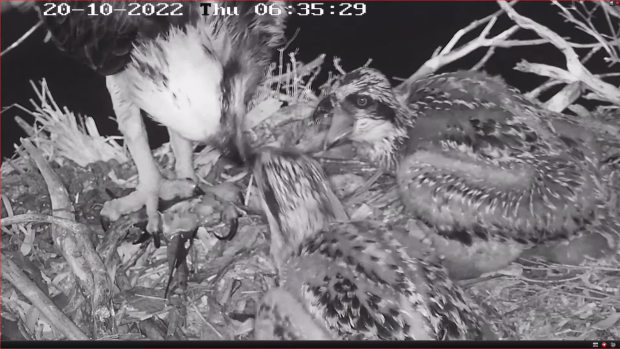
Pip watch at Moorings Park osprey nest of Harry and Sally. Keep your eyes on that camera! Don’t you love the sound of an osprey thanking her mate for bringing her a fish?

Sally is acting like something is happening. She keeps talking to Harry!

Toby says there is nothing like tearing up Mum’s dish towels on a sunny afternoon!

Thank you for being with us today. Please take care. We will see you soon.

Thank you to The Guardian for its reporting and to the owners of the streaming cams who allow us to look into the lives of our favourite raptor families.

Sadness, Sticks, and Snow…late Tuesday in Bird World

17 February 2026

Dear Friends,

I am so sorry to write and tell you that the only egg of Jak and Audacity that carried such hope for another Betty Lou this season has broken.

Send out your love to this amazing Bald Eagle couple. They tried so hard and we hoped with them.

At the Fernow Tower nest of Big Red and Arthur on the Cornell Campus, our 23-year-old Queen of the Red-tail Hawks and her mate, Arthur, have brought in the first sticks to their nest. Cornell Bird Lab caught it on video. https://youtu.be/dERgvuToQS4?

Do we think that Jackie and Shadow are thinking about a second clutch? SK Hideaways has them looking at that nest in the snow. https://youtu.be/2PqA-NX63FY?

So sorry to have to send the news about Jak and Audacity. We were so hopeful. There is a snowstorm on its way here that will begin in a few hours. Heavy snowfall warning with perhaps 16 cm. We will be fine. Please take care of yourself…and before I leave I want to show you an image that ‘R’ sent me from Gainsville, Florida. You might think that nest is in the palm tree but it is on a pole on the other side! Thanks, ‘R’. We will look forward to any report of little ones!

Thank you to Cornell Bird Lab and SK Hideaways for their videos, to the IWS/Explore.org for its camera at Sauces and to each of you for loving our raptor families. Thank you to ‘R’ for that great photograph.

Anna and Louis have a hatch, pip for Connie and Clive…Monday in Bird World

9 January 2022

Good Morning Everyone,

I hope that you had a lovely weekend. Maybe some time to watch some birds? or did you stay glued to the screen over the Es at Southwest Florida? It was beautiful here on the Canadian Prairies with a reasonable temperature but, the wind remained such that being outside had you gasping for breath. I am hoping to get out this coming week! Til then I am still working on all my new year’s cleaning! How can two kittens, not big cats yet, leave behind so many furry balls every day? It is like they invite friends over and party all night! Quietly.


I love the Starlings that come to my garden. I would not want them to ever stop coming. They are on the Red List in the UK – they were one of the first birds I posted when I began listing the 20 or so out of the 160 odd that are vulnerable to extinction. Here they are in murmuration.

Have a read. The decline in winter birds that migrate to the UK and their empty nests has many worried. Once there would have been 2 million Starlings murmuring in Somerset at dusk, now there is only 25% of that number. What is the cause?

https://www.theguardian.com/environment/2023/jan/08/uk-wintering-birds-sharp-decline?CMP=share_btn_link

HeidiMc has a lovely video of a day in the life of Ron and Rose..greetings, working on the nest, lots of chortling and a fish delivery. A nice celebration of a new relationship! Thanks H.

And another video by Golden Gate Audubon. Peregrine Falcons have been spending time on Richmond and Rosie’s Whirly Crane Osprey nest in SF Bay. I wondered if they were any of the fledged CalFalcon chicks but they answered this in the description – no. If they find out where the falcon was banded, they will let us know. Until then…he or she is a cutie.

There is news of WBSE27: On the 14th of December, WBSE 27 was at Swan Bay on the Karuah River. You can see Sydney and then the red pin. It is a distance of 188 km.

Isn’t she beautiful? I wish Lady and Dad knew their baby was safe and doing well.

WBSE27 is 17 months old and is going through her first moult. As a result she has shed her tracker which was attached to her tail. WBSE 27 is banded so any future sightings will be from the band and not the tracker. “Now SE27 starts the new year afresh – while we can no longer follow her adventures, we have a wealth of information to analyse and share! We are happy that she has found her way in the world after such a rocky start. She is familiar with a wide expanse of the Hunter Region of NSW, and has established travel corridors, roosting and feeding areas. We hope that in the next few years she’ll be able to find a territory, mate and nesting site, and one day produce chicks of her own to continue the journey.” Tears. After watching these beautiful babies thrive on the nest, it is a tragedy that they are so attacked by the smaller birds to the point of near death or death unless someone finds them and takes them so they can have the care they require. WBSE30 will get a sat pak tracker when she is released and we will be able to watch another baby.

My wish for the new year is that all of the sea eagle fledglings go and sit in front of the Discovery Centre – right away after fledging – and are taken into care so they will be able to thrive in the wild knowing how to hunt prey and fly well like 27. OR that someone comes up with a solution to the Currawongs, Boobook Owls, and Magpies that harass them til they are no longer in their parents territory, are injured, or stave to death.

Suzanne Arnold Horning caught Big Red and Arthur out in the sunshine on Sunday. Big Red first and Arthur the second image. Thanks SAH.

There are birds that instantly will draw me to tears – tears of joy and relief. In Ferris Akel’s tour of 7 January, we saw Big Red and L4 hunting. Cornell has posted a tweet showing L2 on Sunday morning. Also Karel Sedlacek had Arthur on his iPhone presentation on Sunday. So why am I so happy? All of Big Red and Arthur’s kids from 2022 are accounted for: L3 is in care but preparing for release in the spring (we believe). L2 and L4 are hunting in their parent’s territory. Sadly, we lost L1 when she hit a glass corridor at Cornell (shame on them for having no bird proofing on that!). This is the very first year that I can remember fledglings being present in January! There is obviously plenty of food and Mum and Dad are not anxious for them to go anywhere. Tears of joy.

Finally a good look at both of the eaglets on the Superbeaks cam at once and look at those crops. Goodness these eaglets are being well fed and nicely cared for by Pepe and Muhlady. Notice also that a big stick has been placed across that opening to the left! Yes.

Big crops for both E3-01 and E3-02 at 1302 on Sunday! And it looks like there are still about nine fish on that nest. Alex is a great provider.

Alex came in yesterday and diffused a bonking event. E3-01 was 12 days old. Bonking seems to start with the growth of the thermal down (or at the age of about 8 days in Ospreys). It is hard to watch and entirely not understandable with a nest with so much fish but, in fact, food sometimes has nothing to do with it. Just a dominance issue. Thanks, Alex, for stepping in. Not worried about them…the eldest just making sure the little one knows who is boss!

Sunday. Look at the fish on the nest of Alex and Andria. Both babies eating well.

The key is to let the older sibling eat til it is about to pop and then feed the younger. This is only a problem if there is not enough food. On this nest there is tonnes of fish. No shortage here and both parents are willing to feed til they each have a crop as in the image above and below. The eldest can be a stinker.

Anna is listening to the eggs as she has a fish lunch at the E1 nest in the Kisatchie National Forest. There is a pip in one of the eggs.

And there is a hatch!!!!! Welcome to the world, E1-03.

Oh, precious. Louis will start hauling in the fish now. Can’t wait to see what he brings in – last year he was so excited he brought in 11 and Anna brought in 9 for a total of 20 fish on the nest in a single day. These eagles in Louisiana hatched at Kincaid Lake eat well!

MO and FO are still there. Reports are coming in from the SW coast of Florida that a lot of Ospreys are now returning to the area. I hope there are not too many nest fights. Will Lena return? Is Andy still out there?

MO and FO are working on technique.

E21 and 22 are fed well. There is some beaking at times. Still, they are adorable. How many eaglets has Harriet raised? Everyone to fledge as far as I know. I do not worry about these two at all.

Gabby and V3 on alert today.

Both Gabby and V3 were sleeping at the nest tonight. You could see Gabby on cam 1 and V3 on cam 2.

It is nearing 0700 and Zoe is awake wishing for a breakfast fish. Mum and Dad appear to be trying to get their girl to go out and fish for her own breakfast. Yesterday Dad brought a fish and Mum brought a fish but the times for the deliveries were late in the day: 16:42 and 17:50. So our girl went to sleep full to the brim. Today she is 113 days old.

A screaming Indigo!!!!!!!

I wanted to stop and check on Karl II’s family – the Black Storks from the Karula National Forest in Estonia. There has been no transmission from Karl or Kaia since they were in Africa and this is expected. There has been no transmission from Bonus since he was crossing the Eastern Desert in Egypt and I do not know yet what to think about that. Urdu (2021) remains in Turkey near the Aegean Sea although he flew west and not south. Perhaps Udu will stay in Turkey??

Little Waba (2022) seems to have really settled in to staying in Sudan on their side of the Nile. He is actively fishing.

A few bobble heads to watch and keep you yelling at the screen when they are beaking. It does end! It is often not nice to watch. If it drives you crazy, take a few days off. It looks like Diane at Achieva has a problem. She flipped in the nest into that hole in the centre. Last year that ‘hole’ at their eggs. No sense laying them this year if that hole that the squirrels made is not patched!!!! It appears that the eggs at Metro Aviation are not viable. The female is new replacing a long term mate of the male this year. The new female is very restless on the eggs tonight. Maybe a miracle late hatch? It would be nice as that nest has a history of successful fledges.

Last, congratulations to Connie and Clive on the pip of their first egg at Captiva. Last year their eggs were not viable. Wonderful news after the tragedy of Hurricane Ian, too.

Thanks for being with me today. Take care all. See you soon!

Thanks to the following for their notes, posts, videos, announcements, tweets, and photos, and streaming cams that make up my screen captures: The Guardian, Heidi Mc and WRDC, Golden Gate Audubon, Raptor Recovery Australia, Suzanne Arnold Horning, @CornellHawks, Superbeaks, KNF-E3, KNF-E1, Window to Wildlife, SWFlorida Eagle Cam and D Pritchett, NEFL-AEF, PLO, Elain and Charles Sturt Falcon Cam and Cilla Kinross, and Looduskalender.

It’s not all about Raptors…

19 October 2020

Hello Everyone,

The first feeding at Port Lincoln was a good one, save for Mum. She has two big osplets that could sit and eat fish all day. It went well. Smiling. And it is warming up on the Canadian Prairies. It is 11 degrees. Tomorrow is going to be beautiful. It will be a good day to get outside!

In the Mailbox:

‘D’ writes:  You often mention some of the visitors to your garden. Today the squirrels were included again. I’m interested to read that you have greys & reds visiting. As you know, the greys in the UK are a threat to the reds, I wondered are yours a different species?

A Eurasian Red Squirrel in the Scottish Cairngorms. Photo by Dani Connor Wild.

I did not know the answer to ‘D’s question right away although I knew that Little Red looked different than the Red Squirrels in Sweden and the UK that Danni Connor photographs. First, the Grey Squirrel is native to North America. It was introduced by the aristocrats of Victorian England as an ornamental species. It is very invasive and there are currently issues with it and the native Red Squirrel in the UK. In my garden, Dyson is the matriarch of all the grey squirrels. She has been visiting for several days now along with her babies from the summer. One of the young ones prefers the shelled peanuts and will spend hours eating on the deck in the warm sunshine. Dyson will eat anything – as all of you know – but she much prefers the solid seed cylinders with the nuts and cranberries.

There are 3 species of Red Squirrel: the North America species is the one that lives in my garden in Canada. It has no ear tufts and has a single cache of winter food. Previously, Little Red used the garden shed but now he stores his nuts in the wood box. Eurasian Red Squirrels live in the UK, Europe, and parts of Asia. They have tufted ears and spread their cache to multiple sites. Gosh, I loved that question. It made me look closer at my own garden animals and it reminded me of Dani Connor Wild. I wonder what she has been up to?

Well, Dani has made a trip to Scotland to see rewilding and reintroduction measures. Wow. So today, it isn’t all about raptors…but imagine, in these Scottish Highlands, in the spring, the call of the Osprey!

Making News:

Arthur was caught on camera this morning at the Cornell Red Tail Hawk nest on the Fernow Light Tower. He delivered a single stick at 083726. It sounds like Big Red has chosen which nest to use for the 2023 breeding season. Arthur looks good!

Here he comes!

I am so fascinated at how they fly so fast, talons first and pull back their wings so they are not ripped off as they go through the metal bars.

Well, hello Arthur. It is really nice to see you!

The streaming cam at the nest of Southwest Florida Eagles Harriet and M15 is now operational again after Hurricane Ian. You can watch the nest building progress.

Australian Nests:

It is sometimes not easy watching raptor nests. We love the little gaffers and take them to our hearts. Most of the time all is well but, there are times when it isn’t and we lose one. Many of us still want to honour Little Bob in some way. We are discovering more and more about the legislation and who is responsible for permissions. When ways to help ask for intervention permissions are discovered, I will certainly let everyone know.

This was the day that the beaking began – 26 September. Little Bob was so tiny next to Big.

This is a video put together by Bart who is one of the moderators on the PLO chat that is beside the streaming cam. Difficult but best to watch to the very end.

I had so hoped that Big would settle and let peace reign on the Port Lincoln Osprey nest. That happened until it didn’t. Let’s hope that today is different.

The first fish of the day, a whole fish, arrived on the nest at 063037. This is early and very promising. So far Middle has been able to have bites without being beaked…although he is visibly cautious of Big. Middle is the furthest away from the screen.

Oh, it’s a nice big fish. Middle is so hungry and he is getting so good at the old snatch and grab. Every once in awhile, if you watch it live, you will see Middle jerk over to the right with its head and shoulders – trying to get his head out of the way if Big goes for him. But so far, so good. Big has ‘leaned over’ to try and remind Middle she’s the boss but Middle is so hungry he is doing a great job at snatch and grab. Hopefully Big will be friendly all day long but she tends to get grumpy…let’s just blow the grump out of her!

Now Mum needs some fish. That was a great feeding. Back and forth between the two. Middle finished with a really nice crop. So happy. The feeding was over at 064511. Fifteen minutes to vacuum down a big fish with its head. Gracious.

Pigeons are arriving early in Melbourne. Mum waddled down the ledge with the breakfast offering before the lights in the CBD had come on. It was 05:42:33. That pigeon was finished and Mum flew off with a couple of bones at 06:06:22. Gosh, just stare at the eyases with their thick white down and the feathers beginning to appear. Many are beginning to look like that cartoon hero The Hulk or maybe a member of the Australian Rugby team as they try to stand and use their wings for balance.

Just look. One trying desperately to stand and the other all fluffy with a nice tail. They are changing before our eyes. The thermal down will be beneath their feathers when they finish getting their plumage before fledge.

Everyone looked like they were full.

At Orange, the kids are awake. Diamond has been restless and Rubus is starving! No surprise there. It is shocking how much prey that little one can hold. And here I must admit something. I think that Rubus is one of the cutest eyases I have ever seen. He is such a character. They are waiting for breakfast to arrive.

Xavier flew to the ledge with a freshly caught unplucked Starling at 055658. The kids got a lesson in plucking. Rubus was so excited to see prey that the little gaffer was happy to have a mouth full of feathers.

Xavier was visually delighted that Diamond was not in the scrape and he got a chance to feed Rubus and Indigo.

It is 1536 on the Canadian Prairies. The sky is cloudy but it is warming up. The Juncos are busy eating Millet off the red garden carpet, their favourite. What a nice way to close the blog with the garden birds happy and all the chicks in the Australian nests fed. It is such a relief that Middle got a good feed this morning first thing.

Thank you so much for being with me. Please take care. See you soon.

Thank you to the following for their posts and streaming cams that made up my screen captures: Dani Connor Wild, SWFlorida Eagle Nest and D Pritchett Family, Cornell Bird Lab, 367 Collins Street by Mirvac, Charles Sturt Falcon Cam and Cilla Kinross, and Port Lincoln Ospreys.

Thanksgiving Thursday in Bird World

Our wildlife rehabilitation clinic has seen a 21% increase in patients in the last week. If you live in Manitoba and have the finances, send them a donation, however small or large. They receive no government funding. Everything is done on a donation basis – as is the case with most wildlife rehabilitation clinics. They have a long list of items they need on their website and all monetary donations are tax deductible.

I know that many of my readers live elsewhere but if this is happening here then perhaps it is happening all over.

There was a very sobering article on that cute little Korora (Tiny Blue Penguin) that is doing well in NZ. Its sibling died because the parents have to go so far to feed. For those that love those New Zealand birds such as the Royal Albatross at Taiaroa Head and wildlife that depend on the oceans to survive, what they are seeing is warming waters which mean the fish move or even die (like the trout did in Montana when the Clark Fork River got too water). It is time we demand that governments get serious and take radical steps to try and stop the situation from getting worse.

I want to remind everyone of Ferris Akel’s tours. You can go to YouTube, search for Ferris Akel, and hit the subscribe button to the live stream. He has lots of archived video tours as well. They normally take place on Saturdays at noon, Ithaca NY time. Ferris is out at Sapsucker Woods today for Thanksgiving and he has just found a beautiful juvenile Red-tail hawk that is hunting.

Notice the ‘eyebrow’ that helps to keep the glare away from its eyes when hunting. Oh, isn’t this a beautiful raptor?

Ferris just caught a Belted Kingfisher close to the RTH. There have been other birds this morning included Canada Geese and maybe another Kingfisher.

In the summer and fall, Ferris finds lots of shore birds and in the winter there will be owls! You can leave Ferris on like a radio if you are busy or you can watch as little or as much as you like. There is also a chat function with great people who can answer questions.

I am so thankful for Ferris Akel and his tours and his generosity in allowing us to share his images. I have learned so much from him over the years just wish I had a better ear to know which birds are out there by their beautiful voices.

Little Yurruga, the Peregrine Falcon fledgling at Orange, has been seen on top of a building so it is flying alright. Xavier and Diamond have been seen taking food in and out so she/he ? is being provided for. Isn’t this wonderful?!!!!!!

Below is the image that Dr Cilla Kinross took the day Yurruga fledged. She placed it in a tree. What a lovely little falcon you are, Yurruga.

This appeared on the FB Page of the Orange Peregrine Falcons today.

Have you ever wondered about the colour morphing of birds? The Audubon Society has a nice ‘Ask Ken’ article on that very topic! Thanks BM for letting me know!

The NZ DOC rangers at Taiaroa Head are deciding which Royal Albatross couple will be the Royal Cam family this year. There are 36 eggs and they believe that is all for this year. The favourite couple, WYL and BOK, who have made us so happy with their cuddles have not laid an egg – maybe next year! Will keep you posted!

It is a quiet day in Bird World and that is something to be very thankful for – no drama, nothing horrible happening.

Take care everyone. Have a marvellous day. To those having Thanksgiving, enjoy. See you soon.

Thank you to the following for their streaming cams where I took my screen captures or their FB pages: Cornell Bird Lab and NZ DOC, Ferris Akel Tours, Orange Peregrine Falcons FB page and the Cornell RTH FB Page.

Adventures in Ospreyland and other bird tales 16 July 2021

Imagine that you have one child. Everyone is happy – it is easy to provide for the one. Then imagine one day you blink and think you are seeing double. But you aren’t. There are two children. Now imagine that you are away from home and return to find three. Osprey families have the same difficulties in providing for multiple children just like humans. The adults at the Patuxent River Park in Upper Marlboro, Maryland, Osprey nest number 2 now have that challenge! The pair had only one chick of their own and are now fostering two chicks about the same age as theirs.

Cathy Cohen of the Jug Bay Natural Area posted the following image on the park’s FB page today of the mom and the three chicks. The first foster chick was placed on the nest on 30 June. Nest 2 was chosen because the foster chicks are about the same age as the one hatched on the nest. There they are. It is incredible. They look like a perfect match. How wonderful to give those two lucky ones another chance. Intervention can be a good thing.

The foster Mom was said to have welcomed the chick who had fallen from a barn silo with open wings yesterday! Here she is looking over the babies while they are sleeping (or supposed to be sleeping).

And here they are this morning. It is getting warm and the new babies are getting shade.

Most of the time if I say the name ‘Iris’ everyone knows who I am talking about. If you don’t, here is a mini-bio. Iris is an Osprey. She is 26-28 years old. This makes her the oldest Osprey in the world. Iris has her nest at Hellgate in Missoula, Montana. The platform was put up for her and her mate, Stanley, to save them from getting electrocuted on the hydro lines. When Stanley did not return from migration, Iris bonded with Louis. They have only had one chick survive. That was a female, Le Le, in 2018. The reason for this is that Louis has another mate and another nest at the ballpark. For years, people have watched Iris perfect the renovations on her nest, catch magnificent fish, mate with Louis, lay her eggs and then either have the ravens steal and eat the eggs or have the chicks die because the female cannot protect them and fish at the same time. Individuals are very vocal in their support of Iris. They want her to have another mate and to be able to raise chicks. I have always thought maybe she could retire with dignity and just take care of herself during her summers in Montana. At the same time you know just seeing her work on the nest and the fish she brings in that she would be an amazing parent. The issue is one of territory. Iris’s nest is in Louis’s territory – according to Louis. Louis has protected Iris on a couple of occasions this summer from intruders. Iris has also managed on her own to thwart them. She is strongly independent.

When someone posted an image of Iris sitting on a branch with another Osprey on Twitter 15 July 2021, people got excited.

The notion that Ospreys mate for life is not consistently true. When Blue 5F, Seren, got tired of laying a nest full of eggs only to be abandoned by Aran because he also had a nest with Mrs G at Glaslyn, she left Aran’s territory and found another mate, Dylan, at Clywedog. According to Google Maps, Seren moved a distance of 67.4 miles. Seren and Dylan are the proud parents, this season, of fledgling Blue 396 otherwise known as Only Bob.

It will be very curious to see how things develop over the end of the summer.

We all worry about Tiny Little. It is easy to forget looking at Blue 463 that at one time his older siblings kept him from eating and were quite aggressive. Because of that Tiny Little is hesitant to engage with the older siblings and, in particular, Blue 462. So there are worries that he will not get enough to eat. Today White YW brought in a fish and within about 15 minutes he brought in another fish. Blue 35 took that one and fed Tiny Little while the other two were eating fish pieces. What a beautiful image of Mum and her three chicks on the Foulshaw Moss nest having a nice meal of fish.

People have been asking if Tiny Little has been flapping. OH, yes, he flaps those wings all the time.

If you want to join in the fun watching Tiny Little prepare to fledge, this is the link to the Cumbrian Wildlife Osprey Cam:

https://www.cumbriawildlifetrust.org.uk/wildlife/cams/osprey-cam

Erick Green with the Montana Osprey Project posted some images of chicks who were entangled with baling twine. They saved three chicks a week ago but sadly one had died. Another chick had twine cutting into his right leg to the bone. Dr Green reported today that the chick is doing fabulous today. In his posting I learned something interesting. He says, “One thing that seems to work in their favor is that ospreys (and all birds) have very high body temperatures – about 105 degrees Fahrenheit. These high body temperatures help birds fight off many bacterial infections.”

Only Bob, Blue 396, has gotten really good at flying and zooms in when Dad Dylan does a food drop. Poor Seren might have to discuss Dylan bringing in an extra fish for her. Only Bob can finish them off pretty good! Look at how big this fledgling is. Wow. Dylan delivered the fish around 13:09.

At the Dyfi Nest, Idris and Telyn are waiting for Ystwyth to fledge! So is her brother Dysynni. He is sitting there urging her to come on and join in the fun while the parents are up on the camera perches watching. Ystwyth was getting some really good height to her hovering and she will go soon if not today. She is 53 days old.

Here is Ystwyth hovering. Isn’t she great?

Other nest news:

There is sad news coming out of Taiaroa Head, NZ. One of 33 Northern Albatross chicks died yesterday. The chick was not gaining weight and the NZ DOC rangers gave it a supplementary feeding. When the chick died following this it was discovered during the necroscopy that it had a piece of charcoal stuck in its trachea. As Sharon Dunne notes, charcoal floats on the surface of the ocean and it can easily be taken in by the parents when they are out fishing for food for their chick. I never imagined charcoal! Everyone is distraught. The rangers do such an excellent job taking care of these parents and chicks. Condolences go out to all of them including the albatross parents.

Our little Golden Eagle, Zenit, has had a prey delivery – a bird – and is beginning to stand really tall and strong on its legs – adult style. All good news! The Golden Eagles eat the bones – absolutely every part of their prey so Zenit will have something later. Still, having lots of meat is what this young eaglet needs right now. Excellent news.

Ferris Akel has posted a nicely edited version of his tour on Wildlife Drive on the 14th. The editing is well done and there are discreet bird names in case you do not recognize what you are looking at. There are some really nice shots of a Black Tern. Here is that short clip.

My friend, ‘T’ tells me that there is a stork with an injured food that is getting a prosthesis. Will try and find out all the news on this incredible intervention.

And speaking of storks, there are still three White Storklings on the Mlade Buky nest in Czechoslovakia:

That’s a short morning round up of happenings late Thursday night and early Friday morning at some nests. Remember that Ferris Akel does his tours on Saturday. He begins at noon NY time and ends up at the Cornell Campus. It is a great opportunity to see the Red tail fledglings in action. They have now moved from flying near to the nest to other buildings farther away. Big Red and Arthur do this with prey drops gradually to expand their territory. It will not be too long til they are down by the barns at Cornell. Always fun. You can search Ferris Akel Livestream on YT. Thank you so much for joining me. Take care everyone.

Thank you to the following for their streaming cams where I get my screen shots or add their videos: Ferris Akel Live Tour, Patuxent River Park Ospreys, Montana Osprey Project FB Page, Cumbrian Wildlife Trust and Foulshaw Moss Osprey Cam, Dyfi Osprey Project, CarnyX Wild and Llyn Clydewog Osprey Cam, Capi Hnizdo- Mlade Buky, and Asociatia Wild Bucinova.

June 13 Fledge Watch continues

There are several ways used to determine the age of a red tail hawk chick. Using the Cornell method both J1 and J2 were born in the same 24 hour period; they are both 49 days old today and Little J3 is 45 days old. The average age that a chick has fledged in the last three years is 46.1 days. Of the Js, only one has fledged, J2 who fledged yesterday at age 48 days. As you might then imagine, Cornell RTH watchers were on pins and needles today expecting J1 and J3 to both fledge at the same time. They are buddies – Big Sis taking care of Little Brother.

J1 allopreening J3. Preening is when a bird cleans their own feathers. Allopreening is when a bird preens another bird. Some hawkaholics call it kissing. Arthur is often seen allopreening Big Red when they are resting.
Arthur allopreening Big Red on the Bradfield Building ledge.

So what happened today? J2, having spent the night sleeping in a pine tree across the road, returns to the nest for breakfast.

J2 has really mastered hovering, flying, and landing on rails and branches. Here he is sitting on the rail before jumping down to join J1 and J3 for a chippy breakfast.
This is Arthur bring prey to the nest. Note how high the nest is on the grating. You can see one of the chicks clearly in the nest bowl looking at their dad bring food.
Arthur delivering a squirrel to the nest in early April. Notice the pine needles. These are thought to keep insects from the nest.

Parents will continue to provide most of the food for the chicks until they are fully able to hun themselves. Even then it is not unusual for chicks to chase their parents begging for food.

Ever though about what a young nestling might eat? Ah, probably not! Unless you are a hawkaholic and joke about making chocolate chippie cupcakes with a squirrel glaze? All kidding aside, food is essential to the well being of these red tail hawks.

Prey is delivered to the nest beginning at just before sunrise and just after sunset. On average, in this prey rich area, food items are delivered ten to fifteen times a day. This provides each nestling with an average of 410-730 grams of food per day. The Cornell Labs keep a daily log of which parent delivers prey and when and what it was. There have been more than 300 deliveries so far since the chicks hatched in late April. The male – in this case Arthur – is the main hunter. He has brought in a snake, cottontail bunnies, goslings, pigeons, mature grey squirrels (didn’t like them so much because they have tough skins), smaller squirrels, voles, Starlings, other small birds, and a whole lot of chipmunks. In fact, chipmunks comprise approximately 77% of the chick’s diet this year according to the prey log. In 1990 a study was done and at that time, the red tail hawk diet consisted of 68% mammals, 17.5% other birds, 7% reptiles and amphibians, and 3.2% invertebrates. The list of possible prey items (food) depends on the geographical location of the nest and the amount of prey available. Hawks have 20/2 vision which means that they can see something at 20 feet as if it were only 2 feet away. This is a tremendous help in hunting for food as you can well imagine. The survival of the red tail hawks depends on their prey base.

Big Red and Arthur have a territory of 1.5-2 square miles. The area that Big Red and Arthur have on the Cornell campus is abundant with prey. When the chicks were little the chat group used to joke that only people who love hawks talk about and try to identify dead animals. This year we decided that Arthur belonged to “Over Providers Anonymous.” There was so much food that at one time chippies and squirrels almost completely carpeted the nest area.

The three Js in their fur lined nest in early April. J2 is in the front. J3 (back right) leans on his buddy, J1.

Chicks need a lot of food to aid in their tremendous growth. From the time they hatch to an average of six weeks remember, they go from being a bobble headed newborn growing almost as large as their parents. In fact, their wing and tail feathers are longer than their parents to aid in their flight training. During their first molt, these feathers will return to a normal size. They also need a lot of calories to grow so fast.

The three Js being fed by their mother, Big Red. Big Red is the one on the far side at the left. Notice how large the chicks are. They do not have their distinctive red tail feathers yet. These will come in their second year. The two oldest chicks are 41 days old in this picture.

So tomorrow is June 14. To encourage J1 and J3 to fledge, Big Red resorted to bringing thorn branches to the nest around 7pm! Stay tuned.

I am grateful to Barb Michel Matthews, Karel Sedlasek, and the Cornell Lab for the images in this blog.

Teaching nestlings the value of food

By the time the three Red-tail hawks have fledged off the light stand at Cornell University, many of you might well be tired of listening to my natterings about the good parenting of these amazing raptors. Every day there are new lessons or repeated ones for the eyasses so that they can live a full and healthy life without relying on their parents. Isn’t that what all of us really want for our children? To sit back and smile knowing that they can take care of themselves if we are not there?

Today’s lesson involved a pigeon.

Just before the nestlings bedtime (around sunset), Arthur, the tercel (male/father) delivered a pigeon right in the middle of the nest and fledge area.

Arthur delivering the plucked pigeon.

Food to the nest has been dispersed sparingly as the nestlings approach the time they will fly off the natal nest. From morning til about 6pm, each had something to eat. And now it is right before bedtime. This is an easy snack! Their dad even plucked it for them. But the nestlings go about playing and picking up sticks and dreaming of flying and ignore the prey.

One of the nestlings near the prey but it shows no indication of being hungry or ready to eat.

Big Red (the mother/formel) comes to check on the state of the pigeon about ten minutes after it has been delivered. Ten minutes after this she comes with a branch and does some nest reconstruction. The youngest chick starts chirping wanting to be fed and the other two approach her as if she will fed them. Big Red has other ideas.

In the real world of hawks off the nest, prey can be scarce and young fledglings have to learn to eat when food is available, not ignore it. That was the lesson for today. Big Red looked around for a bit, picked up the pigeon with her talon and with nestlings chirping, she left with it. She does not bring it back even if they beg. It is gone. Too late. Too bad. Adios.