Little Yurruga

As many of you are aware, Yurruga has not been seen since last Thursday. Cilla Kinross saw him on the top of a building in the pitching down rain and later, university workers also saw Yurruga on the same building. Cilla sent me a short note this morning because I had written to her earlier about Yurruga’s 2nd right tail feather still being contained by the quill. The local vet did not think this was a problem but, like Cilla Kinross, was concerned about a lack of feather development on the little falcon. What impact this might have had will never be known. Cilla has looked and looked in all the places Yurruga might be and others but she is concerned and has posted a note that has been placed on the FB Page for the Orange Peregrine Falcons. I was very touched because she referred to Yurruga as a ‘poor little lamb.’ Every day is a test for our birds. Even the strongest have challenges. It is difficult enough for fledglings but compounded with unkind weather for numerous days, well. Yurruga should be flying around screaming at his parents for food and the conclusion is that he is no longer with us.

The parents, Xavier and Diamond, had an extremely long – fifteen minute or more – bonding session in the scrape yesterday morning at 05:15. This is simply not something that would normally happen with a fledgling needing prey and training. Considering the work of Marc Bekoff (Emotional Lives of Animals), Jane Goodall, the observations of Hob Osterlund with the Laysan Albatross, the bonding behaviour of Xavier and Diamond should be considered alongside grief. While we have only a limited view of the falcon’s behaviour, it might be assumed that the couple have now grieved for their wee one and are, with the weight of that loss, reconfirming their love and commitment to one another. We cannot do a brain scan on Diamond’s hippocampus (area of brain in human animals for emotion) to see if it lights up, Barbara J King in her book, How Animals Grieve, would tell you that the investment in the mating, the making of the egg, the care and incubation, the care and feeding after and training, she says that ‘grief comes from love loss.’ There have been roadside funerals of Crows, Ospreys who have mourned the loss of their chicks by predators. Other bird species and drowned themselves after the death of their mate. And, of course, all of you reading my blog, will know about Arnold and Amelia, the two Canada geese. Arnold and Amelia lived at the pond on the grounds of the clinic (fortunate for them!).* Arnold had one of its digits severed by a snapping turtle and required surgery. Amelia went to look for Arnold and watched through the glass, finally sharing a meal and a pen til Arnold was released.

So, today, we grieve with Xavier and Diamond over the loss of little Yurruga.
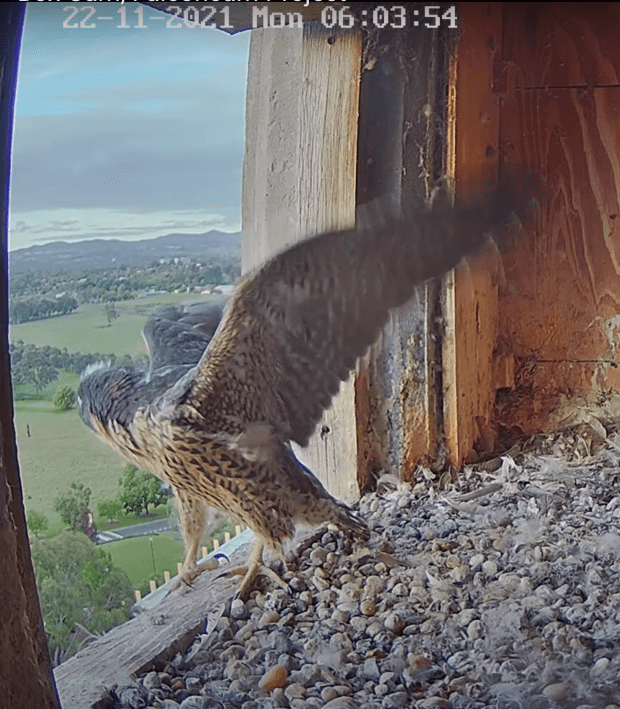
It was a beautiful morning when little Yurruga flew for the first time.
Diamond and Yurruga bathed in the golden glow of the sun the morning Yurruga flew.
Xavier feeding his baby.
Xavier brings prey for Yurruga.
Diamond and her baby.
Xavier feeding Yurruga. Xavier loved getting a chance early on to feed his little one.

What an adorable little eyas. Fly high little one. Fly high.

I am so sorry to bring this terrible news to you. We join Xavier and Diamond, Cilla Kinross and the team at Orange in their mourning.

Thank you to Charles Sturt University and Cilla Kinross for the streaming cam where we get to share the joys and the sorrows – and where I took my screen shots of this lovely Peregrine Falcon family.

  • I say this because many do not consider the mate when one is taken into care. Arnold and Amelia were extremely lucky.

From Port Lincoln to Kauai to Juneau

Oh, gosh. We really are going to miss these three boys when they finally leave the Port Lincoln barge. Ervie was wet this morning. He has been focusing very hard on finding a fish and catching it. We might never know, sadly, when that moment occurs – unless he brings it up to the ropes like Dad. Wouldn’t that be wonderful?!

Bazza seems to have landed the first fish this morning on the nest. Falky doesn’t seem bothered and Ervie had flown off earlier.

Port Lincoln gave us a nice image of Bazza over on the ropes. These three males are quite handsome.

When Ervie flew back to the barge he was really keen on preening those feathers.

You can really see that sharply hooked beak that helps to tear the fish so they are easier to eat. Unlike Peregrine falcons, Ospreys do not have a tomial tooth. In my images it is a bit difficult to see that valve which seals the Osprey’s nostrils when they dive for their fish but, it is there.

Looking at that beautiful image of Ervie below you will notice that the Ospreys lack that very heavy eyebrow of some of the other raptors. Instead, they have that incredible black line which passes from the eye down to the neck. That black line helps them with the glare.

Ervie missed the the 8:14:14 fish that Dad brought in. Falky claimed in.

Port Lincoln has reported that Ervie has been flying farther. They also note that he has been checking out the coast. Here is the latest map of Ervie’s movements from the barge.

Ervie and his siblings will get their adult plumage at their first moult which is fully completed by the time they are a year old. That change in plumage does not indicate Ervie’s sexual maturity. Osprey do not normally breed until they are three years of age. The 2019 fledgling from Port Lincoln, Calypso, has been spotted sitting on a branch with a male. Might there be chicks next year? That would be marvellous!

When Penny Olsen’s book on the raptors of Australia was published in 1995, the map of Australia indicated that the Eastern Ospreys were located only around the coast. Ironically, that map did not indicate any ospreys in the Eyre Peninsula. This is one of the things that has changed since its publication. We have to look no further than the Port Lincoln Opsrey Barge and Thistle Island. We also know from Solly being the first tracked Osprey that the birds do go inland. Not all that far but further inland than anyone had understood previously. We are fortunate that Solly was able to provide so much information to us in the 14 months that she was alive. Port Lincoln can now compare the dispersal of a female to that of a male with the tracking of Ervie.

There are many threats to Osprey. I imagine that everyone reading my blog can name at least four. I want to add warming seas and the decline in fish numbers as yet another.

As you know, I highly recommend Dr Marc Bekoff’s book, The Emotional Lives of Animals. He also wrote The Ten Truths with Jane Goodall. A very moving story is coming from the island of Kauai, Hawaii. Some of you might recognize the name of Hob Osterlund. She posted a very moving story that can be added to the cornucopia of evidence that Bekoff and Goodall have that support animals having emotions which they express. Once you have read those two reasonably priced books, you will never ever apologize again for anthropomorphizing animals again.

Here is that posting:

Tears.

One of my readers ‘B’ asked me if I had seen the snow at Glacier Gardens. I had not! So I went to check. Oh, my goodness, it is so beautiful. If you close your eyes you can see that beautiful Kindness using that nest and those branches like a trampoline. What a magnificent juvie Kindness was. She is off eating Salmon along the river.

On Taiaroa Head, 122 birds have been seen so far and there are 36 eggs laid. No mention yet on who the Royal cam stars for 2021-22 will be! Soon. And there has been no update on Grinnell. No further updates on WBSE 27 either.

Thank you so much for joining me today. Take care. See you soon.

Thank you to the following for their streaming cams where I took my screen shots: Glacier Gardens Bald Eagle Cam, Port Lincoln Osprey Project, and to Hob Osterlund and her FB page for that moving story. Much appreciated.