It is ‘the golden’ time in the garden. The sun is setting and there is a peachy-apricot- with a touch of lilac glow that kisses all of the western branches of the trees and the shrubs in the garden. Mr Crow is cawing. There are gulls, hundreds of them, flying overhead. They have found insects! The feeders are now quiet. Toby is beside me on the bench and like ant toddler, he wants my attention. No more computer!
I cannot wait to take him to the beach next Saturday. I think a lifejacket needs to be purchased, just in case he is not the great swimmer I think he is. Don is going to sit and watch his grandson, Carter, fishing. It is set to be the perfect end of the summer – ospreys included. The family and their chicks are still at their nest! So excited.
Today I am baking a peach kuchen. Every summer I make at least one, usually a plum one, in memory of one of my dearest friends, Rosemarie. We lived in Southern Manitoba, and our children were friends in the 1970s. She was remarkable. Her parents had sent her over the Berlin Wall to freedom – and that is how she came to be in Canada. I treasure all the recipes she taught me and the time we spent together. They moved to BC, where her husband had a position with the CBC. I left for the UK, and we lost touch. Thank goodness for memories!
Prayers for the people and wildlife in the zone of the hurricane.
The Guardian shows how rewilding can help against drought – and that is something many need to consider.
Geemeff’s Woodland Trust daily summary for Loch Arkaig Friday 21st August 2026 No sight of Amber 8P6 again today so it looks like she might have headed south, very young, but then she always was very determined and ahead of her older sister. Juniper 8P7 is very much still here, on and off the nest throughout the day and always announcing her arrival, occupation, and departure. She’s had to contend with several Hoodie invasions today and shows no hesitation lunging at them to drive them off, defending her fish and using a crow voice just like her mum Dorcha did. At one stage she flew off the nest clutching a fish, circled round, landed with it then took off again, possibly to find a place to eat without attendant Hoodies. Louis brought her two new fish, taking the Nest Two tally to four hundred and fifty, and his personal tally to four hundred and forty five, however there was also plenty of leftover fish from yesterday, and the Hoodies managed to get some while Juniper was away. No activity at Nest One bar a couple of songbirds. The weather was settled today and will continue dry but
chilly overnight with a low of 7°C, continuing dry and bright tomorrow with sunny intervals and a high of 15°C. Today’s videos:https://youtu.be/t5D_e4cLKwI N2 Louis brings fish one but several of yesterday’s are still there 06.07.15https://youtu.be/ZawjOTbmSDA N2 Juniper tries to protect her fish from a marauding Hoodie 11.09.48https://youtu.be/HDLYdQM9HkM N2 Fish number two arrives and so does a Hoodie 11.53.37https://youtu.be/tX2bGpkf4FkN2 Juniper flies with fish and aHoodie enjoys the leftovers 16.40.47
Bonus webinar – next Thursday 27th, with analysis by @SteveQuinn of Louis’ fishing performance and other nest activity this season, and an update from @WTScotland on the restoration of Arkaig Community Forest, with a Q&A afterwards:
The birds are on the move. What can you do to help? Turn out your lights! Ask your town and City to turn off their lights. Leave out water and if you can, put out food!
We now have at least 300 birds eating in the evening. My daughter gave me two triple-tube feeders…we are going through seed as the songbirds make their way south to their winter homes. I am so glad I can help them, along with the ones who live here all winter.
An article about a Snowy Owl – and just to note, the first Snowy Owl, has been photographed in Manitoba this season. Some interesting research – have a short read!
A satellite-tracked female snowy owl in the eastern Canadian Arctic spent 186 days on sea ice, hunting ducks at open water cracks in the pack ice hundreds of miles from land in total winter darkness. The biologists who tagged her expected her to fly south for the winter. She flew north onto the frozen ocean. The finding flabbergasted them. Inuit seal hunters had known about it for centuries.
Jean-François Therrien, a doctoral student at Université Laval working with professor Gilles Gauthier, tagged 12 adult female snowy owls on Bylot Island in Nunavut as part of an International Polar Year research project studying key indicator species of northern ecosystems. When winter came, the tracking data showed something nobody in the academic world had documented with technology. Eight of the 12 owls spent more than 95 percent of their winter locations over sea ice or along the coast. Six adult females spent most of the winter far out on the Arctic sea ice. One stayed there for 186 consecutive days. She was not lost. She was not drifting. She was hunting.
The ocean freezes across the Canadian Arctic every winter but it does not freeze solid. Leads and polynyas, cracks and pools of open water, persist throughout the ice sheet. Sea ducks, particularly eiders, and seabirds concentrate at these openings because the open water is where the food is. The owls found the ducks by finding the water. Gauthier described the hypothesis directly: bird researchers at coastal field sites have observed snowy owls attacking eiders in winter. If the satellite positions of the owls matched the locations of open water leads recorded by other satellite systems, the connection would be confirmed.
The owls were not behaving like the animal most people picture when they hear the words snowy owl. Most people imagine a white bird sitting on a fence post in a farm field somewhere in Minnesota or upstate New York, hunting mice in the snow. That version of the snowy owl is real. It is the owl that shows up on Christmas Bird Counts and birding websites and nature documentaries filmed in places where camera crews can reach. The other version, the one the Inuit have always known, is an owl that flies north when winter starts, lands on sea ice in the Arctic dark, finds a crack in the frozen ocean, and sits beside it killing ducks at temperatures that drop below minus 50 degrees Fahrenheit.
The isotope data confirmed the diet shift. Stable isotope analysis of feathers showed that marine prey made up a substantial portion of the winter diet for owls that chose the sea ice. A snowy owl that breeds on lemmings in the summer and switches to sea ducks in the winter is not a rodent specialist. It is a predator that changes its entire hunting strategy, its prey base, and its habitat seasonally, moving from tundra grassland to frozen ocean the way a seasonal worker changes job sites.
Project SNOWstorm, a US-based tracking initiative that has followed more than 115 snowy owls with GPS transmitters since 2013, found the same behavior at a smaller scale on the Great Lakes. Snowy owls wintering in the northern United States moved out onto frozen Lake Michigan and Lake Erie for weeks at a time, hunting ducks at the cracks that opened and closed between wind-driven ice sheets. The researchers described the Great Lakes behavior as practice for the full Arctic version: owls learning or maintaining the ice-hunting skills that adult females use on the Arctic Ocean in the years when they stay north.
Source: Therrien et al., Université Laval / Gauthier, Université Laval / ScienceDaily / Project SNOWstorm / Birds of the World, Cornell / Old Farmer’s Almanac / COSEWIC (2025).
Bonding sessions are taking place at the Peregrine Falcon scrape of Gimbir and Diamond on Charles Sturt University in Orange, Australia.
Great news. Aurora from Loch Arkaig nest 1 has been photographed in Poole Harbour fishing! Fantastic.
Viki sends us her latest:
“I am pretty certain Junior brought a live fish back to the north copse overlooking his nest – I haven’t seen either parent all morning!!!!
I AM AS PROUD AS A PARENT !!!!! He’s gonna make it !!!”
“Well, he clearly still needs plenty of fish as do his parents, apparently. And that little snit will NOT dive for a frozen bait fish I throw – but Dad (and I think Mom) will …. But they took 2 or 3 fish before Dad carried one out to Junior – who, btw, whether he stole that live fish out of another’s nest or not, dropped at least half of it —- TEENAGERS !!!
But aside from all that, I am so proud of that crazy, crafty #2 chick and his dad!!!!
Back out to throw some more fish. Dad is hanging around so maybe Junior will get some and SHUT UP!!! LOL”
“Junior had been practicing dragging his feet in the water. When he saw me coming down the deck with the fish bag he returned to nest but flew off his nest when I tossed the fish and must have been thinking about going for it, but flew off the wrong direction and Dad got it and brought it to their other “veranda” -nest. So I threw another. Junior just looked and kept calling. Dad brought the fish he’d had to Junior and then did four or five more dives for the other fish TO SHOW JUNIOR HOW TO DO IT RIGHT BEFORE MY VERY EYES !!!
Amazing. And now that I’ve picked my second tick off for that effort I’ll hit the shower. Sheesh.”
Viki is my heroine. She has kept this single osprey family alive on Indian Creek, Maryland, where there should have been 5- 60 chicks; one survived because of her. My heart beats softer and happier because good people like Viki exist in the world.
I love this family and I am so afraid that Iris will not return next spring. We want them to live forever, don’t we?
Clark has a fish. No one comes. In flies Wensi…Clark returns with the fish!
Ospreys at Charlo at night but during the day it seems they are over at Roger’s Place.
No one is home at Coeur d’Alene, Idaho.
Mum continues to provide fish at Santiam. I am not clear what is happening at Blackbush.
One of my favourites, Blue 33, checking the nest at Rutland. The gulls are moving in – known as the clean-up crews – when they think a nest is just about at the end of the season. Blue 33 will be the last to leave after all the youngsters and Maya.
At Tweed Valley:
Kielder’s Kirknewton was the intruder at Dylan and Seren’s nest at Llyn Clywedog. How grand.
Teifi and Elen fledged their entire clutch of three. Beautiful osplets!
It is a wonderful day. Viki added a note that I will put here: “Your stamina as a caregiver is extraordinary. I can’t imagine how you get anything else done. Your husband is very fortunate for having been so unfortunate.
Thinking of you – and so you’ll smile –” . And, yes, I did smile at the incredible feat she undertook to keep that osprey family alive. Bravo. In a world when too many ‘count’ the dead, it is a relief that someone dares to feed.
It is exhausting being a caregiver. I am not sure I have any stamina at all. I am busy reading several books, including one that our reader and friend, ‘R ‘, recommended. My goal is to enrich Don’s life as much as possible, try to understand when he has trouble communicating, and recognise that he is also frustrated living in a body where he is not the person he was. Still, we try to make every day a little special. It could be a friend’s visit, a trip to the park, a walk with Toby – it doesn’t need to be much. The trips to the farm are excellent, and we are definitely looking forward to going to the beach next week!
Take care everyone. We will see you soon.
Thank you to all the contributors today – to Geemeff, to the owners of the streaming cams, to those that post information and images on FB – we thank you so very much!
As the days of summer give way to thoughts of falling leaves and back to school, our beautiful Ospreys think of migration. Those in the United Kingdom have already already headed to the area around Poole Harbour to have a last good feed and sleep on land before heading south to Brittany and on to Africa. Those in the United States and Canada will take various routes. The male is still in Manitoba with one chick at the nest I watch.Some head to southern Texas and places in Mexico while those in the northeast fly over the cost, over the length of Cuba heading to South America. One of those leaving her summer breeding grounds in Missoula, Montana will be Iris.
Iris is not ringed. No one knows where she goes for the winter but, she turns up in tip top shape to her nest at Hellgate Canyon every spring.
Typically Iris spends more time at her nest before her departure. Last year she said goodbye on 8 September. Because of her age, many worry that she will not return. It is always an anxious wait until spring and she arrives again full of hope and hormones.
Sharon Leigh Miles shared this image of Iris taken on her favourite tree on Mt Sentinel on 6 September at 09:22.
She is there. Just squint.
Iris is the oldest osprey in the world – the grand dame of all of them. In her lifetime it is estimated that she has fledged between 30 and 40 chicks but no one knows for sure. It is possibly more. Iris is known around the world. Her arrival on 7 April 2021 to her Hellsgate nest made print and television news. Dr Ericke Green of the University of Montana believes Iris is at least 25 years old, perhaps more.
In the image below, Iris just landing from her winter migration. All the worrying about whether or not she survived another winter is put to rest.
Welcome home, Iris. 7 April 2021Landing with a nice big breakfast. 10:36 am. 11 April 2021
Iris’s nest, prior to the one she uses now, was on a hydro pole about 68 metres or 200 feet from this one. This artificial nest was built for Iris because of the high rate of electrocutions on power lines – all birds, not just Osprey. The power lines are high enough and have a clear view that they appear to be desirable. The new nest, erected in 2007, is all set up with a high resolution camera. Iris took to the new nest right away, thankfully. Iris mate, at the time was Stanley. Stanley did not return from migration in 2016. Her current mate, Louis, and her have had a very chequered relationship. Louis also has another nest with Star, his primary nest, near the baseball park. Iris and Louis fledged one chick, Le Le, in 2018.
Many of us are glad that Iris has been spending the summer of 2021 taking care of herself. Raising chicks is not an easy job – and everyone loves Iris and wants her to return year in and year out from her migration.
I have included some images taken at the nest this year.
Iris worked on building the best nest that she could. Every day she brought in more material. She eventually will lay three eggs – that we and she – seem to know are destined not to hatch. These were bittersweet moments for everyone.
She was fierce in her fishing and the protecting of her nest. Indeed, her and Louis protected the nest together several times. The video below is from 22 August.
Sharon Leigh Miles provided a chart of the departure dates for Iris for her migration. Today is 6 September so we are definitely in the range. These are the previous dates of her departure:
2012: 6 September
2013: 6 September
2014: 11 September
2015: 4 September
2016: 8 September
2017: 9 September
2018: 10 September
2019: ?
2020: 8 September
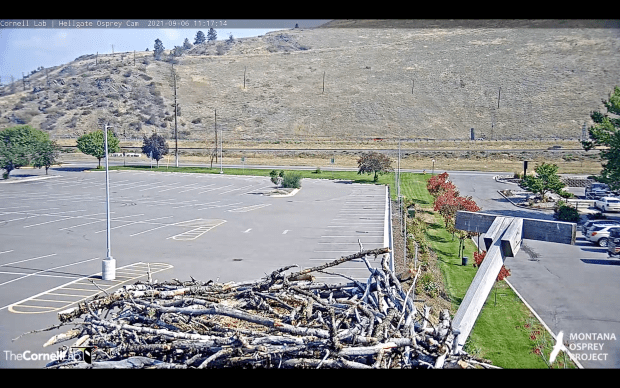
There is no one on the Hellgate Canyon nest this morning. Everyone is hoping that Iris will make several long appearances on the nest before she departs. This has been her MOD in the past. Fingers crossed!
If you would like to periodically check on the nest, here is the link to the streaming cam:
The Montana Osprey Project has had one fundraiser – the Iris pens – this year. If you would like information on how to order one of these, send me an e-mail and I will provide the details. They are lovely. There are also plans to commemorate Iris by a woodblock print. As information comes through I will post it.
Keep Iris in your heart. Migration is challenging. We wish her a safe journey, good winds, lots of fish, and a safe return to Montana in the spring.
Thanks for joining me. Take care everyone.
Thank you to the Montana Osprey Project for their streaming cam where I took my screen shots and their FB page. Thank you Sharon Leigh Miles for allowing me to use your images posted on the FB page.