Iris, the Grand Dame of Ospreys

As the days of summer give way to thoughts of falling leaves and back to school, our beautiful Ospreys think of migration. Those in the United Kingdom have already already headed to the area around Poole Harbour to have a last good feed and sleep on land before heading south to Brittany and on to Africa. Those in the United States and Canada will take various routes. The male is still in Manitoba with one chick at the nest I watch.Some head to southern Texas and places in Mexico while those in the northeast fly over the cost, over the length of Cuba heading to South America. One of those leaving her summer breeding grounds in Missoula, Montana will be Iris.

Iris is not ringed. No one knows where she goes for the winter but, she turns up in tip top shape to her nest at Hellgate Canyon every spring.

Typically Iris spends more time at her nest before her departure. Last year she said goodbye on 8 September. Because of her age, many worry that she will not return. It is always an anxious wait until spring and she arrives again full of hope and hormones.

Sharon Leigh Miles shared this image of Iris taken on her favourite tree on Mt Sentinel on 6 September at 09:22.

She is there. Just squint.

Iris is the oldest osprey in the world – the grand dame of all of them. In her lifetime it is estimated that she has fledged between 30 and 40 chicks but no one knows for sure. It is possibly more. Iris is known around the world. Her arrival on 7 April 2021 to her Hellsgate nest made print and television news. Dr Ericke Green of the University of Montana believes Iris is at least 25 years old, perhaps more.

In the image below, Iris just landing from her winter migration. All the worrying about whether or not she survived another winter is put to rest.

Welcome home, Iris. 7 April 2021
Landing with a nice big breakfast. 10:36 am. 11 April 2021

Iris’s nest, prior to the one she uses now, was on a hydro pole about 68 metres or 200 feet from this one. This artificial nest was built for Iris because of the high rate of electrocutions on power lines – all birds, not just Osprey. The power lines are high enough and have a clear view that they appear to be desirable. The new nest, erected in 2007, is all set up with a high resolution camera. Iris took to the new nest right away, thankfully. Iris mate, at the time was Stanley. Stanley did not return from migration in 2016. Her current mate, Louis, and her have had a very chequered relationship. Louis also has another nest with Star, his primary nest, near the baseball park. Iris and Louis fledged one chick, Le Le, in 2018.

Many of us are glad that Iris has been spending the summer of 2021 taking care of herself. Raising chicks is not an easy job – and everyone loves Iris and wants her to return year in and year out from her migration.

I have included some images taken at the nest this year.

Iris worked on building the best nest that she could. Every day she brought in more material. She eventually will lay three eggs – that we and she – seem to know are destined not to hatch. These were bittersweet moments for everyone.

She was fierce in her fishing and the protecting of her nest. Indeed, her and Louis protected the nest together several times. The video below is from 22 August.

Sharon Leigh Miles provided a chart of the departure dates for Iris for her migration. Today is 6 September so we are definitely in the range. These are the previous dates of her departure:

  • 2012: 6 September
  • 2013: 6 September
  • 2014: 11 September
  • 2015: 4 September
  • 2016: 8 September
  • 2017: 9 September
  • 2018: 10 September
  • 2019: ?
  • 2020: 8 September

There is no one on the Hellgate Canyon nest this morning. Everyone is hoping that Iris will make several long appearances on the nest before she departs. This has been her MOD in the past. Fingers crossed!
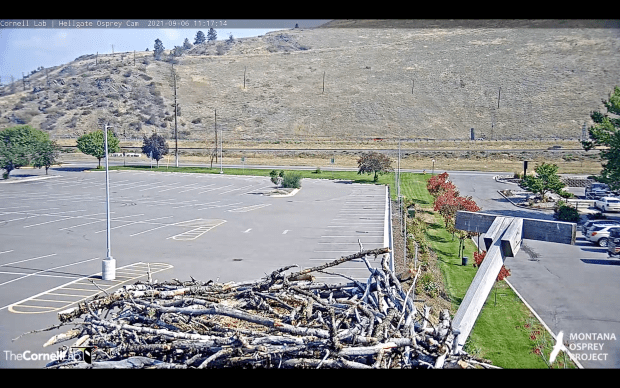
If you would like to periodically check on the nest, here is the link to the streaming cam:

The Montana Osprey Project has had one fundraiser – the Iris pens – this year. If you would like information on how to order one of these, send me an e-mail and I will provide the details. They are lovely. There are also plans to commemorate Iris by a woodblock print. As information comes through I will post it.

Keep Iris in your heart. Migration is challenging. We wish her a safe journey, good winds, lots of fish, and a safe return to Montana in the spring.

Thanks for joining me. Take care everyone.

Thank you to the Montana Osprey Project for their streaming cam where I took my screen shots and their FB page. Thank you Sharon Leigh Miles for allowing me to use your images posted on the FB page.

Monday Nest Hopping – to keep my mind off Elsa

There were some lovely letters in my inbox today – articles and quesions – to keep me busy and to try and curtail me from checking on Tropical Storm Elsa every half hour. My friend Wicky – lover of books and hawks as long as they leave her songbirds alone – pointed my noise to an article in The New York Times by Margaret Renkl. Renkl is the author of Late Migrations, a fabulous book that I pick up often to simply read a single entry. Today in “Hawk. Lizard. Mole. Human”, Renkl speaks to the garden that she can see out her windows. She says, “How lucky I am to live in a home with windows. Against all odds – the encroachments of construction companies and lawn services and exterminators – those windows still open onto a world that stubbornly insists on remaining wild”.

Here is the link. I hope that you can open it. Renkl is a wonderful writer always leaving me appreciative of her love of our feathered friends and – others. Thank you, Wicky.

Like Renkl, I am grateful for my windows and astonished at what happens in a tiny bit of paradise inside the heat and concrete of a big and growing city. The birds have returned to the garden after the extreme heat. It is simply glorious seeing them splash around in the baths, having drinks, and sneaking off with some birdseed that looks like trail mix. The Blue Jays love the cashews and the berries and have gone through the large berry-insect-suet cylinder in a few days. There seem to be fewer insects every year. Is it the spraying of the caterpillars who eat the leaves off the trees? the greening of the lawns so that they look like they came out of a magazine, or the opposite where concrete is replacing grass? What are the birds to eat? Thankfully a growing number of people are willing to put the time and effort into helping them survive.

A lovely note came in from Finland, also, telling me about the ten Osprey nests. Thank you Tiny Toefan! I admit to not knowing enough about the Finnish nests but tonight while that storm is churning through the Gulf of Mexico towards Florida I am going to begin my education on these Ospreys. I want to learn more about them so I am just not an occasional observer. Tiny Toefan says that their Ospreys had a bit of a sad year. The attack of the Raven at the Satakunta Nest and the death of Alma spread quickly within the community of Osprey Lovers around the world. Our hearts broke for that dear family. Intruders, lack of food, and weather-related events have wrecked havoc with all the Ospreys this year.

Speaking of intruders, the UK nests are having issues with the returning two year old juveniles. They are all excited and flying about while the adults are trying to take care of their chicks that will soon be fledging. Today there were three intruders at the Glaslyn nest. All hatched at the Dyfi Nest. Z2 (Aeron, 2017) has chicks on the PC nest with 01 at Glaslyn. He quickly moved Hesgyn KA3 (2019) and Dinas KS6 (2018) along before they could do any lasting damage. Here is a video clip of all that action:

There were intruders at Foulshaw Moss Nest also. While watching Tiny Little get ready to stand up, in a quarter of a blink he was flat down like a pancake. For a moment I thought he had broken his leg – but, no – somewhere there were unwanted guests.

Did the adults teach them to do this? or is this 65 million year old instinct at work?

My friend, “R” also wrote today to tell me of another bird in the wrong place. It begs to ask how many instances of birds being where they shouldn’t are there? There is a Stellar’s Eagle in New Brunswick, Canada that should be in Russia and there were definitely birds out of location in Toronto earlier in the season.

The bird in England is a beautiful Black-browned Albatross. It should not be in the Northern Hemisphere! Imagine what a sight it was for those in Britain. I will follow up later on this story with more information. Thank you, “R”.

Here is the article. If it won’t open, try to copy and paste the URL in your browser. What in the world is this bird doing in England!?

https://www.thisisthecoast.co.uk/news/local-news/rare-albatross-sighting-on-yorkshire-coast/?fbclid=IwAR2lu8erfI5wv_J-I0gGdUvcJ2YM35wipWkXornJDTVtlAdiUgMs372NWRQ

In a swing through the Osprey nests, Tiny Tot is not on the Achieva Osprey Nest. She came in during the night and then left. The fireworks for the 4th must have been really disturbing to all the Osprey in that area. I am going to hope that Tiny Tot is down by the water catching fish to hold her until Elsa passes. She might also be looking for a place to hunker down til the storm passes. Again, because she is a fish eater and not an insect or nectar eater, Tiny Tot should be alright. It is the wind and flying debris if it gets bad. Well, it is worrisome. We can all image a hundred scenarios. I continue to run Laura Culley’s advice in my head – “worrying is nothing more than establishing an outcome in your mind before it happens. Don’t do it!” Need to put that mantra on repeat. Culley would tell me that these birds are much smarter than we are.

Electra has a huge fish that she is eating on the Cowlitz PUD Nest. It is good to see her eating well. She needs to regain her strength. On the other hand, it also makes me very sad. It would have been grand if that size of a fish came on that nest when the little tykes were alive. It might have made all the difference.

Give a shout out to the linemen of Fortis Alberta and to the streaming cam watchers who notified them that Legacy was tangled in monofilament line. They got there in time and saved her life. Legacy was so wound up in the line that she could not even lift her head to eat – and this was during the heat wave. She needed that hydration! The linemen responded to the call quickly. They removed the fishing line as well as the two dead chicks from the nest. Today, just look at her. Legacy is chowing down on a nice fish on the Fortis Red Deer Nest. There are still dark clouds but the rain has stopped and the nest seems to be drying out. That said the forecast is calling for rain tomorrow. The temperatures are in the 17 degree C range, a far cry from the extreme 40s C.

The two chicks on the Fortis Exshaw Nest at Canmore, Alberta seem to be doing alright, also. They are both being fed by mom. The skies are the same as those at Red Deer but they are calling for a thunderstorm tonight and rain tomorrow at the nest. Oh, stay dry little ones!

There seems to be a constant stream of intruders on the Hellgate Osprey Nest of Iris. It is prime real estate right next to the river and the fishing continues, despite the heat and low water, to be good for Iris. Louis has come and helped ward off the Dunrovin juveniles looking for a nest but sometimes, Iris has had to fend for herself The indignity of it all!

There are not enough good trees for the Ospreys and the placement of platforms has to be carefully evaluated because of all the territorial issues. It is confusing. On the one hand old timers tell me that Ospreys do not have territories but if you watch, Louis certainly claims this nest and the one at the baseball park as his even if he fishes in the same river as the other Ospreys. As more male chicks survive and return, careful planning will need to be undertaken for nests – if the water in the rivers and the fish stay sufficient to support a growing population of these fish eagles.

The predictions for Elsa are becoming more worrisome. Each change in the model sees it bearing down more heavily along that Southwest coast of Florida including Fort Myers up to St Petersburg. Please send any warm wishes you have that the system pulls more to the West as it heads towards Florida after Cuba.

Thank you for joining me today. Stay safe wherever you are and thank you to everyone who writes to me. I do try and get to answer your letters as quickly as I can and please know that I appreciate them. I learn something new every day from you! And thank you to all of you for simply loving the birds and doing what you can to make their lives better.

Thank you to the following for their streaming cams where I grab my screen shots: Fortis Exshaw, Fortis Alberta, and the Cumbria Wildlife Trust and the Foulshaw Moss Osprey Cam.