Migration woes and daily threats to our feathered friends

5 August 2022

Good Morning Everyone! It is a hazy day on the Canadian Prairies. The birds have been up early feeding as temperatures are set to rise to 29 degrees C today. The plants in the garden are looking a little droopy despite watering – we have been lucky to have all that rain. Some areas are really struggling. It is now a little after noon and the Crows and Blue Jays are reminding me that they need more peanuts and want their water changed! They are so smart. Wonder if I could teach them how to use the water hose?

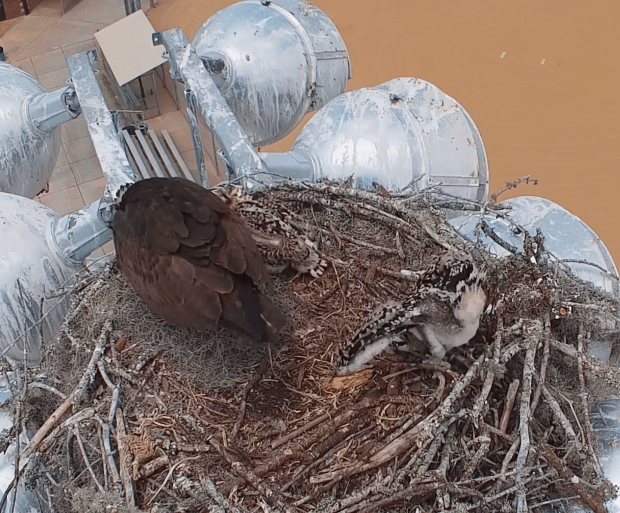
I hope that you enjoyed seeing those beautiful pictures of Brooks back on the nest with Mum and Dad, Rosie and Richmond, at the WWII Whirley Crane. HE is well and beautiful. In case you missed it, Brooks (Blue XA) arrived back to the nest yesterday in the late afternoon and DNA testing has confirmed that Brooks is a male. Molate was also confirmed to be a male. This is a photo of him. He is very handsome.

Richmond does not migrate but Rosie does. Wonder which Brooks will choose? It is much safer to stay put!

Rosie has brought Brooks a lovely fish. Welcome home, Brooks.

Fish hooks and monofilament line are dangerous for all birds that eat fish like Ospreys and eagles. This is a reminder that things on nests can happen quickly — and for us to clean up our environment! Join a riverbank of lake clean up. It will make you proud that you have helped.

As we get ready to begin the great autumn migration, it is perhaps best if we take a deep breath. Migration is extremely dangerous especially for first year fledglings but it is becoming increasingly difficult for ‘seasoned’ birds as well.

I was surprised when I brought home a book from our nature centre, Atlas of bird Migration. Tracking the Great Journeys of the World’s Birds. It has good solid information on species with maps, information on the difference of gender in certain species as to migration —– and, hold on, out of 176 pages, four are devoted to “Threats and Conservation.” Out of those four, two pages had large photographs. The book lists: water (they show an oil spill), field and forest (they show fires), hunting and caging. Can you think of good current examples of these that will impact the birds we love heading to their winter quarters? what are they missing? Send your ideas to me and they will be included in a special blog on migration next Friday, 12 August.

Do you live anywhere near Hawk Mountain in Pennsylvania? You can visit but, you can also take part in the annual count. Here are the dates that the birds fly over. Even if you didn’t help with the count what a special time to see the birds flying with the thermals, soaring over the mountains on their way to South America.

Hawk Mountain has kept track of spring and autumn migrations since 1934. You can go to their link and see population shifts. It is an eye-opener in some cases.

https://www.hawkmountain.org/conservation-science/resources/migration-data

Each of the nests below has faced or is facing challenges like many others. If you looked at the picture of the nest could you come up with issues they have faced? Try it before reading my text!

The two osplets at the Osoyoos Osprey nest have not fledged yet. They are working on some wingersizing. Caught them enjoying an early fish from Olsen this morning. Today will be good but by Sunday the temperatures at the nest will be 36 rising to 38 on Monday and 40 on Tuesday. Extreme heat has been an issue at this nest for several years with the temperatures continuing to rise and rise.

Thanks to the lovely people who live around the Notre-Dame Eagle nest we have more pictures of ND 15, 16, and Little Bit 17. It is always so funny…Little Bit seems to love to hide behind the small branches with leaves. So grateful to all those keeping track of the trio!

Hi Sweetheart.

The Parramatta River and Sydney Harbour have some significant toxins in the water that impacts the fish eaten by the sea birds.

The toxins leaked into the river from a shipping container company as reported in The Sydney Morning Herald on 16 May 2009. The article said, “The Patrick’s site on the Camellia peninsula, near Rosehill Racecourse, has been found to be leaking the chemical Chromium VI, posing a risk to people and marine life.”

In 2017, 2ser 107.3 reported that the Parramatta River was a “toxic time bomb.” They said, “Fifty years of toxic chemical residue is sitting on the bottom of Sydney Harbour and the Parramatta River. It’s a toxic time-bomb and disturbing this sediment could worsen already dire pollution levels. And now sweeping developments along the shore of the River could be bringing more pollution to the already sullied waters.” While many might have hoped to swim in the river before they were too elderly to do so, contaminated storm water was pumped into the river in December 2020 causing more problems.

It is unclear what impact this is having on the White-bellied Sea Eagles who are at the top of the food chain along the river. Despite research being carried out, the direct implication to these WBSE is not normally discussed. If you know of a study with results, please let me know.

Lady with WBSE 29 and 30. They are filling up the nest cup!

Karl and Kaia missed each other by a flap of a wing. The fish basket has been replenished! Karl II rains down fish on the storklets. You can see the fish on the nest in the image below and then in the video. So grateful for Urmas and his fish baskets that have kept this family in good health. Areas where the Black Storks used to fish is becoming too developed and it is becoming more difficult to find fish – so grateful for the intervention. I continue to question whether or not it would work -in nests impacted by human action such as Osoyoos – to place a fish basket for the Ospreys? Would they use it? We are constantly told that the temperatures we are experiencing now are not going to alter but will get hotter. We need to work on plans for the birds.

Kaia has also been collecting fish for the four.

The four were stuffed after the feedings from both Karl II and Kaia. They will not fledge in rainy weather nor will they fledge when they are so full.

Urmas posted this note on Looduskalender yesterday. It has some information about what will happen once the storklets fledge.

The storklets now have names. Bonus will keep his name. The other three are Voog, Wada, and Iks.

The three storklets of Karl II and Kaia are Voog. This is Voog standing up

Waba is on the perch.

Iks is preening Waba. So there are the three!

Last year Kaia left for her migration on 11 August. These storklets should have fledged last week but they have not. Recent heavy rains have halted this or large feedings. The longer they stay on the nest and eat the stronger they will be.

The storks will travel to the centre of Africa for their migration. Have a look at a map and remember that that they often stop west of Odessa at a nature reserve. What particular issues will they face during migration?

The migration threats to the White Storks of Mlade Buky in the Czech Republic are similar to the ones that Klepetan faced when he migrated back and forth from Croatia to South Africa. He would visit his mate, Malena in Croatia for the breeding period. The person who cared for Malena was particularly concerned with the White Storks passing over Lebanon? S Vokic even wrote to the Prime Minister and President of Lebanon. Do you remember what his concerns were?*

Dad continues to provide fish on the Janakkalan Osprey nest in Finland. I have not seen Titi fly.

He can fly. He just does not know it and he has no mother like Nuppu to encourage him. As such he continues to be a target for predators. It is good to remember that Ospreys talons are for holding fish – getting them out of the water and transporting them – not for fighting. They are too curved inward.

Despite concerns over migration or intruders, the birds on the nests are doing fine. Their health appears good and food is coming in on a regular basis – even at Osoyoos where Olsen brings fish in early on the hottest of days and late in the day. Once the birds fledge they can also cool off in the water. Keep sending them your warmest wishes. Life is getting ready to get difficult as they fly, perfect their flying, and set off on their own course in life.

There is some great news coming out of Yorkshire! More firsts for the UK Osprey population. Fantastic.

Sharon Dunne posted an update on when the Royal Cam chick will be banded. They ran out of time yesterday. Here is the announcement:

The Albatross face particular threats that some of the other migrating birds do not face. QT chick will fledge in September. When she flies off Taiaroa Head she will head out to sea where she will spend 4-6 years before ever returning to land. Then she will return as a juvenile with wobbly legs for a bit partying it up with the others hoping to find a mate for future years. What could happen to these lovely birds on the high seas for all those years?

In the Northern Hemisphere, the lovely sea birds around the UK continue to die from Avian Flu. They thought it was over and it has come back with a fury. Dutch scientist, Thijs Kuken says the solution for future outbreaks is to stop the factory farming of poultry. So far the Ospreys in the UK seem to have not fallen victim to the latest outbreak.

https://theecologist.org/2022/aug/01/avian-flu-outbreak-killing-wild-birds?fbclid=IwAR1erpdLzQUUobsxWqc5oQM5e9hURsLjGxXpP0vVS1Eu7HzmlSDPbLXIc1E

Thank you for joining me today. Remember do your research on threats to our feathered friends due to migration. Think about it. Send me your findings by Thursday of next week. That would be 11 August on the Canadian Prairies. Take care everyone. See you soon!

  • If you said shooting for sport you would be correct.

Thank you to the following for their posts and/or streaming cams where I took my screen captures: SF Ospreys and Golden Gate Audubon, Notre Dame Eagles FB, Sea Eagles@Birdlife Australia Discovery Centre Sydney Olympic Park, Finnish Osprey Foundation, Eagle Club of Estonia and Looduskalender, Mlade Buky White Storks, and the Osoyoos Osprey nest.

Late Wednesday in Bird World

4 May 2022

It seems to be a good day in Bird World.

First up, Louis brought Iris a fish. He did not stay to incubate their egg at the Hellgate Canyon Nest in Missoula but, hey – he brought a fish. I am grateful. I am not going to get mad and stomp my feet. This is, I believe, the third fish this season. Grateful.

Iris, you are so gorgeous! The oldest osprey in the world and you look better every year.

It was also a good day, so far, at the UFlorida-Gainesville Osprey nest. Mum brought in a fish at 11:59:52 and low and behold Dad flew in with another nice fish at 13:04. Both of the eaglets ate. When one chick is dominant and eating the most, it really helps when the bigger fills up and another lands on the nest right after. That way Mum gets food and hydration, too. Happy.

Big wandered about a bit and even did a ps before he thought about more food. All the while Middle was gobbling up the fish as fast as Mum could get it to the beak.

Big had eaten and was not in an aggressive mood. Nice.

Both chicks get to eat. The fish is finished at 13:27.

It has been raining in Ithaca, New York. Not a torrent, thankfully. Big Red is trying to keep those wiggly nestlings dry! Are they cooperating? Not always.

That’s L4 with its head raised up.

CalFalcons posted a short video of Alden incubating the eggs. Gosh, it is possible there will be pips tomorrow but, more likely, on the 6th! Oh, I hope that all three hatch. That would be wonderful. Despite the injury to Alden’s left ankle, he really seems to have adapted and is doing well. He certainly has been a terrific mate to Annie since Grinnell was killed.

Nancy has stepped up and is delivering prey items to the MN-DNR in order that her and E1 survive without Harry. Nancy is perfectly capable of fishing and hunting and E1 has its juvenile feathers so that it can regulate its temperature. We are fortunate that the eaglets were older when Harry disappeared eight days ago. (For those who do not know this nest, Harry disappeared. Chicks were extremely hungry. E1 was very aggressive to E2 and had been for a long time. E1 pushed E2 off the nest and E2 had to be euthanized.)

Unless something dramatic happens, we should expect E1 to fledge and for Nancy to have a new mate next year – unless Harry miraculously, at this stage, returns.

Despite the fact that a UFO, a catfish, and a sucker were brought on to the Notre-Dame Bald Eagle nest, ND17 still struggles to get food. Today there were three feedings and a bit of one before noon. At the last feeding, the small eaglet got food to create a crop. Another Relief but another struggling nest trying to get enough food for everyone. Did I ever say I wish these nests would not have more than 2 hatches?

During the first UFO feeding, ND17 stayed in submission. It did not even try to get up to have something to eat.

He did go up after and try to find a place to nibble on the prey item.

ND17 also stayed away from the second feeding.

The little one managed to get some fish at the last feeding. There was even fish left on the nest. Thankful.

Fish delivery at Dale Hollow. Looks like Middle gets it first and then later Big comes down to have some. Nice sharing. That is Big up on the edge of the nest behind the parent.

The leaves are lush and green at the National Arboretum nest of Mr President and Lotus. The day started off soggy and now the sun is shining on DCD9 and he has dried out.

Martin made two deliveries this afternoon to the Dulles-Greenway eaglet. The first was a duckling at 14:28 and this was followed by something else that I could not identify at 15:19.

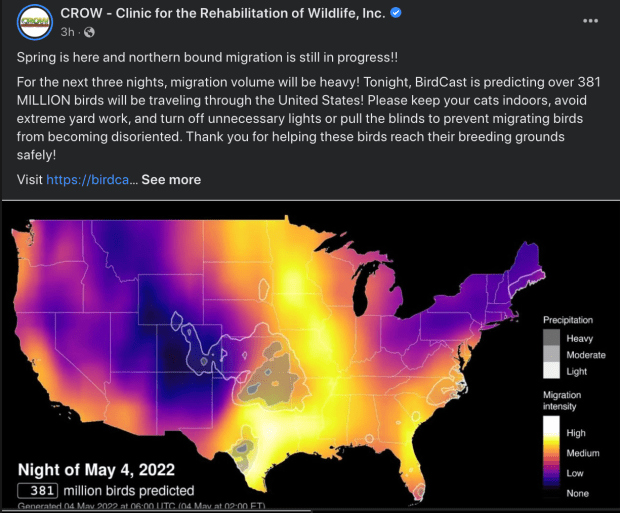
One of my all time favourite wildlife rehabbers is reminding us to help the migrating birds. CROW posted this today on their FB page. Check your region and help! Thank you.

As predicted, we went from winter to summer on the Canadian Prairies. Everyone is outside – and most around me are having their first official barbecue of the season. The birds have not been happy with my clearing up their old seed and I suspect that Mr and Mrs Grackle once again have their nest in the wood shed which is why Mr Raven and Mr Crow have been around so often. My neighbour tells me that he saw about 20 Pelicans in a tree – sounds like the tree with the Great Egrets in Grenada to me. Summer is here. No spring. Just summer.

I hope this blog finds all of you well. Some of the nests are still struggling but life is good and it is pip watch for the Cal Falcons tomorrow!!!!!!!! Yes. I cannot wait to celebrate the three eyases.

Take care. Thank you so much for being here with us. See you soon.

Thank you to the following for their streaming cams and/or FB pages where I took my screen captures: UFlorida-Gainesville Ospreys, Montana Osprey Project, Dulles-Greenway Bald Eagles, ND-LEEF, Cornell Bird Cam RTH, CROW, NADC-AEF, MN DNR, and DHEC.

Comings and Goings in Bird World

Over the course of the year I get a lot of questions. Some of them I can answer, some I find the answers for, and others seem to elude everyone. I want to provide you with two really good sites for information. The first is the “everything you would ever want to know about Bald Eagle” blog. Your answer to any question will be found right there. It is also a great way to get introduced to other Bald Eagle nests. Many of you will recognize the name Ranger Sharyn. She is the NZ DOC Ranger on Taiaroa Head and she has a site where she answers questions and discusses issues. She also gives up to the minute information on the Royal Albatross Colony.

The Bald Eagle breeding season is underway in the United States. Last year, the very first egg was laid during the first week of November! Wow. The days pass like water flowing between your fingers sometimes. There is one person that has all of the information you need on one single site. I really applaud the work done including a listing and the ability to click on a link for absolutely every single Bald Eagle streaming cam. Yes, you read that right. There are also data sheets showing dates for eggs laid, hatchings, and fledgings. There is information on how to measure an eagle, etc. It is mind-boggling all the information devoted to Bald Eagles in one place. That blog is written by elfruler and the latest offering is entitled, Ready to Roll? Here is the link. Please sign up to get the latest information if you are a Baldie fan!

I know that many of you love the Royal Albatross and are anxiously awaiting news of returnees including OGK’s YRK. I also know that most of you are following the Royal Albatross group’s FB page. But what about following Ranger Sharyn Broni on DISQUS? Here is the link to the latest and other information.

https://disqus.com/by/disqus_JDCTCk0WoB/

The Port Lincoln nestlings (can we still call them that when they have juvenile feathering?) had their first meal at 08:35:57 on 25 October. They are so civilized. I just adore this nest.

Little Bob is on the left and he will stop eating at 08:57:56 and move to the rim of the nest. It is quite odd for him to leave first. It was a nice sized fish and he looks like he might want to go back to sleep! I do hope that Mum gets to eat some, too.

You can see Little Bob’s ‘beard’.

Mind you, there is nothing ‘little’ about Little Bob or the other two siblings. They are really taking up nest real estate now!

This was the trio 17 days ago on 8 October. That gorgeous copper red feathering on the back of the heads is prominent and they are getting feathers on the tips of their wings and tails.

This is the trio on 26 September, one month and 3 days ago. Little Bob is there in front, up by Mum’s beak. So tiny you can’t see it.

I was so worried about Little Bob but the pattern that was set early continues until today. Little Bob is up eating and Middle and Big Bob are together waiting their turn or taking turns getting bites. The two older Bobs are right in the middle of the reptile phase.
This is 21 September. Oh, look at Little Bob. He still has all his soft light grey down and his egg tooth. The big sibling behind him is getting its pin feathers and transitioning into the reptile phase. It is hard to imagine looking at them then – and now!

The fast growth of all of the birds is simply incredible.

I have been following the advances of Karl II and his children, Pikne and Udu. It is time to bring everyone up to date on the Black Storm family from the Karula National Forest in Estonia. The last time I posted about them Udu was in Poland, Pikne was in Moldova, and Karl II was in the Ukraine.

In the map below you will see that Pikne and Karl II are following the Eastern land route while Udu finds himself on an island in the Mediterranean Sea.

The green line is Udu and he is currently at the village of Vainia on the island of Crete. The red line is Pikne. She is now in Egypt near Hurghada. She is being described as ‘flying like a rocket’. Indeed, there have been storms and strong winds and there was a worry that Udu would try to cross the sea but he did not. Smart stork. He hunkered down on Crete. We are very anxious for news of the father, Karl II. He was flying along the Jordan River and returned to Israel. There has been no transmission for almost five days now. The last was 21 October. Perhaps there is a problem with the ability of the area to transmit data or the GPS tracker is not operating because of cloud cover. (As someone said, Karl II could be in the Sudan now. I hope it is one of these reasons.) Karl II is an incredible dad. He stayed with Pikne til she was ready to leave the nest – my hat is off to him. These beautiful storks have almost reached their wintering grounds safe and sound. Please send them the very best wishes for a safe arrival with lots of food!

There have been a number of sightings and photos taken of WBSE 27 around the Discovery Centre. There was a sighting of a juvenile being chased by Currawong and the poster thought that it might be WBSE 28. I sure hope so because that means it is mobile and not on the forest floor where the foxes are.

All of the other nests are doing really well. There is not much to report in the way of Bald Eagles save for the Captiva nest on Santibel Island in Florida. Connie seems to be attracting at least two potential mates who are battling it out for dominance. As far as I know, other than sub-adult and some juvenile intruders, all of the other nests are secure. I wonder if the Bald Eagles will attempt to make a nest in Farmer Derek’s tree this year or have the Great Horned Owl family secured it? Time will tell.

Take care everyone. See you soon.

Thank you to the following for their streaming cams where I took my screen shots: the Port Lincoln Osprey Project. I want to thank the public forum for the Eagle Club of Estonia for posting the map of the locations of Karl II and his family.

Iris, the Grand Dame of Ospreys

As the days of summer give way to thoughts of falling leaves and back to school, our beautiful Ospreys think of migration. Those in the United Kingdom have already already headed to the area around Poole Harbour to have a last good feed and sleep on land before heading south to Brittany and on to Africa. Those in the United States and Canada will take various routes. The male is still in Manitoba with one chick at the nest I watch.Some head to southern Texas and places in Mexico while those in the northeast fly over the cost, over the length of Cuba heading to South America. One of those leaving her summer breeding grounds in Missoula, Montana will be Iris.

Iris is not ringed. No one knows where she goes for the winter but, she turns up in tip top shape to her nest at Hellgate Canyon every spring.

Typically Iris spends more time at her nest before her departure. Last year she said goodbye on 8 September. Because of her age, many worry that she will not return. It is always an anxious wait until spring and she arrives again full of hope and hormones.

Sharon Leigh Miles shared this image of Iris taken on her favourite tree on Mt Sentinel on 6 September at 09:22.

She is there. Just squint.

Iris is the oldest osprey in the world – the grand dame of all of them. In her lifetime it is estimated that she has fledged between 30 and 40 chicks but no one knows for sure. It is possibly more. Iris is known around the world. Her arrival on 7 April 2021 to her Hellsgate nest made print and television news. Dr Ericke Green of the University of Montana believes Iris is at least 25 years old, perhaps more.

In the image below, Iris just landing from her winter migration. All the worrying about whether or not she survived another winter is put to rest.

Welcome home, Iris. 7 April 2021
Landing with a nice big breakfast. 10:36 am. 11 April 2021

Iris’s nest, prior to the one she uses now, was on a hydro pole about 68 metres or 200 feet from this one. This artificial nest was built for Iris because of the high rate of electrocutions on power lines – all birds, not just Osprey. The power lines are high enough and have a clear view that they appear to be desirable. The new nest, erected in 2007, is all set up with a high resolution camera. Iris took to the new nest right away, thankfully. Iris mate, at the time was Stanley. Stanley did not return from migration in 2016. Her current mate, Louis, and her have had a very chequered relationship. Louis also has another nest with Star, his primary nest, near the baseball park. Iris and Louis fledged one chick, Le Le, in 2018.

Many of us are glad that Iris has been spending the summer of 2021 taking care of herself. Raising chicks is not an easy job – and everyone loves Iris and wants her to return year in and year out from her migration.

I have included some images taken at the nest this year.

Iris worked on building the best nest that she could. Every day she brought in more material. She eventually will lay three eggs – that we and she – seem to know are destined not to hatch. These were bittersweet moments for everyone.

She was fierce in her fishing and the protecting of her nest. Indeed, her and Louis protected the nest together several times. The video below is from 22 August.

Sharon Leigh Miles provided a chart of the departure dates for Iris for her migration. Today is 6 September so we are definitely in the range. These are the previous dates of her departure:

  • 2012: 6 September
  • 2013: 6 September
  • 2014: 11 September
  • 2015: 4 September
  • 2016: 8 September
  • 2017: 9 September
  • 2018: 10 September
  • 2019: ?
  • 2020: 8 September

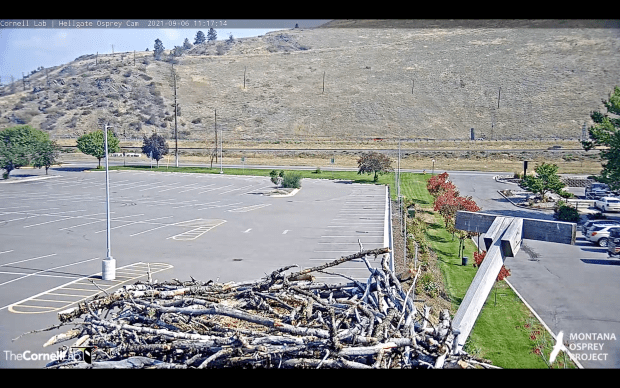
There is no one on the Hellgate Canyon nest this morning. Everyone is hoping that Iris will make several long appearances on the nest before she departs. This has been her MOD in the past. Fingers crossed!

If you would like to periodically check on the nest, here is the link to the streaming cam:

The Montana Osprey Project has had one fundraiser – the Iris pens – this year. If you would like information on how to order one of these, send me an e-mail and I will provide the details. They are lovely. There are also plans to commemorate Iris by a woodblock print. As information comes through I will post it.

Keep Iris in your heart. Migration is challenging. We wish her a safe journey, good winds, lots of fish, and a safe return to Montana in the spring.

Thanks for joining me. Take care everyone.

Thank you to the Montana Osprey Project for their streaming cam where I took my screen shots and their FB page. Thank you Sharon Leigh Miles for allowing me to use your images posted on the FB page.