I was not expecting to see a notification that Ferris Akel was on the Cornell University Campus in Ithaca this evening. What a wonderful surprise! The reason that everyone wants to see Big Red and her family is not to see spectacular things but, really, it is just to know that each and every one of them is safe and well. After the worry of Hurricane Elsa and the nests along the southwest coast of Florida, this was simply a joyful treat.
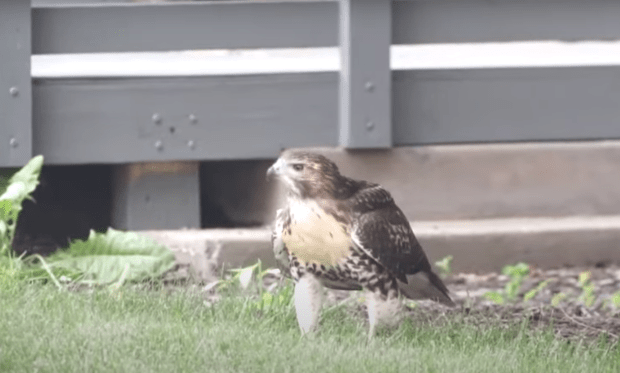
Ferris found K1 on a window ledge. How she got there is anyone’s guess. My goodness she is so cute. Whoever said that she is a mini-Big Red is so right. Her plumage is such a deep brick red and she has a full red-feathered belly band, too, with lots of peach on her chest.

Look at the image below. Notice the feathered area that extends above K1’s eyelid. It starts at the beak and goes to the back of the head. It is called the supercilium. The supercilium helps keep the glare out of K1’s eyes! It is often simply called a bird’s eyebrow.

Hawks can turn their heads 270 degrees. Sometimes it looks like they can do the complete 360 but they can’t.

You can see in the image below, despite it being blurry (rain at started), the peach on the chest and the low very dark feathers of the belly band.


The cere is the area around the nostrils above the beak. You can easily see it in the image of K1 above and below. It is light yellow. Notice that the eyes are a green-gray. When K1 is an adult they will be brown getting a deeper brown the older she gets.
Last year, Big Red and Arthur’s fledgling, J3, was born with deep brown eyes.

Ferris did some close ups of K1’s back so that we could see the scapular ‘V’. When both wings are held tight to the body it is the ‘V’ on the upper back. Examine K1’s scapular V. It has its own pattern. Some people use this along with the tail and the belly band to try and identify hawks that are not banded.

You can think of the scapular V as being the way the hawk’s back looks when the wings are closed.

K1 has a white terminal band on her tail feathers. In fact, it is rather wide. Notice the dark bands. When hawks fledge, we want them to have five, preferably six dark bands, so that they get lift and control and will be successful. K1 now has at least eight dark bands. We know that she is also an excellent flier.
The tail feathers help the hawk to do controlled manoeuvres. This is why it is so much better if they are longer at the time of fledge. The wing feathers – you can see the tips of them in the image below- are the most useful for flying. Did you know that the wing and tail feathers of the fledglings are actually longer than those of the adults? This is to assist them when they are learning to fly. After their first moult, they will grow in the standard length of an adult hawk (return to a normal length). Another interesting fact is that at the time of fledging, the feathers actually weigh more than the bird itself!
At the beginning of their second year, when they moult, the fledglings will get their red tails. When Big Red and Arthur bonded, Arthur did not yet have his red tail! Lots of people questioned Big Red’s intentions. She had many suitors but I think we can all agree that Big Red knew best. She has a wonderful mate in Arthur.

Ferris found K3 in one of the pine trees near to Rice Hall’s parking lot. What gave K3 away? Robins vocalizing!


K3 is looking at something intently.

K3 was doing a lot of preening. The preen or the oil glands are at the base of the tail. These oils reinforce or condition the surface of the feathers. Just like the oil you put in your car, the preen oil changes composition during the year. This oil, once it is exposed to sunlight, has been found to contain vitamin D.

Big Red was over on the ledge at Bradfield. I almost did not recognize her. In the summer when Big Red begins to moult, she starts becoming Big Blond. It looks to me like this process is starting.
But why do hawks moult? Feathers are made out of keratin, just like human fingernails. But unlike our fingernails, feathers do not continually grow. Once they are fully formed, they stop growing. Over time the feathers get damaged. This damage comes from normal wear and tear, the sunlight, parasites, and from injuries. These feathers have to be renewed. Hawks do not moult or change their feathers all at once. They would be unable to fly or function and would die. Moult is a gradual process. Big Red does not begin her moult during breeding season. It is too hard on her. The birds deplete their calcium producing eggs and Red tail hawks can lose approximately 20-30% of their body weight by the time the chicks fledge. Big Red will spend the summer and fall getting back into condition and replacing her feathers.
Feathers help the birds fly, they offer camouflage, and they also keep the birds dry.

Arthur was on ‘the throne’ on Bradfield. Neither Big Red nor Arthur moved from their locations during Ferris’s visit. Both Ks appeared to have a crop and neither were food begging. The crop is the first stage of digestion. It is like a pouch under the beak and the mouth. The crop expands with the food. The undigestables are rolled around in the crop to form a casting which the hawk throws up or ‘casts’. The rest of the food that can be digested enters the digestive system proper. The only raptor that does not have a crop is the owl. Owls have gizzards. If you watch Ospreys you will have looked to see if the chicks have crops. That way you can tell if they have had food recently.

It was an absolutely wonderful surprise. There is nothing nicer than spending the end of the day with Big Red and her family. I hope you enjoyed seeing them, too.
This is a great shout out to Ferris Akel. Thank you Ferris for taking your time to go and check on ‘the family’. It is wonderful to know that they are all fine and well.