The ‘Alberta Clipper’ is just starting to impact Winnipeg with some light snow flakes. We are in an extreme blizzard warning area until tomorrow morning when the winds and snow – getting up to 90 kph (or 55 mph) – dissipate. The garden birds were a little strange today. They ate and left. Normally they come and stay all day but a couple of waves of different groups came and went. I suspect they were going to try and find a place to hunker down for the duration. This storm system is also going to impact a huge part of the US including my childhood state of Oklahoma.
It is snowing on the Storks near Freiburg, too.
There is wind and blowing snow in Durbe, Latvia, the home of Milda, the White-tailed Eagle. The sound from the camera’s microphone makes you shiver – the wind is just howling through the forest.
The female Bald Eagle at Duke Farms is also under some snow and it looks like she might get more as this weather system moves through the eastern US.
There is good news in Bird World. Both of the USS Bald Eagles were seen at the nest today. The worry last night over whether or not there was an injury melted away. Nice.
The thermal down is coming in on the eaglet at the KNF in Central Louisiana. The light natal down is giving way to dandelions. Notice how much longer the beak is and how large the cere has become. The cere is the soft fleshy part above the black beak, seen below. The cere varies in shape, size, and colour amongst raptors. The beak will turn that beautiful yellow when this eaglet is approximately 4-5 years old and be pure yellow by the time it is 6 years old. At that time, it will also finish getting its adult plumage including that full beautiful white head.
The meals are more spread apart but the eaglet is eating longer and its crop is getting much fuller. Just look below. The crop is a pouch along the espophagus. It stores food before it gets to the stomach. It also processes prey items that cannot be processed in the stomach. The raptor will regurgitate a compressed pellet of those items that do not go to the stomach.
The Wildlife Biologist has just confirmed that this crop is at least 3-4 inches (10 cm) long! Wow.
Poor Baby. It took some maneuvering with the weight and flopping of that crop for it to get in a position to PS. Obviously the crop weighs more than the chick’s bottom does.
This baby has really grown in the last 4 or 5 days and is changing more and more with every blink it seems.
Despite being full to the brim and hardly able to move, Anna is making certain that the little one is topped up before bedtime.
NE26 and 27 are awash in Spanish Moss. The nest seems to be covered with it and fish. Lots of fish.
There are those sweet little fluffy dumplings in the nest bole.
Sleeping quietly under Mum.
At the WRDC Nest in Miami, R1 and R2 have popping crops, too. The pin or blood feathers can be seen coming in through the thermal down.
R1 is closest to you. R2 without the fluffy hair is in the back and also has a large crop. Both eaglets are doing well and there is plenty of food on the nest.
The 2022 Albatross Count on Midway Atoll is completed. Here is the information as it was posted by Friends of Midway Atoll National Wildlife Refuge today:
YRK flew in and switched places with OGK yesterday at the Royal Albatross Quarry Track Nest in New Zealand.
Lady Hawk caught that sweet reunion.
The camera is still offline in Port Lincoln. Would love to have had a good look at our Ervie.
Tuesday February 1 is Lunar New Year for many of our friends. For all of you celebrating the Spring Festival, we wish you a healthy, happy, prosperous Year of the Tiger.
Thank you for joining me today. So happy to have you with me. Stay safe, stay warm!
Thank you to the following for their streaming cams where I took my screen captures: Cornell Bird Lab and the NZ DOC, Friends of Midway Atoll WildlifeRefuge FB Page, KNF Bald Eagle Nest, NEFlorida Bald Eagles and the AEF, WRDC Eagle Cam, Duke Farms, Latvian Fund for Nature, and the Stork’s Nest Livestream.
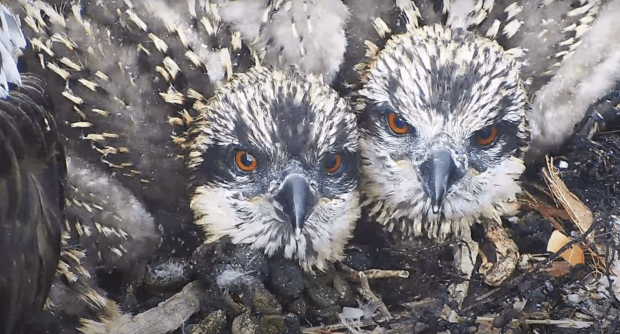
As soon as you read that title, I bet you thought I was going to bombard you with more floofs, cute little Peregrine Falcon eyases. Not today. Surprise! The Port Lincoln Osprey Barge cam operator gave everyone a present by zooming in on the adorable faces of the osplets.
There are several interesting things about these close ups. First, notice that the chicks still have remnants of their egg tooth remaining at the tip of their beak. Can you see the white dot? That will grow and wear off. Ospreys must keep their beaks clean and sharp! You can also see the dark charcoal down that is actually underneath the feathers. It remains while the white fluff disappears. I cannot see any quills but the feathers are growing out of quills that contain blood. Feathers have to have blood to grow. For those who have been reading my blog regularly, they will know that I have carried on and on about how to identify Little Bob. Because he is a third hatch Osprey, I have a special interest in him and his survival and future success so I have to be able to recognize him. So, I discovered that his cere, the part above the beak but before the feathers, has a lot of white. It looks like someone sloshed white paint. That white continues more under Little Bob’s eyes, too. Big Bad Bob has a smooth black cere with little white. As it happens, Big Bob and Little Bob hang out together. So on the left is Big Bob and on the right is Little Bob. Throughout the images below, Big Bob will remain on the left and Little Bob will be on the right. The portraits were snapped off the streaming cam every 5 seconds. There are subtle differences in their expressions.
Oh, just look at that face staring directly at us! So cute.
The angle of Little Bob’s head shows you all the white on the cere and under the eye. It is a degree more than the other chick.
Oh, how I wished Little Bob had looked up like Big Bob earlier.
They are adorable. Several of those will become fridge magnets. Awhile ago now, my ‘eagle expert’ that I consult with my questions, told me that they always make magnets out of their favourite juveniles for each year. I started doing it. It is a super way to wake up in the morning when you open the fridge and say hi to all of them!
There is the following thinking in raptor circles. The first theory is that two females never hang out together. Female raptors do not get along. There is the further belief, since medieval times, that the third, the tiercel, is always a male. Additionally, there is also a belief that the first hatch is a female. If all of those things are true, then Big Bob is a female and Little Bob is a male. In the end, of course, only DNA tests and an egg prove one way or the other. However, since these three will get satellite-paks and will be banded, I am assuming that they will also determine the gender just like was done with Solly and DEW last year. You do not want to band the chicks too early but, the rule is before they are 35 days old. After that, the stress and the approach by humans might force an early fledge. Any earlier and their legs would not be the size of an adult bird and the bands might prove to be problematic.
Tomorrow is the October Big Bird Day. You can help. All you need to do is look out your window for at least 15 minutes and count the birds that you know. You do not have to spend all day and you don’t have to travel if you don’t want to or can’t. Here is the information to sign up. The information helps track declining and increasing population numbers, locate migrate waves, check on how climate change is impacting the birds during migration, etc. Everyone can join in. It is free and it would be very helpful if you did a count. Go to this link for all the information that you need.
There is still only one hatch for Xavier and Diamond. And at 367 Collins Street, Mum finally let dad feed the kids.
It is easy to look at the scrape and think it is a mess. Falcon experts say that couples look for a scrape box where there is a lot of ‘ps’ markings everywhere as they know that means it is a prey rich area.
After Dad fed the little ones, Mum came in with a huge fresh pigeon and fed them again! No one goes hungry on a Peregrine Falcon scrape.
Thank you for joining me today. I hope you enjoyed the close ups of the Ospreys. I have to admit that out of all the birds of prey I am extremely partial to Ospreys, falcons, and hawks. Take care of yourself. Have a lovely weekend. See you soon!
Thank you to the following for their streaming cams where I took my screen shots: the Port Lincoln Osprey Barge and 367 Collins Street Falcons by Mirvac.
Oh, just look who showed up on the NorthEast Florida Eagle’s nest in Jacksonville today – none other than the resident male, Samson! It was 7:23. So very nice to see you, Samson.
Samson is the son of Romeo and Juliet. Samson hatched on this very nest on 23 December 2013. Samson fledged and left the area on 22 April 2014. He was 120 days old.
At the end of the summer in 2019, in August, Samson arrived at the very nest he hatched from and began bringing in sticks. His mate, Gabrielle arrived on the nest on 12 September. In May of 2020, their two chicks, Jules and Romey, named after Samson’s parents, Romeo and Juliett, fledged. In 2021, they fledged their only hatch, Legacy.
The picture below is of Mama Gabby and baby Legacy in February 2021.
Samson has been seen at the nest earlier this month when the technicians came to do the maintenance on the streaming cam. Samson remains in the area of the nest year round while Gabby migrates to a cooler place – although, as I have often said, I don’t know where that would be this year! She will return about the middle of third week in September. It will be wonderful to see her back. Can’t wait.
Samson may be working on a nest but the Peregrine Falcon couple, Diamond and Xavier, are expecting eggs in the nest week or a week and a little bit. Their scrape box is high on a water tower, 170 steps up, on the campus of Charles Sturt University in Orange Australia.
This is Diamond on the ledge of the scrape box today.
Diamond and Xavier’s 2021 fledgling, Izzi, was the joy of everyone. As the only little falcon he was loved and spoiled by his parents. There was some concern he would not leave the scrape box before this year’s eggs are laid. This is the latest message from Cilla Kinross, the head researcher on the Falconcam Project:
“Izzi has not been in the box now for 12 days, but we think he is still around from calls. Parental behaviour continues as normal, with up to three prey a day being delivered to Diamond and preparation of the scrape. Eggs are expected soon (within a week or two). Generally, Diamond starts to spend more and more time in the scrape and her backside looks large and fluffy.”
You can watch Diamond and Xavier here:
Peregrine falcons are nothing short of amazing. Bald Eagles are big but Peregrine falcons are fast.
The cere is the yellow part above the beak. Now look at the nostrils in the cere. There are small keratinous tubercules – they look like small little bumps inside the nostril. Can you see the one on the right nostril of the falcon above? Those are what help the Peregrine Falcon fly so fast. They serve as a baffle against the wind driven in so forcefully into the lungs of the falcon as they do their high speed dives. Otherwise, their lungs would burst.
Most Peregrine Falcons that you will see on a streaming cam lay their eggs in a scrape box like the one of Diamond’s, above. Some make their nests on the side of cliffs like this one in Japan on the island of Hokkaido.
Peregrine Falcons do not make their nest out of twigs. It is believed that this helps to stop the spread of disease from twig nests pests like flies and parasites.
Here is a short 8 minute video to introduce you to the speed and hunting methods of the Peregrine Falcon:
It’s a great day for Malin! We do not know Malin’s exact hatch date. There were three chicks and the youngest hatched on 18 June. Two chicks perished in the heat. So Malin is either celebrating his two month hatch today or his two month hatch and a couple of days, more or less. His first delivery came around 9am and the second was at around 10:14. Malin is really growing.
Here is Malin next to mum, Marsha, this morning. You can see that Malin’s feathers are growing in nicely. Look at the crossing of those wing feathers. Yippeeeeeee. This chick has really grown with the increase in feedings.
And look at all of the bands on those tail feathers – looks like a clean 7 – while, at the same time, there are no spaces in the wing feathers.
Oh, Malin, aren’t you beautiful?
Malin has gotten very good at self-feeding.
Malin is off to a great start on Wednesday. Terrific.
It is raining heavy in Latvia at the nest of Grafs and Grafiene. There are some concerns on the amount of energy used to keep warm by the nestlings.
This is the nearby ditch. It is 200 m long. A portion of the ditch has been closed off and fish have been placed in there along with the decoy of Grafiene. The decoy of Grafiene was painted by an active chat participant and installed by Janis Kuze, the ornithologist.
I hope you don’t mind if I correct just minor details. The beautiful decoy was painted by the active chat participant B.K. and installed by the ornithologist Jānis Ķuze.
These are the size of fish being put into the feeder for Grafs. So much effort. Now we need Grafs to find this spot for his three storklings. It is a very, very difficult time for everyone especially with the rain. If you would like to check on the Latvian Forum for progress, please go to this link:
The situation of the Black Storklings in the nest in Jegova County, Estonia appears to be better than in Latvia. Jan has come to the nest to feed the storklings 3 times today. The storklings have not almost completely depleted the fish that was brought on the 13th when they received their transmitters and bands. They appear to be healthy and doing well. It is not raining on this nest today.
The three storklings are 63 and 64 days old today. The average for fledging appears to be 71 days but then the young storklings are dependent on their parents for another two to three weeks before leaving the nest area. That only puts us at the end of the first week of September for these three to be totally independent of Jan — but, of course, those numbers are only averages. It appears there is time! We all must hope for these birds. They are very rare and very special and there has not been a lot of studies done on them.
The Forum with ongoing information on the Estonian Black Stork nest is here:
Karl II has been in to feed the one fledgling on the Black Stork Nest in the Karula National Park in Estonia. Oh, that fledgling was so happy. That was at 18:33. It is Urmas, the only chick still being fed by a parent. Kaia has left for her migration and the other two siblings appear to have left the nest area and might be travelling as well.
I know that there is much sadness and anxiety in the region for the two Black Stork nests that had late hatches. But, we must also celebrate the happiness of this nest in Estonia, that of Karl II and Kaia. Three fledglings, all healthy! We need to send the most positive wishes for Kaia and the other two siblings as they make their way through Europe trying to get to Africa. And, then, of course, for Karl II and this storklet when they begin.
I have tried to catch the number to confirm this storkling but it is nearly impossible.
The smudge is right in the way!
For those of you watching the North American migration, it kicked off Sunday, the 15th of August at Hawk Mountain in Pennsylvania. The first over the ridge that day was a Broad-winged hawk. There was a strong wind that day and the count was 4 Bald Eagles, 2 Cooper’s Haws, 25 Broad-winged Hawks, and 3 American Kestrel. If you would like to check on the migration in North American on the route over the mountains with all their thermals, here is the place to go for a day to day check in:
It’s 17:16 in Cumbria in the UK and our second great Osprey chick survivor this year – Tiny Little Bob on the Foulshaw Moss nest – is waiting for dad, White YW, to bring her the teatime fish! Every day is a blessing to see you on the nest, Tiny Little (Blue 463).
Thank you so much for joining me today. Please send all your positive energy to our friends in Latvia and to Grafs for him to find the feeder and for the safe migration of all of the birds. Take care everyone. See you soon.
Thank you to the following streaming cams and forums where I grabbed my screen shots: The Forum for the Latvian Fund for Nature and the Sigulda Black Stork Nest, The Eagle Club of Estonia and the Black Stork Nest at Jergova County, The Eagle Club of Estonia and the Black Stork nest in the Karula National Park, Collins Marsh Nature Centre, Northeast Florida Bald Eagle Cam and the AEF, Cumbria Wildlife Trust and the Foulshaw Moss Osprey Nest, and Cilla Kinross and the Falconcam Project at Charles Sturt University in Australia.
I was not expecting to see a notification that Ferris Akel was on the Cornell University Campus in Ithaca this evening. What a wonderful surprise! The reason that everyone wants to see Big Red and her family is not to see spectacular things but, really, it is just to know that each and every one of them is safe and well. After the worry of Hurricane Elsa and the nests along the southwest coast of Florida, this was simply a joyful treat.
Ferris found K1 on a window ledge. How she got there is anyone’s guess. My goodness she is so cute. Whoever said that she is a mini-Big Red is so right. Her plumage is such a deep brick red and she has a full red-feathered belly band, too, with lots of peach on her chest.
Look at the image below. Notice the feathered area that extends above K1’s eyelid. It starts at the beak and goes to the back of the head. It is called the supercilium. The supercilium helps keep the glare out of K1’s eyes! It is often simply called a bird’s eyebrow.
Hawks can turn their heads 270 degrees. Sometimes it looks like they can do the complete 360 but they can’t.
You can see in the image below, despite it being blurry (rain at started), the peach on the chest and the low very dark feathers of the belly band.
The cere is the area around the nostrils above the beak. You can easily see it in the image of K1 above and below. It is light yellow. Notice that the eyes are a green-gray. When K1 is an adult they will be brown getting a deeper brown the older she gets.
Last year, Big Red and Arthur’s fledgling, J3, was born with deep brown eyes.
Ferris did some close ups of K1’s back so that we could see the scapular ‘V’. When both wings are held tight to the body it is the ‘V’ on the upper back. Examine K1’s scapular V. It has its own pattern. Some people use this along with the tail and the belly band to try and identify hawks that are not banded.
You can think of the scapular V as being the way the hawk’s back looks when the wings are closed.
K1 has a white terminal band on her tail feathers. In fact, it is rather wide. Notice the dark bands. When hawks fledge, we want them to have five, preferably six dark bands, so that they get lift and control and will be successful. K1 now has at least eight dark bands. We know that she is also an excellent flier.
The tail feathers help the hawk to do controlled manoeuvres. This is why it is so much better if they are longer at the time of fledge. The wing feathers – you can see the tips of them in the image below- are the most useful for flying. Did you know that the wing and tail feathers of the fledglings are actually longer than those of the adults? This is to assist them when they are learning to fly. After their first moult, they will grow in the standard length of an adult hawk (return to a normal length). Another interesting fact is that at the time of fledging, the feathers actually weigh more than the bird itself!
At the beginning of their second year, when they moult, the fledglings will get their red tails. When Big Red and Arthur bonded, Arthur did not yet have his red tail! Lots of people questioned Big Red’s intentions. She had many suitors but I think we can all agree that Big Red knew best. She has a wonderful mate in Arthur.
Ferris found K3 in one of the pine trees near to Rice Hall’s parking lot. What gave K3 away? Robins vocalizing!
K3 is looking at something intently.
K3 was doing a lot of preening. The preen or the oil glands are at the base of the tail. These oils reinforce or condition the surface of the feathers. Just like the oil you put in your car, the preen oil changes composition during the year. This oil, once it is exposed to sunlight, has been found to contain vitamin D.
Big Red was over on the ledge at Bradfield. I almost did not recognize her. In the summer when Big Red begins to moult, she starts becoming Big Blond. It looks to me like this process is starting.
But why do hawks moult? Feathers are made out of keratin, just like human fingernails. But unlike our fingernails, feathers do not continually grow. Once they are fully formed, they stop growing. Over time the feathers get damaged. This damage comes from normal wear and tear, the sunlight, parasites, and from injuries. These feathers have to be renewed. Hawks do not moult or change their feathers all at once. They would be unable to fly or function and would die. Moult is a gradual process. Big Red does not begin her moult during breeding season. It is too hard on her. The birds deplete their calcium producing eggs and Red tail hawks can lose approximately 20-30% of their body weight by the time the chicks fledge. Big Red will spend the summer and fall getting back into condition and replacing her feathers.
Feathers help the birds fly, they offer camouflage, and they also keep the birds dry.
Arthur was on ‘the throne’ on Bradfield. Neither Big Red nor Arthur moved from their locations during Ferris’s visit. Both Ks appeared to have a crop and neither were food begging. The crop is the first stage of digestion. It is like a pouch under the beak and the mouth. The crop expands with the food. The undigestables are rolled around in the crop to form a casting which the hawk throws up or ‘casts’. The rest of the food that can be digested enters the digestive system proper. The only raptor that does not have a crop is the owl. Owls have gizzards. If you watch Ospreys you will have looked to see if the chicks have crops. That way you can tell if they have had food recently.
It was an absolutely wonderful surprise. There is nothing nicer than spending the end of the day with Big Red and her family. I hope you enjoyed seeing them, too.
This is a great shout out to Ferris Akel. Thank you Ferris for taking your time to go and check on ‘the family’. It is wonderful to know that they are all fine and well.