Thursday in Bird World

The camera for Daisy’s nest is offline. This is the last image and it was raining at the time. Daisy will come to the nest just as she has done for the first 7 days to lay egg 8 today. It will become increasingly difficult for Daisy to cover the eggs as the number increases unless there is a miracle on the nest and a bunch of leaves fall for her to gather. As I pointed out in an earlier blog, Daisy had much more down last year and this was helpful but – it is not helpful in the rain as it shrinks and is for naught. We can only hope that Daisy’s luck continues but we must be prepared that it is a long slog for our little duck until these eggs hatch. Anything and everything can happen.

I will bring a brief update on Daisy later this evening if the camera starts streaming. Just wish our little duck all the luck you can.

There are wonderful reports coming from Jean-Marie Dupart in Senegal. The Osprey count is more than he would have imagined and he is having to report early. Dupart believes, by the end of the month, that he might have counted 1000 individual Ospreys!

At the Kalissaye Reserve, there were 127 for the entire month of November. Already in December for one week, the count is 160. Saloum Park had 64 birds for all of November and now already there are 90. Dupart is overjoyed.

The Kalissaye Reserve is a small nature centre or reserve near the Casamance River. The Casamance Region is know as ‘The Green Garden of Senegal’.

Wet lands and the Casamance River in the background. This is the area of the Ospreys. Wikimedia Commons.

This is Saloum Park or Delta in Sengegal. These look like perfect places for our Osprey to over winter.

Wikimedia Commons
Wikimedia Commons

The Port Lincoln Lads had plenty of fish yesterday. Ervie had the first two fish at 06:19 and 08:39. Bazza had the next four deliveries! At 14:22, 15:58, 17:33, and 20:40. Falky did steal one of Bazza’s fish so he did get something to eat yesterday. Mum delivered the 14:22 fish to Bazza – she even looked like she might have even fed her big boy! I think Bazza is indeed Mum’s ‘baby’ despite the fact that he was the first hatch.

The Captiva Osprey Pair, Andy and Lena, arrived back at their nest early.

I will give you this link to watch this nest but there is a word of caution. Andy and Lena have had many successful hatchlings but have never fledged any Osprey. The reason is that the Crows come and eat the chicks. That is so sad. Maybe this year Andy and Lena will have good luck like Port Lincoln.

The Kakapo Recovery has announced that 2021 adoptions are closing today – that is the 10th of December in New Zealand. If you are a supporter of the Kakapo Recovery, you might wish to adopt one of the non-flying parrots as a holiday gift to all your family.

There are two eggs at the Captiva Bald Eagle nest with Connie and Clive and two eggs with Anna and Louis at the KNF nest in central Louisiana.

Connie’s new mate, Clive, looks at the two eggs.

You can watch Connie and Clive here:

Louis is just a great dad down at the KNF Bald Eagle nest. Last year he was so excited when Kisatchie hatched that there were 18 fish on the nest for the eaglet and Mum. There was no way they could eat all of them. This year he is really helping to build up a really cosy nest!

This is Anna and Louis’s second breeding attempt. Last year they fledged Kisatchie. They are in a very old nest in the Kisatchie National Forest. It had belonged to another Bald Eagle couple who had fledglings up to 2013. Kisatchie, last spring, was the first eaglet to fledge from the nest in 8 years. It was a wonderful event.

Here is the link to Anna and Louis’s nest. I promise they are a fun couple.

Thank you for joining me today. It is so nice to have you stopping in to check on the birds. Isn’t that a great count of Ospreys in Senegal? Wow. I am hoping that Blue 463 might be spotted — our very own Tiny Little Bob from the Foulshaw Moss nest in Cumbria. Take care everyone.

Thank you to the following for their streaming cams or their FB Pages where I took my screen shots: the Kakapo Recovery, the KNF Bald Eagle Cam, the Captiva Bald Eagle Cam, Port Lincoln Osprey Project, Sea Eagles @Birdlife Australia Discovery Centre, Wikimedia Commons, Captiva Osprey Cam, and Jean-Marie Dupart for his report on the Ospreys in Senegal.

Good News in Bird World

There is a lot to celebrate in Bird World this evening. Everyone on the Taiaroa Peninsula and perhaps the whole of New Zealand are celebrating the arrival of the 2021 Royal Albatross Cam Princess, Tiaki, at the feeding grounds just 70 km off the coast of Chile – safely! This really is amazing. As was pointed out on the Royal Albatross FB page, this young bird fledged on 25 September and arrived in the waters off the coast of Chile, 8500 km away, in 35 days. Incredible. Congratulations!

For those watching the return of the Royal Albatross to Taiaroa Head for the upcoming breeding season, OGK has flown off the peninsula to feed. He continues to wait for his mate, YRK. I have asked and been told that OGK is not the only male still waiting for its mate. That gives me some hope that this adorable couple will still be reunited. They were the parents of last year’s Royal cam princess, Pippa Atawhai.

There has been no new tracking data for Karl II but, on the 28th of October, he had reached Umm Harazat in the Sudan close to where he winters. Udu was at the Farafa Oasis in Egypt on the same day and Pikne was along the Red Sea. I expect that Udu and Pikne could be further into Africa by the time the next transmission comes in.

The Farafa Oasis is an area known as the White Desert.

Udu made a splendid flight across the Mediterranean Sea. The White Desert is home to a number of wells and there is farming in the area. It is most know for its white rock figures.

Pikne’s position:

Karl II’s position:

Moving away from the migrating birds back to Australia, little Yurruga took some big steps today. What a sweet little falcon! Here is a short clip I made of this momentous event.

Yesterday, Dad fed the 367 Collins Street Four in an area that could be viewed easily. There are, of course, concerns that the falcons will fledge from the end where there is no camera view. The owners of the cameras have stated that they will not change the direction of the camera again as it is too disturbing for the birds. That is quite understandable at this stage. No one wants to frighten these lovely eyases and have them fly and fall to their doom. And there is no telling which end of the ledge they will fledge. We just simply wait. They are so strong and healthy. Mum and Dad have been heroic in their efforts to sustain them. So please keep feeding the pigeons in Melbourne – our falcons need them!

There has been no word from the vet team about the condition of WBSE 27 since it was attacked by the Pied Currawong and found on pavement near to the Sydney Olympic Forest.

The Sydney Sea Eagle Cam FB page had originally posted WBSE 27 on the pavement unconscious. This disturbed some people so it was replaced with the image below. I have said that no news is good news but this has been several days since the incident. Send all the positive energy to this beautiful bird that you can!

There is good news at the Kakapo Recovery. The team has discovered that the eggs that are laid but do not hatch are not always infertile. Since the beginning of trying to help the Kakapo to recover numbers, it was always believed that the eggs were simply infertile and that is why there was no chick to hatch. The chicks are dying at an early stage. If they can figure out what is the cause, they might be able to assist these lovely non-flying parrots to have more successful hatches. Here is the posting on the Kakapo Recovery FB page. It talks about their efforts with the University of Sheffield to understand the issue and be able to have more live births of this critically endangered bird. Bravo!

The ospreys on the PLO barge are doing great. Little Bob is 45 days old today. Fledging is coming soon. Oh, how I am going to miss this wonderful trio. They have delighted hundreds and hundreds of people this season. Pure joy!

Look at Little Bob showing off! Besides loving to eat Little Bob really does like to give those wing muscles a go. I don’t think Big Bob is very amused.

In the image below, from left to right: Middle Bob (2), Little Bob (3), and Big Bob (1). If I were to have to base a guess on their gender due to the legs, I am afraid that I would have to change my prediction.

Middle Bob’s legs are definitely shorter and stockier than either Little Bob or Big Bob. Big Bob’s legs look like those of a male. That leaves us with Little Bob that I continue to believe is a female. Oh, I cannot wait for those measurements. They are not 100% certain but, perhaps, they will also do DNA testing on the three when they ring them!

Little Bob gives its two older siblings a big hug.

There is Little Bob looking off to the left after the morning breakfast. Three gorgeous nestlings. Ringing, naming, and measuring will take place the week of 8 November. I will keep you posted to the more exact date when I find out.

Thank you so much for joining me today. I hope that you are all well. Take care!

Thank you to the following for their streaming cams where I took my screen shots, video clips, and maps: Port Lincoln Osprey Project, 367 Collins Street Falcons by Mirvac, Charles Sturt University Falcon Cam at Orange and Cilla Kinross, Birdmap, Kakapo Recovery FP Page, Wikimedia Commons, and Wildlife Computers.

Monday in Bird World

There is some sad news coming in from the Kakapo Recovery. During routine checks, Tutu was found dead. He hatched in 2019 and the team says he was quite ‘the character’. This brings the total population of Kakapo in the entire world to 201.

Photo of Tutu @ Petrus Hedman Kakapo Recovery FB

The news coming in is not all bad but, it could be a lot better. I reported that Grafs had provided two feedings for the Black Storklings on the nest near Sigulda. As it turns out, after I posted my newsletter, Grafs returned two ore times making a total of four feedings on 15 August. The team are hoping that Grafs will find the feeding table. If Grafs does and accepts the food, this nest could turn around quickly! At the present time the storklings are in a critical condition.

This is the news from Janis Kuze:

“I can report that fish were let into the feeder last night, the place is a few hundred meters from the nest and is easy to see from the air, but the bird still has to find it.
Thanks to everyone who provided support!”
Jānis Ķuze

Grafs arrived with some larger fish for the storklings at 14:47. He has yet to find the feeding table. Some are thinking that it might not be in his territory. There is a discussion about putting a decoy black stork to attract Grafs.

A feeding table has also been set up for the Estonian Black storklings of Jan and Janika. I understand a decoy – a White Stork decoy painted black – is at that table to try and lure the male to the fish for the storklings.

Yesterday I said that the storklings had eaten all of the fish. That was incorrect. They have been stomped into a pile but the Estonian storklings are still eating from them today and they have had a feeding from Jan. You can see the remaining fish today on the back left of the nest. Thankfully the nestlings are eating from them. If you look at their bills they are still a dull colour which is good. They are also not getting stress lines in their feathers like the storklings of Grafs. Stress lines are translucent feathers caused by all manner of stresses not just lack of food. Regular growth in feathers is not translucent.

Here is the link to the streaming cam of the Black Storklings in Latvia:

Here is the link to the streaming cam of the Black Storks in Estonia:

If you want to keep up to the minute with what is happening at either or both of these nests, please look under the information of each streaming cam. You will find the link to the English forums.

Please be mindful that these are extremely difficult times for the moderators and helpers on the chats and the forums. These two nests showed great promise – the best – and as I have said many times — the fate of our birds hangs on a fragile piece of thin thread. It can change any moment. The biologists and vets are doing everything possible. We need for the male storks to find the fish tables. Send your warm thoughts to all. The little ones need a miracle.

UPDATE: It appears that Jan has found the fish table. He has flown in and brought 2 very large fish to the nest in Estonia. There are also fish left there from the bander! Great news. Let us hope this continues and now we just need Grafs to find the fish.

And now on to some rather silly news. Blue 462 at the Foulshaw Moss Osprey Nest in Cumbria, got the breakfast fish. And, of course….Tiny Little was right there making sure her big sibling could not eat in peace. Tiny Little is giving them back what they gave to her as a youngster in the nest!

Tiny Little loves moving around the sticks. It is really disturbing to the one who is trying to eat.

One of the cameras got knocked but what it did was give us a nice close up of all those sticks Tiny Littles moves and returns, moves and returns.

There were others wanting some of that fish – those pesky crows who seem to be around, too.

Tiny Little kept running at the crows to get them to go away but finally, it was 462 that flew away leaving Tiny Little that great big fish all to herself. Do you think Tiny has enlisted the crows to help her? with the promise she will leave some food? Normally, Tiny Little is like a vacuum cleaner removing every piece of fish!!

In the image below, 462 has just flown off the nest. Tiny Little is moving towards that big fish she is going to have for breakfast.

Tiny Little spends some time making sure the siblings and the crows are not going to bother her. At one time or another the crows were climbing and flying around that part of the nest. But never mind. Tiny Little started 16 August off with a nice big crop. Well done Tiny Little.

It’s now 17:30ish on the Foulshaw Moss nest and Tiny Little is there calling White YW for food along with another sibling. It looks like 464 to me but I cannot catch the band number. Tiny Little is the fledgling at the back.

Tiny Little is such a character. She is one of the good news stories of the year for sure! I really hope that when she returns to raise her family it is on one of the nests with a streaming cam.

Do you recognize this view?

That is the scrape box for the Collins Street Falcons in Melbourne! and the YouTube channel is up and running. This is fantastic news to all of us that have waited to see this couple and their eyases again. Dad is just the cutest.

Both parents are working on the scrape box. That is mom in the image below.

Here is the link so you can be in on the action from the very beginning:

It doesn’t get any cuter nor any happier than the little sea eaglets in the nest on the old Ironbark Tree in Sydney’s Olympic Park.

Both of them are thriving! That is 27 facing us with its big crop and 28 is still eating.

Yesterday, Malin went to sleep with his head on a fish and another whole Bullhead on the left side of the nest. He woke up this morning and finished off the “pillow fish” and Marsha flew in and fed him and ate a lot of the Bullhead herself.

Malin has a nice big crop! Mom is getting some fish and that catch did not go to waste. And that is a good thing.

Thank you so much for joining me today. This newsletter comes about six hours earlier than I expected. It is nearly 100 degrees F on the Canadian Prairies and the birds are in hiding. No photography until later. I will continue to monitor the two Black Stork nests and bring updates. Send your prayers and your warm wishes to those two Black Stork nests. They need a miracle to get the males to accept the fish! Bukacek did so we need Grafs and Jan to do the same!

Thank you to the following for their streaming cams or their FB pages where I took my screen shots: The Kakapo Recovery FB, Collins Marsh Nature Centre Osprey Cam, Sydney Sea Eagles, Birdlife Australia, and The Discovery Centre, Cumbrian Wildlife Trust and the Foulshaw Moss Osprey Nest, 367 Collins Falcons, The Eagle Club of Estonia and The Latvian Fund for Nature.

The Great White Egret

Sometimes there are birds that seemingly get forgotten as I rush to find out if Tiny Little beat the big older siblings to the fish or to check on Malin’s feather growth. Clearly one of those has been the Kakapo. There are now only 202 Kakapo, parrots that cannot fly and who love to eat Rimu, on a couple of small islands near New Zealand. They are continually monitored and all have satellite transmitters. They get health checks and are flown off island for care, if needed.

The Kakapo Recovery has partnered with On the EDGE Conservation to create the Kākāpō Run game. As a player you can help the Kakapo evade their predators will collecting Rimu Fruit. Because it is filled with facts about these amazing birds, it is a good way to learn about them. You can download the game here:

https://play.google.com/store/apps/details…

https://apps.apple.com/us/app/kakapo-run/id1569861836

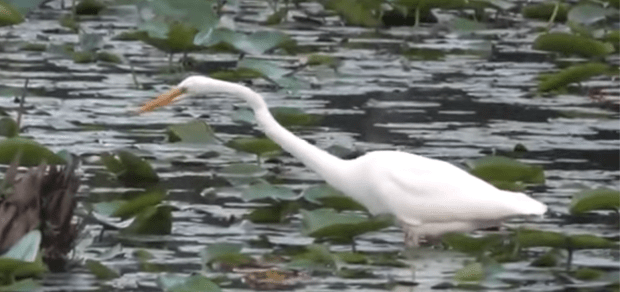
Ferris Akel spent most of the Saturday tour at Sapsucker Lake near Ithaca, New York. It was magical. We never made it to see Big Red and her family at Cornell University but it was a great time. One of the highlights was a Great White Egret which is rare to Sapsucker Lake.

Great Egrets are also called the Common Egret or Great White Heron.

Great Egrets will generally stand and wait to see their fish. They also slowly and quietly wade through the water until their neck snaps quickly and they get their fish.

Patience. Quiet. The Great White Egret gets its dinner.

Great Egrets nest in trees.

The beautiful white plumage that adorns these graceful wading birds was used for women’s hats in the late 19th century. Those silky white plumes are called aigrettes – which gives the bird its name. At the beginning of the 20th century, an ounce of Great Egret feathers was worth $32 USD, more than an ounce of gold according to the authors of Birds of Canada. People were so outraged that some of the first legislation to protect birds and their feathers was because of the Great Egret being brought to near extinction for hats!

In Canada, the Great Egrets nest in a very small number of places – in the very southern parts of Saskatchewan, Manitoba, a small part of southeastern Alberta, and southern Quebec. They are found in the Americas, Asia, and parts of southern Europe.

“Great egret rising” by wolfpix is licensed under CC BY-ND 2.0

The Great Egrets are large birds. They are 94-104 cm (or 37-41 inches) with a wing span of 1.3 m or 4.2 feet. They weight about 1000 grams or 2 pounds. They are all white with black legs and a yellow bill like the one shown above. During breeding season, a patch between its eyes turns neon green and long plumes grow out of its back.

“Great Egret Pointing the Sky” by TexasEagle is licensed under CC BY-NC 2.0

Non-breeding Great Egrets have a small yellow patch between its eyes and bill.

“Great Egret on nest with chicks” by Photomatt28 is licensed under CC BY-NC-ND 2.0

Great Egrets build a flat nest or platform of twigs and sticks. They will lay between 1-6 eggs which are incubated for a period of 23-26 days. It will be another 21-25 days til fledging for the youngsters. Aren’t they cute!

I am getting so excited for Peregrine Falcon season to begin in Australia. The male at the 367 Collins Street Nest also known as the CBD Nest arrived with prey for the female today. He is just such a cutie. The nest camera that streams on YouTube is not up and running. It will begin operations after the eggs are laid (normally). For now there is a camera operated by the owners of the building, Mirvac. Here is the link:

https://367collins.mirvac.com/workplace/building-overview/falcons-at-367-collins?fbclid=IwAR3vGCMkdnScju_KTKjhCrcHRnbsYxJm3kAKTLIOzylSVe8PX3UmwaJEn-s

The other Peregrine Falcon nest is that of researcher, Dr Cilla Kinross, at Charles Sturt University. The scrape box is home to Xavier and Diamond and they have been working on the scrape for some time now. We expect eggs at both nests by the end of August.

If you watch both nests you will get a good glimpse into the difference between a falcon nest on a high rise building in a major city, Melbourne, and the more open rural area of Orange, Australia. The prey is very different!

As it turns nearly midnight on the Canadian prairie, the day is just starting on the Foulshaw Moss Osprey nest in Cumbria. No doubt our beautiful Blue 463, Tiny Little, will fly out from where she is roosting on the branches of the tree in the distance, to the nest. White YW has a trio of big Osprey fledglings to feed. He has demonstrated that he is perfectly capable of feeding a family of five.

Thank you so much for joining me. Take care everyone. I hope to have some local images of bird life in Manitoba for you shortly.

Thank you to the following for their streaming cams where I get my screen shots: Ferris Akel and Cumbrian Wildlife Trust and the Foulshaw Moss Osprey Nest.

Feature Image Credit: “Great egret (Ardea alba) in flight at sunrise at Venice Rookery, Venice, Florida” by diana_robinson is licensed under CC BY-NC-ND 2.0

Late Monday 19 July in Bird World

When every fledgling is hungry and Mum brings in a fish:

This is currently the state at the Foulshaw Moss Osprey nest where the three fledglings are waiting on the nest for a fish drop and each one of them is food begging. Tiny Little has lost out today so let us hope that Blue 35 shows up and feeds him. The birds do not need to eat every day – a lesson that they will have to learn.

I have watched and watched but was away for a couple of hours. It is unclear if Tiny Little had any fish today. At 22:00 one of the big siblings was on the nest eating. At first Tiny Little food called to Mum but then he laid down like his cute duckling self and didn’t continue. The big sibling ate the entire fish, flew off, and then Blue 35 left also.

Nite Nite Tiny Little. Have some sweet fishy dreams – and if you are hungry tomorrow, let everyone know it.

The film, Brave New Wilderness, is only showing in New Zealand on Vimeo right now. It is about the recovery efforts going on for the Kakapo and the Takahe. Watch for when it will be released worldwide on Vimeo. Here is that trailer:

There are now only 202 Kakapo in the world. Kakapo parrots that cannot fly. They are loners. They rarely interact with one another. The only time that they come out of their ‘own space’ is during the summer and fall breeding season or you might find 2 to 4 gathered at a food dispenser on the island. Kakapo will only breed if there is lots of food and that food must be Rimu fruit. It is sometimes called Bush Tucker and is a group of Indigenous foods that grow wild.

“Ripe rimu fruit” by Department of Conservation is licensed under CC BY 2.0

This is Sinbad and he has been fitted with a very special transmitter by the Kakapo Recovery. This transmitter will not only will give Sinbad’s GPS but will also tell the researchers and staff of the recovery if Sinbad has mated.

Because of their solitary nature the Kakapo have to be fitted with transmitters so that they can get their health checks. It has made a huge difference in the population as any ill birds can be sent out for wildlife veterinary assistance.

Some people thought it was funny but right now it is such an effort to feed four people that Laddie, LM 12, losing a fish over the side of the nest on a delivery at 17:05 feels rather tragic. I know that Tiny Little would have liked to have been under that nest to catch that fish!

The storkling that fledged is back up on the nest with her other siblings. So everything is fine in Mlade Buky with the White Storks. Good news. So happy when the fledglings don’t get themselves into a spot of mischief.

It’s 5:54 at the Patuxent Osprey Nest 2 and Mom has a fish and there are three hungry chicks. The chick that fell into the water is doing fine. What a relief to have that little one back on the nest! One of the rescuers told my reader ‘L’ that they were fortunate because it was still low tide when they went to find the baby. Everyone is still so grateful!

I have to admit to almost having a mini-meltdown. One of the chicks was so well hidden behind mum that it looked like this nest had lost another one overboard. Thank goodness it was just the angle of the camera!

That is a short round up today. All of the UK Osprey nests are doing great. The fledglings are all flying and getting stronger save for our little one, Tiny Little. Her confidence is growing and no doubt by this time next week we will be wishing she was back being a duckling on the nest.

Thank you so much for joining me. So happy that you enjoy the birds! It is lovely to have you with us.

Thank you to the following for their streaming cams where I get my screen shots: Mlade Buky White Stork Cam, Scottish Wildlife Trust and Friends of Loch of the Lowes, Cumbria Wildlife Trust and Foulshaw Moss Osprey Nest, and the Patuxent Park Osprey Nest 2 as well as the Kakapo Recovery FB Page and SF Bay Ospreys and Golden Gate Audubon for their video.