A Cracker of a Day for Malin

Oh, it’s a cracker of a day! We know that the Sharp-shinned Hawk that comes to our garden is here often but since the extreme head we had not seen him. He flipped around on the lines bringing the Internet into the house and then in a blink was in the lilac bushes. He stayed there for about ten minutes and out he flew between the houses heading north. No chance for a photo but I tried! We feed approximately 300 urban birds a day – yes, you read that right. I never grieve over the single sparrow that Sharpie is sometimes able to catch. He has to eat, too.

Sharpie is an aberration according to Cornell Bird Labs. He should not be living on the Canadian Prairies in the winter but he does! He is a year round resident. It was his mate – in January 2017 – that changed my life. It is so good to see him.

Malin is such a sweetheart. He has the sweetest face. It has been a good day for Malin, too.

Last night, Malin slept on a piece of fish about the size of the one in front and to the right of him. There was also a small Bullhead on the nest last night. Malin woke up and ate the fish he was sleeping on. Mom arrived and shared the Bullhead with him. On top of those two, Malin had four other deliveries today. A total of 6 fish! His crop is about to pop. We have never seen this Osprey chick this full. I wonder if he will use this fish as a pillow? save it for breakfast? or finish it off a little later? He is one lucky little Osprey today.

Those pesky little sea eagles will have several good feeds today, too!

WBSE 27 is the one on the left and cutie pie WBSE 28 is on the right.
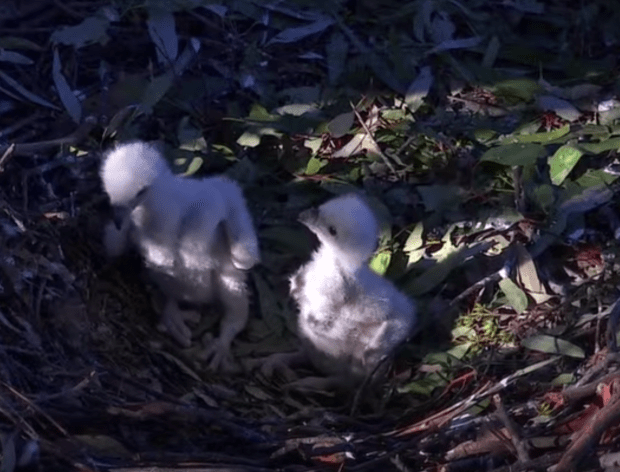
There is still a tiny bit of egg tooth left but it is disappearing quickly. If you look closely under that soft down are there little pin feathers growing?

WBSE 27 hatched on 29 July and WBSE 28 hatched on 31 July. Today, they are 17 and 15 days old. This is the end of week 2 going into week 3.

  • Week 2: The wee ones are covered all in white down. Their beak is starting to grow longer but the egg tooth (the white dot) is still visible.
  • Week 3: We should be seeing the bill and the eyes enlarged but still the white down. The chicks are now doubled in size from when they hatched. They are looking around and noticing things.
  • Week 4: Those pin feathers I wondered about are starting to show on the wings. You will see them begin to preen their feathers and they should be moving around the nest picking up sticks and leaves. They will also be resting on their tarsus assisted by their wings for balance. The tarsus is the part of the leg from the top of the foot to the knee.

Ah, so sweet when they are asleep and growing!

The day is yet to begin in Latvia and Estonia. We wish that those beautiful Black Storklings get lots of fish today.

Thank you so much for joining me for this quick update on Malin. We are so pleased that Malin has had lots of fish today. He is getting so big and no doubt the more he eats the stronger the little one will get for fledge. The featured image is our little cute Malin. Take care. See you soon.

Thanks to the following for their streaming cams where I took my screen shots: Collins Marsh Nature Centre and Sea Eagles, Birdlife Australia, and The Discovery Centre.

Oriental Storks survive fire

The number of wildfires burning during the summer of 2021 has boosted concern for the birds and wildlife being impacted. For the past three days there has been constant reporting in Europe on the state of migrating storks passing over Greece. They are dying or, if not dead, being taken into care for smoke inhalation. It is tragic. In Canada and the Pacific Northwest, nestlings died during the heat wave at the end of May that triggered a number of fires. Some Coopers hawks in that region began jumping out of their nests when temperatures reached almost 50 degrees C.

When an area begins to burn, most of the birds will fly away from the fire to a nearby safe spot. Not all birds can fly – nestlings will be killed. Smoke inhalation may cause long term damage to the lungs of the birds and, as we have seen in 2020 in the SW United States and now in Greece, fires impact birds that are migrating. The fires and smoke can kill them. Indeed, there have been so many fires in recent years that it is difficult not to remember specific birds that have been impacted. Anyone watching Iniko as the forest around his Redwood nest burned during the Dolan Fire will understand the problem as well as those who saw the koalas caught in the fires in Australia. Birds and animals get displaced during fires and while the forests will grow and again provide shelter and food, it is the immediate impact – loss of nests and nestlings, the heat, death or smoke damaging lungs that is so horrific. No one appears to know the long term impact of smoke inhalation on birds.

On the 13th of May 2019 a male Far Eastern Stork saved his five storklings in Siberia. It made news around the world. Humans started the fire. The lesson the video teachs us is that artificial bird nests should be made out of materials that will survive wildfires. I wonder how high they should be to afford the benefit that the nest below does to Father Stork and his five babies.

Each of you has seen the storks in Europe who love to be around humans. They roost and make their nest on the homes of humans and sometimes, even are cared for by humans. The Far Eastern or Oriental Stork, Ciconia boyciana) does not like to be around humans. It will make its nest as far away from us as it can. Sometimes on the outskirts of forest areas, near lakes and marshes so it can feed its young.

The Oriental Stork is larger than the European White stork. Normally weighing 2.8 to 5.9 kg (or 6.2 to 13 lbs). It has a wingspan of 2.2 metres (7.3 ft). You can immediately tell the difference between a European White Stork and an Oriental stork by the red skin around the eye of the Oriental Stork, the whitish iris and its black bill.

“Oriental Stork” by ltshears is licensed under CC BY-SA 2.0

The Far Eastern or Oriental stork is is extremely rare. It used to live in Russia, areas of China, and in Japan and Korea. Today, it is found only in the eastern areas of Russia where 95% breeds in the Amur-Heilong river area. It winters on Yangtze River in China. The other small percentage of birds breed in the Northeast of China. There is good reason for the stork not to trust humans. It was poached, it was shot, and it was killed by herbicide use.

“東方白鸛 (Ciconia boyciana#Oriental Stork)” by Lin Sun-Fong is licensed under CC BY-SA 2.0

Here is a time lapse image of our hero’s nest from wee storklings to fledge. It is very short. Have a look at those babies fly off! They are gorgeous.

This morning was a great one. It looks like the little Osprey on the Collins Marsh nest in Wisconsin had a nice crop! Malin woke up and found an old fish tail and ate it – oh, this chick reminds me so much of Tiny Tot at the Achieva Nest. Then Dad flew in with either a small fish or ? . It appeared Malin ate it all and then Mom flew in and fed Malin some more fish. An hour of so later, Dad flew in with another fish for Malin to self-feed. Gosh. Malin with a crop! It is rare like the Far Eastern or Oriental Stork. So happy!

And then Dad flew in with another fish. Fantastic. What a great beginning of the day. It is not even noon yet on the nest. Dad looks like he has a good crop, too.

My friend ‘S’ from Hawaii gave me a gift last night. She didn’t realize how special it was. She sent me the link to a documentary on YouTube. It is the story of a young man who decades later returns in his 60s to document the Philippine Eagles. The scenery in the forests of the Philippines is gorgeous as are the other animals that live there. So instead of a Netflix moment next time, why not check this out? The Cornell Bird Lab helped with the production. Here is the link to the trailer:

To watch the full movie, go to “Birds of Prey Philippine Eagle full movie” on YouTube. They will not allow me to embed the link to the full length movie on this blog.

There is another 25 minute documentary on the Philippine Eagle here:

Check out those amazing birds!

All of the birds seem to be doing what they always do! Tiny Little is on the Foulshaw Moss Nest wanting prey. She is now the most dominant bird on that nest. Another great third hatch. So far our worries are only with the Storks leaving for their migration who are passing over Greece. Voting continues at the Collins Marsh nest for the chick that a group of us have been calling Malin meaning ‘little warrior’. There is still time to vote. Head over to the Neustadter Nature Centre FB page and the second posting. You will see the names. Add your choice of a name in the comments. Don’t like, write the name in. So far, Malin is leading the pack of votes but, not by much. The sea eagles are fine and Dad’s injuries are looking good.

Thank you for joining me this morning. Take care. See you soon.

Thank you to the Collins Marsh Osprey Cam where I took my screen shots and to ‘S’ who sent me the link to Birds of Prey.

Featured image is the Philippine Eagle. Here is the credit to the person who took this beautiful image: “Philippine Eagle” by billydl is licensed under CC BY-NC-ND 2.0

Late Wednesday and early Thursday nest check in

Kindness, the Bald Eagle nestling in the Glacier Gardens Bald Eagle Nest in Juneau, Alaska is 70 days old today (5 August). Bald Eagles are considered fully grown at 12 weeks. The average age of fledging on the Glacier Gardens nest is 89 days while the rest of Alaska is 80 days. Kindness had a quiet Thursday. It was misting rain. Mid-afternoon Dad brought Kindness a small live fish. She ate it all!

Kindness is very good at mantling.

Kindness was fascinated by the flopping of the tail of the live fish.

She is growing into such a beautiful juvenile.

Kindness is such a sweet little Eaglet.

You can watch her here:

The little osprey nestling, Malin, on the Collins Marsh Nature Cam, had at least five feedings on Wednesday. A big shout out to ‘S’ in Hawaii for counting those feedings! Malin’s tail and wing features are looking so much better.

It was nice to see Malin with a bit of a crop early Wednesday afternoon. Those feathers are really developing and that girl loves to use her eye liner. Can’t wait to see what Malin looks like when she has all of her juvenile plumage.

Malin’s crop got bigger. So happy to see this. When Tiny Tot on the Achieva Nest needed food to really grow and begin to catch up, it arrived. Everyone’s warm wishes must be working for Malin! I do hope she grows feathers back over that shiny crop. I don’t think I have ever seen that in an Osprey chick, have you?

Malin is becoming quite the character. She is so happy when mom is on the nest. I wish I could sit in that yoga position like Malin does!

The Collins Marsh Osprey Cam is here:

At the White Bellied Sea Eagle nest in Sydney, it is all about the feedings. Unlike Kindness who eats more and requires less feedings, these little nestlings require lots of feedings with fewer bites. Lady and Dad have both been taking turns feeding and brooding. Lady does do all of the night time brooding. 27 and 28 can melt your heart. I have been told the bonking is minimal.

27 is 7 days old and 28 is 5 days old. These two are really sweet.

Lady just adores these little ones. She is so happy to be a mom again.

You can catch all of the action at the WBSE Nest in the Sydney Olympic Park here:

Hob Osterlund reports that Amazonia, the last of the Laysan Albatross Colony to hatch, fledged sometime between Monday and Tuesday off Kauai. For me, there are always a few tears when the birds fledge but no more so than for the Albatross who spend 4-6 years at sea before ever returning to land. What a leap of faith that first flight brings and how astounding it must be to fly. Take care H958. We hope to see you in Kauai in a few years with your sea legs on.

@ Hob Osterlund

There is troubling brewing down in Orange, Australia. Xavier and Diamond have been preparing the scrape box for the 2021 season. Izzi was officially 10 months old yesterday. There was a confrontation in the scrape box with Xavier. Neither bird was injured but it was Xavier that left the box. Most people feel that Xavier and Diamond will now have to treat Izzi like any other intruder – unless, of course, he wants to join in raising his siblings. It has happened – actually worked well – in the UK. We wait and watch.

Cilla Kinross posted a very short video of the unfortunate encounter:

It is a new day in the scrape box. Xavier arrives with a male Red-rumped Parrot as a food gift for Diamond around 11:20. He calls Diamond and she quickly arrives accepting the gift and fleeing the scrape box. Xavier waits and leaves after. This is good. I did not see anything of Izzi!

Diamond must have been so happy that Xavier brought a parrot than a Starling!

She grabs it quickly and goes out to enjoy her meal.

Here is the link to the camera for the Falcon Cam at Charles Sturt University:

The female at the Port Lincoln Osprey Barge laid her first egg of the 2021 season two days ago. Today should be egg#2. It wasn’t there at 12:32 on August 5 (nest time) but Mum looked restless and uncomfortable.

Still only one egg. Old timers tell me that there can be 4 days between eggs.

The 2018 hatch, Calypso, has been seen hunting just north of the barge. She was the first Osprey banded for a long, long time in Australia. She stays within 10 km of the barge – a real difference from Solly who remains up near Eba Anchorage, more than 200 km away.

Those beautiful Black Stork nestlings are doing very well. Everyone worries because these lovely nestlings hatched so very late. It is hoped their parents will stay with them and not leave for migrate before they can fly.

My friend in Latvia, ‘S’, also included a video that was made showing how the nest looked after last year’s season was ending. Wow, that nest is really narrow at the base. Have a peek!

The light in the forest changes throughout the day. There has been lovely misty rain in the early mornings with the sun bursting through later in the day. I must rewind the streaming cam today to find the parents returning to this nest to feed this trio.

There is still plenty of time before these beauties fledge. You can watch this rare Black Stork nest in Latvia of Grafs And Grafiene here:

Thank you so much for checking in with our birds today. It looks like everyone is doing fine except for Xavier and Izzi. We hope that is sorted and Izzi, the little cutie pie that no one wants to leave, is on his way to start his journey and find a mate! Take care all. See you soon.

Thank you to the following for their streaming cam where I took my screen shots: The Latvian Fund for Nature, the Glacier Gardens Bald Eagle Cam, Collins Marsh Nature Centre, Sea Eagles, Birdlife Australia and the Sydney Discovery Centre, Port Lincoln Osprey Project, Falcon Cam Project at Charles Sturt University in Orange, and to Hob Osterlund for the photo of Amazonia on her FB page.