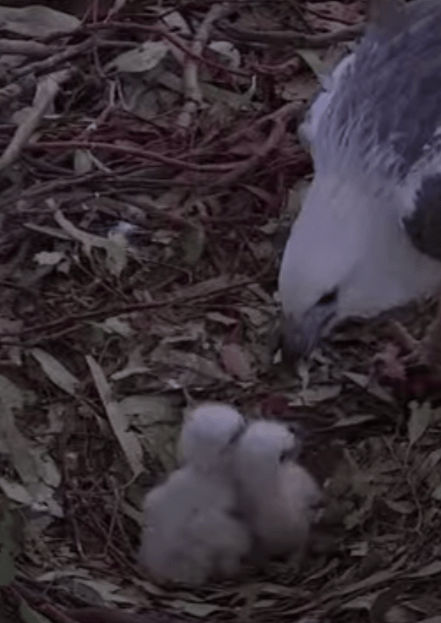
I want to thank everyone who took the time to either comment, send me a personal e-mail, or both about Malin. It is clear that this sweet little soul was loved by so many.
When I wrote my last newsletter I felt a little like a detective in a TV crime show not wanting to compromise an ongoing investigation. I do not wish to cause any issues to those who are working on the ground to get some justice for Malin. In fact, I will not do that. But, there is a lingering bonafide question that needs to be answered:
Why did an employee of a nature centre deny a wildlife rehabber access to the tower on Thursday to look for Malin with their binoculars? Why did they make them wait for three full days to get permission?
The wildlife rehabber found the body of Malin near to the nest in 30 minutes from the top of the tower once they had access on the 21st. Feather comparisons, tail bands, etc. have been compared carefully and the Osprey juvenile found on Sunday is confirmed to be Malin. It is believed that Malin was still alive on Friday when Marsha was calling and looking down the edge of the nest of the tower.
This is a quote from Marc Bekoff, Professor emeritus of Ecology and Evolutionary Biology at the University of Colorado:
“When we make decisions that damage the environment or harm animals, it is rarely because of a lack of knowledge and concrete data. Rather, losses to biodiversity, inadequate animal protections, and other negative impacts are typically due to problems of human psychology and social and cultural factors. Science alone doesn’t hold the answers to the current crisis nor does it get people to feel compassion or to act differently”. Bekoff is keen to get people to imagine the world from the perspective of wild beings. I would like to do that for Malin and his parents. Bekoff always emphases the role of human values in protecting our wildlife. He says, “…coexistence has to do with our human hearts.”
So why did the staff of the Collins Marsh Centre deny an individual trained to save and rehabilitate animals access to the tower to look for Malin when time was of the essence? According to Bekoff, that answer lies in the heart of that individual.
As I learn of things I will let you know if they do not compromise ongoing local enquiries.
Collins Marsh is part of Caretakers of the Environment International, CEI, a global, independent organization for environmental education and protection.
There is a form to send concerns on that site if you wish to do so.
If you wish to bring the concern I have raised to the local board that oversees Collins Marsh, I suggest that you FB message the Treasurer, Marilyn Starzewski. I am unable to locate the other members of the Board. It is of no benefit to write the e-mail address on the website of the centre.
Also, in my posting yesterday there were two typos. Malin fledged on Thursday at 3:47pm the 19th of August. His parents called him and brought fish to the nest on the 20th. The wildlife rehabber was given access to the tower on the 21st. I apologize for any confusion. It was a very emotional day.
Thank you for being with me today and thank you for caring for Malin. Malin will become a symbol, I hope, of the need for wildlife to have strong advocates and for their rights to be enshrined in law and in our minds and hearts so that incidents such as this never happen again.
On Thursday, 19 August, 2021 the nestling Osprey, Malin, had a forced fledge.
Malin hatched either the 16th or the 18th of June. His parents were Collins and Marsha. The smallest chick died on 28 June and the larger of the two surviving died on 14 July. The body of that bird was not removed so the cause was never determined.
For the three weeks prior to Malin’s forced fledge, so much had improved on this nest. The heat of June had dissipated. The tiny fish that came to the nest were slightly larger. The deliveries became more frequent. They were so frequent that Malin often turned away from being fed he was so full. Malin began to grow. He stood and walked more and was flapping his wings. This is a video from 9 August of little Malin exercising:
Still Malin’s development was behind. His tail had just grown to reveal six dark bands on the day of the forced fledge. The earlier concern over his missing or delayed feathers was disappearing. There was great hope, because of the food deliveries, that Malin would fledge successfully. He just needed additional time and he would also require no less than a month on the nest to hone his skills while the parents provided him with food. Then an intruder enters the air space of the nest on top of the fire watch tower, 120 feet up, on 19 August in the late afternoon.
Some claim that this was a perfect first fledge. But Osprey experts who have worked for more than 50 years in the field say it is anything but. This was a forced fledge. In normal fledges, the bird goes a short distance. The bird returns to the nest. The fledgling will be lured back to the nest with food – just as Collins and Marsha tried with Malin. This is what is happening with Kindness, the Bald Eagle fledgling up in Glacier Gardens. The fledglings spend, on average, 36 days being fed on the nest while taking flights, getting its wings stronger. It is well known that if there is a forced fledge then the bird needs assistance. It will be on the ground. Time is of the essence!
This is Malin on 14 August. Oh what a beautiful bird.
It is with a very heavy heart that I confirm that our beautiful Malin died. The circumstances of Malin’s death are not clear but I believe that he was alive until the time when the parents quit going to the nest. Their last visit was in the afternoon of the 21st.
My concern is always the bird. When there is a forced fledge it is imperative that individuals in charge act immediately. An excellent example is when ‘Silo Chick’ fell off the Patuxent Osprey Nest #2. The park had closed but help was notified and they responded quickly. The chick was saved and back on the nest within 2 hours. That chick is alive today because two people who were off work for the weekend got their canoe and drove out to the park and found the chick. It really is that simple.
I want to thank each and every one of you for caring for this little Osprey. I have received so many notes from you telling me how much Malin meant to you. Malin will always be our strong little warrior.
Malin’s soul is soaring.
My screen shots and video clips were taken from the Collins Marsh Streaming Cam.
I reported earlier today that Malin, the Osprey chick on the Collins Marsh Nature Centre’s nest, had fledged. Malin flew off the nest at 3:42 pm.
We use the term ‘fludge’ when a bird accidentally falls out of the nest and flies. But what do you call it when a nestling is scared off their nest and flies?
For several minutes before Malin flew, his mother, Marsha, had been on the nest. She was watching and alerting. There was an intruder. Marsha even ducked on occasion. When Mom flew off the nest something happened to spook Malin. He had been pancaked. Malin had done this before. But this time, the intruder must have come near enough to the nest that it spooked Malin. Without thinking and scared out of his wits, Malin flew.
Here is a video clip. You can see the shadow of a bird flying at 10 o’clock – it is impossible to know who it was – at the end.
Malin was not prepared to leave the nest. He had been exercising his wings but he had never hovered. He really needed another couple of weeks to work his wings. His feathers were continuing to grow and he was catching up for his age but he was still behind. Today, Malin was 2 months old and a day – we think. He is the only one of three hatches to survive and it is not clear which hatch he was.
Mom immediately returned to the nest looking for Malin.
Collins, the dad, came in later with a nice piece of fish hoping to entice his son to the top of the tower. Collins did look over in the area of the trees and I am hoping he knew that Malin was there.
The nest is 120 feet up and I am told that flying up is much more difficult for a bird than down. Malin is not a sophisticated flier – could he make it to the top of the tower? Collins seems to think so. I hope he is right. Indeed, I hope that Malin is unharmed and makes his way home so that he can benefit from more food and more wing exercises.
This situation has heightened my call for all streaming cams to have emergency contact numbers immediately after the name of the site and before any historical or current information about the nest. That is so the numbers can be found quickly and easily. The minute this situation happened, the office at the Nature Centre was called. The message went to voice mail. At that instant a flurry of e-mails went out from the US and Canada to try and find someone who could go and look for Malin on the ground. FB Messages were sent. Luckily ‘S’ found the wildlife rehabber for the area, living 25 minutes away. By this time more than thirty minutes had passed, possibly 45. This individual listened to what had happened and got in their car and went to check on Malin. By the time they arrived it was getting dark. They reported that it was quiet around the marsh. Tomorrow this person will return and is hoping that Malin will be close by or food crying. Of course, it would be even better if Malin were sitting up on the nest or sleeping duckling style from all the activity. The three of us that named Malin are hoping that he lives up to the name he was given, ‘Mighty Little Warrior.’ Tonight we are anxious and fearful – all we can do is hope and wait. It will be a very long night.
For the past year I have been requesting that individuals responsible for streaming cams ensure that there is emergency information so that the community of birders watching these nests can contact someone – a responsible person who will provide assistance to the bird or animal – immediately. I realize that individuals do not wish to give out their private phone numbers. The park or nature centre with the streaming cam could have two dedicated cell phones only for emergency calls. Those could be provided to those in charge. Then they would not have to have their own numbers or phones used. The person at the end of that phone line would have their own list of specialists to contact for the specific emergency. It really is that simple.
The alternative is to have a 24/7 chat room with moderators who have emergency numbers. Moderators are volunteers. They do it because they love the birds. That is actually the simplest and cheapest way to handle emergencies.
The vast majority of individuals who watch the nests are bird lovers. If they see a tiny leg tangled in fishing line they want that bird to get help. If they hear a chick fall off a nest into water, they want to help. If they notice nestlings behaving strange, having tremors, refusing to eat, they want to fine someone who will listen and help. This year all of these things have happened, some many times, and it was thanks to the community birders that help came. Sometimes people did not listen to the alarms set off by fifty or more persons watching two eaglets on a nest in Florida. They were behaving poorly. One died. Then the second. The person who set off the first alarm said ‘rodenticide’ – and they were correct. Community birders are not quacks. Many have watched nests for more than a decade. They are informed and they want to help. They do not want to waste anyone’s time.
Thank you for sending your prayers and your warm wishes to Malin and to the boots on the ground who are trying to find him and care for him. Thank you for listening to my call for a solution so that help can come to the birds immediately when something happens. If you are in charge of a streaming cam or know someone who is, please talk to them about having emergency numbers or 24/7 moderators on the chat who can get in touch with the right person if something comes up. It is really important. Thank you!
Thank you to the Collins Marsh Nature Centre and the Cumbrian Wildlife Trust and the Foulshaw Moss Osprey Nest for their streaming cams where I took my screen shotsand my video clip.
I plan to bring an updated report on the Black Storks in Latvia and Estonia later tomorrow. There is still someone who can pull at my heart strings even when I am so worried about Malin and that is Tiny Little! It is 6:30 on her nest in Cumbria and there she is having her breakfast fish compliments of White YW. Thank you, dad. Thank you, Tiny Little. You give me hope for Malin tonight.
There are some very interesting developments going on in Estonia with the Black Storklings of Jan and Janika. On the 18th of June, Jan fed the storklings one time. He has not found the feeding pond, dug especially for him, with the decoy of Janika but, a Blue Heron has!
@Forum of the Jergova Black Stork Nest in Estonia
After dark, Urmas and a helper delivered a pail of fresh fish for the three storklings. You can see the pail that he is holding and all of the fish that have been poured onto the nest. Urmas was hoping to clean up the old fish with a branch but he did not because it could harm the storklings or the storklings might bite him. Everyone is doing an amazing job to make sure that these three rare Black Storklings will live and fledge! I cannot imagine another thing that Urmas and his team could possibly do for these beautiful young birds. Thank you Urmas!
@ Eagle Club of Estonia and the Form of the Black Stork Nest at Jergova
After Urmas has left, the storklings went back to sleeping. They will wake up to a fine meal.
@ Eagle Club of Estonia and Black Stork Nest Forum at Jergova
Grafs has delivered two feedings to his storklings at the Siguldas Latvian nest. They were so hungry and so glad to see him for the second feeding. We can only continue to hope that a miracle happens and Grafs finds the feeder with all of the little fish. This nest is not stable like the one in Estonia so no one can climb with a pail of fish and deliver them.
In stark contrast, Malin, the Osprey in the Collins Marsh Osprey Nest has a crop that is so big that it looks like it could pop. I have seriously lost track of all the feedings today, the size of the fish, and what might have been left from last night.
This Osprey chick has not seen so much food in its entire life! His system has adjusted to eating more fish. Originally, Malin would eat and then stop before he had a crop. Now he eats and eats as much as he can.
Marsha has flown in and is feeding an already full Malin that fish that was on the nest.
A few minutes ago, around 4:20 nest time, Malin still has his crop and Mom is looking pretty good, too. I wish there was someway to measure Malin. He looks like he is twice as big as he was at the beginning of the month with much more feather development.
By the size of the feet most people would say Malin is a little male. I know when the banders ringed Tiny Little on the Foulshaw Moss nest they could not tell if Blue 463 was a male or female. That was because of the lack of food. And that is precisely the problem with Malin – a lack of food might trick us. Malin could be a female but my ten cents worth is on a small very handsome male.
Don’t you just love how those wing feathers are crossing over the tail? This chick has been such a worry but it feels like that anxiety is all gone. Let us hope that the good feedings keep up for all three of the birds – Marsha, Collins, and little Malin. We want them healthy for their migration.
Ha, ha. My friend, S, in Hawaii just sent this picture to me – the one below. She is calling it the ‘Battle of the Bulges’. ‘My crop is bigger than your crop!’ Too funny. It is so nice to be able to relax and laugh. For so long we thought Malin was doomed but wow. I wish this kind of happiness for the Black Stork nests.
There is something troubling brewing. EC from France has posted images on FB of the fire, now four days old, burning the Massif des Maures in France. It is a huge mountain range. This is the worst fire in that area in 20 years he reports.
@ Eric Calvete@ Eric Calvete
The fire is in the area with the red teardrop marker.
Google Maps
Here is the map showing the two main routes of the European birds. You will see on the top left that the birds from the UK normally fly over France, through Spain and across the Straits of Gibraltar and then the Sahara and Atlas Mountains. This is an extremely challenging journey. If they stay west in France, they will miss the fires currently burning at Massif des Maures. The good news is they should. The Eastern routing through Turkey and Greece still has major fires burning and is causing much difficulty. You can see how the arrows in the dark green – from The Netherlands to Latvia and Estonia converge and go through both Greece and Turkey to reach Africa.
We are told that the heat we are experiencing will now not go away. I hope that if that is the case our birds make adjustments to their schedules.
@ Open University
Some quick news from other nests:
NC0 is still feeding her fledglings at the Loch of the Lowes. LR2 snagged a really nice fish delivery from mom. So this is one female who has not started her migration.
Idris has been feeding Dyssni and Yestwyth at the Dyfi Nest in Wales today. Telyn has been seen so she has not left on her migration despite earlier reports that she might have.
All three chicks were on the Foulshaw Moss Nest. It looked like 464 had snagged the fish delivery with the other two waiting to see what happened. I have not seen Blue 35 and I do not know if she has departed or is just allowing White YW to do the feeding duties while she fattens up for migration.
Maya was caught on camera at the Rutland Manton Bay nest yesterday. Will continue to monitor her whereabouts. Both chicks, 095 and 096, are at Rutland.
There is our beautiful albeit somewhat grumpy looking Tiny Little on the right. It was nearing 7pm at the nest. Her crop looks good. Gosh she is a big bird! That look reminds me of Mrs G. So stern. That also makes me think she is a female!
It is always nice to see Tiny Little with a crop! And that is a good place to close for today. I hope everyone is keeping well. Sending off prayers and warm wishes to the nests and people in Latvia and Estonia and to the birds trying to make their way to their winter homes.
Thank you to the following for their streaming cams where I took my screen shots: The Cumbrian Wildlife Trust and the Foulshaw Moss Osprey Nest, The Scottish Wildlife Trust and the Loch of the Lowes, Collins Marsh Osprey Nest, The Eagle Club of Estonia, The Latvian Fund for Wildlife.
Oh, it’s a cracker of a day! We know that the Sharp-shinned Hawk that comes to our garden is here often but since the extreme head we had not seen him. He flipped around on the lines bringing the Internet into the house and then in a blink was in the lilac bushes. He stayed there for about ten minutes and out he flew between the houses heading north. No chance for a photo but I tried! We feed approximately 300 urban birds a day – yes, you read that right. I never grieve over the single sparrow that Sharpie is sometimes able to catch. He has to eat, too.
Sharpie is an aberration according to Cornell Bird Labs. He should not be living on the Canadian Prairies in the winter but he does! He is a year round resident. It was his mate – in January 2017 – that changed my life. It is so good to see him.
Malin is such a sweetheart. He has the sweetest face. It has been a good day for Malin, too.
Last night, Malin slept on a piece of fish about the size of the one in front and to the right of him. There was also a small Bullhead on the nest last night. Malin woke up and ate the fish he was sleeping on. Mom arrived and shared the Bullhead with him. On top of those two, Malin had four other deliveries today. A total of 6 fish! His crop is about to pop. We have never seen this Osprey chick this full. I wonder if he will use this fish as a pillow? save it for breakfast? or finish it off a little later? He is one lucky little Osprey today.
Those pesky little sea eagles will have several good feeds today, too!
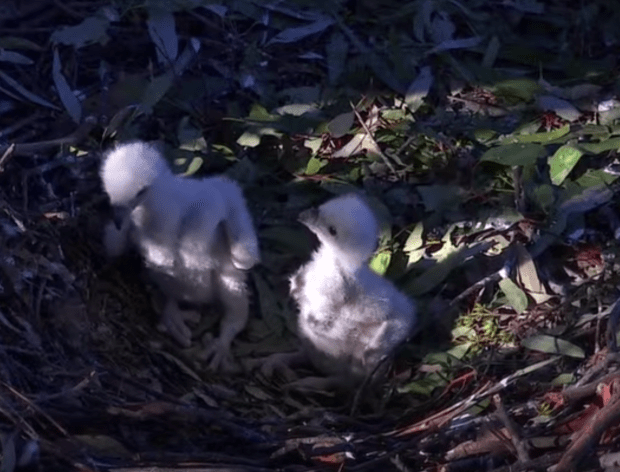
WBSE 27 is the one on the left and cutie pie WBSE 28 is on the right.
There is still a tiny bit of egg tooth left but it is disappearing quickly. If you look closely under that soft down are there little pin feathers growing?
WBSE 27 hatched on 29 July and WBSE 28 hatched on 31 July. Today, they are 17 and 15 days old. This is the end of week 2 going into week 3.
Week 2: The wee ones are covered all in white down. Their beak is starting to grow longer but the egg tooth (the white dot) is still visible.
Week 3: We should be seeing the bill and the eyes enlarged but still the white down. The chicks are now doubled in size from when they hatched. They are looking around and noticing things.
Week 4: Those pin feathers I wondered about are starting to show on the wings. You will see them begin to preen their feathers and they should be moving around the nest picking up sticks and leaves. They will also be resting on their tarsus assisted by their wings for balance. The tarsus is the part of the leg from the top of the foot to the knee.
Ah, so sweet when they are asleep and growing!
The day is yet to begin in Latvia and Estonia. We wish that those beautiful Black Storklings get lots of fish today.
Thank you so much for joining me for this quick update on Malin. We are so pleased that Malin has had lots of fish today. He is getting so big and no doubt the more he eats the stronger the little one will get for fledge. The featured image is our little cute Malin. Take care. See you soon.
Thanks to the following for their streaming cams where I took my screen shots: Collins Marsh Nature Centre and Sea Eagles, Birdlife Australia, and The Discovery Centre.
Today, the Collins Marsh Osprey chick, Malin, had six fish deliveries. SIX! Feel free to correct me but I don’t ever remember this much fish on this Osprey nest. Ever.
In fact, there was so much fish with deliveries coming in on top of one another that Malin simply could not eat all the fish. There is a bullhead left – it is on the left below the light. Malin is sleeping on half of a bigger fish. What a grand pillow for an Osprey. He can have fishy dreams all night! And, Malin can wake up in the morning and not have to wait for a fish delivery.
Fish. It makes all the difference in the health and well-being of our Ospreys and Storks.
In the image below, the setting sun puts a soft glow over our little one. Please note that the big feathers are now beginning to cross. Malin is also standing and walking more and is flapping his wings much more often to get them strong for flying.
A month ago there was concern that Malin would not develop his plumage and would be unable to fly successfully off the nest. Now just look! Food – the right kind of food and the amount of it – makes all the difference in the world in Malin’s development.
Malin is miracle #3 for 2021.
Here on the Foulshaw Moss nest, Blue 463 or Tiny Little Bob, is eating the fish her dad delivered. White YW would have heard her several miles away screaming for fish. Blue 462 had gotten the earlier fish and Tiny Little wasn’t liking it. Dad came to the rescue! Indeed, White YW and Blue 35 should get a round of applause. They pulled off a nest of three fledglings this year. They did not lose a hatch.
The crows are hoping that Tiny Little will leave some bites for them! I don’t know. She is a bit like a nest vacuum when it comes to food falling between the twigs!
Tiny Little is miracle #2 and, of course, miracle #1 is Tiny Tot from the Achieva Osprey nest in St Petersburg, Florida. I am certain that there are others that will come to mind when I publish this newsletter. For now, however, these three were enough to cause lots of anxiety.
I did a Sunday hop-skip-and-jump through some of the UK Osprey Nests to see if anyone was home. This is the Dyfi nest in Wales of Idris and Telyn. On the nest is Ystwyth, their daughter. Telyn is on the nest perch and Idris is on the far perch.
Idris and Telyn together. How beautiful.
Does he need an introduction? The chick on the Llyn Clywedog Osprey Nest, Only Bob? Only Bob was so big when he was ringed that everyone believed him to be a large female. Nope. It is just all that fish that Dylen and Seren fed him. My goodness did Blue 496 grow.
He has spotted Dylan flying in with a fish. We are so lucky to see this. Indeed, to see so many of the UK fledglings on the nests today is fantastic.
That is a gorgeous fish for dinner. Only Bob looks pretty excited.
Watch out for your toes Dylan.
Only Bob learned well despite the fact that he was the only chick on the nest. He is excellent at mantling. But, stop, and take a look at that tail and the size of those wings. I would be ever so grateful if Malin’s was half that size when he fledges.
Oh, let’s just move this beauty over here so I can eat it!
At least one of the chicks on the Loch of the Lowes has a huge crop. It is so big, it looks like it could pop. The other is hoping for a fish delivery. Of course, neither is showing us their pretty blue bands.
NC0 and Laddie have done an amazing job raising these two. NC0 has really moved up to be one of the females that I want to watch. She is becoming super mom. She can fly and haul fish to the nest just like Iris – and she isn’t afraid to do it!
Grafs was able to find enough fish for two deliveries today. The first was a bunch of small fish at 15:29 and the second came at 19:41 with some bigger fish. The storklings are starving. They are already beginning to show the signs of malnutrition.
Grafs makes sure he moves around so that each one gets a little something.
It was mentioned that not only the sunken bodies but also the fact that the bills are turning a bright colour indicates starvation.
Once the people watching these nests realized what was happening, they became very vocal in their demands that the birds be fed. Everyone knows about the fish table that the two engineers set up for the White Storks in the village of Mlade Buky, Czechoslovakia. The people demanded that their storks be fed and the wildlife staff heard them. After seeing only one feeding by 15:00, Janis Kuze wrote the following on 15 August 2021: “It may be necessary to support the operation of the feeder – to bring live fish there regularly (once a day or two). I will write about it in the coming days.”
Liz01, the moderator of the looduskalender.ee/forum (English forum for the Latvian Fund for Nature and this Black Stork Nest) posted this notice:
“Due to the fact that the female has not been seen in the stork nest for several days, she has probably started migrating, opportunities are being sought to artificially feed this nest. Currently, the only feeder is the male, whose capacity is too small for the young birds to be successfully. One way of trying to help the inhabitants of this nest is to set up an artificial feeder. There is one ditch near the nest where it can actually be done. Ornithologist Jānis Ķuze is ready to take over the management of this event, but he needs the help of the society. Therefore, we are looking for: 1) people on the Sigulda side who would help to set up a feeder, 2) human or fish feeders on the Sigulda side, which would be willing to donate and / or catch small fish (they must be still alive), with the possibility, to put these fish into the feeder, thus regularly replenishing fish stocks in the feeder a third person or another link in the chain). If anyone has the opportunity to help with this event, please send a message to Jānis Ķuze by e-mail: janis.kuze@ldf.lv. This is currently the only real way you can still try to help the young birds in this nest survive and fly successfully! It is not known whether it will work, but we think it would be better to try not to do anything and just watch.”
Immediately, there were too many offers to help the Black Storklings and Grafs. Tears. People are so generous. All we have to do is ask.
If you wish to follow the discussion about what is happening at this particular nest in English, please go here:
When I have news of what is happening at the Estonian Black Stork nest, I will let you know.
You can watch the Black Stork Nest in the forest near Sigulda, Latvia here:
We all send our prayers and warm wishes to these beautiful birds and the people helping them. We need a miracle like that at Mlade Buky.
Thank you so much for joining me. It is wonderful to bring you such good news. Please send all your positive energy to Latvia and Estonia so that the efforts to save the Black Storklings from starving to death will be successful. It is heart warming to see so many people answer calls for help.
Thank you to the following for their streaming cams: The Latvian Fund for Nature, the Collins Marsh Nature Centre, Dyfi Osprey Project, Cumbrian Trust and the Foulshaw Moss Osprey Nest, Scottish Wildlife Trust and Friends of Loch of the Lowes, Llyn Clywedog Osprey Nest and CarnyX Wild, and Bywyd Gwyllt Glaslyn.
Just a note. My newsletter will be posted late on Monday 16 August. Thank you!
Sometimes the good news in our Bird World gets suppressed by horrific news or concerns – and in that moment, we begin to lose hope that anything is being done to protect our feathered friends. Today, we are going to start off with the worrying news and end with some really positive happenings.
The real worry centres around one word: migration. Normal migration brings enough troubles to the birds – winds, lack of prey, predators but this year underneath that big umbrella of migration are two other concerns: the wildfires that are impacting birds already in the midst of their migration and those who will be starting their journeys to Africa from Europe and the UK and the late hatches. For those of you that do not know, the fires around the Mediterranean are causing birds to fall dead from the sky or to go into care for smoke inhalation. It is heating up in France and Spain with record temperatures. High atmospheric pressure is fanning the heat. It is extremely dangerous for the birds to fly through the fires to reach their winter homes. The second worry are the birds that were born late – some three to four weeks after the others. Will their parents stay and feed them? or will they die on the nest? will the father who remains while the mother has already left be able to find enough food for these large birds nearly ready to be on their own?
The latter issue is pressing down on stork nests in both Latvia and Estonia. We have had the pleasure of watching Grafs and Grafiene feed their three Black storklings on the nest in the forest near Sigulda.
Grafiene last came to the nest to feed her babies on 13 August. The Storklets were normally getting 10 feedings a day. On the 13th of August they had four feedings but, on the 14th, the next day, there were only two. It is, as we all know, extremely difficult for one parent to maintain the level of feeding when they are also preparing for migration. There is fear in the Latvian community for these beautiful birds.
My friend ‘S’ in Latvia advises me that through the efforts of the community – the calls for help for these birds – the ornithologists in charge of the area have set up a food table for the father near to the nest. This is very similar to the help given to Bukacek in Mlade Buky when the female was electrocuted. Let us hope that Grafs will accept the food and feed his nestlings. They will not be ready for fledging for at least another two weeks. Please send your warm wishes for these beautiful birds that they survive.
You can follow what is happening at the nest of Grafs and Grafiene here:
At the Black Stork Nest in Jegova county in Estonia, the storklings were fitted with satellite transmitters late on 13 August. This is the nest of Jans and Janika. The banders left a pile of frozen fish on the nest that they hoped would last a few days. Janika was last seen feeding the storklings on 6 August. The father has managed to bring some big fish to the nest but ‘S’ tells me that these fish have been difficult for the nestlings to eat because of their size.
Two things you will notice in the image below taken on the 15th. You can see the transmitters on the legs of the three storklings but you will not see a pile of frozen fish – the storklings ate all of the fish provided! This is wonderful news and gives one hope that the efforts of everyone in both Estonia and Latvia will prevail and the six rare Black storklings will fledge and survive to return to their home countries.
Here is the link to this nest:
The pandemic which began in 2019 and continues to take lives around the world also contributed to some projects that have brought much hope in regard to the natural world and our bird friends. James Aldred, an award-winning documentary filmmaker was given an assignment to document a family of goshawks living in the New Forest. The New Forest is in Hampshire in southern England. It is the largest area of forest and pastures in England consisting of 71,474 acres.
The natural landscape of the New Forest consists of areas of open fields and heavily treed forest areas.
Aldred was there to study the Goshaws who are medium large raptors that live in the forest. They are larger than the Sharp-shinned hawk that comes to my garden and the Cooper’s hawks that I see at the park but they are significantly smaller than eagles. They are known to be fiercer in temperament than the Sharpies or the Coopers. Because they live in the forest very secretively – not liking to be around humans – they are often hard to find. Stealth hunters they are known for their excellent flying skills seeking out both bird and mammal.
The females are, like other raptors, larger than the males. The couple build a very large nest in trees using twigs where the female will lay between 2-4 eggs that are incubated for a period of 28-38 days. Fledging normally takes place after 35 days.
So what was our documentary filmmaker doing with the goshawk family in the New Forest? Aldred spent 15 hours a day in a tent recording the comings and goings of the goshawk family. He created lots of notebooks about the intricacies of their lives often unseen by humans. Aldred said it was like going back in time a thousand years. There was silence in the New Forest which is normally underneath the flight paths of thousands of airplanes every day. He said what gives him hope is that “Very soon after humans deserted the forest last spring, wild animals started reclaiming it.” In addition to the goshawk family, deer, badgers, and fox cubs came out to play.
“The sheer emptiness of the place…It felt weird, being out there in that paradise on my own.” What he saw and experienced is now in the book, Goshawk Summer: A New Forest Season Unlike Any Other.
The brilliant take away from all of this is that once pandemic restrictions were eased people flooded the area with what Aldred calls their ‘pandemic puppies’ killing and scaring away the birds whose nests were on the ground. The arrival of so many humans scared all of the animals back into hiding and leading their lives in a very different way than during the period when no persons were allowed into the forest. The Forestry Commission listened to Aldred about managing visitor numbers and the woodland paths so that the animals would not be harmed by humans who visit the area.
Each of these stories brings us hope and encouragement. I am delighted to hear that the ornithologists -after hearing from so many people – are providing food to the storklings. It is hoped that those in Estonia will return and place more fish on the nest or nearby for Jans. That nest is wide enough. The Latvian nest is problematic because it is too narrow and might collapse if someone tried to place fish directly on it. Let us hope that the feeding continues and that it is successful.
We also have a late hatch – little Malin at the Collins Marsh nest in Wisconsin. So far, Malin has had only one fish and that was delivered by Collins around 8am. I really hope that he is going to get enough food today. This is another nest that needs someone to supply fish for the family because of the drought and heat that has happened.
Malin is getting some air beneath his wings in the image below and those feathers look good. Oh, he is so tiny!
Over in Cumbria, big sibling 462 got the fish and there is Tiny Little hollering for White YW to bring her one! And, of course, she is giving her big sibling ‘that look’.
It is another hot day on the Canadian prairies. My resident Blue Jay has learned where to sit to tell me that more water is needed in the bowls or that the ‘buggy’ suet is all gone. Him and his mate plus another Jay have been coming to the garden for several years. They live in a tree just across the back lane. It is always lovely to see them playing in the bird bath!
Thank you so much for joining me. Send all of your best wishes to the birds who are in the process of migrating. It could be catastrophic if all of them perish in the fires trying to get to Africa. At the same time, take a cue from what has happened in Latvia and Estonia – support those that want food tables set up to help the birds survive. Donate fish if you have them to give. One other thing is to thank those who helped and are continuing to help. Take care everyone.
Thank you to the following for their streaming cams where I took my screen shots: Collins Marsh Nature Centre, Cumbrian Wildlife Trust and the Foulshaw Moss Osprey Cam, the Latvian Fund for Nature and the Eagle Club of Estonia. Thank you to the banders in Estonia and the persons supplying fish to Grafs in Latvia. We appreciate your stepping in to show how much you care at this critical time for the birds.Thank you ‘S’ for sending me all of the news. It is much appreciated.
By 18:30, the smoke and the temperatures were cooperating and it seemed like a good time to go and check on the Cooper’s Hawk family in Assiniboine Park. When I arrived at the Park, there were several cricket games going on, families were meeting and sharing a pot luck outside – many for the first time since spring 2020, there were birthday parties and children running around.
When I found the spot and knew where the hawks had their nest and were hunting for bugs and chipmunks the other day, there were children running around. I could see the hawks in the sky circling. They never went to the nest tree or came to the ground. It is the life of a birder. It would be wonderful to see them a few more times before migration. The Canada Geese do not usually begin leaving until the middle of September through to the end of October. I have seen some miss the group and wind up walking about on an early snow. Weather is such a significant factor in the challenges our birds face.
For those who are not sure what migration actually is. Our feathered friends Move from one area for breeding during the spring and summer to another area for winter. They have adapted to the pattern of coming and going in order to survive. It is based on food supplies.
Different species travel different routes to their winter homes. These are long journeys. For example, the Ospreys in the United Kingdom will travel some 8,000 kilometres or 5,000 miles to places in Africa. The birds will fly over land, sea, and desert to reach their destinations. People wonder why the birds just don’t live in Africa all the time. The answer is rather simplistic: there would not be enough nesting sites or food for all of them plus their chicks. There are also a lot of very hungry predators ready to take those lovely fluffy little ones. So they disperse from Africa to sites in the United Kingdom and Europe.
The birds decide when it is time for them to migrate. The hormones in their body begin to change. Unlike spring when this hormone change leads to breeding, the autumn sees the birds restless until they know that it is time to depart. These hormones trigger a lot of eating. Fat begins to gather under their skin. They gain weight. It is that fat that will see them through their migration. Still, they stop and feed along the way. Normally they hunt for food in the early mornings and late afternoons. High pressure systems are good for flying but low pressure systems bring winds and rain. When the birds get into a low pressure system, they will normally stop flying, if they can, and wait til another high pressure system comes through. Migration times vary because of the winds and the weather. Birds that soar and ride the thermals can travel as much as 465 km or 300 miles in a stretch. Some gather in flocks like the storks in Latvia and Estonia. Sometimes birds pair up to migrate. For the Ospreys, the female leaves and the male stays behind until there are no fledglings crying for food.
Not all birds migrate. Even I have a sedentary Sharp-shinned Hawk that defies all logic to stay on the Canadian prairies for the winter. The Osprey in Australia do not migrate. The birds in the Amazon Rainforest do not migrate. There is plenty of food and nesting sites for them year round. This past spring and early summer there was much discussion over the migration of birds from Florida. In Jacksonville, Samson, the father of Legacy, stays in the area of the nest year round. Gabrielle, on the other hand, migrates north – yes north – to cooler summer climates. This year she might have discovered it is hotter up north! Even some of the Ospreys in Florida do not migrate; they stay year round. There are plenty of fish for them as well as nests.
Birds take different routes. The White Storks from Latvia either taken a western route or an eastern route. Dr Erick Greene and his team in Montana study the migratory movements of the Ospreys from the Clark Fork River area with satellite transmitters. In the United States, some fly over Hawk Mountain where there is an annual count. In fact, you can go to this site to see the number of birds traveling over this marvellous area with its thermals. Here is the link for you for their autumn migration count that will being in about a week!
Migration is extremely challenging and we hope that all of the adults will return to their nests the following spring and that we will see the juveniles who take their first flight to Africa in a couple of years.
And now for some birding and nest news
Poole Harbour: Blue 022 and CJ7 who were so visible until a few weeks ago sky dancing, mating, and working on the nest with the streaming cam are now working on another nest in the area. There is no camera. They are still doing everything together and everyone is looking forward to the first hatches in Poole Harbour for 200 years.
Dahlgren: A large part of the nest in King George, Virginia, collapsed today. It will be fixed in the fall well after Jack and Harriet’s migration.
Kielder Forest: All 16 of the 2021 juveniles have fledged successfully. Everyone is elated. This is 6 more fledglings than their previous best year. Congratulations everyone!
Mlade Buky: Bucachek and his new love spent the night on the nest in Mlade Buky, Czechoslovakia. Oh, how sweet! Just as the dawn is beginning to appear, they are both preening.
Balloons, something that impacts all birds: Virginia, Maine, Maryland, and Delaware have or are going to pass shortly the release of balloons. Hawaii has already passed a law on helium balloons.
Port Lincoln Ospreys, Australia: Dad and Mom have been taking turns incubating the eggs. Here is dad on the nest. A little earlier he had been pestering Mom. He kept pulling on that turquoise rope wanting his turn. It was too funny. The Port Lincoln Ospreys are an example of sedentary birds. They do not migrate. There is no need.
Loch Arkaig: The two juveniles of Louis and Dorcha have now fledged. I have not heard anything about the chosen names yet.
Collins Marsh: Malin was a little wet off and on during Saturday. S/he is sleeping on the nest alone tonight. There is no perch – let us hope that the parent or both parents are in a nearby tree in case there are any owls about. It seems like a pattern. Does mom always spend Saturday night off the nest?
WBSE, Sydney Olympic Forest: 27 and 28 continue to eat until their crops almost burst and sleep. Meanwhile there has been an intruder today and Lady and Dad were honking in alert.
And last but very special, A Place Called Hope. Along with other wildlife centres, they are receiving quite a number of starving Great Blue Herons and other herons. Why would they be starving? It has been raining in the Connecticut area and all the herbicides and pesticides that people put on their lawns and gardens makes its way into the environment, into the water table, into the ponds. It is poison. If your gardening centre or lawn care person tells you that the chemicals they use are ‘Green’ – well, think again. Whatever they are using kills. So sad. It is OK if your lawn doesn’t look emerald green.
Thank you so much for joining me today. Have a lovely Sunday. Take care of yourselves. I look forward to seeing you soon.
Thank you to the following for their streaming cams and their FB pages where I grab my screen shots: A Place Called Hope, Mlade Buky White Stork Cam, Collins Marsh Osprey Nest, Port Lincoln Osprey Project, and Sea Eagles, Birdlife Australia and the Discovery Centre.
The featured image is Dad at the Port Lincoln Osprey Barge taking his turn incubating his two eggs.
One of the big announcements came today when four extremely rare Hen Harrier Chicks fledged in Derbyshire, England. They were predated by hunters and owners of estates where grouse hunting was popular as well as ‘land management practices’. They are now protected under the 1981 Wildlife and Countryside Act.* In North America, the Hen Harrier is called the Northern Harrier while in France it is the Buzzard of St Martin.
Hen Harriers are a bird of prey like most of the birds that I write about. They are related to kites, hawks, and eagles. Have you ever heard of them? or seen one?
The males are pale grey as in the image below. The primaries are a dark espresso colour. Here the male is flying low over the countryside looking for prey.
The females are brown as are the juveniles with a white rump and long barred tail. The females are often called ‘Ringtails’ because of the bars or bands on the tail. Like the Honey Buzzard their heads are rather small in comparison to other raptors. They will measure no more than 42 cm with a wing span of 120 cm. They weight less than a pound at 300-400 grams. Hen Harriers eat small birds and mammals. Besides flying low and finding prey, they also use the cover of bushes in the woodlands to surprise and take their prey on the ground (normally).
When hen harriers are courting, they do a fabulous sky dance or rolling and tumbling. The Hen Harriers normally lay 4 to 5 eggs in a nest on the ground or in cattails or long dense grass. The male and female both take care of the chicks but the males provide the food. They hunt it and when successful pass the prey to the female by tossing it at them mid-air. They would make great softball players!
Look carefully at the image below. Notice that the facial features of the Hen Harrier look like an owl. Like owls, they have a parabolic facial disk which allows them to hunt by sound (like owls) as well as their incredible ‘hawk’ eyes.
*There continues to be the debate between the grouse hunting societies and those that protect birds and want grouse hunting banned. Any number of associations who do not support the killing of animals are active in supporting the reintroduction of the Hen Harrier. You can do a simple search on Goggle for ‘Hen Harrier Myths’. There is even a Hen Harrier Day celebrated in the Highlands of Scotland.
Other Bird World News:
Foulshaw Moss Osprey Cam, Cumbria: After waiting and moving about sticks, Tiny Little (Blue 463) was prey calling and in flew big sibling chasing after Dad or White YW. 464 took the fish and then flew off with it. Poor Tiny Little.
Nasty older sibling!
WBSE in Sydney Olympic Park, Australia: Well, they just can’t stop getting cute!
Collins Marsh Nature Centre, Wisconsin: Malin is looking really good to me. I focused on her wings whenever I checked in. She has been fed and the feathers look grand. I can also see four bands or bars on the tail now so Malin is continuing to grow and develop.
Besides this lovely tail growing and those gorgeous scalloped back feathers – I adore Osprey, can you tell? Malin is no longer dragging one of her wing feathers. It just seems it took almost 7 weeks to get these things sorted. Joy. Real joy. What a beautiful Osprey chick?!!!!!!
Patricia Fisher, the local wildlife rehabber just wrote and agreed that Malin’s feathers are looking much better. They still have to cross but fingers crossed on that one. More Joy. Thanks, Patricia for keeping an eye on this little one with all you have to do.
Port Lincoln Osprey Barge, Australia: Mum is busy rolling two eggs and I believe there remain two, awaiting third. Dad and her have been taking turns incubating.
Dad has returned to see if Mom would like a break. He is annoyed by the blue rope material and Mom seems to be annoyed by him pulling it out from under her! What a pair.
Fortis Red Deer: It is embarassing. I have not mentioned our Canadian Ospreys in Alberta for awhile. When I last checked you could only see Legacy’s little head hardly extended above the sticks. Look at this beauty now. Wow. These chicks have grown. This is what I want to say about Malin’s growth at Collins Marsh in a week!
Fortis Exshaw, Canmore, Alberta: It looks like the ospreys were practicing with their ‘ps’ or there was rain and enough blowing wind to throw mud balls up on that lens!
The good thing is that you can hardly tell which are the two chicks and who is the adult. Incredible.
It has been hot but more than that the smoke pollution has made it difficult to breathe at times on the Canadian Prairies. I am keeping an eye on the White Rock fire in British Columbia. You might all know Dr Christian Sasse and his love of Bald Eagles and Osprey. He often streams live generously showing us these beautiful birds. Well, his cottage where he streams them is in the path of the fire. Send warm wishes his way as well as all the wildlife in the region. The White Rock fire is misbehaving badly, not doing normal things so the firefighters are really having a time of it.
Thank you for joining me today. I had hoped to bring you some local hawk pictures. I am heading out hopefully later. Take care everyone.
Thanks to the following for their streaming cams: the Collins Marsh Nature Centre, the Sea Eagle Birdlife Australia, and Discovery Centre, Cumbrian Wildlife and Foulshaw Moss Osprey Nest, Port Lincoln Osprey Project, Fortis Alberta Red Deer, and Fortis Alberta Exshaw. A Special thanks to Patricia Fisher from Wisconsin who cares about Malin and takes time to answer all our questions. I am so grateful.
It is a gorgeous day on the Canadian Prairies. The extreme heat of the past has dissipated and the sun is shining. There is no wind, every leaf is still. The only thing moving in the garden are the little songbirds waiting for the feeders to be filled. No wind means there is no smoke from the wildfires farther north. It is a nice change. We are all hoping for big downpours and, if the weather report is correct, that will come at the weekend.
A serious lump came in my throat this morning when I went to check on Tiny Little at the Foulshaw Moss Osprey Nest. No one was there this morning (nest time) and now the crows are picking at the nest. Normally, at this time of day, Tiny Little would be on the nest waiting for a fish drop. There appear to be no birds in the parent tree in the background. The Crows are a reminder that the days of seeing our Ospreys are precious ones.
I returned to the Foulshaw Moss nest several times. The last visit revealed Blue 464 – the first of White YW and Blue 35’s chicks to fledge – on the nest food calling. You could see the shadow of another bird on the camera at times.
There are some ‘late’ nests and some just starting in case you are having empty nest syndrome.
One of those nests is at the Collins Marsh Nature Centre in Wisconsin. So as not to confuse everyone, the constant watchers got together. Each felt the chick needed a name, even if it was just for us. ‘S’ from Hawaii suggested Malin which means ‘strong little warrior.’ It fit perfectly for this small chick. Voted for unanimously amongst our small but caring group! So from now on I will refer to him or her as Malin, just so you know.
The female was not on the Collins Marsh nest when I checked. She is absent for long periods of time. I want to think she is fishing and will be back to feed Malin or she is just resting. The male has made a fish delivery. This time it is headless. Malin is confused because Dad will not ever do any feeding. Malin is standing and walking much better than last week but he still wants to be fed by the adult.
Malin continues to try and get the male to feed him the fish but it is not happening!
Once Malin realized that he was being left to fiend for himself, he started self-feeding on the fish. Because this one is headless, Malin is making much better progress. This little one is trying very hard.
There is a concern about the feather growth of Malin. Unfortunately, the camera is not clear. Yesterday, ‘S’ took some screen shots that indicated some wing feathers near the tips could be missing. If you look carefully at the image below, you can see the green grass through both wings clearly. This could be a serious concern for this young bird.
Thinking about Malin’s development, a search through the FB pages of the nature centre indicates that three chicks hatched on this nest on 16, 18, and 20 of June. Historically, the smallest – the third – has died on this nest with the exception of one year. This year Malin is the only one to survive leaving us to believe that he was either the first or second hatch. That would mean that he is either 46 or 44 days old. From Osprey development charts, it appears that Malin is about two weeks behind the average in growth. This is most likely due to the low food deliveries.
Maris Strazds, from the Institute of Biology at the University of Latvia states that the availability of food determines the dates of fledging and also that the survival rate of chicks is better if they spend more time on the nest after fledging. Strazds is speaking specifically about storks but this is also known to be true in hawks and falcons and I would like to think that it also extends to Ospreys and Bald Eagles.
While the feather growth is being monitored by the Wisconsin DNR Biologist and a concerned Wildlife Rehabber of the area, access to the nest is a problem. The nest is situated on top of a wildlife tower that was moved to this site so that people could climb the stairs and view the countryside. Here is a close up view. It appears that a metal roof with a peak was fabricated to fit on top of the flat roofed water tower.
In this image the nest looks quite deep. This image was taken several years ago and it seems that the nest has been reduced in size – perhaps by strong winds. Photographic comparison of the nest cup now with the chick and a couple of years ago also indicates a loss of nesting material, perhaps substantial amounts, missing.
It is difficult to determine if there is a wooden support under the twigs. If you look at the images of the nest with Malik (above) it appears that there is something ‘square’ underneath a couple of layers of twigs.
My concern is that if the feather development on Malin is problematic, there is no emergency access to the nest from the observation box. In other newsletters I have indicated that there should be a means to access the nest without compromising the safety of the individuals trying to help the birds.
There is only one operational White-Bellied Sea Eagle cam in the world. It is at the WBSE nest in the Sydney Olympic Park and the excitement there is just beginning. These two little ones, 27 and 28, appear to be getting along without food competition. Of course that can change but there has been plenty of Catfish Eels (or is it Eel Catfish?) on the nest.
Right now the sea eagles are sleeping. One little babe can be seen sleeping on Lady’s leg.
You can access this streaming cam here:
Tomorrow I will give you some information on other nests in Australia including two Peregrine Falcon streaming cams.
If it is Bald Eagles you love then the Glacier Gardens Bald Eagle Nest in Juneau, Alaska is not to be missed. Kindness is such a little sweetheart. Liberty and Freedom are helping her by trying to get her self-feeding skills honed. The eagles fledge later in Alaska because they are bigger in size than the ones hatching in the Southern US who are already off the nest. At Glacier Gardens, the average fledge is 89 days after hatch while the rest of Alaska is 80 days on average.
‘L’ also sent me the link to an Osprey nest that she has just discovered. The chick hatched on 23 June. It is a real little sweetheart ——- and the camera definition is excellent!
It is the Minnesota Landscape Arboretum Osprey Nest. There is only one surviving chick. The other perished on 26 June; the cause is not clear. This chick looks extremely healthy. The nest is on top of a platform at the University of Minnesota. Enjoy!
Because so many of you love storks, I want to mention two that my friend, ‘S’ in Latvia says are very special. One nest is in Latvia and the other is in Estonia.
The Black Stork nest in Latvia is very special. The birds are listed as critically endangered and it is rare to see them in Latvia even though the White Stork population is healthy. The male is Grafs. ‘S’ explains to me that the nest is late because Grafs was a bachelor and waited a very long time for his mate, Grafiene, to arrive. The three storklings hatched on 12, 14, and 15 of June. There are many challenges for this couple and their trio. The first is the late hatching date and the worry about whether or not the parents will remain with the storklings until they are developed and strong enough for migration. The storklings will be ready for fledging in 20 or more days. That puts it at the third week of August. As we know, storks are already gathering for their migration so watchers can only wait and hope and take the beauty of this nest a day at a time – as we always do with other nests. The second concern has been the dangerous heat that has hit nests all around the world causing a drop in prey delivery. The third is the nest itself. It appears to be unsafe despite the fact that other stork couples have fledged chicks in previous years.
I want to add that the chicks are very healthy – they are doing so well so I want all of us to be optimistic. This year I have seen miracles happen on nests – I only have to look at Tiny Tot on the Achieva Osprey Nest and Tiny Little on Foulshaw Moss to know that positive things can happen if we all send warm wishes. Even the turning of the deadly storm cells away from the nest at Collins Marsh was another of those miracles or the safe return of the male at the Barnegat Light Osprey Nest in NJ after being missing for a day due to that same weather system. So, we wait, watch, and hope.
You can watch this beautiful nest here:
It is raining today on the nest. Oh, how I wish the beautiful storklings could send some of that moisture to Canada!
There is also a forum in English for this nest where you can go back and see the long history and discuss the nest. You can access it at
The second Black Stork nest is actually in Estonia. As in Latvia, Black Storks are loved in Estonia and are rare.
It is also raining at this nest today, too.
The parents are Jan and Janika. The nest is very stable so there are no worries with the structure. But because of the horrific heat that has impacted all nests, food deliveries have sometimes been problematic. Janika, like the mother on the Collins Marsh Osprey nest also disappears for long periods. These storklings will also have a challenge to be flight ready for when the migration begins. Again, we can watch with wonder at these extraordinary birds but we must be aware of some of the challenges that birds encounter. Life is not easy.
I really want to thank ‘S’ for bringing these two Black Stork nests to my attention plus sending me all of the information about them. They are such beautiful and rare birds and it is a real privilege to see them hatch, grow and learn, and then begin their journeys. In addition, I want to thank ‘L’ for sending the information on the Minnesota Landscape Arboretum Ospreys and ‘S’ for finding all the images of the tower at Collins Marsh and the Nest and the great name for the Collins Marsh chick – Malin.
And I want to thank you for joining me today. It is always a pleasure to have you here with all the other bird lovers around the world. Stay safe everyone. See you soon.
Thank you to the following for their streaming cams where I took my screen shots: Eagle Club of Estonia, Latvian Fund for Nature, Collins Marsh Nature Center, Cumbrian Wildlife Trust and the Foulshaw Moss Osprey Nest, Sea Eagle Cam, Birdlife Australia, and the Discovery Centre, Glacier Gardens Bald Eagle Nest, and the Minnesota Landscape Arboretum Osprey Cam.