1 November 2026
Hello Everyone,
Gosh, the week flew by. In some parts of the world, the time changed, but here in Manitoba, we stayed the same. This year, we did not ‘fall back’. A vote was taken, and there will be no more Daylight Saving Time. I wonder how this will impact people’s lives – or not. We wait to see.
Gorgeous birds at the feeders all week. Those Starlings sure love the cat and dog kibble.

Mr Crow isn’t all black – check out those gorgeous iridescent feathers!

We could not forget about Junior. We continue to have seven Blue Jays at the feeder the instant the peanuts are put out. It is fantastic to wake up to their presence and their song throughout the day.


You probably wonder about the Calicos – Calico and her baby, Hope. They tend to keep to themselves while these three hang out together all day long.

Again, thank you for your wonderful letters of support. I won’t lie. Am I doing OK? Not really, but we are doing the best we can in a horrible situation, just like millions of other families are right now. I am so grateful for the support I have and the small team that makes sure Don has someone visit him each day. It makes a difference to me. Does it mean something to Donald? I sure hope so, as it is an effort for everyone, and I am so grateful. It gives me a chance to recharge my batteries a bit, so to speak, and to clear my head.
I am hoping to get everyone who visits to get someone to take a photo with them and Donald and then I am going to have those images printed for a book and a tiny blanket. Perhaps it will help him to remember.
Did you have little ones for Halloween? Toby dressed up like a lizard and helped me deliver goodie bags to the five children on our block and one special adult. A nearby street has their annual block party for Halloween, and there are about thirty other children who come trick-or-treating- the weather was grand.
This is the latest from Judy Harrington re the WBSE:


November 1: Rain in the night, with the eaglets flapping -then it eased and all settled again. Early start to the day then both were seen down on the river, one appeared to be eating. Lady arrived at the nest at 7:21, closely followed by Dad with an eel. Eaglets were quick to react – as was Lady, claiming the prey. She fed 37 then both ate. Before that just before 6am SE37 branched -at last official. And again at 6:37. More prey at 9:40 when Dad came with a fish, quickly grabbed by 38 -eating until 37 took over. 38 moved to PB beside Dad. 37 self-fed very well, finishing the rest. Then they rested and waited. Late afternoon both parents were down on River Roost, with a duet. Late afternoon, Lady brought a gull nestling in and again fed them both. Satisfied eaglets at end of day.
With no little chicks this year for Gimbir and Diamond, Holly Parsons has been posting memories along with other ‘Diamond Fans’. Here is a YouTube compilation of Gizmo and Pluto from 2019 by Holly: https://youtu.be/VJvrY7Jbhsw?
The trio at 367 Collins Street are growing right before our eyes. The oldest is a real corker – loving to hang out on the ledge and give us all indigestion with worry.
SK Hideaways has the mischief on video: https://youtu.be/fPE_FIXZFqQ?

In the US, nest prep continues for the Bald Eagles:

Narasu and HG at the West End nest in the Channel Islands today:

Gabby and Beau at the NE Florida Bald Eagle nest near Palm Court, Florida:

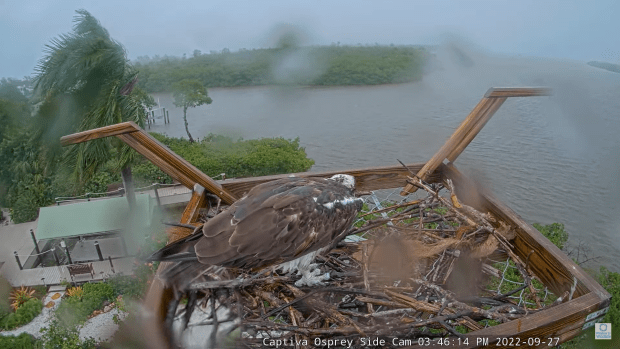
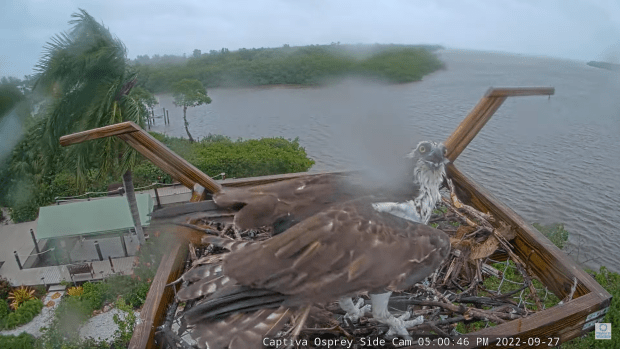
Nothing on the SW Florida cam, and, of course, the Captiva Bald Eagle cam is no longer operational as Lori Covert has sold the property.
Ospreys continue to visit (Jack and Jill, it is believed) the Achieva Osprey nest in St. Petersburg, Florida.

Birdlife International discusses the four flyways and why they are essential to migration:
In the UK, the arrival of many Siberian nutcrackers has excited birdwatchers.
e-Bird states a Northern Nutcracker is a : “Large, distinctive corvid, roughly the size of a Eurasian Jay. Note the long and heavy bill, white-flecked face, and black cap. Note white-spotted dark brown back and sides. Short tail, white vent, and white tail markings evident during undulating, woodpecker-like flight. Inhabits coniferous and mixed forests, from lowlands up into high montane forests. Often stores nuts for the winter. Mostly resident but large numbers may irrupt periodically out of the normal range in response to food shortages. Gives a variety of calls, especially during the breeding season, including harsh grating rasps, as well as quieter “mumbling” calls and mimicry. Formerly grouped with Southern Nutcracker under the more generic “Eurasian Nutcracker.”
When asked about the challenges that the Northern Nutcracker faces, we get the following:
The primary environmental challenges for the northern nutcracker are centered around climate change, indirect habitat degradation, and volatile food supply failures:
- Indirect Climate Change Impacts on Seed Sources
The northern nutcracker is a dietary specialist that relies heavily on a co-dependent, mutualistic relationship with specific trees. In Europe, its primary winter food comes from the seeds of the Swiss stone pine (Pinus cembra) and the common hazel (Corylus avellana), while its Siberian counterpart (N. c. macrorhynchos) relies on the Siberian pine.
- Alpine Habitat Contraction: Climate warming alters subalpine and mountain ecotones. While nutcrackers assist trees in colonizing higher altitudes by caching seeds at upper treelines, long-term modeling indicates that alpine and montane habitats are at severe risk of extensive species contraction due to rising temperatures.
- Severe Food Failures and “Irruptions”
When localized ecosystems experience consecutive years of optimal weather, nutcracker populations experience a breeding boom. However, if these boom cycles are immediately followed by widespread pine seed crop failures, the birds suffer catastrophic food shortages.
- Mass Displacement: Extreme resource scarcity forces the birds into massive, desperate migratory events called irruptions. During these periods, tens of thousands of nutcrackers are forced out of their native habitats—Siberian nutcrackers, for example, have been pushed thousands of miles across Scandinavia, the Netherlands, and into the UK in search of basic sustenance.
- High Boreal Forest Dependency
According to data tracked by the BirdLife International DataZone, the northern nutcracker possesses a high forest dependency rating. This makes them acutely vulnerable to any disruptions in contiguous old-growth coniferous and mixed forests. Widespread logging, clear-cutting for infrastructure, and extreme, climate-driven boreal wildfires heavily compromise the specific stands of trees they need to harvest and cache up to 100,000 seeds annually per bird.
The end of the season update from Rutland Water on the Ospreys with a YouTube video link:
“As all three got more confident in their flying abilities, 8R7(26) caused a bit of concern on 22nd July. Seen leaving the nest just after 6am, he was absent for a large portion of the day, but returned to the nest just after 4pm, having not been seen at any of his usual spots during that time at all.
It was then 8R5(26)’s turn to disappear, spending extended periods off the nest and then, on 31st July, we saw him for the final time this year, flying off the poplar branch after a large breakfast, off round the back of the poplar trees and away. At the time, he was 80 days old, so rather young for migration, but he had proven to be a strong chick during his 29 days since fledging. Hopefully, we’ll see him again in two years.
Seemingly inspired by her male siblings, 8R6(26) then had a period of disappearing from the nest for more than a day at a time but, after a week of this, then stayed around the nest. However, on the morning of Friday 21st August, both 8R6(26) (99 days old) and 8R7(26) (96 days) were seen spiralling up on thermals over Manton Bay, led by 33(11), a short while after 10:15am. Neither of the chicks were then seen on or near the nest, so had obviously started to make their way south. It’s interesting that they chose to go together. The winds were favourable that day, blowing from the north west, so we hope they both made swift, and safe, progress.
Meanwhile, over on our previously unoccupied nest this season, at Lagoon 4 on the reserve at Egleton, we suddenly had a regular visitor. We were able to see this close up thanks to the two cameras now installed at the nest. Identified as 9R0(26), one of the chicks from Site B, she was being visited by her male parent, 359(21), who would bring fish and sticks. This went on for a few weeks.
The sharp-eyed of you might remember the number 359(21) as he was one of the pair that spent a lot of time at Lagoon 4 last year, but he and 3H9(23) went their separate ways when they returned this year, taking up spaces on nests where experienced parents didn’t return. 359(21) took over from 30(10) at Site B, pairing with HJ8(14), and they had two chicks – 8R9(26) and 9R0(26). According to Tim Mackrill, HJ8(14) looked like she had already migrated and 359(21) was left feeding the two chicks, with 8R9(26) staying at Site B and 9R0(26) moving to Lagoon 4. Interesting behaviour and possibly shedding some light on the off-nest time of our Manton Bay chicks…
For the full end-of-season nest recap for Blue 33 and Maya, here it is: https://youtu.be/WG3D1VpRpHo?
Thank you so much for being with us today. I will be posting one or two times per week for the next little while. I find that The Girls and Toby are quite needy, in addition to my regular every-other-day hospital visits. Keep us in your thoughts. We are hanging in there, and I hope that you are, too, no matter what is thrown at you. We can’t change what happens to us, but we can change how we react. Right now, Don is much more content, and that helps me. We have picnics, listen to John Lennon and Yoko Ono’s Double Fantasy album, and dance in the dayroom with the help of a wheelchair. It makes us smile.
Thank you to all who created videos today – Rutland Water, SK Hideaways, Holly Parsons amongst others. To those who posted information and images, we are always grateful and to the owners of the streaming cams – thank you more than you will ever know!