Bazza, the first hatch at the Port Lincoln Osprey Barge, is the last nestling to fledge. OK. He hasn’t fledged yet but you might have been fooled at 06:15 this morning when you saw an empty nest. Bazza was doing amazing hovering. Maybe this will be his day to fly! Wouldn’t that be grand? Bazza could begin to explore the cove with his brothers, Ervie and Falkey.
He really seems to want to be out there enjoying all the fun! But to put all of this into perspective, Ervie fledged early at 60 days. Bazza is 65 days old and Solly fledged last year at 65 days. DEW did not fledge til 73 days. Ervie just got us all excited! And then of course, Falkey followed suit rather quickly, too. But if Bazza does fledge today it will be right in line with Solly.
Yurruga, the nestling Peregrine Falcon in the scrape box of Xavier and Diamond on the grounds of Charles Sturt University in Orange, Australia, is waiting for her breakfast. She is looking a little ‘ragged’ this morning. Almost all of the baby down is off!
Grinnell, the resident male Peregrine Falcon, at the Campanile on UC-Berkley’s campus, was released one hour ago in his territory. He has been in the Lindsay Wildlife Rehabilitation Hospital and in ‘home care’ since he was injured in a territorial take over bid on 29 October. That is the latest news that I have. The cameras are being rotated a bit to try and get a glimpse of what will ultimately happen when Grinnell tries to land on the Campanile and take his place beside Annie. Will he succeed? Will the interloper? Here is a link to one of the cams:
It is nothing short of a blustery winter day on the Canadian prairies. Snow is blowing everywhere, some more flakes are falling, and the temperature is warm enough to be causing ice. It was a bit worrisome when I stopped at the pond and found a few ducks in a small open space of water.
They seemed to be enjoying themselves. No one seemed to have feather or wing issues but that open water is closing in fast.
There they are from a distance. It will give you some perspective on the size of the little pond.
I was surprised to see a few standing on the ice. Ducks – at least here – tend not to like to get their paddles cold.
My garden has been ‘very loud’ all day with about 200 or more House Sparrows all clamouring for food – which is in abundance. This little fellow was all puffed up to stay warm.
There was one lone Black-Capped Chickadee eating something in the Flame Willow. Like the sparrows, the chickadees are year round visitors to the feeders.
The two books from Roy Dennis Wildlife – Mistletoe Winter and Cottongrass Summer – arrived today. I have just finished Chris Packham and Meg McCubbin’s book and Isabella Tree’s on wilding to help restore the environment. It will be interesting to see what Dennis says in his latest book, Mistletoe Winter. Now for a nice cup of hot tea to go with it.
Send out positive wishes to Grinnell and all our feathered friends.
Thank you for joining me today. Take care everyone and be safe.
Thank you to the following for their streaming cams where I took my screen shots: Charles Sturt University Falcon Cam and Cilla Kinross, and Port Lincoln Osprey Project.
The fish arrived on the nest at Port Lincoln at 6:35:01 and immediately Ervie was mantling it.
Needless to say, Ervie really is the boss of this nest and for good reason. He has fabulous survival instincts.
As you know, my interest is in third hatches and how well they do on nest and off. It will be very informative on how well Ervie does when he leaves the area of the nest seeking out his own fishing spots.
Bazza and Falky might wish that Ervie would fly off and not return.
I only commented once but watchers were calling Falky ‘Mellow Yellow’. It is time that Falky was not so laid back. Yesterday, Bazza took the second fish while Falky had the fish tail from Ervie’s earlier breakfast. If I missed Falky getting a fish, I apologize. It would be good if each had one fish per day. They are all well-feathered and Bazza and Falky will fledge when they are good and ready. e
Oh, wouldn’t it be wonderful to watch Ervie learn how to fish?
At 7:43, Ervie is still eating but his two siblings are hanging close hoping to get some leftovers.
Ah, and Falky got it. Well done, Falky.
If you missed Ervie’s fledge, here it is again. It is quite beautiful on the take off and fly by but the landing was not impressive! Still, I applaud our third hatch lad. Ervie, you are amazing. You are definitely the leader of the pack, so to speak.
If you missed Victor Hurley’s Q & A discussion, it was really really super. I posted that link in my blog, Ervie Flies! early this morning. Very informative and you can start and stop it as you like. If you are interested in falcons or Australian birds of prey – it really is a talk not to miss.
Since the shut down of the 367 Collins Street camera, I hope that many of you are filling that gap with Yurruga in the water tower scrape of Charles Sturt University at Orange. As a former academic, we do not like to comment on others’ research. There were a couple of questions to Victor Hurley about the scrape at Orange and he answered in general terms. Someone asked about the low hatch rate and the eggs. VH said that if the eggs are too large (and he does not know that is the case at Orange) it is hard for the chick to kick them to create a crack all around the egg. He also noted that sometimes eggs get turned when a beak is protruding and the chick cannot right itself if the egg is turned around. Of course, VH said that those are general statements and not specific to Orange. He did comment that Yurruga gets all the food while the four at Collins Street had less bites per chick. He also noted that the Collins Street Four developed quite fast this year and that Yurruga appears to be developing normally. So, she is 8 days younger and the amount of floof she has is normal for this stage.
One of the things that I took away from VH’s discussion was how adaptable Peregrine Falcons are. If there is a drop in numbers of a prey item, they will move to something else. For example, some Alaskan Peregrines have been known to eat trout. The image below was shown as an example.
This year I noted a drop in the amount of pigeon delivered to the scrape at Collins Street. This could, according to VH, be a result of the several lockdowns they have had due to the pandemic. Less people eating their lunch and feeding the pigeons. He did note that the male did bring in Quail and Rail. The falcons normally have a 5 km hunting range but are known to go farther. The are for Collins Street is prey rich. The red dot indicates the site of the nest box.
The falcons do not spend a lot of time on the ledge after the eyases fledge. There is a good reason for this – parasites.
As we learned with Grinnell, the male at the University of California – Berkeley Campanile scrape, birds can become loaded with parasites and they might not be able to protect themselves as well as if they were healthy. Grinnell was taking anti-parasite medication to overcome this. We know he is improving and will be released shortly.
One of the most interesting things to come out of this talk had to do with how the females are attracted to a mate. VH said that there are ‘stunning’ Peregrine males. You and I have seen them. They have an almost orange cere and legs. Dark black, really black, hoods with cream chests and very fine pinstripe chests. Those are the extremely healthy males and the females want healthy. Pale yellow indicates unhealthy. So now when you look at a falcon you can tell healthier vs not so much.
Also falcons divorce. If the female hooks up with a male and he does not share incubation duties or bring in prey, she will move on the next year. The male stays with the nest but it could be in a prey deficit area. At any rate, it was a real good discussion! It is nice to listen to the expert in the area – even talk about rodenticide.
Little Yurruga is doing well. She was working on her breakfast the last I checked.
My daughter went to the Assiniboine River for a walk and discovered about thirty-five ducks still on the river. She sent some photos for us. She noted that there was at least one other group this size down the river.
There are a lot of signs on our park ponds not to feed the ducks and geese or they will not migrate. My daughter ran into a neighbour that says the ducks stay at that part of the river year round and people feed them. They added that parts of the river in that location have been open – not frozen over. I sure hope that is the case this year! There is also an American Bittern hanging around one of the creeks. Maybe they know that this big snow is just to scare us into thinking it is going to be a horrible winter and it will be mild. We wait to see.
The garden birds have found the seed left on the deck and Dyson has, of course, been helping himself. I missed getting him hanging upside down on a suet cylinder. The migrating birds are all gone from this area. Thankfully.
Dyson always knows when the food comes out!!!!!!!!!!!!!!!
The feeders – and there are many different kinds – are all full. It was interesting to me that the sparrows did not mind standing on the snow. According to my daughter, the ducks really like being in the water and not having their paddles on the cold ice.
It is a good day to be inside!
Thank you for joining me today. There could be another fledge at Port Lincoln and we know there will be lots of prey for Yurruga. Take care everyone. See you soon.
Thank you to the following for their streaming cams where I took my screen shots: Port Lincoln Osprey Project and Charles Sturt Falcon Cam and Cilla Kinross. I also want to thank the 367 Collins Street FB group for posting the link for Victor Hurley’s talk and my daughter for those great duck images.
It is still the middle of the night in Australia and New Zealand so not a lot is happening in Bird World.
The rangers at Taiaroa Head in NZ shocked everyone when they announced that OGK’s mate, YRK, laid her egg yesterday. She obviously snuck in and visited with OGK and no one saw her. Chris McCormack shared an image of OGK and YRK at the nest OGK prepared down the hill from where Atawhai hatched. This was on the Royal Cam Albatross FB Page. Thanks, Chris. This will be the couple’s 8th breeding attempt. As most of you know, they were the parents of the Royal Cam chick in 2020.
For all Royal Albatross fans, the rangers also announced that 111 birds are on the island and 15 eggs have been laid. Eggs take approximately two months to hatch.
There are still two Peregrine Falcon chicks to fledge at 367 Collins Street in Melbourne. The first fledged at 06:34 on 8 November and the second at 07:46 on 9 November. Take note that those are early morning times. Falcons typically fledge in the early morning or early evening but not normally during mid-day.
The adults have brought prey onto the ledge for these two. In fact, the parents will continue to provide food to all four of their chicks until the chick makes its ‘first kill’. These two could fledge at any moment.
What you are looking at below, is an image of Bazza (Red band) looking enviously at the empty talons of Ervie (Dk Green band). Ervie managed to take the fish tale from Falky (yellow band) and didn’t share a scrap. Bazza was hoping there would be some left. No. Never. Fish tails must be very special – everyone wants them!
There’s Ervie eating that precious tail. Awwww. It is nice to know that having that sat-pak has not changed Little Bob at all!
I am a raptor person but so many enjoy watching the feeders for the Boreal birds. There is one that is just up and running, sponsored by Cornell. It is located in Northwestern Ontario. Here is the link if you would like to check it out.
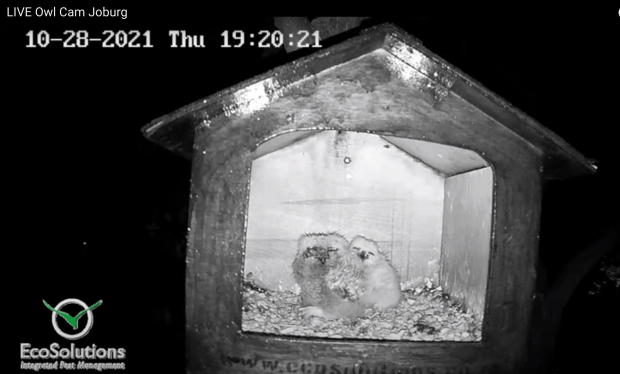
Last but not least, those pesky Spotted Eagle owlets in Joburg. Yesterday there was only one owlet left in the nesting box. The adoptee and one of the resident owlets are both wandering around in the garden of the owner. Mum, in the meantime, is having to feed the one inside the box and then go and feed the other two. She is busy! Here is a short video of the one in the box. It is really watching its siblings and well, who knows, it could be down there any minute!
It is 17:35, still day light, and the little one is still in the box.
This is just a quick check. There have been no updates on the satellite trackers of Karl II, Udu, and Pikne, the Black Stork family from the Karula Forest in Estonia. It is hoped that they are out of range and enjoying their winter vacation. If so, we will have to wait until next spring to find out if they are alright. There is also no update on WBSE 27. The last one was 5 November. There is, however, going to be a webinar where Ranger Judy talks about her work with the WBSE as well as other guests. It is later in November. If you are interested in joining in, check out this link and follow the instructions.
Thanks so much for joining me. Take care everyone. See you soon.
Thank you to the following for their streaming cams where I took my screen shots: EcoSolutions, Port Lincoln Osprey Project, 367 Collins Street Falcons by Mirvac and to Royal Cam Albatross FB Page and Chris McCormack for the image of OGK and YRK.
It has been quite the day in Bird World. It started out with gorgeous weather on the Canadian Prairies and my hunt for Wood Ducks. Were they still here? Yes, they were! There was only a pair at Kildonan Park but what cuties they were. I almost didn’t see them at first. They were both standing on a log back in a hollow with an overhang. I have so fallen in love with Wood Ducks the last six months.
The last time I visited the duck area of Kildonan Park, there had to be three dozen in the stream near the Witch’s Hut but, not today. I walked up and down the shore, down close to the water, and well, they had to be hidden really well if they were there.
This time it was also easy to count the Mallards. 25 in total. Each of the Mallards were busy either preening or dabbling for food. I thought I would give you a view different perspectives for a couple of the males. Their plumage is simply gorgeous.
In the image below, I love the soft feathers on the chest in contrast with the two white borders of that deep navy. Look at the curls on the tail and the horizontals on the chest. Stunning.
This is a great example of how waterproof their feathers actually are.
There were about 350 Canada Geese at various locations. Some were feeding on the grass, others were in the water. None of them liked the people walking their dogs.
Today was a problem because I wanted to get back and hear the updates and discussion about Grinnell, the injured falcon from UC-Berkeley. Sadly, I did not have as much patience with a little Red Squirrel that seemed to not like my taking photos of the ducks. It chattered away the whole time. Perhaps it wanted its picture taken? I decided that it didn’t because it would not give me one of those cute squirrel poses everyone else seems to capture. This little one was determined to hide behind that branch!
Oh, it screeched at me til I got out of sight! My phone told me that I had a little over an hour. Would it be possible to check on the duck pond closer to where I live? Were there any Wood Ducks there?
I scoured Duck Island at St Vital Park, walked the entire perimeter of the pond, and could only find three Wood Ducks – 2 females and a male in Eclipse plumage (the one in the middle). All of the others were gone.
There were not nearly the number of Mallards or Canada Geese despite the wide open soccer and cricket areas where they can feed.
It seems that the cooler weather a few days ago really did get many to head South. It will be nice when April comes and we can hear them honking overhead. I can’t wait.
I have reported on the update on Grinnell earlier today. You can read about it here and there is a link to the live event in my blog:
At this point it felt like the day was almost over and I had yet to check on the ‘regulars’ – the PLO osplets set to be banded on 8 November, the 367 Collins Street Four, and Yurruga, the Peregrine Falcon nestling at Orange.
The first was little Yurruga. I think I will stop using the adjective ‘little’. Yurruga is growing and changing. She is really beginning to loose that fluffy down revealing her juvenile feathers. Despite the fact that Yurruga has had short bouts of self-feeding, today was a bit of a surprise. I captured it for you in a short video.
Several hours later, Diamond came into the scrape and fed Yurruga the remaining portion of the Starling.
What wonderful training. Yurruga worked and worked on that prey item until she was tired. She did well. Mum knew to give her time and then come in and feed her little one. These are incredible parents. I also want to add that Diamond is walking much better! Her injury is healing.
Wow. Could it get any better? Well, I don’t know if it is better or not but I can say that the three osplets at Port Lincoln are even civil when wing flapping. They take turns! That said, I just about fell out of my chair watching them. Little Bob is flapping first. The trio are to be ringed on Monday, measured, given names, and at least one will have a sat-pak attached to its back. I just hope they are still on the nest! Can you imagine planning for that and they have literally flown the nest? It could happen!
Little Bob really wants to fly.
I am not certain which of the other siblings is featured in this clip testing out its wings. Mum is feeding – it sure doesn’t take long now to consume an entire fish! What a change from six weeks ago. Little Bob is on the right and unknown sibling on the left eating.
They take turns.
All three are getting some air. Oh, my. I was almost afraid to check on the 367 Collins Street Four for fear they had all fledged while I was away or doing other things. Relief. All four were on the ledge a few hours ago.
These are bittersweet moments. Fledge can happen at any time. At least one of them is more than ready. In an interview today, Victor Hurley, the lead researcher of Peregrine Falcons in Victoria, says he believes that there are 2 females and 2 males this year. How lovely!
It has been an exciting day with more to come in the next week. There will be fledges in Melbourne and Port Lincoln for sure.
Thank you for joining me today. Take care everyone.
Thank you to the following for their streaming cams where I took my screenshots and video clips: the Port Lincoln Osprey Project, 367 Collins Street Falcons by Mirvac, Charles Sturt University Falcon Cam and Cilla Kinross.
Oh, how they have entertained us. How we waited to see if that fourth egg would hatch. How we watched as Dad was incubating during the earthquake. It has been quite the season with the Melbourne Peregrine falcons. Today, there is another nice article on the 367 Collins Street Falcons today. I have attached it in case you missed it!
We are so lucky that the four of them have decided to come out so that we can see them. Those downy feathers are disappearing quickly and they look like grown up falcons capable of taking on the skies of Melbourne -for awhile – til Mom and Dad boot them out. Certainly Mom and Dad have been doing flying demonstrations trying to lure them into thinking about taking the leap! They are a little over 5 weeks old today. Forty days and onward is approximate for fledging.
Over in Orange, or should I say ‘up’ in Orange, Yarruga was one hungry chick waiting for supper that did not arrive. S/he had two feedings yesterday so she is going to be ravenous when breakfast arrives. There is no need to worry, though. She had a nice crop, larger than Diamond’s and Yarruga will not starve. In the world of raptors there are days of plenty and days of naught. Little ones need to learn that, too. Yarruga is 28 days old today. Four weeks.
Diamond was seen putting her entire weight on her right leg in the middle of the night to clean her talons. This is very good news. She has moved over to the ledge to grab some sleep before dawn and Diamond seems to be doing much better. How grand.
The Port Lincoln osplets are sound asleep. Little Bob is 50 days old today – while the two big siblings are 52 days old. We will be keeping an eye on those numbers because last year Solly fledged at 65 days (in the Northern Hemisphere it is 49 days onward). Solly was banded at 47 days and DEW at 46. On Monday, 8 November, these three will be banded, named, measured, and at least one will get a tracker. They are just wonderful – the three of them. I am surely going to miss this nest – perhaps the most civilized brood I have ever seen.
There is sadly some commotion going on at Taiaroa Head. Our beloved OGK may have realized that his mate, YRK, is not returning. He tried to mate – rather vigorously – with BOK who is also waiting for her mate to return. Being the gentleman that he is, OGK, returned to apologize in the Albatross way by doing a sky call with BOK later.
If it happens that YRK, Pippa Atawhai’s mum, does not return, it will not be from old age but from being caught in the lines of the fishing trawlers. I hope that you will think about our beloved Pippa and what a horrible death that would be – and it is entirely preventable! I feel rather gutted because these are all useless deaths that never have to happen. An albatross does not need to be decapitated every 5 minutes! The fixes are really easy. They include setting the lines at night, line weighting, and bird scaring lines. Some organizations are supplying these measures for free to the boats. The deaths are preventable. There needs to be international laws. Every country needs to stand up and demand that the fishing factories take these simple steps or not be able to fish. Write letters, phone your political representative – do it for Pippa. Then check out what the RSPB is doing. They are working alongside the Albatross Task Force to help end bycatch. Check out their website, ask who to contact. And remember – writing e-mails does help. Public pressure helps.
The Bald Eagles are really busy working on their nests in the US while the ones who came to Manitoba for their summer breeding are very slowly making their migration. Images of 30 or 40 along the river in my City have been posted locally the last few days but are not available to share beyond the Manitoba Birding and Photography FB page. I still have a few Slate Grey Juncos and today that meant a trip to the seed seller to get some more Husked Millet for them. The day is just starting in Australia and New Zealand so no telling what will happen. I long for YRK to fly in and just land on OGK’s head! That would be a rather dramatic entrance fitting for this very patient male who has been working on a nest for about six weeks now. No doubt Yarruga is going to be screaming for breakfast! I will post the updates on Grinnell tomorrow afternoon. In the meantime, thank you for joining me and take care everyone.
Thanks to the following for their streaming cams where I took my screenshots: Port Lincoln Osprey Project, 367 Collins Street Falcons by Mirvac, Charles Sturt University Falcon Cam and Cilla Kinross, and Cornell Bird Lab and NZ DOC.
It started out as a grey, damp, raining on and off again day in my neighbourhood and then…the sun came out, the sky turned blue, and the garden was a flurry of activity. As it happened, it also helped us solve a mystery: Who was stealing Mr Blue Jay’s corn cob?
Mr Blue Jay has been suspicious, too. Today he more or less stood guard while his partner ate her fill.
They had no more than begun their morning breakfast and the corn cob disappeared! So who is taking it? The largest of the grey squirrels was not around and even if Little Red’s ego would make him think he could shift that cob, he couldn’t. So who is it? For several days now we have not been able to catch the culprit but, today we did!
Look who has the corn! It is the smallest of the Grey Squirrels. It worked really hard to get that big cob full of kernels off the lower deck and around to the other side of the garden.
The cob has fallen in a little hole and the squirrel is able to dig its nails in and lift it.
Oops. It is falling down again.
He stopped to eat some of those prize kernels and then he began nibbling them off and burying them in the grass.
We left him to it and went and checked on the ducks at the local pond. When we returned the corn cob was gone and he was madly filling his cheeks with the nuts from the deck.
Just watching him I laughed and said that he was like a vacuum cleaner – and there you have it. That is how the smallest Grey Squirrel came to be re-named Dyson on 28 October 2021.
The duck pond was relatively quiet. Normally you cannot hear yourself think for the honking of the geese. The parks department has turned off the fountains and there were people raking leaves from the edge of the pond into a truck.
There were a few Mallards remaining along with 10 Wood Ducks. Apparently, 10 is a high number for Wood Ducks to still be at this location. Thankfully, I could prove to Cornell’s eBird Submit that there were 10 just through the photos!
It was cold walking around the pond and hopefully these remaining waterfowl will decide to move on to more warmer climates shortly.
Besides about 40 Canada Geese and Cackling Geese, there were a few Mallards. There was, however, one special little duck swimming around with all the regulars – a visitor. She was a female Ring-necked Duck. They are sometimes called a Ringbill.
Ring-necked Ducks breed across Canada during the summer and in a few northern US states. They live in freshwater marshes or near shallow ponds and lakes. You can apparently see thousand upon thousand of these ducks near Rice Lake in Minnesota during the fall migration.
They are dapper divers. This means they are quickly in and out, diving in shallow water to feed on aquatic plants, tubers, and invertebrates. They also eat worms, leeches, midges, and flies, etc.
There is a very distinctive grey head. The forehead slopes down and in a few of the images you can see the peaked rear crown. Because she has been diving, it is not as prominent as it might be when dry. The female has a white ring around its eye. The back is a gorgeous dark brown with a paler brown underpart. You can see the distinctive ring on the bill. That is not, however, what gives the duck its name. The males have a light chestnut coloured ring around their necks….something that is very hard to see I am told.
The colouring on this duck is simply gorgeous.
She really stood out
Sadly, there is another injured duck. This time it is a male Mallard in eclipse plumage. We will try to retrieve it tomorrow to take it to the rehabilitation clinic and that, for me, is always problematic. These two were inseparable all the time I was at the pond. Ducks do not form life long bonds but the bonding is seasonal. Still, it ‘feels’ bad to break the pair-bond but still necessary if this duck is to survive. It appears that it has a broken wing just like the female Mallard a couple of weeks ago.
Hopefully some food will lure this young man out of the centre of the pond tomorrow. Wish us luck!
Before I leave, I also want to introduce you to another streaming cam. Last year there was a lot of excitement when the two Great Horned Owls named Bonnie and Clyde stole the Bald Eagle’s nest on the grounds of Farmer Derek. We all watched in awe has Clyde hunted and Bonnie fed the two owlets. Well, I have another owl box for you to watch. This one is in Joburg, South Africa. It is the home of a Spotted Eagle Owl. On 13 October two eggs hatched. Today they are 15 days old. What makes this nest box interesting is that there was an orphan owlet placed in the box on the 22nd of October. It is 5 days older than the resident pair. No one knew if the female would accept the orphan – but she did. She is raising it as her own!
Just look at how adorable they are waiting for Mum to return with a meal.
There she is feeding all of them.
I think you might really enjoy seeing these three owlets grow up.
It turned out to be a great day for the birds. It is a relief to finally find out who is taking Mr Blue Jay’s corn cob. We are going to have to figure out a way to thwart Dyson. And then there is the injured Mallard to deal with – tomorrow.
Thank you so much for joining me today. I hope everyone is well and enjoying the birds. Next week they will be ringing the three osplets at Port Lincoln and in two weeks the Collins Four will be fledging. After that it will only be a week until Yarruga is ready to fly. Take care!
Thank you to the following for their streaming cams where I took my screen captures: EcoSolutions Joburg Owl Cam.
There was quite a bit of worry a couple of days ago when there had beern no transmissions received from Karl II, Udu, or Pikne.
Karl II, 2021Karl II and his mate, Kaia, 2021Karl II with his and Kaia’s three chicks in the nest in the Karula National Forest, Estonia, 2021. Of the three, Udu and Pikne survived. Tuul sadly passed.
Sometimes we just have to trust and hope that the birds are alright. One of the best ways to keep the GPS trackers very light weight is to power them by the sun. Even in the Mediterranean, the sun does not always shine and the batteries can run very low and need a charge OR the birds can be outside of an areas with signals OR both. Today, we are going to celebrate! Just look at the tracking below for Karl II, Udu, and Pikne, the Black Storks from the Karula Forest in Estonia. Tears.
Ladies first today. Pikne is in the Eastern Desert of either Ethiopia or Eritrea and is currently out of signalling range. She has moved and is making great time!
The Eastern Desert is simply the area of the Sahara Desert on the east side of the Nile River. It is sometimes called the Red Sea Hills. There are mountains as well as the coastal waters along the Nile. The area is known for its beautiful clear waters and excellent scuba diving.
Udu successfully crossed the Mediterranean and is now in the Western Desert of Egypt. So, Udu is west of the Nile River. That is incredible news. It is extremely challenging for the birds to cross the Mediterranean Sea and this fledgling did it on his first trip. What a strong bird Udu is!
Dad may have stayed around the Baltic Sea for awhile but he has really moved and look – he is at the Merave Reservoir in Sudan along the Nile River. He is alive!
The whole family is safe. What an incredible relief for everyone.
People in New Zealand and all the followers of Tiaki, the Royal Albatross Cam Princess for 2021, can also celebrate. She has reached the waters off the coast of Chile.
Another tracker that has been on the ‘fritz’ is Solly, the 2020 female fledgling from the Port Lincoln Osprey Barge. People were also getting worried, just like they did for Karl II and his two children. But all is well with Solly, too. She is still staying at her favourite tree at Eba Anchorage.
In a week or so, one or all of the three Bobs at the Port Lincoln Osprey barge will be fitted with a tracker like Solly. It is going to be so interesting to follow their travels and to see where those wings take them to fish and live.
Here is a great article on the use and benefits of satellite telemetry to study birds and their migration. It was written in 2012 but everything still applies today.
It is raining on the Canadian Prairies just like it has been in Melbourne and Port Lincoln. Even so, the birds were fed and all are well. The falcons at Melbourne learned about thunder and lightning! It is hard to imagine but we will be on fledge watch in two weeks for those four running up and down the gutter – and the week after that we will be expecting Yurruga to fledge. My, my. Time passes so quickly.
Thank you for joining me today. For those of you who did get to see Season of the Osprey, drop me a line and tell me what you think. Take care all. Stay warm and dry and safe.
Thank you to the Port Lincoln Osprey FB page for the figure showing where Solly is, for the NZ DOC and Wildlife Computers for the tracking of Tiaki, and to the Eagle Club of Estonia for its Forum page and its streaming cam where I took screen grabs of the family and the map showing where Karl and his family are currently located.
One task I take very seriously is alerting readers to the importance of banding and monitoring the birds, reporting sightings, and examining ways to stop human induced injury or death to our lovely feathered creatures. A few days ago I reported the tragic death of Blue 2AA, a Rutland 2015 hatch, who had killed when it landed on a high voltage wire in Spain where he had wintered for the past six years. Here is a well-written article from Rutland that covers many of my concerns with special regard to Duracell, 2AA:
For those of you waiting word about this fabulous documentary, Season of the Osprey, here is the news for viewers in the US:
This is just two days away!!!!!! Please watch and make sure you check your local stations for any change to the time. I also understand that a DVD will be sold at a later date. That is great for folks like me that don’t have cable television. Thank you PBS!
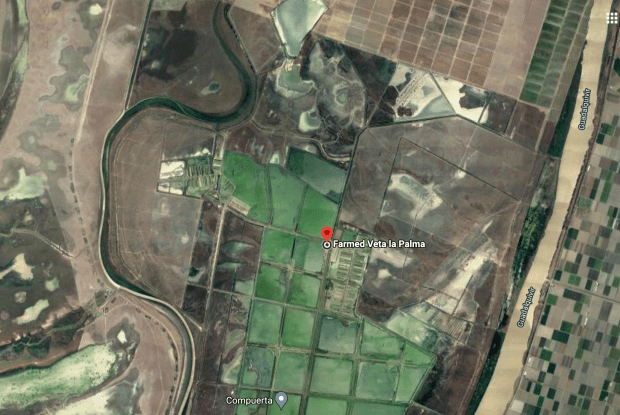
Spotters in Africa and the Iberian Peninsula continue to report Osprey sightings. There are now more than 600 in Senegal alone. I know that each of you will be thrilled to hear that Loch of the Lowes couple Laddie and NC0’s 2021 female fledgling, LR2, has been repeatedly spotted in Spain. She is at the Veta la Palma Espacio Natural Donana, La Puebla del Rio.
This is one of the largest nature reserves in all of Europe. She could not have picked a safer and more appropriate spot for her very first winter. Here are the map images and here is a link to the website so you can see all of the birds and wildlife at this ecological site. I am also posting this in case some of you want to travel at some time to see the birds – all kinds – this time of year – but do not wish to go all the way to Africa.
It is always good news when the first year fledges find a safe place with abundant resources. It is even better when we know about it and can celebrate with them. As you know only about a third of the fledglings succeed so big smiles all around. Laddie and NC0 would be thrilled! Another Rutland bird, Blue 081, a male fledgling of Maya and Blue 33 spent his first year, 2020, and has been seen this year, at Veta la Palma, Cota Donara, Spain. I continue to wait with great hope for news of Blue 463, Tiny Little Bob from the Foulshaw Moss Nest.
It is early morning in Australia. Mirvac has changed the zoom on the camera for the 367 Collins Four but you might find that the eyases are still out of view. I understand that it will not be changed again. You can hear the little ones running around on the metal.
Diamond and Yarruga are awaiting a breakfast delivery.
The trio at Port Lincoln Osprey Barge are still snoozing.
There has been no further word about WBSE 28. WBSE 27 has been seen by several people and photographed near to the Discovery Centre across the river from Lady and Dad’s roost. They will surely know where 27 is and be providing food for it. The eagles first get their flying and landing skills down before fishing and hunting (normally). The parents help them by providing them with food. I sure hope that Lady and Dad also know where 28 is! Ranger Judy reported she has done a walk through the forest adding she did not hear or see anything but that it is a large area.
That is it for today. It is a cool sunny day on the Canadian prairies and it is time to clean up bird seed. The goose flight images were not good last night because of where people had to stand due to pandemic restrictions. I hope to go out to the other nature centre before the end of the month to see if I can catch some of the thousands of Canada Geese making their way south.
Take care everyone. Thank you so much for joining me today.
Thank you to the following for their streaming cams where I took my screen shots: the Port Lincoln Osprey Project, the 367 Collins Street Falcons by Mirvac, and Charles Sturt University at Orange Falcon Cam and Cilla Kinross.
Over the course of the year I get a lot of questions. Some of them I can answer, some I find the answers for, and others seem to elude everyone. I want to provide you with two really good sites for information. The first is the “everything you would ever want to know about Bald Eagle” blog. Your answer to any question will be found right there. It is also a great way to get introduced to other Bald Eagle nests. Many of you will recognize the name Ranger Sharyn. She is the NZ DOC Ranger on Taiaroa Head and she has a site where she answers questions and discusses issues. She also gives up to the minute information on the Royal Albatross Colony.
The Bald Eagle breeding season is underway in the United States. Last year, the very first egg was laid during the first week of November! Wow. The days pass like water flowing between your fingers sometimes. There is one person that has all of the information you need on one single site. I really applaud the work done including a listing and the ability to click on a link for absolutely every single Bald Eagle streaming cam. Yes, you read that right. There are also data sheets showing dates for eggs laid, hatchings, and fledgings. There is information on how to measure an eagle, etc. It is mind-boggling all the information devoted to Bald Eagles in one place. That blog is written by elfruler and the latest offering is entitled, Ready to Roll? Here is the link. Please sign up to get the latest information if you are a Baldie fan!
I know that many of you love the Royal Albatross and are anxiously awaiting news of returnees including OGK’s YRK. I also know that most of you are following the Royal Albatross group’s FB page. But what about following Ranger Sharyn Broni on DISQUS? Here is the link to the latest and other information.
The Port Lincoln nestlings (can we still call them that when they have juvenile feathering?) had their first meal at 08:35:57 on 25 October. They are so civilized. I just adore this nest.
Little Bob is on the left and he will stop eating at 08:57:56 and move to the rim of the nest. It is quite odd for him to leave first. It was a nice sized fish and he looks like he might want to go back to sleep! I do hope that Mum gets to eat some, too.
You can see Little Bob’s ‘beard’.
Mind you, there is nothing ‘little’ about Little Bob or the other two siblings. They are really taking up nest real estate now!
This was the trio 17 days ago on 8 October. That gorgeous copper red feathering on the back of the heads is prominent and they are getting feathers on the tips of their wings and tails.
This is the trio on 26 September, one month and 3 days ago. Little Bob is there in front, up by Mum’s beak. So tiny you can’t see it.
I was so worried about Little Bob but the pattern that was set early continues until today. Little Bob is up eating and Middle and Big Bob are together waiting their turn or taking turns getting bites. The two older Bobs are right in the middle of the reptile phase.
This is 21 September. Oh, look at Little Bob. He still has all his soft light grey down and his egg tooth. The big sibling behind him is getting its pin feathers and transitioning into the reptile phase. It is hard to imagine looking at them then – and now!
The fast growth of all of the birds is simply incredible.
I have been following the advances of Karl II and his children, Pikne and Udu. It is time to bring everyone up to date on the Black Storm family from the Karula National Forest in Estonia. The last time I posted about them Udu was in Poland, Pikne was in Moldova, and Karl II was in the Ukraine.
In the map below you will see that Pikne and Karl II are following the Eastern land route while Udu finds himself on an island in the Mediterranean Sea.
The green line is Udu and he is currently at the village of Vainia on the island of Crete. The red line is Pikne. She is now in Egypt near Hurghada. She is being described as ‘flying like a rocket’. Indeed, there have been storms and strong winds and there was a worry that Udu would try to cross the sea but he did not. Smart stork. He hunkered down on Crete. We are very anxious for news of the father, Karl II. He was flying along the Jordan River and returned to Israel. There has been no transmission for almost five days now. The last was 21 October. Perhaps there is a problem with the ability of the area to transmit data or the GPS tracker is not operating because of cloud cover. (As someone said, Karl II could be in the Sudan now. I hope it is one of these reasons.) Karl II is an incredible dad. He stayed with Pikne til she was ready to leave the nest – my hat is off to him. These beautiful storks have almost reached their wintering grounds safe and sound. Please send them the very best wishes for a safe arrival with lots of food!
There have been a number of sightings and photos taken of WBSE 27 around the Discovery Centre. There was a sighting of a juvenile being chased by Currawong and the poster thought that it might be WBSE 28. I sure hope so because that means it is mobile and not on the forest floor where the foxes are.
All of the other nests are doing really well. There is not much to report in the way of Bald Eagles save for the Captiva nest on Santibel Island in Florida. Connie seems to be attracting at least two potential mates who are battling it out for dominance. As far as I know, other than sub-adult and some juvenile intruders, all of the other nests are secure. I wonder if the Bald Eagles will attempt to make a nest in Farmer Derek’s tree this year or have the Great Horned Owl family secured it? Time will tell.
Take care everyone. See you soon.
Thank you to the following for their streaming cams where I took my screen shots: the Port Lincoln Osprey Project. I want to thank the public forum for the Eagle Club of Estonia for posting the map of the locations of Karl II and his family.
For those of you hoping for a second hatch at Diamond and Xavier’s scrape box, it is not to be. Either the eggs were not viable or the second chick died trying to hatch. What we have, however, is one really healthy eyas whose eyes will open in the next few days and what a delight that will be. One healthy baby is just fine!
A video was made of one of the chick’s feedings. I cannot wait til it can see its parents! How wonderful.
It is pitching down rain in Port Lincoln. Mum and the three osplets are absolutely soaked to the core.
Mum is the best. She is trying as hard as she can to keep her three babies from catching a chill. Sadly, Melbourne’s weather says it is to have rainy periods through Saturday. I do hope the nest gets a chance to dry out for this incredible Osprey family.
To my knowledge no breakfast has come in yet. Mum is really tired and would appreciate the sleep. She has a smelly wet pillow!
It is an hour later and Mum is beginning to dry out just a little. Hopefully Dad will be in with a fish soon.
The Melbourne Four have already had three meals today – before 8:30! These parents are working overtime. It has to be exhausting. Look how big that little one is and how big its crop is. These four are also healthy and strong. Well done Mum and Dad.
Skipping over to the US, those who fell in love with Anna and Louis during their first year as Bald Eagle parents will be excited to know that the streaming cam is up and running. Here is the link to that nest at Lake Kincaid in the Kisatachie National Forest. Last year, Anna and Louis had one eaglet fledge, Kisatachie. It was wonderful to watch the parents grow into their roles as parents. One time Louis was so eager to provide food early on that he had 18 fish in a pile. I can sure imagine quite a few nests that would have liked some of that! Kisatchie grew big and strong and honoured this old Bald Eagle nest that had not had an eaglet hatch or fledge in 13 years. Incredible.
Cody, Steve and the gang are handling the chat to answer any of your questions.
I have not checked on the Black Storks from Latvia and Estonia for some time. There is some troubling news, perhaps. regarding Julge. This latest report is on Birdmap.
“In the morning September 8, Julge crossed border between Germany and Belgium and from next overnight there was not long distance up to France border, anymore. 20-30 km, depends in what direction Julge continues migration. But perhaps, there is time to improve energy sources? Interesting, if quarry is good place to find food for stork…. Anyway, Julge flew south in September 12. That means France is next country Julge visits. And stayed in a village called Saint-Hilaire-le-Petit. Nor dare not fear the closeness of people. He could be seen picking up insects from the lawn in the parking lot of the nearby Pontfaverger supermarket … But on the afternoon of September 21, Julge flew some 30 km in direction of Paris. On 22 September, Julge reached a stopover between Paris and Reims, where the latest data were received on the morning of 25 September. Next behaviour of Julge is unknown. A local newspaper is also involved in the searches of Julge.”
You can check the migration status of the Ospreys, Black Storks, White-tailed Eagles, Eurasian Cranes, and the Lesser Spotted Eagles here:
I also wanted to check on Karl II and his three children and on their migration status.
First is Udu. This is from the Forum: “It is now becoming unlikely that Udu will find/follow the ‘usual’ eastern migration route, I fear. All other options to cross the Mediterranean Sea are far more complicated, difficult and dangerous. Unless Udu will winter in southern Italy, or in Greece?” Udu is now in Kosovo.
Here is the map showing the three members of the family: Karl II, his daughter, Pikne, and son, Udu . They are making wonderful progress!
You can follow the Black Stork family whose nest was in the Karula National Forest in Estonia here:
This was just a quick check on the developments at the Orange Australian scrape box of Xavier and Diamond. I am certain that chatters and followers would loved to have seen two eyases hatch but, it was not to be. We can, however, wait with wonder to see the little one open its eyes and see its parents for the first time – and grow, thrive, and fledge. Send positive wishes for a fish to arrive at the PLO and for the rain to let up so the nest can dry.
Thank you for joining me. It will get chilly on the Canadian Prairies tonight – down to 4 C. It will certainly feel more seasonal. Take care everyone. See you soon.
Thank you to the following for their streaming cams or Forums where I took my screen shots: the Port Lincoln Osprey Project, 367 Collins Street Falcons by Mirvac, Charles Sturt University at Orange Falcon Cam and Cilla Kinross, the KNF Bald Eagle Cam, the Latvian Fund for Nature, the Estonian Eagle Club, and BirdMap.